Kissinger’s corrosive legacy still weighs on U.S. policy in Asia

Strategy of aiding China’s rise has come back to bite Washington and its allies

Chinese President Xi Jinping, right, with Henry Kissinger in Beijing in 2018: A lingering Kissingerian mindset still crimps U.S. policy toward an increasingly muscular China. (Pool via Reuters)

Brahma Chellaney, Nikkei Asia

Henry Kissinger’s biggest diplomatic achievement — orchestrating America’s opening to China — led to a 45-year U.S. policy of aiding Beijing’s economic rise which, in turn, created the greatest strategic adversary Washington has ever faced.

The costs of this approach included empowering a more aggressive and expansionist China and perpetuating Communist Party rule.

When strongman Deng Xiaoping brutally crushed a student-led, pro-democracy movement in Beijing in 1989 through the military assault that came to be known as the Tiananmen Square massacre, Kissinger opposed imposing sanctions on China.

“China remains too important to U.S. national security to risk the relationship on emotions of the moment,” the former secretary of state wrote in a Washington Post op-ed. “The U.S. needs China as a possible counterweight to Soviet aspirations in Asia, and needs China to remain relevant in Japanese eyes as a key shaper of Asian events.” He added a prediction: “China will exercise a moderating influence in Asia and not challenge America in other areas of the world.”

By that point, Kissinger had accumulated not just influence with the Chinese leadership but also personal financial interests.

Shortly before the fateful events of June 4, 1989, he had established a $75 million investment fund together with Chinese state-owned group CITIC. In addition, his private advisory company, Kissinger Associates, had already then been working in China on behalf of American businesses for seven years.

More fundamentally, the flawed policy initiated by Kissinger led the U.S. to continue strengthening China even after the Cold War had ended with the Soviet Union’s disintegration in 1991. By the time the U.S. began reversing course during the presidency of Donald Trump, its relative decline had already set in.

Kissinger’s foreign policy was based on the rampant exercise of American power but was devoid of concern for human lives. Across large sections of Asia, Kissinger’s legacy still rankles because of disastrous decisions that resulted in the deaths of countless numbers of people and destruction across vast regions.

As national security adviser to then-President Richard Nixon, Kissinger extended the Vietnam War by derailing a planned peace conference and ordered the carpet-bombing of Cambodia and Laos. The U.S. dropped more than7.5 million tons of bombs on Vietnam, Laos and Cambodia, twice the amount dropped around Europe and Asia during World War II.

Under the following administration of President Gerald Ford, Kissinger aided Indonesia’s bloody invasion and occupation of East Timor as secretary of state.

Indian Prime Minister Narendra Modi, right, and U.S. President Joe Biden in June: Despite an improved relationship, U.S. strategic objectives still diverge from core Indian interests. © Reuters

The corrosive legacy of this modern Machiavelli has long weighed on U.S. policy in Asia. Nowhere is this truer than in America’s relations with India, the world’s largest democracy.

Developments during 1971 had a profound impact on the bilateral relationship and India’s strategic calculus. That year, the Pakistani military brutally resisted Bangladeshi efforts to seek independence, slaughtering up to 3 million people, holding 200,000 women in rape camps and forcing 10 million to flee to India.

Kissinger and Nixon were more than complicit in the Pakistani military’s rampage. They provided political cover for then-military dictator Gen. Yahya Khan to continue the massacres. With the help of Khan’s regime, Kissinger then made a secret trip from Pakistan to China in July 1971, paving the way for a Sino-U.S. rapprochement.

The opening to China thus came at a fatal cost to untold numbers of Bengalis while others were forced to flee to India. But that was not all. To try to prevent Bangladesh from breaking away from Pakistan, Nixon and Kissinger even urged China to take military action against India.

In December 1971, after the massive refugee influx led India to intervene in the final stage of the nine-month independence conflict, the U.S. deployed a nuclear-capable naval task force led by the aircraft carrier USS Enterprise off the southern tip of India in a show of force.

Anticipating Sino-U.S. collusion, India’s then-Prime Minister Indira Gandhi had concluded a friendship treaty with the Soviet Union barely four months before Indian forces midwifed the birth of Bangladesh. The friendship treaty signed with Moscow in August 1971 helped deter China from military action against India.

The developments of that year cast a long shadow over U.S.-India ties. The U.S. tilt toward Pakistan and its opening to China not only spawned Indo-Soviet strategic cooperation, but America’s gunboat diplomacy also spurred India into conducting its first underground nuclear test just two and a half years later. This, in turn, led the U.S. and China to help Pakistan build its own nuclear bomb.

For the following quarter century, India remained under U.S.-led technology sanctions, as America cozied up to China and Pakistan, New Delhi’s regional adversaries.

The U.S.-India relationship has been dramatically transformed in this century. But Kissinger’s legacy has not been fully purged from the relationship.

In India’s neighborhood, U.S. strategic objectives continue to diverge from core Indian interests, especially in regard to Pakistan, Bangladesh, Myanmar and counterterrorism.

The U.S. maintains close ties with Pakistan’s domineering military, condoning its current indirect rule over the country. Under a $450 million deal, it is modernizing the cash-strapped country’s fleet of Lockheed Martin F-16 fighter jets, which will make the aircraft more lethal to India.

There may be a greater convergence now of U.S. and Indian interests on China. Yet Kissinger’s China fantasies, to some extent, persist in U.S. policy, complicating the pursuit of a clear-eyed strategy to deter Chinese President Xi Jinping from moving against Taiwan.

For over 42 months, Indian and Chinese troops have been locked in a standoff along the two countries’ Himalayan frontier, but U.S. President Joe Biden has yet to utter a word about the confrontation, despite fatal clashes. This is a reminder that a lingering Kissingerian mindset still crimps U.S. policy toward an increasingly muscular China.

With the Kissinger-initiated rapprochement with Beijing having paved the way for China’s rise to dominance over parts of Asia, only India and Japan are today in a position to forestall Beijing’s hegemony across the continent. It did not have to be this way.

Brahma Chellaney is professor emeritus of strategic studies at the Centre for Policy Research in New Delhi and a former adviser to India’s National Security Council. He is the author of nine books, including “Water: Asia’s New Battleground.”

Biden’s Flawed Myanmar Policy

It was America’s abandonment of a failed sanctions policy in favor of calibrated engagement that helped bring about the formal end of Myanmar’s military dictatorship in 2015. Today, US President Joe Biden’s administration must adopt a similar strategy – or risk allowing Myanmar to become a failed state.

BRAHMA CHELLANEYProject Syndicate

As the Israel-Hamas war rages, the dire humanitarian situation in Gaza is grabbing headlines – as well it should. But another armed conflict, in Myanmar, is also causing mass suffering, with more than two million people internally displaced and over a million more streaming into neighboring Bangladesh, India, and Thailand. And it is attracting far less international attention.

This is not to say that outside forces are not engaged in the conflict in Myanmar. On the contrary, the United States seems to view supporting the rebel and pro-democracy groups attempting to overthrow the military junta – which returned to power in a February 2021 coup – as a kind of moral test. But its approach is doing Myanmar little good.

After the military overthrew Myanmar’s nascent civilian government – to which it had begun ceding power barely six years earlier – US President Joe Biden’s administration re-imposed wide-ranging sanctions, which it has since ratcheted up. But, so far, the sanctions have left Myanmar’s military elites relatively unscathed, even as they have unraveled the economic progress made over the last decade and inflicted misery on ordinary citizens.

The Biden administration has also deepened engagement with the so-called National Unity Government that was formed as an alternative to the junta. Though the US, like the rest of the world, has refrained from formally recognizing the shadow government, this has not stopped the Biden administration from providing “non-lethal aid” to its notional army, the People’s Defense Force, as well as to ethnic insurgent organizations and pro-democracy groups, under the BURMA Act. And the US has a history of interpreting “non-lethal” rather loosely. Non-lethal support for Syrian rebels, for example, included enhancing their operational capabilities on the battlefield.

The groups the Biden administration supports in Myanmar do not share a common cause, let alone a single political strategy. The shadow government has failed to win the support of all major ethnic groups, and its armed wing lacks a unified military command. The ethnic insurgent groups – some of which have records of brutality – are often more interested in securing autonomy for their communities than in building an inclusive federal democratic system, and some are willing to collaborate with the junta to get it. Complicating matters further, these groups’ territorial claims sometimes overlap.

It is impossible to say for certain whether growing US aid flows have fueled more violence in Myanmar. But there is no doubt that rebel attacks have lately intensified, with serious consequences not only for civilians, who often are caught in the crossfire, but also for neighboring states. Just last month, a major offensive – which enabled the rebels to gain control of several border towns and dozens of military outposts – drove at least 72 government soldiers to flee to India in just one week. The junta responded by intensifying its own lethal force, including punitive air strikes and artillery barrages.

Meanwhile, more than 32,000 ethnic Chin from Myanmar have taken refuge in India’s Chin-majority Mizoram state, where they live mostly in refugee camps. Thousands more have fled to another Indian border state, Manipur, fueling an increasingly violent conflict between the local population’s two main ethnic groups.

US aid to armed groups around the world has often fueled disorder and suffering, undercutting the quest for democracy. Judging by Myanmar’s deteriorating humanitarian situation, it seems that this may well be happening again. And Myanmar’s neighbors are being affected in much the same way the US would be affected if faraway powers sought to punish Mexico and aid rebel groups there. Yet, far from letting the neighboring countries take the lead in setting policy toward Myanmar, the Biden administration has insisted they toe the US line.

America’s uncompromisingly punitive approach to Myanmar’s military junta has hopelessly divided the ten-country Association of Southeast Asian Nations, preventing it from playing a constructive role in the conflict. Paradoxically, the US has sought to co-opt ASEAN to promote democracy in Myanmar, even though the majority of the group’s members remain under authoritarian rule.

India, the world’s most populous democracy, is increasingly concerned that the US approach is pushing resource-rich Myanmar into China’s arms. India not only shares long land and sea borders with Myanmar, but also views the country as a strategic corridor to Southeast Asia. Given the cross-border movement of people and guerrillas – some trained and armed by China – close counterinsurgency cooperation with Myanmar is vital for India’s security.

Biden’s misguided Myanmar policy seems to align with his public rhetoric about a “global battle between democracy and autocracy.” But elsewhere, his administration has adopted a more pragmatic foreign-policy approach, deepening strategic relations with non-democracies in order to counter China’s growing influence. For example, during the G20 summit in New Delhi this past September, Biden sought to mend ties with Saudi Arabia. He then visited Vietnam, calling it a “critical Indo-Pacific partner.”

Such realism should be welcomed: if the promotion of democracy and human rights overrode all other considerations, US diplomacy would have very few partners outside the West. But this approach needs to be extended to Myanmar. The US would stand a better chance of helping to end direct military rule there by opening up lines of communication with the junta and offering it incentives to reverse course.

It was the abandonment of a failed sanctions policy in favor of calibrated US engagement that helped bring about the formal end of Myanmar’s military dictatorship in 2015. If Myanmar is to avoid becoming a failed state, the Biden administration must adopt a similar strategy today.

Brahma Chellaney, Professor of Strategic Studies at the New Delhi-based Center for Policy Research and Fellow at the Robert Bosch Academy in Berlin, is the author of nine books, including Water: Asia’s New Battleground (Georgetown University Press, 2011), for which he won the 2012 Asia Society Bernard Schwartz Book Award.

© Project Syndicate, 2023.

Israel’s historical role in the rise of Hamas

BY BRAHMA CHELLANEY, The Japan Times

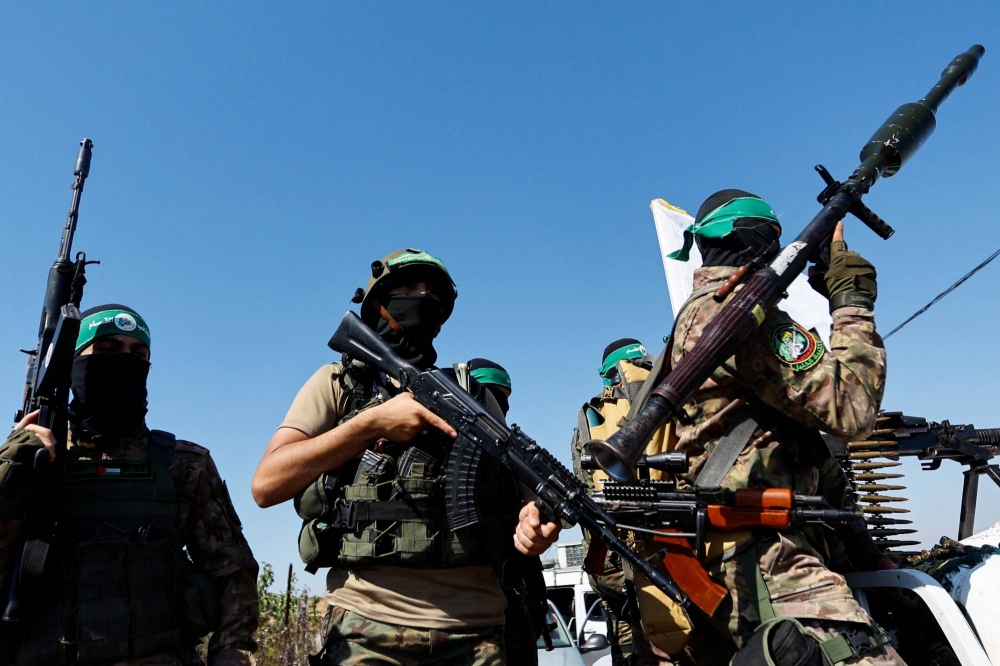
Hamas fighters take part in a military parade in Gaza in July to mark the anniversary of the 2014 war with Israel. | REUTERS

Israel, which withdrew from Gaza in 2005, has come full circle with its invasion of that territory in response to the atrocities perpetrated by the Hamas militants.

But, just as the United States invaded Afghanistan in 2001 to oust from power a terrorist militia whose rise it had facilitated via its Pakistani intelligence connections for Afghanistan’s stability sake, Israel is tasting the bitter fruits of a divide-and-rule policy that helped midwife the birth of the Hamas “Frankenstein monster” that it is now seeking to subdue.

Treating the Hamas slaughter of innocent civilians as a kind of Pearl Harbor moment, Israel has vowed to “wipe out” the Gaza-based militia group through a military offensive that is one of the most intense of the 21st century, according to the New York Times. The terrorism-glorifying ideology of Hamas, however, cannot be crushed by military means alone, raising the question whether Israeli forces could get bogged down in Gaza the way America’s Afghanistan invasion turned into a costly quagmire.

The international focus on the war in Gaza has helped obscure the fact that Israel in the 1980s aided the rise of the Islamist Hamas as a rival to the secular Palestinian Liberation Organization and its dominant faction, Yasser Arafat’s Fatah. Israel’s policy was clearly influenced by the U.S. training and arming of mujahideen (or Islamic holy warriors) in Pakistan from multiple countries to wage jihad against Soviet forces in Afghanistan.

The multibillion-dollar American program from 1980 to create anti-Soviet jihadis represented what still remains the largest covert operation in the Central Intelligence Agency’s history. In 1985, at a White House ceremony attended by several mujahideen, then-U.S. President Ronald Reagan gestured toward his guests and declared, “These gentlemen are the moral equivalent of America’s Founding Fathers.”

Out of the mujahideen evolved the Taliban and al-Qaida. As then-U.S. Secretary of State Hillary Clinton openly admitted in 2010, “We trained them, we equipped them, we funded them, including somebody named Osama bin Laden … And it didn’t work out so well for us.”

Hamas, for its part, is alleged to have emerged out of the Israeli-financed Islamist movement in Gaza, with Israel’s then-military governor in that territory, Brig. Gen. Yitzhak Segev, disclosing in 1981 that he had been given a budget for funding Palestinian Islamists to counter the rising power of Palestinian secularists. Hamas, a spin-off of the Palestinian branch of the Muslim Brotherhood, was formally established with Israel’s support soon after the first Intifada flared in 1987 as an uprising against the Israeli occupation of Palestinian lands.

Israel’s objective was twofold: to split the nationalist Palestinian movement led by Arafat and, more fundamentally, to thwart the implementation of the two-state solution for resolving the protracted Israeli-Palestinian conflict. By aiding the rise of an Islamist group whose charter rejected recognizing the Israeli state, Israel sought to undermine the idea of a two-state solution, including curbing Western support for an independent Palestinian homeland.

Israel’s spy agency Mossad played a role in this divide-and-rule game in the occupied territories. In a 1994 book, “The Other Side of Deception,” Mossad whistleblower Victor Ostrovsky contended that aiding Hamas meshed with “Mossad’s general plan” for an Arab world “run by fundamentalists” that would reject “any negotiations with the West,” thereby leaving Israel as “the only democratic, rational country in the region.” Avner Cohen, a former Israeli religious affairs official involved in Gaza for over two decades, told a newspaper interviewer in 2009 that, “Hamas, to my great regret, is Israel’s creation.”

To be sure, some others, including the U.S. intelligence establishment, have not endorsed the Israeli connection to the rise of Hamas, portraying it simply as an offshoot of the Muslim Brotherhood.

About seven years before U.S. special forces killed bin Laden in a helicopter assault on his hideout near Pakistan’s capital, an Israeli missile strike in 2004 assassinated Hamas founder Sheikh Ahmed Yassin, a quadriplegic and partially blind cleric. By drawing specious distinctions between “good” and “bad” terrorists, Israel and the U.S., however, continued to maintain ties with jihadis.

While Barack Obama was in the White House, the U.S. and its allies toppled Libyan leader Moammar Gadhafi, creating a still-lawless jihadi citadel at Europe’s southern doorstep. They then moved to overthrow another secular dictator, Syria’s Bashar Assad, fueling a civil war that helped enabled the rise of the Islamic State, a brutal and medieval militia, some of whose foot soldiers were CIA-trained. And apparently shocked by the brutality of some of those U.S.-backed militants, and amid questions over the effectiveness of the policy, then-American President Donald Trump in 2017 is reported to have decided to shut down the covert Syrian regime-change program.

Israel, by contrast, persisted with its covert nexus with Hamas. With the consent of Israel, Qatar, a longtime sponsor of jihadi groups, funneled $1.8 billion to Hamas just between 2012 and 2021, according to the Haaretz newspaper.

Israeli Prime Minister Benjamin Netanyahu, who has been in power for much of the past decade and a half, told a meeting of his Likud Party’s Knesset members in 2019 that, “Anyone who wants to thwart the establishment of a Palestinian state has to support bolstering Hamas and transferring money to Hamas,” adding, “This is part of our strategy — to isolate the Palestinians in Gaza from the Palestinians in the West Bank.”

Israel, like the U.S., may have been guided by the proverb, “the enemy of my enemy is my friend.” But, as history attests, “the enemy of my enemy,” far from being a friend, has often openly turned into a foe.

America’s longest war ended with the Taliban’s return to power. The reconstitution of a medieval, ultraconservative, jihad-extolling emirate in Afghanistan has no direct bearing on a distant America. But Israel’s war against the monster it helped spawn will greatly shape Israeli security.

Brahma Chellaney is a geostrategist and the author of nine books, including “Water: Asia’s New Battleground.”

Biden’s policies make Taiwan more vulnerable

Brahma Chellaney, Taipei Times

American fantasies about China helped create the biggest strategic adversary the US has ever faced. For over 45 years, from Richard Nixon to Barack Obama, successive American presidents aided China’s economic rise as a matter of policy. Even as Beijing cheated on trade rules, stole technology, and flexed its military muscle, including against Taiwan, the US looked the other way, in the naive hope that a more prosperous China would liberalize economically and politically.

Despite the fundamental shift in America’s China policy introduced by then-US president Donald Trump’s administration, US fantasies, to some extent, still persist, complicating the pursuit of a cleareyed strategy to deter Chinese President Xi Jinping (習近平) from moving against Taiwan.

Consider, for example, President Joe Biden’s greater emphasis on placating Beijing than on strengthening deterrence, including by taking the possibility of a Chinese blockade of Taiwan seriously. The US needs to urgently help bolster Taiwan’s defenses by stepping up arms sales and military training. But with Biden continuing to prioritize weapons deliveries to Ukraine despite its failed counteroffensive against Russian forces, US arms transfers to Taipei are lagging years behind orders.

This year has stood out for Biden’s conciliatory moves toward China — from sending a string of cabinet officials to Beijing and holding a summit meeting with Xi in California to emphasizing that the US-led effort is to “de-risk” the relationship with China but not to “decouple” from it.

While keeping the door to diplomacy with Russia shut, Biden has beseeched China to stabilize bilateral ties. By presenting the US, the stronger power, as more zealous than China to improve relations, Biden could embolden Xi’s risk-taking.

In dealing with China, Biden has a weaker hand that he would like. The deepening US involvement in the Ukraine and Israel wars is sapping America’s diplomatic and military resources. This could tempt Xi to move on Taiwan, especially because he knows the US would struggle to deal with a third war simultaneously. In fact, the longer the Ukraine and Gaza wars rage, the greater would be the likelihood of Beijing launching aggression against Taiwan.

Yet, while letting hope drive his overtures to China, Biden has not only doubled down on his Ukraine strategy but also is raising the specter of “American troops fighting Russian troops” if the US Congress does not approve US$61 billion in additional assistance for Kyiv. A US mired in a protracted Ukraine war would open greater opportunity for Beijing to move on Taiwan.

Despite the China-policy debate in the US reflecting more realism in recent years, illusions continue to guide Biden’s approach. One illusion is to believe, as Biden apparently does, that China would cooperate with the US on major global issues. Another illusion is that risks of aggression against Taiwan or miscommunication can be mitigated through regular dialogue, including military-to-military contact.

Such thinking misses the fact that China’s strategy centers on stealth, deception and surprise. These three elements have characterized China’s expansionism from the South China Sea to the Himalayas. Xi’s unpredictability demands greater US attention to shoring up deterrence in the Indo-Pacific region.

Unfortunately, the China fantasies extend to some American scholars. For example, three China specialists argued in a recent essay that averting Chinese aggression against Taiwan demands that the US “reassure, not just threaten, China.” Their thesis effectively calls for rewarding China for steadily regularizing its coercion of Taiwan.

This is redolent of how the US looked the other way as China created and militarized artificial islands in the South China Sea. Indeed, at the height of Xi’s island-building drive, Obama argued in his final year in the White House that “we have more to fear from a weakened, threatened China than a successful, rising China.” Such appeasement helped turn China’s contrived historical claims to the South China Sea into reality without Beijing incurring any international costs.

Success in the South China Sea has made Xi more determined to annex Taiwan on his watch, especially as China erodes America’s military’s edge in the Indo-Pacific. Worse still, America’s entanglement in the Ukraine war has made Taiwan more vulnerable to Chinese aggression. Ukraine has secured key war materiel that could have gone to Taipei.

Yet, some Americans still argue that the US must first defeat Russia in Ukraine before pivoting to deter China. It is as if Xi would wait on Taiwan until the US has humiliated Russia on the battlefield and turned its attention to containing China!

Taiwan’s continued autonomous status is central to America’s safeguarding of its global preeminence. Yet, at a time when more than two-thirds of American voters worry about the 81-year-old Biden’s mental and physical health, the lack of US strategic clarity on how to deter or respond to a Chinese attack on Taiwan is striking.

If Xi perceives that China has a window of opportunity to act during the Biden presidency, he will likely move on Taiwan. If that were to happen, China would likely emerge as a pressing military threat to the US itself.

Brahma Chellaney, a professor of strategic studies at the New Delhi-based Center for Policy Research, is the author of nine books, including the award-winning Water: Asia’s New Battleground (Georgetown University Press).