
India’s front-line battle against autocracy more important than ever

Chinese troops dismantling their bunkers at Pangong Tso region in Ladakh in February 2021: China has turned other captured areas into permanent all-weather military encampments. © AP

The risk of renewed skirmishes with China is growing

Brahma Chellaney, Nikkei Asia

Two years after nighttime hand-to-hand combat with Indian troops resulted in China’s first combat deaths since its 1979 Vietnam invasion, the Chinese and Indian militaries remain locked in multiple standoffs over some of the most inhospitable terrains on Earth.

The war in Ukraine may be obscuring China’s border conflict with India, including the largest Himalayan buildup of rival forces in history. But as U.S. Defense Secretary Lloyd Austin reminded the annual Shangri-La Dialogue in Singapore last weekend, “we see Beijing continue to harden its position along the border that it shares with India.”

With tens of thousands of Chinese and Indian troops facing off against each other, the risks of renewed skirmishing, if not outright war, are significant.

The clashes of June 15, 2020, were the bloodiest of a series of skirmishes or scuffles that began more than six weeks earlier after China, taking advantage of India’s preoccupation with enforcing the world’s strictest coronavirus lockdown, stealthily infiltrated key border areas in the high-altitude Indian region of Ladakh and established heavily fortified bases there.

The surprise encroachments were not nearly as clever a plan as Chinese President Xi Jinping probably thought when he gave his go-ahead. Far from handing China an easy win, they have plunged Sino-Indian relations to a nadir, kept the border crisis simmering and made the fact of a major Indian military buildup inevitable.

The June 15, 2020, clashes not just marked a watershed in India-China relations; they also stood out for their savagery. With a 1996 bilateral agreement prohibiting the two countries’ soldiers from using guns at the border in peacetime, encroaching Chinese soldiers employed metal fence posts and clubs wrapped in barbed wire in a post-sunset ambush attack on an Indian army patrol.

Some Indian soldiers were beaten to death, others were thrown from the soaring cliffs into the fast-flowing Galwan River before Indian reinforcements arrived and fought pitched hand-to-hand battles with the intruders under a moonlit sky.

After the hours-long fighting, India quickly honored its 20 fallen soldiers as martyrs and then established a war memorial to commemorate their sacrifices. But China has still not disclosed its death toll, which U.S. intelligence reportedly placed at 35 and Russia’s government-owned Tass news agency estimated at 45. More than eight months after the clashes, Beijing announced posthumous awards for four Chinese soldiers without revealing the full death toll.

This should not be a surprise, as the Chinese Communist Party rarely reveals the full truth: it disclosed the Chinese death toll from the 1962 war with India more than three decades later in 1994 after significantly lowering the figure.

With the world’s most powerful propaganda machine, the CCP seeks to manufacture reality. While releasing a propaganda video of the clashes, it jailed at least six Chinese bloggers for criticizing its death toll cover-up, with one blogger who had 2.5 million followers on Weibo sentenced to eight months in prison. More recently, it picked the military commander who led the ambush attack as a torchbearer of the Beijing Winter Olympics, provocatively feting him as a hero.

The border crisis has also cast an unflattering light on India, which has instituted no inquiry into why its army was taken unawares by the multiple Chinese intrusions, some of them deep into Indian territory.

India is the world’s third-largest defense spender after the U.S. and China, with the army continuing to appropriate the lion’s share of the defense budget. Yet over the years, the Indian army has repeatedly been caught napping by the cross-border actions of China and Pakistan.

Indeed, it has become somewhat of a tradition in India that, whenever an adversary springs a military surprise, the army generals take cover behind the political leaders, and the ruling politicians hide behind the generals, allowing accountability to go unenforced.

Chinese forces braved harsh weather to intrude into forbidding landscapes, just before thawing ice reopened access routes. But the Indian army ignored warning signs from China’s heightened military activities near the frontier, including an unusually large, wintertime troop exercise that became the launchpad for the aggression.

Yet not a single Indian army commander was relieved of his command for the fiasco. Worse still, Prime Minister Narendra Modi has maintained a conspicuous silence on the military crisis for the past two years.

Instead, Modi has put faith in negotiations, with Beijing using endless talks to string India along while frenetically building new warfare infrastructure that General Charles A. Flynn, head of the U.S. Army Pacific, recently called “eye-opening” and “alarming.”

While withdrawing from some positions it seized, China has turned other captured areas into permanent all-weather military encampments, with large combat-ready forces and newly built roads and heliports that allow front-line positions to be quickly reinforced with fresh troop inductions.

Xi’s aim against India, as in the East and South China Seas, is for China to ultimately win without fighting by employing coercion under the shadow of its deployed military might. To Modi’s credit, India appears determined to frustrate that goal, vowing to sustain the military standoffs, despite the risk of a full-scale war, until China rolls back its encroachments.

India, the world’s largest democracy, is on the front-lines of the battle between democracy and autocracy. If China is able to coerce India into submission, it will open the path for the world’s biggest autocracy to gain supremacy in Asia and reshape the international order in its favor. No wonder Secretary Austin said in Singapore that India’s “growing military capability and technological prowess can be a stabilizing force in the region.”

Brahma Chellaney is a geostrategist and author of nine books, including “Asian Juggernaut: The Rise of China, India and Japan.”

Why is Biden appeasing China?

BRAHMA CHELLANEY, The Hill

President Biden is yet to make his long-anticipated China strategy speech to define his approach to a country that has emerged as the greatest rival that the United States has ever faced. Instead, Secretary of State Antony Blinken laid out the administration’s approach in a speech that acknowledged that China poses “the most serious long-term challenge to the international order.”

In Blinken’s words, “China is the only country with both the intent to reshape the international order and, increasingly, the economic, diplomatic, military and technological power to do it.” 

The president, however, has been fixated since taking office on the weaker of America’s two main foes, Russia, while letting China escape scot-free for covering up the COVID-19 virus’s origins and for detaining more than a million Muslims in internment camps. Indeed, the Biden administration labels only Russia as an adversary, while calling China merely a competitor.

A careful examination of Blinken’s speech, the White House’s “Indo-Pacific Strategy” released in February and Biden’s own actions since last year confirms that a conciliatory approach toward China is taking root, despite occasional tough-sounding rhetoric.

Under President Trump’s administration, a fundamental shift in China policy occurred with the aim of reining in a country that, with U.S. help, became America’s main rival. The paradigm shift formally ended America’s “China fantasy,” which lasted over 45 years — a period in which successive presidents, from Richard Nixon to Barack Obama, aided China’s rise in the naive hope that, as China became increasingly prosperous, it would naturally pursue economic and even political liberalization.

Backed by a broadly bipartisan consensus in favor of ending China’s free ride, this policy change promised to reshape global geopolitics and trade.

Biden, however, has unobtrusively undertaken a course correction, with Blinken’s speech offering more evidence of the administration’s efforts to “coexist and cooperate” with the world’s largest autocracy.

Blinken’s soothing message for Beijing was that the U.S. does not seek to block China’s “role as a major power,” or hinder its economic growth or “transform” its totalitarian system. “We are not looking for conflict or a new Cold War. To the contrary, we’re determined to avoid both,” he declared.

In contrast to the Trump administration’s launch of an ideological offensive against China as a predatory communist state without political legitimacy or the rule of law, Team Biden has repeatedly forsworn any intention to transform that country’s political system in any way.

Biden himself assured Chinese President Xi Jinping in a virtual summit meeting last November that the U.S. will not seek to change China’s political system or direct its alliances against it. And when he telephoned Xi last September, Biden, according to a U.S. background briefer, sought to explain American actions toward China “in a way that [is] not misinterpreted as … somehow trying to sort of undermine Beijing in particular ways.”

Similar reassurances are embedded in the Biden Indo-Pacific strategy document, which declares that, “Our objective is not to change the PRC [People’s Republic of China] but to shape the strategic environment in which it operates…” Contrast that with the administration’s publicly declared goal to “see Russia weakened,” including triggering its economic collapse and degrading its military capabilities.  

With Biden willing to give China a pass on its expansionist policies, the risk is growing that Xi will make Taiwan his next target after his regime’s success in swallowing Hong Kong, redrawing the geopolitical map of the South China Sea and changing the territorial status quo in the Himalayas.

Not once, not twice, but three times in recent months Biden has said that the U.S. will militarily defend Taiwan, only to have his senior officials on each occasion walk back his comments. While creating international confusion afresh on that issue during his Tokyo visit, Biden played down the possibility of China invading Taiwan, saying, “My expectation is that it will not happen.”

But by appeasing China, Biden may invite such aggression. Indeed, Biden’s deepening of U.S. involvement in the Ukraine conflict offers Xi an opening to move on Taiwan at an opportune time when a distracted America is taken by complete surprise. Through rising bullying, Xi is already normalizing China’s hostile pressure on Taiwan.

Nothing better illustrates Biden’s efforts to appease China than Taiwan’s exclusion from his newly unveiled Indo-Pacific Economic Framework for Prosperity. The White House has offered no credible explanation for omitting this economic powerhouse, which is a hub of global semiconductor production.

Taiwan’s exclusion shows how Biden, by bending over backwards not to antagonize Beijing, is sending mixed messages about U.S. commitment to that island democracy. Prioritizing Ukraine’s defense over Taiwan’s, Washington has informed Taipei that the 2022 scheduled delivery of an important U.S. artillery system would be delayed until 2026 at the earliest. Commerce Secretary Gina Raimondo, meanwhile, referred to Taiwan by the demeaning name of “Chinese Taipei” while listing it as one of the founding members of the newly established Cross-Border Privacy Rules Forum.

Make no mistake: Xi is unlikely to be deterred by the harsh U.S.-led sanctions against Russia. The Chinese economy is 10 times larger than the Russian economy, and enforcing sanctions against China would cause serious economic disruptions in the West and upend global supply chains.

In this light, the mixed messages from Washington could lead Xi to believe that Biden lacks the strategic vision and political will to defend Taiwan against a Chinese attack.

More fundamentally, Biden is quietly dismantling, brick by brick, the Trump administration’s China policy without drawing attention to it. U.S. pressure on Xi’s regime is gradually being eased. Examples include letting it off the hook over its great COVID-19 stonewall and dropping fraud charges against the daughter of the founder of China’s military-linked Huawei Technologies.

Despite the FBI director publicly warning that Chinese spying in the U.S. has reached unparalleled levels, Biden has effectively disbanded the “China Initiative,” which was intended to empower the Justice Department to combat Beijing’s vast espionage campaign.

Biden may now target the Trump-era trade tariffs on $370 billion worth of Chinese goods, telling reporters in Tokyo that he was considering rolling them back. As a first step in that direction, his administration has initiated a legally required review of the tariffs, which were slapped on as part of a strategy to use economic levers to weaken China — a kind of death from a thousand cuts.

Rolling the tariffs back would break Biden’s promise not to unilaterally lift them unless China improved its behavior on issues of U.S. concern — from its unfair trade practices to its theft of intellectual property. Team Biden has already condoned Beijing’s failure to meet commitments in the so-called Phase One trade deal with Washington. It also has reinstated exemptions from Trump-era tariffs on 352 products imported from China.

America’s trade deficit with China, meanwhile, continues to swell, jumping over 25 percent in 2021 to $396.6 billion. It now makes up nearly 60 percent of China’s total global trade surplus, which has become the main engine of its economy, besides financing its warfare machine.

Continuing to underwrite China’s economic and geopolitical power not only means that the U.S. has yet to learn from how it aided the rise of a hostile giant; it also is likely to accelerate America’s relative decline.

Brahma Chellaney is a geostrategist and the author of nine books, including the award-winning “Water: Asia’s New Battleground” (Georgetown University Press). Follow him on Twitter @Chellaney.

India should invite Myanmar’s foreign minister to ASEAN meet

Giving Naypyitaw the cold shoulder is not in New Delhi’s interests

Brahma Chellaney, Nikkei Asia

Min Aung Hlaing is greeted by an Indonesian official upon arrival at the airport on the outskirts of Jakarta in April 2021: The presence of the Senior General at the leaders’ meeting in Jakarta emphasized the ASEAN family.   © Indonesian Presidential Palace/AP

India not only shares long land and maritime borders with Myanmar, but it also sees the country as a strategic corridor to Southeast Asia. Given the porous state of the frontier and the cross-border movement of people and guerrillas — some trained and armed by China — close counterinsurgency cooperation with Myanmar is vital for India’s security.

Yet, as the host of the June 16-17 Association of Southeast Asian Nations-India foreign ministers’ meeting, New Delhi is giving Myanmar the cold shoulder.

Falling in line with double standards practiced by the U.S., India will host the foreign minister of Thailand, where the army chief who staged a coup in 2014 remains in power in civilian garb, but not Myanmar’s foreign minister after the military there seized power 16 months ago.

The military has long dominated politics in Myanmar and Thailand. But Washington, while seeking to isolate and squeeze Myanmar, has deepened cooperation with the Thai government, despite its crackdown on pro-democracy protesters, including use of lese-majeste laws to imprison anyone deemed to have insulted the king.

The 10-nation ASEAN has traditionally favored a policy of engagement and noninterference, which explained the presence of Myanmar military chief Min Aung Hlaing at its April 2021 leaders’ meeting in Jakarta that emphasized “the ASEAN family.” But later, wilting under stepped-up U.S. pressure, ASEAN excluded him from its annual summit last October.

Here is the irony: In the name of promoting democratic rights, U.S. President Joe Biden’s Myanmar policy has sought to win the cooperation of ASEAN, most of whose member states are under authoritarian rule.

They include Brunei, an absolutist monarchy; communist-ruled Vietnam and Laos; Singapore, governed by only one party since independence; and Cambodia, where the ruling party holds all the parliamentary seats.

Indeed, Biden invited only three ASEAN states — Indonesia, the Philippines and Malaysia — to his democracy summit last December, while at his recent special summit with ASEAN leaders, Myanmar was represented by an empty chair.

The bigger paradox centers on India, whose security over the years has come under pressure from specious U.S. distinctions between “good” and “bad” terrorists and “good” and “bad” autocrats.

For example, despite Pakistan’s politically dominant military maintaining a close nexus with terrorist groups, Washington still retains that state as a “major non-NATO ally,” a special status conferred on 17 other countries but not India.

Yet, by not inviting Myanmar’s foreign minister to a meeting during the officially proclaimed India-ASEAN Year of Friendship, New Delhi is giving credence to Washington’s geopolitically driven distinction between Myanmar and the other ASEAN states.

In justifying Myanmar’s foreign minister’s exclusion, India’s foreign ministry has sought to hide behind the U.S.-shaped ASEAN stance of inviting a nonpolitical Myanmar representative. In response to India inviting just its top foreign ministry bureaucrat, Myanmar will likely boycott the New Delhi meeting, as it has done with other ASEAN meetings since last October.

More fundamentally, Biden’s sanctions against Myanmar affect that country’s neighbors in the same way the U.S., already confronting a southern border crisis, would be affected if it sought to punish and isolate Mexico. Still, without consulting Myanmar’s neighbors that face an influx of refugees, Biden has stepped up his sanctions drive against Myanmar, even as he eases sanctions pressure on Taliban-ruled Afghanistan.

Biden’s use of economic and political levers to help unseat Myanmar’s military regime has only worsened the situation in that strategically located country, emboldening some opponents to take up arms and hardening the military regime’s crackdown while exacerbating cross-border impacts.

And just as the deepening U.S. involvement in the Ukraine conflict to help inflict a strategic defeat on Russia is beginning to fracture European unity, Biden’s uncompromisingly punitive approach toward Myanmar has hopelessly divided ASEAN, unraveling its long tradition of a consensus-based decision making.

Meanwhile, in less than six months, a feckless India has gone from sending its foreign secretary to Myanmar to meet the military ruler to excluding that country’s foreign minister from its upcoming meeting with ASEAN.

Indian Prime Minister Narendra Modi’s yielding to U.S. pressure has already undercut India’s once-growing relationship with a key neighbor, Iran. The U.S. used its Iran sanctions to deprive India of cheaper oil and turn it into the world’s largest importer of American energy — a development that allowed India’s rival, China, to become Iran’s almost exclusive buyer of oil at a hefty discount, as well as becoming top security partner and investor.

Now Modi could be making a similar mistake with Myanmar, which China views as its gateway to the Indian Ocean. Myanmar has historically been a peaceful neighbor for India, never posing a threat to its security. But the Modi government’s snub could jeopardize Indian projects in Myanmar and counterinsurgency cooperation.

Biden’s Myanmar policy has had the perverse effect of weakening America’s hand while strengthening China’s. And by nudging India into giving Myanmar the cold shoulder, Biden is pushing that resource-rich nation into China’s arms.

Modi, for his part, is forgetting that a country that allows its policies toward its own neighbors to be influenced by a distant power will inevitably be seen as weak.

Brahma Chellaney is a geostrategist and author of nine books, including “Asian Juggernaut: The Rise of China, India and Japan.”
The Clash of Asia’s Titans

Chinese President Xi Jinping has picked a border fight that he cannot win, and transformed a previously conciliatory India into a long-term foe. This amounts to an even bigger miscalculation than Indian Prime Minister Narendra Modi’s failure to see it coming.

BRAHMA CHELLANEYProject Syndicate

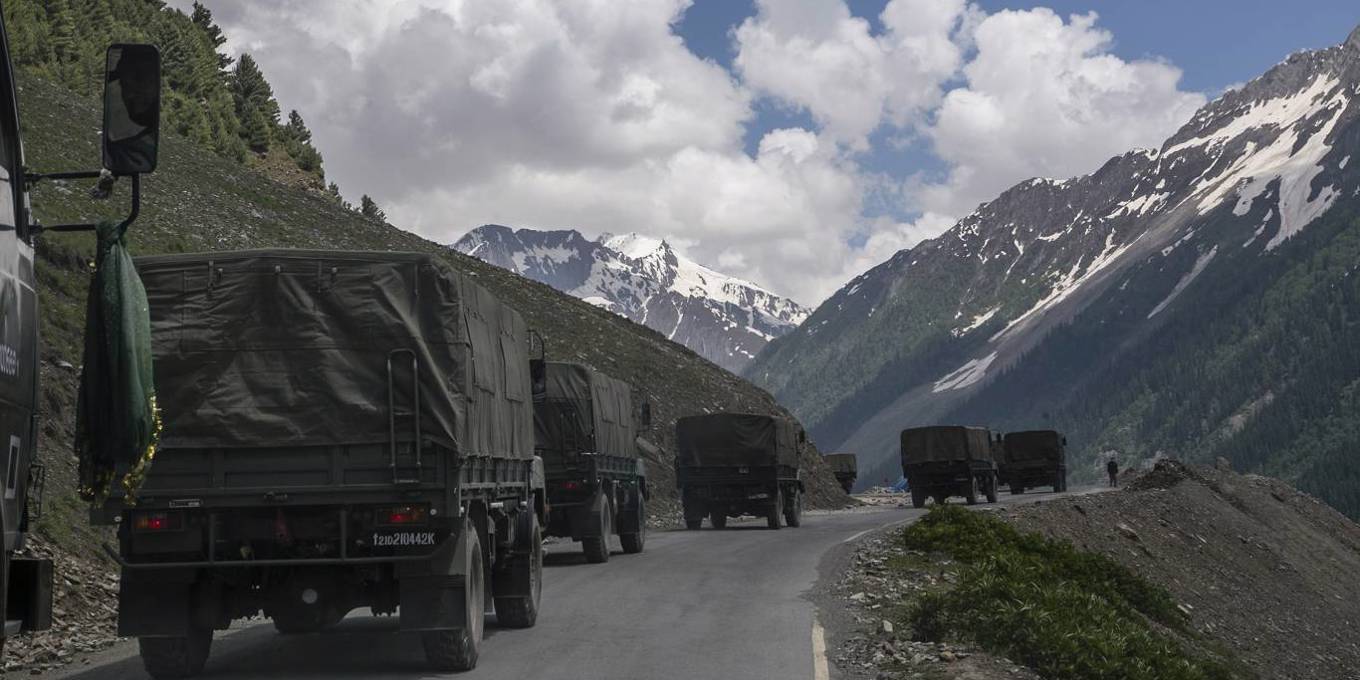
With global attention focused on Russia’s war in Ukraine, China’s territorial expansionism in Asia – especially its expanding border conflict with India – has largely fallen off the international community’s radar. Yet, in the vast glaciated heights of the Himalayas, the world’s demographic titans have been on a war footing for over two years, and the chances of violent clashes rise almost by the day.

The confrontation began in May 2020. When thawing ice reopened access routes after a brutal winter, India was shocked to discover that the People’s Liberation Army (PLA) had stealthily occupied hundreds of square miles of the borderlands in its Ladakh region. This triggered a series of military clashes, which resulted in China’s first combat deaths in over four decades, and triggered the fastest-ever rival troop buildup in the Himalayan region.

India’s counterattacks eventually drove the PLA back from some areas, and the two sides agreed to transform two battlegrounds into buffer zones. But, over the last 15 months, little progress has been made to defuse tensions in other areas. With tens of thousands of Chinese and Indian troops standing virtually at attention along the long-disputed border, a military stalemate has emerged.

But stalemate is not stagnation. China has continued to alter the Himalayan landscape rapidly and profoundly in its favor, including by establishing 624 militarized border villages – mirroring its strategy of creating artificial militarized islands in the South China Sea – and constructing new warfare infrastructure near the frontier.

As part of this effort, China recently completed a bridge over Pangong Lake – the site of past military clashes – that promises to strengthen its position in a disputed area of India’s Ladakh region. It has also built roads and security installations on territory that belongs to Bhutan, in order to gain access to a particularly vulnerable section of India’s border overlooking a narrow corridor known as the “Chicken Neck,” which connects its far northeast to the heartland.

All of this, China hopes, will enable it to dictate terms to India: accept the new status quo, with China keeping the territory it has grabbed, or risk a full-scale war in which China has maximized its advantage. China’s expansionism relies on deception, stealth, and surprise, and on apparent indifference to the risks of military escalation. The aim of its brinkmanship is to confound the other side’s deterrence strategy and leave it with no real options.

China learned from its strategic folly of invading Vietnam in 1979 and has become adept at waging asymmetric or hybrid warfare, usually below the threshold of overt armed conflict. This enables it to advance its strategic objectives, including land grabs, incrementally. Coercive bargaining and overt intimidation also help to overcome resistance.

This salami-slicing strategy has already enabled Chinese President Xi Jinping to redraw the geopolitical map in the South China Sea. And the terrestrial application of this approach being deployed against India, Bhutan, and Nepal is proving just as difficult to counter. As India is learning firsthand, countries have virtually no options other than the use of force.

One thing is certain: simply hoping that China will stop encroaching on Indian territory will do India little good. After all, India got into this situation precisely because its political and military leadership failed to take heed of China’s military activities near the frontier. On the contrary, while China was laying the groundwork for its territorial grabs, Indian Prime Minister Narendra Modi was bending over backwards to befriend Xi. In the five years before the first clashes flared in May 2020, Modi met with his Chinese counterpart 18 times. Even a 2017 standoff on a remote Himalayan plateau did not dissuade Modi from pursuing his appeasement policy.

Seeking to protect his image as a strong leader, Modi has not acknowledged the loss of Indian territories. India’s media enables this evasion by amplifying government-coined euphemisms: China’s aggression is a “unilateral change of status quo,” and the PLA-seized areas are “friction points.” Meanwhile, Modi has allowed China’s trade surplus with India to rise so rapidly – it now exceeds India’s total defense budget (the world’s third largest) – that his government is, in a sense, underwriting China’s aggression.

But none of this should be mistaken for unwillingness to fight. India is committed to restoring the status quo ante and is at its “highest level” of military readiness. This is no empty declaration. If Xi seeks to break the current stalemate by waging war, both sides will suffer heavy losses, with no victor emerging.

In other words, Xi has picked a border fight that he cannot win, and transformed a conciliatory India into a long-term foe. This amounts to an even bigger miscalculation than Modi’s policy incoherence. The price China will pay for Xi’s mistake will far outweigh the perceived benefits of some stealthy land grabs.

In a sense, China’s territorial expansionism represents a shrewder, broader, and slower version of Russia’s conventional war on Ukraine – and could provoke a similar international backlash against Xi’s neo-imperial agenda. Already, China’s aggression has prompted Indo-Pacific powers to strengthen their military capabilities and cooperation, including with the United States. All of this will undercut Xi’s effort to fashion a Sino-centric Asia and, ultimately, achieve China’s goal of global preeminence.

Xi might recognize that he has made a strategic blunder in the Himalayas. But, at a time when he is preparing to secure a precedent-defying third term as leader of the Communist Party of China, he has little room to change course, and the costs will continue to mount.

Brahma Chellaney

Brahma Chellaney, Professor of Strategic Studies at the New Delhi-based Center for Policy Research and Fellow at the Robert Bosch Academy in Berlin, is the author of nine books, including Asian Juggernaut; Water: Asia’s New Battleground; and Water, Peace, and War: Confronting the Global Water Crisis.

© Project Syndicate, 2022.