
The Quad’s moment of truth has arrived

Biden’s empty Taiwan rhetoric reveals Quad’s core weakness

Brahma Chellaney, Nikkei Asia

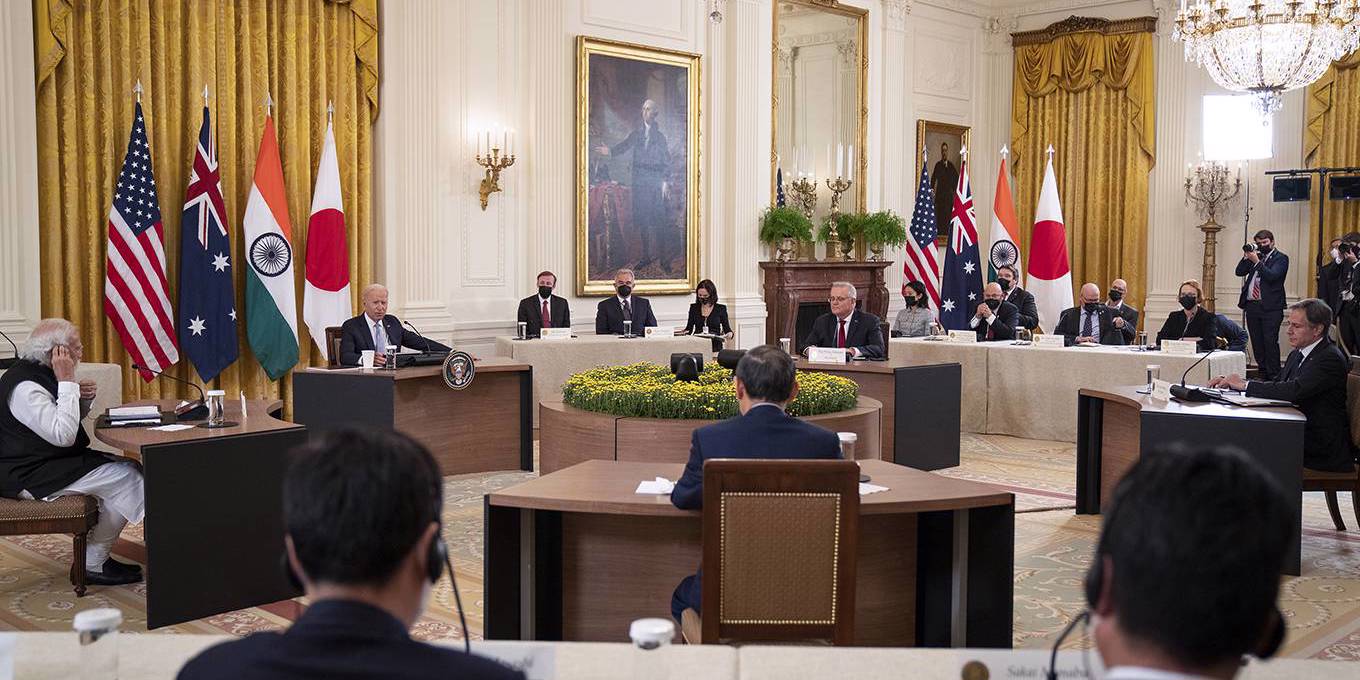
Anthony Albanese, Joe Biden, Fumio Kishida and Narendra Modi at the Prime Minister’s Office of Japan in Tokyo on May 24: The Quad’s moment of truth has arrived.   © Reuters

Nearly five years after it was resurrected from a decadelong dormancy, and then integrated as a strategic coalition of the Indo-Pacific’s leading democracies, the Quad is struggling to make a difference in a region whose rising economic and geopolitical heft promises to reshape the international order.

Amid the deepening global fallout from the Ukraine war and the NATO-Russia proxy coflict, this week’s Quad summit in Tokyo showed that the group comprising the U.S., India, Japan and Australia has its work cut out if it is to make a meaningful impact, which will be measured in terms of deliverables, rather than the number of times its leaders get together and make promises.

While the Quad is trying to get its act together, the geostrategic dynamics are changing rapidly in the Indo-Pacific, where the world’s fastest economic growth is incongruously juxtaposed with fast-rising naval capabilities and the most dangerous strategic hot spots.

Intended to serve as a bulwark against Chinese expansionism, from the South and East China Seas to the Himalayas, the Quad has done little to rein in China’s unilateral moves to alter the regional status quo, with Beijing’s wide-ranging security accord with the Solomon Islands just the latest example.

In Tokyo, U.S. President Joe Biden stole the summit’s thunder with various pre-summit announcements or assertions, including unveiling his administration’s Indo-Pacific Economic Framework — an economic platform that seeks to promote cooperation among its 13 member-states on global issues such as supply chains, clean energy and digital rules, but without reducing trade barriers or tariffs.

Biden’s indication that the U.S. would use force to defend Taiwan grabbed global headlines, yet, paradoxically, Biden has gradually been easing pressure on China. Examples include letting China off the hook over the COVID-19 origins, dropping U.S. fraud charges against the daughter of the founder of China’s Huawei Technologies, and allowing Beijing to escape scot-free over its failure to meet commitments in the so-called Phase One trade deal with Washington.

Further, Biden revealed in Tokyo that he was considering rolling back trade tariffs on Chinese products, an action that would break his promise not to unilaterally lift tariffs unless Beijing’s behavior improved.

Not once, not twice, but three times Biden has said in recent months that the U.S. will militarily defend Taiwan, only to have his senior officials walk back his comments on every occasion. A day after sowing international confusion afresh, Biden himself walked back his Taiwan comments, telling reporters, “My policy has not changed at all.”

Lost was the exclusion of Taiwan from Biden’s Indo-Pacific Economic Framework, with the White House offering no explanation for omitting the global semiconductor hub.

The defense of Taiwan has assumed greater significance for Indo-Pacific security, given that three successive U.S. administrations have failed to credibly push back against China’s expansionism in the South China Sea, relying instead on rhetoric or symbolic actions. Beijing’s swallowing of Hong Kong also has essentially been cost-free.

All of this has renewed questions about the Quad’s strategic direction and mission. While it remains integral to the U.S. strategy of a free and open Indo-Pacific, Biden’s September 2021 launch of the AUKUS alliance with Australia and Britain signaled the Anglosphere is back and confirmed a shift in the Quad’s focus under him to everlasting universal challenges, from climate change and cybersecurity to global health and resilient supply chains.

Biden, after taking office in January last year, initiated the practice of Quad leaders holding summit meetings, with the Tokyo meeting representing the fourth such summit in just 14 months. But under Biden’s leadership, the group has also taken on an expansive agenda.

Given its small size, the Quad is in no position to deal with larger international challenges. Yet the first Quad summit in March 2021, held virtually, launched working groups on climate change, vaccines and critical and emerging technologies.

When the Quad leaders met in person at the White House last September, three more working groups were established on cybersecurity, infrastructure and space. With the Quad unable to meet its own target of delivering one billion Indian-manufactured doses of COVID-19 vaccines to the developing world by the end of this year, this raises the danger that the group will underdeliver on other core promises.

This week’s summit in Tokyo was a reminder that a very broad and ambitious agenda not only dilutes the Quad’s Indo-Pacific focus but also makes it more difficult to produce results.

The leaders’ joint statement was heavy with pious declarations about cooperating on issues extending from peace and security to climate, space, global health security and cybersecurity, but light on concrete plans, including on combating what it acknowledged were “coercive, provocative or unilateral actions that seek to change the status quo” in the region.

The Quad’s moment of truth has arrived. The group today faces a clear choice: start translating its rhetoric into action by leveraging its members’ strengths, or risk becoming a mere talking shop. Given that the Quad is now more integrated than ever, it ought to focus on deliverables to help underscore its strategic value.

Unless the Quad gets cracking, an illiberal hegemonic order in Asia could emerge, creating significant risks for international security and global markets.

Brahma Chellaney is a geostrategist and author of nine books, including “Asian Juggernaut: The Rise of China, India and Japan.”

European scramble for energy comes at Asia’s expense

EU moves to wean itself off Russian oil and gas is creating a self-defeating trap

Brahma Chellaney, Nikkei Asia

A man rests while waiting in a line to buy diesel in Colombo on April 7: Europe’s frenzied efforts to secure alternative sources spells trouble for importing states with lower-paying power such as cash-strapped Sri Lanka.   © Reuters

The era of cheap oil and gas is over. In an increasingly risky and turbulent world, geopolitics more than supply chain issues has driven up fossil fuel prices and spurred growing energy insecurity.

The war in Ukraine has also made global inflation worse, increased debt and slowed economic growth. Financial markets have become more volatile as they start to price in the dual risk of stagnant economic growth and persistently high inflation.

Yet here’s the paradox: as many as 37 advanced economies, from Japan to Australia and Canada, have joined the unprecedented U.S.-led sanctions campaign to isolate and squeeze Russia. Unwittingly, these countries have created a self-defeating trap: their punitive campaign is raising international energy and commodity prices, as well as Russia’s revenues, despite a significant decrease in its energy exports.

And by fueling inflation at home and cutting into their citizens’ standard of living, those imposing sanctions are imposing costs on themselves, with the International Monetary Fund expecting global growth to slow to 3.6% this year from 6.1% last year.

Against this background, Europe’s ambitious mission to wean itself off Russian fossil fuels has been hailed as a “geostrategic game-changer.” In reality, Europe’s scramble to find alternative energy sources is stoking the further rise of international prices and compounding the debt woes of poorer countries.

More fundamentally, Europe’s energy shift, given the scale of its planned supply switch, is set to trigger costly competition with the thriving economies of Asia, the world’s largest energy consumer.

The 27-country European Union, which consumes 11% of the total global energy supply, currently relies on Russia for 40% of its gas and 25% of its oil.

With OPEC Secretary-General Mohammad Barkindo already stating that there is not sufficient global oil capacity to compensate for the loss of Russian supply, it is no wonder that oil prices immediately jumped 4% earlier this month when the EU proposed a phased ban on imports of Russian oil.

Brent crude futures are currently trading more than 50% higher than last year’s annual average of $70.40. Diesel, meanwhile, is already in short supply, with its price soaring as European distributors move away from Russian supplies, while American and other producers of Liquefied Natural Gas are already struggling to meet the increased demand from Europe.

The U.S., the world’s second-largest natural-gas exporter after Russia, is on track to become the world’s largest LNG exporter this year, overtaking Qatar and Australia. Yet, thanks to Europe’s scramble, U.S. natural-gas prices at home have more than doubled this year, pushing up inflation to a four-decade high of 8.3%.

Still, no region will be more affected by Europe’s shift to non-Russian sources of energy supply than Asia.

By severing its energy ties with Russia and decoupling two interlocked parts of the global energy system, Europe will become the main competitor for the energy that otherwise supplies Asia.

The EU has also opened a path for China to build an energy safety net through greater land-based imports from Russia that cannot be blockaded, even if it were to invade Taiwan.

Rewiring European economies that have long depended on cheap Russian energy will be a costly and lengthy process, requiring the building of new or expanded LNG infrastructure and the recalibrating of oil refineries that are configured for processing only Russian crude.

Meanwhile, the specter of Russia cutting supplies through counter-sanctions has led Europe to frenetically stock up on imported LNG, crude and diesel, often by outbidding Asian buyers.

Since last month, European energy imports from Africa, the Middle East and North America have hit a record high and commanded premium prices. Ironically, the EU is also stocking up on Russian gas, oil and coal, paying Moscow 44 billion euros in just the first two months of the war for such imports, compared with about 140 billion euros for the whole of 2021.

The changing dynamics compound the challenges for Japan, whose companies have invested in the Russian Sakhalin-1, Sakhalin-2 and Arctic LNG 2 projects, each of which has been deemed essential for Japanese energy security. Japan, which relies on Russia for just 4% of its total crude imports and 9% of its gas, is loath to find alternative sources at this stage, despite slapping its own sanctions on Moscow.

A Japanese-made carrier is anchored near an LNG plant on Sakhalin island: The changing dynamics compound the challenges for Japan.   © Reuters
Replacing just its Sakhalin-2 LNG with spot-market LNG could raise Japan’s total yearly import bill by as much as 50% on current trends. India, one of the world’s largest energy consumers and heavily reliant on foreign supplies, has already seen its energy-import bill rise by billions of dollars per week.

Energy markets today can ill-afford a large economy like Japan joining Europe’s scramble. Europe’s frenzied efforts to secure alternative sources already spell trouble for importing states with lower-paying power, such as cash-strapped Sri Lanka, which has declared an unprecedented nationwide curfew to deal with violent street protests.

The risk is growing that the EU, in seeking to hurt Russia, may end up hurting itself while severely penalizing developing economies. Higher energy prices will benefit all the world’s major energy exporters, from the U.S. to Russia. According to the Oslo-based Rystad Energy, despite Russian crude production projected to decline sharply in 2022, Moscow’s total income from oil alone is likely to soar to $180 billion, up 45%.

At a time of such geopolitically driven market disruptions, a Europe competing with Asia for securing greater energy supplies will not only continue to drive up prices but also could derail the economic recovery from the pandemic.

Brahma Chellaney is a geostrategist and author of nine books, including “Asian Juggernaut: The Rise of China, India and Japan.”

The Quad at a Crossroads

The Indo-Pacific’s four leading democracies can hold as many leaders’ summits as they want, but without a clear strategic vision – and an agenda to match – they will have little impact. The group’s purpose is to act as a bulwark against Chinese expansionism and ensure a stable balance of power in the Indo-Pacific.

BRAHMA CHELLANEY, Project Syndicate

When the Quad was first conceived as a strategic coalition of the Indo-Pacific’s four leading democracies, many doubted that it would amount to much. Chinese Foreign Minister Wang Yi mocked it as a “headline-grabbing idea” that would dissipate “like the sea foam in the Pacific or Indian Ocean.” But continued Chinese expansionism, combined with former Japanese Prime Minister Abe Shinzō’s determination to build broad resistance to it, has produced an increasingly consolidated group, with real potential to bolster regional security. The question is whether it will deliver.

One thing is certain: all four Quad members – Australia, India, Japan, and the United States – are essential to realize the vision of a “free and open Indo-Pacific” introduced by Japan in 2016 and affirmed by the US in 2017. While the Quad took some time to get off the ground – it was resurrected during US President Donald Trump’s administration but leaders’ summits began only after Joe Biden took office – it has gained considerable momentum. Its members have held three summits since last year (two of them virtual) and are set to meet in person in Tokyo on May 24.

But the Quad still has a long way to go, not least because its members’ own actions are undercutting its strategic rationale – the need to prevent China from upending security in the Indo-Pacific. A key problem is that all four countries have allowed themselves to be seduced by the Chinese narrative that economic relations can be separated from geopolitics.

China’s trade surplus, which reached a record $676.4 billion last year, is now the main engine of its economy. Without it, Chinese growth would likely stall, especially as President Xi Jinping strengthens state control over private companies. This would also hinder China’s ability to invest in its military and finance its aggressive maneuvers in the Indo-Pacific and beyond.

And yet the US and India are major contributors to China’s trade surplus. The US leads the way: its trade deficit with China swelled by more than 25% in 2021, to $396.6 billion, and now comprises over 58% of China’s total surplus. India’s trade deficit with China – which hit $77 billion in the 12 months through this March – exceeds its defense budget, even as the two countries are locked in a dangerous military confrontation on their long Himalayan frontier.

China’s stealth encroachments on some Indian border areas in 2020 triggered deadly clashes, setting in motion a buildup of forces and border infrastructure that continues to this day. This should have been a wake-up call for Indian Prime Minister Narendra Modi, who had been so committed to appeasing China that he was blindsided by its aggression. But India’s large and growing trade deficit with China suggests that he is still asleep.

Australia and Japan have similarly built up significant dependency on Chinese trade. China accounts for nearly one-third of Australia’s international trade and is Japan’s largest export market. Moreover, both countries are members of the China-led Regional Comprehensive Economic Partnership. For them, enabling China to shape trade rules in the Indo-Pacific is apparently a small price to pay for the economic benefits of increased regional commerce.

Rather than continuing to underwrite China’s economic and geopolitical power, the Quad should be making economic cooperation – including increased trade among its members – a central feature of its agenda. Unfortunately, though Biden has pledged to unveil an Indo-Pacific Economic Framework covering everything from infrastructure to the digital economy, his administration’s unwillingness to commit more resources to the region or offer regional partners better access to US markets severely limits the initiative’s potential. Moreover, Biden has pushed an expansive Quad agenda covering topics that have nothing to do with the group’s core objectives – everything from climate change to COVID-19 vaccine delivery to supply-chain resilience.

America’s deepening proxy conflict with Russia further muddies the strategic picture. Biden is the third successive US president to commit to shifting America’s primary strategic focus to Asia and the wider Indo-Pacific. But the Ukraine war – which he believes “could continue for a long time” – may well cause him, like his predecessors, not to complete that pivot.

The war might also spur Biden to take a more conciliatory approach to China. Even before Russia invaded Ukraine, Biden had begun to ease pressure on China. He effectively let China off the hook for both obscuring COVID-19’s origins and failing to meet its commitments under the 2020 “phase one” trade deal with the US. He also dropped fraud charges against the daughter of the founder of the military-linked Chinese tech giant Huawei. US sanctions over China’s Muslim gulag remain essentially symbolic.

Now, as Biden attempts to ensure that Xi does not offer Russian President Vladimir Putin an economic lifeline, thereby neutralizing the impact of Western sanctions, he is likely to adopt an even more conciliatory approach. Already, the US Trade Representative has reinstated exemptions from Trump-era tariffs on 352 products imported from China. And now the White House is considering a broader reduction of tariffs on non-strategic goods from China.

The Quad can hold as many leaders’ summits as it wants, but without a clear strategic vision – and an agenda to match – it will have little impact. The group’s purpose is to act as a bulwark against Chinese expansionism and ensure a stable balance of power in the Indo-Pacific. At its May 24 summit, all other issues should take a backseat to this objective.

Brahma Chellaney

Brahma Chellaney, Professor of Strategic Studies at the New Delhi-based Center for Policy Research and Fellow at the Robert Bosch Academy in Berlin, is the author of nine books, including Asian Juggernaut; Water: Asia’s New Battleground; and Water, Peace, and War: Confronting the Global Water Crisis.

© Project Syndicate, 2022.

Why sanctions against Russia may not work

BY BRAHMA CHELLANEY, OPINION CONTRIBUTOR, THE HILL

The unprecedented U.S.-led Western sanctions against Russia have been likened to economic weapons of mass destruction (WMDs) that would ultimately destroy the Russian economy. In reality, the sanctions are like a double-edged sword — they inflict pain on Russia but also impose costs on their imposers.

The West, in fact, is caught in a trap: The sanctions and the deepening conflict, by helping to raise global commodity and energy prices, translate into higher revenues for Moscow in spite of a significant decrease in its exports. And the higher international prices, by fueling inflation, mean political trouble at home for those behind the sanctions.

Look at another paradox: Despite Russia being cut off from the world’s financial arteries, the Russian ruble has dramatically recovered through state intervention. But, as if to signal that Japan is paying a price for following the U.S. lead on Russia, the Japanese yen (the world’s third-most-traded currency) has sunk to a 20-year low against the U.S. dollar, ranking this year as the worst performing of the 41 currencies tracked — worse than the ruble.

Meanwhile, the runaway inflation and supply-chain disruptions are threatening Western corporate profits, while the interest-rate hikes to rein in inflation make a bad situation worse for consumers. With economic trouble looming large, April became the worst month for Wall Street since the pandemic-triggered March 2020 plunge. The S&P 500 fell 8.8 percent in April.

In the first two months of the war in Ukraine, those imposing the sanctions ironically helped Russia to nearly double its revenues to about €62 billion from selling fossil fuels to them, according to a report of a Finland-registered think tank, the Centre for Research on Energy and Clean Air. The top 18 importers, with the sole exception of China, were the sanctions imposers, with the European Union (EU) alone accounting for 71 percent of the purchases of Russian fuels in this period.

While Turkey, South Korea and Japan also remain reliant on Russian energy supplies, the EU’s imports of gas, oil and coal from Russia totaled around €44 billion in this two-month period, compared with about €140 billion for the whole of 2021.

Russia, even as its economy takes a hit from the Western sanctions, is doing its bit to keep international energy and commodity prices high, including by cutting off gas supplies to Poland and Bulgaria. Moscow could raise prices further through broader counter-sanctions and yet manage to cushion its export earnings.

The fact is that Russia is the world’s richest country when it comes to natural resources, including serving among the world’s largest exporters of natural gas, uranium, nickel, oil, coal, aluminum, copper, wheat, fertilizers and precious metals such as palladium, which is more precious than gold and used largely in catalytic converters.

Through no fault of theirs, the real losers from the Russia-NATO conflict, sadly, are the poorer countries, which are bearing the brunt of the economic fallout. From Peru to Sri Lanka, rising fuel, food and fertilizer prices have triggered violent street protests, which in some states have spiraled into continuing political turmoil. The debt woes of many poor nations have deepened.

In employing the full range of its economic weaponry, the West sought to unleash “shock and awe” on Russia, as if to underscore that sanctions are a form of war. But like armed conflict, as Russia’s invasion of Ukraine illustrates, sanctions are unpredictable in shaping outcomes and often lead to unintended or undesirable consequences.

Squeezing a major power, especially one that has the world’s largest nuclear-weapons arsenal, with a raft of harsh sanctions is fraught with danger, especially as increasingly sophisticated and heavier Western weapons pour into Ukraine, with the United States also supplying battlefield intelligence, including targeting data.

Almost every day brings a fresh reminder that this conflict is not just about the control of Ukraine or its future status. Rather, this is a full-fledged new Cold War between Washington and Moscow, with Europe as the theater of the growing confrontation. President Biden’s strategy of Containment 2.0 against Moscow is designed to ensnare Russia in a military quagmire in Ukraine, trigger the collapse of the Russian economy and bring about the overthrow of President Vladimir Putin.

As the war has progressed, Biden has become bolder, including deepening America’s involvement in it. Biden’s implicit call for regime change in Moscow and his administration’s publicly declared goal of a “weakened” Russia, however, run counter to what the president said about two weeks into the war: “Direct confrontation between NATO and Russia is World War III, something we must strive to prevent.”

Unfortunately, there has been little American debate on whether sanctions can weaken Russia or whether the generous military assistance to Ukraine can really bog down the Russian military in a protracted conflict. What if, instead of a weakened Russia, a nationalistic backlash spawns a more militarily assertive, neo-imperial Russia?

After its initial missteps that resulted in heavy Russian casualties, Russia is now militarily focused on consolidating its control in the resource-rich east and south of Ukraine. Russia has carved out a land corridor to Crimea and gained control of regions that hold 90 percent of Ukraine’s energy resources, including all its offshore oil and much of its critical port infrastructure. The Ukrainian ports on the Sea of Azov and four-fifths of Ukraine’s Black Sea coastline are now with Russia, which earlier established control over the Kerch Strait that connects those two seas. 

Can the flood of weapons the West is sending to Ukraine undo these new military realities? If Russia stays focused on narrow military objectives centered on establishing a buffer zone in the occupied parts of Ukraine’s south and east, it could avert a quagmire, while remaining free to continue systematically targeting military infrastructure across that expansive country.

Let’s be clear: Sanctions historically have worked better against small, vulnerable states than large or powerful ones. But they have rarely produced timely change. The current Western sanctions could take years to seriously hurt the Russian economy.

The irony is that, despite employing all possible coercive economic instruments against Russia and making it difficult to negotiate an end to the war, the Biden White House doesn’t believe that sanctions alone will work, which explains why it has increasingly turned to weapons supply, including asking Congress for a staggering $33 billion in additional military and economic funds to fuel the conflict and stymie Russian war objectives.

But the sanctions, by signaling the advent of a new era of U.S.-led unilateralism, are likely to weaken and ultimately even undermine the Western-controlled global financial architecture that they are meant to defend. The sweeping sanctions, by spurring broader concerns about the weaponization of finance and its implications for any country that dared to cross a U.S. red line, have created a new incentive for non-Western states to explore establishing parallel arrangements. China will not only lead this process but also is set to emerge as the real winner of the NATO-Russia conflict.

Biden’s belief that “this war could continue for a long time” is backed by Chairman of the Joint Chiefs of Staff General Mark Milley, who testified that he expects it to last years. But as the conflict drags on and the boomerang effects of the sanctions deepen the cost-of-living crisis, the divides in the Western camp will widen and “Ukraine fatigue” will set in.

The West will be left with little choice but to negotiate with Putin to end the conflict, as predicted by Javier Solana, a former NATO chief who also served as Spain’s foreign minister. Such negotiations will be vital to halt Ukraine’s destruction and avert Europe from paying the main price.

Brahma Chellaney is a geostrategist and the author of nine books, including the award-winning “Water: Asia’s New Battleground” (Georgetown University Press). Follow him on Twitter @Chellaney.