
China is Paying a High Price for Provoking India

For Xi Jinping, the COVID-19 pandemic – which has preoccupied the world’s governments for months – seemed like an ideal opportunity to make quick progress on his expansionist agenda. But by provoking India, he may have bitten off more than he can chew.
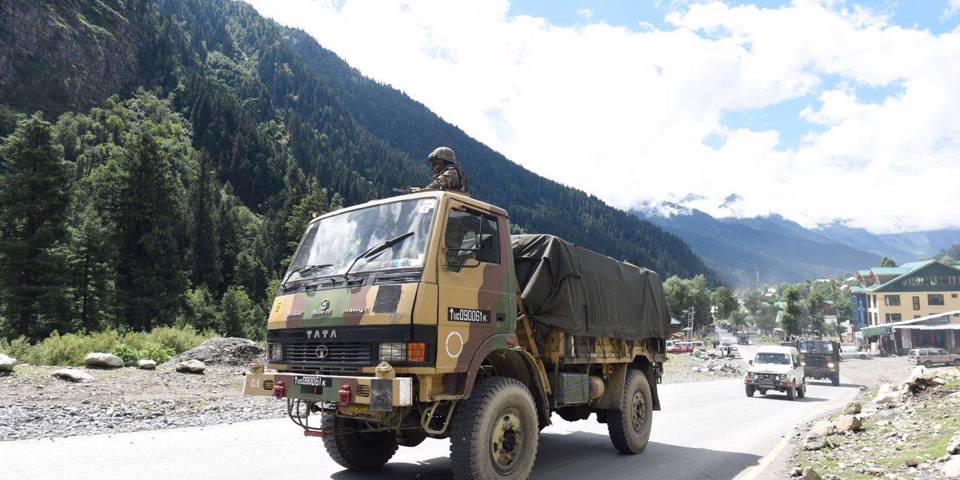
An Indian Army convoy on its way to the frontlines on September 7, 2020. (Photo via Getty Images)

BRAHMA CHELLANEYProject Syndicate

China’s foreign minister, Wang Yi, recently declared that aggression and expansionism have never been in the Chinese nation’s “genes.” It is almost astonishing that he managed to say it with a straight face.

Aggression and expansionism obviously are not genetic traits, but they have defined President Xi Jinping’s tenure. Xi, who in some ways has taken up the expansionist mantle of Mao Zedong, is attempting to implement a modern version of the tributary system that Chinese emperors used to establish authority over vassal states: submit to the emperor, and reap the benefits of peace and trade with the empire.

For Xi, the COVID-19 pandemic – which has preoccupied the world’s governments for months – seemed like an ideal opportunity to make quick progress on his agenda. So, in April and May, he directed the People’s Liberation Army to launch furtive incursions into the icy borderlands of India’s Ladakh region, where it proceeded to establish heavily fortified encampments.

It wasn’t nearly as clever a plan as Xi probably thought. Far from entrenching China’s regional preeminence, it has intensified the pushback by Indo-Pacific powers, which have deepened their security cooperation. This includes China’s most powerful competitor, the United States, thereby escalating a bilateral strategic confrontation that has technological, economic, diplomatic, and military dimensions. The specter of international isolation and supply disruptions now looms over China, spurring Xi to announce plans to hoard mammoth quantities of mineral resources and agricultural products.

But Xi’s real miscalculation on the Himalayan border was vis-à-vis India, which has now abandoned its appeasement policy toward China. Not surprisingly, China remains committed to the PLA’s incursions, which it continues to portray as defensive: late last month, Xi told senior officials to “solidify border defenses” and “ensure frontier security” in the Himalayan region.

India, however, is ready to fight. In June, after the PLA ambushed and killed Indian soldiers patrolling Ladakh’s Galwan Valley, a hand-to-hand confrontation led to the deaths of numerous Chinese troops – the first PLA troops killed in action outside United Nations peacekeeping operations in over four decades. Xi was so embarrassed by this outcome that, whereas India honored its 20 fallen as martyrs, China refuses to admit its precise death toll.

The truth is that, without the element of surprise, China is not equipped to dominate India in a military confrontation. And India is making sure that it will not be caught off guard again. It has now matched Chinese military deployments along the Himalayan frontier and activated its entire logistics network to transport the supplies needed to sustain the troops and equipment through the coming harsh winter.

In another blow to China, Indian special forces recently occupied strategic mountain positions overlooking key Chinese deployments on the southern side of Pangong Lake. Unlike the PLA, which prefers to encroach on undefended border areas, Indian forces carried out their operation right under China’s nose, in the midst of a major PLA buildup.

If that were not humiliating enough for China, India eagerly noted that the Special Frontier Force that spearheaded the operation comprises Tibetan refugees. The Tibetan soldier who was killed by a landmine in the operation was honored with a well-attended military funeral.

India’s message was clear: China’s claims to Tibet, which separated India and China until Mao Zedong’s regime annexed it in 1951, are not nearly as strong as it pretends they are. Tibetans view China as a brutally repressive occupying power, and those eager to fight the occupiers flocked to the Frontier Force, established after Mao’s 1962 war with India.

Here’s the rub: China’s claims to India’s vast Himalayan borderlands are based on their alleged historical links to Tibet. If China is merely occupying Tibet, how can it claim sovereignty over those borderlands?

In any case, Xi’s latest effort to gain control of territories that aren’t China’s to take has proved far more difficult to complete than it was to launch. As China’s actions in the South China Sea demonstrate, Xi prefers asymmetrical or hybrid warfare, which combines conventional and irregular tactics with psychological and media manipulation, disinformation, lawfare, and coercive diplomacy.

But while Xi managed to change the South China Sea’s geopolitical map without firing a shot, it seems clear that this will not work on China’s Himalayan border. Instead, Xi’s approach has placed the Sino-Indian relationship – crucial to regional stability – on a knife edge. Xi wants neither to back down nor to wage an open war, which is unlikely to yield the decisive victory he needs to restore his reputation after the border debacle.

China might have the world’s largest active-duty military force, but India’s is also massive. More important, India’s battle-hardened forces have experience in low-intensity conflicts at high altitudes; the PLA, by contrast, has had no combat experience since its disastrous 1979 invasion of Vietnam. Given this, a Sino-Indian war in the Himalayas would probably end in a stalemate, with both sides suffering heavy losses.

Xi seems to be hoping that he can simply wear India down. At a time when the Indian economy has registered its worst-ever contraction due to the still-escalating COVID-19 crisis, Xi has forced India to divert an increasing share of resources to national defense. Meanwhile, ceasefire violations by Pakistan, China’s close ally, have increased to a record high, raising the specter of a two-front war for India. As some Chinese military analysts have suggested, Xi could use America’s preoccupation with its coming presidential election to carry out a quick, localized strike against India without seeking to start a war.

But it seems less likely that India will wilt under Chinese pressure than that Xi will leave behind a legacy of costly blunders.  With his Himalayan misadventure, Xi has provoked a powerful adversary and boxed himself into a corner.

Brahma Chellaney

Brahma Chellaney, Professor of Strategic Studies at the New Delhi-based Center for Policy Research and Fellow at the Robert Bosch Academy in Berlin, is the author of nine books, including Asian Juggernaut; Water: Asia’s New Battleground; and Water, Peace, and War: Confronting the Global Water Crisis.
© Project Syndicate, 2020.

With China’s aggression, India finds history repeating itself

A common Indian refrain today is that China has betrayed India’s friendship. Those who fail to learn from history are doomed to repeat it. Did India really draw enduring lessons from 1962? If so, how does it explain being “stabbed in the back” again by China?

Brahma Chellaney, The Hindustan Times

Successive Indian governments have put more faith in diplomacy than the armed forces in achieving security objectives. Diplomacy can accomplish little in the absence of strategic vision and resolve or adequate leverage. The diplomatic blunders of 1948 (Kashmir dispute’s internationalization), 1954 (Panchsheel Agreement’s acceptance of the “Tibet region of China”), 1960 (Indus Waters Treaty), 1966 (Taskhent) and 1972 (Simla) have imposed enduring costs.

Worse still, India has learned little from its past, which explains why history repeats itself. Today, with China’s multi-thrust aggression, which caught India napping, history is repeating itself, underscored by a common Indian refrain that Beijing has betrayed India’s friendship.

China’s latest “stab in the back” raises key questions, not about the communist dictatorship in Beijing (which has made a practice of employing deception, concealment and surprise in peacetime), but about India. What explains India’s “hug, then repent” proclivity over the decades that highlights the aphorism, “act in haste, repent at leisure”? Why has India repeatedly cried betrayal, not by friends, but by adversaries in whom it reposed trust?

Why has Indian diplomacy, time after time, rushed to believe what it wanted to believe? Or what makes India keep repeating the cycle of bending over backward to court a foe and then failing to see aggression coming (as in Kargil, Pathankot or Doklam)? More fundamentally, why does India stay at the receiving end of its foes’ machinations and always play the victim? For example, why has it never repaid China with its own “salami slicing”?

One reason history repeats itself is that virtually every Indian prime minister, although unschooled in national security at the time of assuming office, has sought to reinvent the foreign-policy wheel, rather than learn from past blunders. Another reason is that Indian intellectuals and journalists generally shrink from closely scrutinizing foreign-policy moves.

Overselling outcomes of summit meetings with China from 1988 to 2019 for leadership glorification has led to India’s worst China crisis after the 1962 war. For example, five separate border-management agreements were signed at summits between 1993 and 2013, with each accord hailed in India (but not China) as a major or historic “breakthrough.”

Now India admits China has trashed all those agreements with its aggression. Yet India still plays into China’s hands by clinging to the accords and by agreeing recently in Moscow to build on them through new confidence-building measures (CBMs).

China is showing it is a master in protracting negotiations so as to buy time to consolidate its territorial gains, while exploring the limits of its adversary’s flexibility and testing its patience. For Beijing, any agreement is designed to bind not China but the other side to its terms. It is seeking fresh CBMs to make India respect the new, Chinese-created territorial status quo and to restrict India from upgrading its border infrastructure.

China’s foreign minister claims the “consensus” reached at Moscow is to “meet each other halfway.” Meeting China halfway will validate its “10 miles forward, 5 miles back” strategy, with China gaining half but India losing half. This illustrates Beijing’s definition of “give and take” — the other side gives and China takes.

Yet India has placed its faith in diplomacy ever since it discovered China’s intrusions in early May. It reined in its armed forces from taking counteractions until recently. Had it permitted proactive countermeasures earlier, once sufficient acclimatized troops and weapons capability were in place, China’s territorial gains would have been more limited.

China used the talks with India to make additional encroachments, especially on the critical Depsang Y-Junction, which controls access to several areas. Of all the land grabs China has made, the largest is in Depsang, the sector of utmost importance to Indian defences. Yet this encroachment has received little attention.

In fact, some are drawing a false equivalence between the Chinese and Indian military actions to obscure the reality. While China has seized several areas that traditionally were under Indian patrolling jurisdiction, India has occupied its own unmanned mountain heights in one area in order to pre-empt another Chinese land grab.

The defence minister’s statement in Parliament, however, shows the government remains loath to admit that China has encroached on Indian areas. Shielding the government’s image, alas, comes first. This explains why India hasn’t labelled China the aggressor, leaving the field open for China to repeatedly call India the aggressor.

Having redrawn the Line of Actual Control (LAC) in several Ladakh sectors, including Pangong, Gogra-Kongka La, Hot Springs and Galwan, China is now seeking to replace the term LAC with the looser expression “border areas.” It had its way in the Moscow agreement, which repeatedly mentions “border areas,” not LAC (a line unambiguously marked in Indian military maps and up to which Indian forces are supposed to defend all territory).

All the boundary-related bilateral accords and protocols are LAC-centred. But China, signalling its aggressive designs, stopped referring to the term LAC in recent years. Instead it is quietly treating the LAC as a line to actually control by changing facts on the ground.The Moscow agreement’s use of the vague term “border areas” helps to obscure China’s encroachments and creates space for continued Chinese salami slicing.

In this light, diplomacy is unlikely to deliver the status quo ante India seeks. In fact, China seems intent on continuing, below the threshold of armed conflict, coercive military pressure along the entire frontier from Ladakh to Arunachal Pradesh until India acquiesces to its demands, including reconciling to the new status quo.

Will China’s win-without-fighting warfare campaign help create a new India steeped in realism and determined to break the cycle of history repeating itself? At a minimum, it promises to shake up India’s business-as-usual approach to national security.

Brahma Chellaney is a geostrategist.

© The Hindustan Times, 2020.

The Taliban loves China’s money, but can it forget its Muslim gulags?

Beijing has nurtured long-standing ties with the Taliban to help Pakistan call the shots in Afghanistan.

Brahma Chellaney, Nikkei Asian Review

On the day two airplanes crashed into New York’s World Trade Center in 2001, Chinese officials signed an economic and technical cooperation accord with Afghanistan’s then-ruling Taliban, in the latter’s capital, Kandahar. The 9/11 attacks led the United States, in partnership with Afghanistan’s Northern Alliance, to launch a military campaign that ousted the Taliban regime.

Now, China is again courting the Taliban to further its regional interests, centered primarily on safeguarding its Belt and Road projects, extracting mineral resources in Afghanistan, and preventing a surge of violent jihadism in Xinjiang, where Chinese authorities have detained more than a million Muslims for “re-education” in the largest mass incarceration of people on religious grounds in the post-World War II period.

The U.S. plan to exit Afghanistan has added greater urgency to China’s efforts to cozy up to the Taliban. Chinese officials have stepped up contacts with Taliban representatives as President Donald Trump’s administration has steadily cut U.S. troop levels in Afghanistan to 8,600 and closed several bases.

Trump, calling the U.S. military involvement in war zones “the single biggest mistake in the history of our country,” has said that there would be fewer than 5,000 American troops in Afghanistan by U.S. election day in November. The Pentagon, however, says further troop withdrawals would depend on the Taliban’s honoring of its peace deal with the U.S.

In order to win the Taliban’s cooperation, China is reportedly offering to build roads in Taliban-controlled territories, as well as a number of energy projects, including generating electricity.

Here’s the paradox: Communist China has little in common with the Taliban, a hard-line Islamist militia known for brutal, medieval practices and for demolishing the monumental Buddhas of Bamiyan. In fact, China’s concern over Islamic extremism has driven it to take unparalleled steps, including the large-scale deprogramming of Islamic identities in a bid to forcibly assimilate its Muslim population into the dominant Han culture.

Yet China has nurtured long-standing ties with the Taliban — created and armed by Pakistani intelligence — to help Pakistan call the shots in Afghanistan. While the Taliban was in power, China established economic ties with it and launched flights between Kabul and Xinjiang’s capital, Urumqi.

Pakistan, which Beijing considers its client-state, has helped facilitate Chinese-Taliban ties. Indeed, the Taliban’s top leadership, as well as its command and control apparatus, have been ensconced in Pakistan since it was ousted from power in 2001. This allowed China, after 9/11, to quietly continue a relationship with the Taliban.

Such long-standing ties with the Taliban, and a strong strategic nexus with Pakistan, have helped China avert any major terrorist strike on its projects in Afghanistan, including the large Aynak copper mine it secured in 2007. By contrast, Indian infrastructure projects and diplomatic missions in Afghanistan have repeatedly come under terrorist attack.

China’s latest overtures to the Taliban underscore its concern that the U.S. military withdrawal could foster greater violence and instability in the Afghanistan-Pakistan belt, which has long been a terrorism nucleus. Beijing wants to safeguard its heavy investment in the China-Pakistan Economic Corridor, the supposed crown jewel of its Belt and Road Initiative. It also wants to ensure the Taliban do not aid Uighur militants.

America’s Faustian bargain with the Taliban was sealed in February with Pakistan’s active support. The fact that no counterterrorism campaign has ever succeeded when the militants have enjoyed cross-border havens compelled the Trump administration to sue for peace in order to end the longest war in U.S. history.

Less known is that China also played a part in the peace effort by encouraging the Taliban to enter into a deal with the U.S. Indeed, even before Trump took office, Beijing offered to mediate and help revive the stalled talks between the U.S. and the Taliban.

In return, the U.S. last year heeded Beijing’s call to designate the Balochistan Liberation Army, the main separatist group in Pakistan’s sprawling Balochistan province, as a terrorist organization. The U.S. justified its designation on the grounds that the BLA was striking Chinese targets in Balochistan, which is home to the Chinese-run Gwadar port and a potential Chinese naval base.

Since then, relations between Beijing and Washington have deteriorated to a point approaching a new Cold War. Making matters worse, the U.S.-Taliban agreement appears to be tottering, with Washington accusing the Taliban of repeatedly violating the accord’s terms, including by launching rockets last month at two military bases used by American forces and by stepping up terror attacks on Afghan government forces. Hopes of a U.S.-moderated peace settlement in Afghanistan have dimmed.

Against this background, China, despite its ties with the Taliban, is likely to find it difficult to advance its interests in the Afghanistan-Pakistan belt.

Several factors threaten to act as spoilers to China’s regional ambitions, including sharpening geopolitics, a resurgent Taliban — some of whose local commanders appear to be operating independently — and the role of non-Taliban militant groups such as Tehreek-e-Taliban Pakistan that are the nemesis of Pakistani intelligence. Irrespective of the outcome of the U.S. presidential election, a complete American withdrawal from Afghanistan now looks uncertain.

In this conservative region, China’s Muslim gulag and other harsh anti-Islamic measures in Xinjiang are likely to fuel grassroots resentment against it, increasing the vulnerability of its projects.

Brahma Chellaney is a geostrategist and author of nine books, including “Asian Juggernaut: The Rise of China, India and Japan.”

© The Nikkei Asian Review, 2020.

China’s expansionist agenda takes shape on the Indian border

BRAHMA CHELLANEY, Special to The Globe and Mail

As the past weekend’s latest skirmishes between rival troops underscore, relations between the demographic titans, China and India, have hit a low not seen since their 1962 war. The two countries haveforward-deployedtens of thousands of troops and are now locked in a tense military standoff along one of the world’s most inhospitable and treacherous borders, which is as long as the distance between Toronto and Los Angeles.

The clash of the titans, triggered by a series of furtive Chinese encroachments on key vantage points in India’s northernmost borderlands, has received limited international attention. However, the spectre of further troop clashes or a 1962-style Himalayan war continues to loom, despite continuing bilateral efforts to disengage rival forces.

The confrontation highlights Chinese President Xi Jinping’s muscular revisionism, which has led him to open multiple fronts simultaneously – from the South and East China seas and the Himalayas to Hong Kong and Taiwan. Mr. Xi’s expansionism hasn’t spared the tiny country of Bhutan.

While India was wrestling with the outbreak of the Wuhan-originating coronavirus by enforcing the world’s strictest lockdown, China carried out swift and well co-ordinated incursions into the borderlands of India’s high-altitude Ladakh region from late April. Deception and surprise are integral to the Chinese strategy, even in peacetime. The aggression in Ladakh came just six months after Mr. Xi declared on Indian soil that “China-India relations have entered a new phase of sound and stable development.”

China’s intrusions into Ladakh differ from its previous Asian territorial grabs under Mr. Xi in one key aspect. China went beyond its usual practice of occupying vacant border spaces by snatching territories from right under another country’s nose.

The territorial expansion in the South China Sea by China,for example, has centred on capturing disputed but unoccupied shoals and reefs and then using construction activities to turn them into militarized artificial islands. Since Mr. Xi ordered the launch of major land reclamation in 2013, China has changed the South China Sea’s geopolitical map without firing a shot.

An Indian army convoy drives towards Leh, on a highway bordering China, on June 19, 2020, in Gagangir, India. YAWAR NAZIR/GETTY IMAGES

In 2017, China captured the unoccupied and desolate Himalayan plateau of Doklam, which Bhutan claims as its territory. The occupation came soon after China ended a more than 10-week-long troop faceoff on the plateau with India, Bhutan’s de facto security guarantor.

This summer, Mr. Xi’s communist regime laid claim to another 11 per cent of Bhutan territory, in an area that can be accessed only through India’s Arunachal Pradesh state (which Chinese maps already show as part of China). The move thus sought to advance Mr. Xi’s efforts against both Bhutan and Arunachal Pradesh.

In the East China Sea, meanwhile, China has stepped up incursions into the Japanese-administered Senkaku Islands’ territorial waters and airspace, with the aim of weakening Japan’s control and strengthening its own sovereignty claims. By bringing Japan’s security increasingly under pressure, China is signalling that the U.S. alliance system is not an answer to its aggressive revisionism.

Against this background, Mr. Xi’s aggression against India appears to mark the start of a more daring new phase in his expansionism. As U.S. national security advisor Robert O’Brien has said, “the Chinese have been very aggressive with India” lately.

The Chinese encroachments have led to multiple rounds of clashes with Indian troops in Ladakh. The deadliest occurred on June 15, leaving 20 Indian soldiers, and an unknown number of Chinese troops, dead. While India honoured its fallen as martyrs, China still refuses to divulge its losses. U.S. intelligence agencies believe China suffered more casualties than India.

A model head in the likeness of Chinese President Xi Jinping is hung upside down from a building by Tibetan activists during a protest in Dharmsala, India, on July 23, 2020. ASHWINI BHATIA/THE ASSOCIATED PRESS

Mr. Xi’s Himalayan expansionism has sought to take off from where Mao Zedong left. Mao considered Tibet (which he annexed in 1951) to be China’s right-hand palm, with five fingers – Bhutan, Nepal and the three Indian territories of Ladakh, Arunachal Pradesh and Sikkim. The five fingers were also to be “liberated.” In fact, Mao’s 1962 war against India helped China to gain more territory in Ladakh, after it earlier grabbed a Switzerland-sized chunk, the Aksai Chin plateau.

As long as Mr. Xi, like Mao, perceives the strategic benefits as outweighing the international costs, he will persist with his campaign of expansionism.

But by seeking to start the world’s next big conflict with India, Mr. Xi is likely to end up pushing that country closer to the United States and creating an adversarial bloc around China. Already, international attitudes toward Mr. Xi’s regime have hardened and many countries and companies have begun re-evaluating China-dependent supply chains for essential goods.

Brahma Chellaney is a geostrategist and the author of nine books, including Water: Asia’s New Battleground.