Trump shows India the limits of friendship with the US

By Brahma Chellaney, Daily’O

downloadUS President Donald Trump’s offer to mediate Kashmir conflict was not the only controversial or outlandish statement he made in his 40-minute media interaction on July 22 while hosting Pakistan’s military-backed prime minister, Imran Khan, at the Oval Office. Trump also drew a perverse equivalence between India and Pakistan, threw Afghanistan and Hong Kong under the bus, and begged Pakistan to “extricate us” from Afghanistan.

At a time when Trump is under attack at home for his fear-mongering and racist rhetoric, he has also courted controversy with his comments on other nations. Take his comments that he could have had Afghanistan “wiped off the face of the Earth” but did not “want to kill 10 million people.”

Those comments were not just bizarre; they were also paradoxical because they were made in the presence of the prime minister of Pakistan, which, by creating and nurturing the Taliban, has actively contributed to Afghanistan’s ruin. Indeed, Trump’s repeated bragging that he could kill 10 million Afghans sent out a racist and supercilious message, triggering outrage in Afghanistan.

In just one media interaction, Trump seriously complicated his country’s relations with Afghanistan and India while betraying Hong Kong’s pro-democracy movement. Trump not only endorsed Chinese President Xi Jinping’s handling of Hong Kong, saying Xi “has acted responsibly, very responsibly,” but also gave Xi a virtual license to crack down and end the protests, which he lamented had gone on for “a very long time.”

More than Trump’s offer to mediate the Kashmir conflict, it is his turning to Pakistan to “help us out” in Afghanistan that should concern India. The Faustian bargain that Trump is preparing to strike with the Pakistan-sponsored Taliban will seriously impinge on India’s regional interests and on Indian security, especially in the Kashmir Valley.

Pakistan has harboured the Taliban leadership since the 2001 US invasion of Afghanistan in the expectation that the Taliban, with the Pakistani military’s not-so-covert support, would recapture power in Kabul. Trump’s desperation to end America’s nearly 19-year war in Afghanistan has come handy to Pakistan to play Washington again.

In fact, the deal that Islamabad has sought to push with the Trump administration is that, in return for Pakistani help in Afghanistan, the US will agree to play a role in the Kashmir dispute, including helping to revive India-Pakistan talks. So, it was not sheer coincidence that Trump chose to speak on Kashmir in Imran Khan’s presence, including declaring that he would “love to be a mediator” between India and Pakistan.

India should not be surprised by Trump’s Kashmir mediation offer because it allowed him to intercede and defuse the subcontinental crisis after the Indian airstrike on the terrorist sanctuary at Balakot, deep inside Pakistan. It was Trump — not Prime Minister Narendra Modi — who announced the India-Pakistan de-escalation. Trump made that announcement on February 28, 2019 while attending a summit meeting with North Korean leader Kim Jong Un in Hanoi.

The February 26 Balakot strike held the promise of a potential game-changer. India, however, allowed that defining moment to slip away by failing to retaliate against Pakistan’s February 27 aerial blitz. Worse still, it allowed the egotistical showman Trump to intercede and take credit for de-escalating the situation — a development that led to the return of the captured Indian pilot.

India similarly allowed US diplomatic intervention to help end the Kargil War, whose 20th anniversary is currently being observed, with Army chief General Bipin Rawat warning Pakistan of a “bloodier nose” next time.

The blunt fact is that India has never sought to bring finality to its disputes with Pakistan even when opportunities have beckoned it. At Simla in 1972, for example, India could have traded the return of captured territories and 93,000 prisoners of war for a Kashmir settlement and border adjustments, including securing Kartarpur. Yet, despite holding all the cards, India surrendered at the negotiating table what its martyrs gained on the battlefield.

Defence Minister Rajnath Singh said on July 26 that Pakistan can afford to neither fight a full-fledged war nor a limited war with India, which is why it has chosen instead to wage a proxy war by terror. That is absolutely correct. But it is also true that India’s hesitation to bring closure to its disputes with Pakistan, including treating it as a terrorist state in policy (as opposed to rhetoric), encourages Pakistan’s proxy war as well as America’s readiness to intercede.

Today, India should be deeply concerned that Trump, by emboldening the Pakistan-Taliban combine, is riding roughshod over its regional and security interests. Add to the picture Trump’s other actions, including barring oil shipments from Iran and raising India’s energy-import bill, expelling India from the US Generalized System of Preferences, and mounting a trade war to secure Indian concessions.

Pakistan used the US-supplied F-16s against India on Feb. 27. Yet, the US has just approved $125 million worth of technical and logistics support services for Pakistan’s F-16 fleet, saying it will not affect the “regional balance”. Those who claim Trump’s July 22 comments mean nothing are missing the new courtship.

Earlier, Trump patted Pakistan’s back for arresting Hafiz Saeed, the mastermind of the 2008 Mumbai terrorist attacks. Although Saeed has been living in the open in Pakistan, inciting jihad at public rallies and plotting new attacks despite a $10-million US bounty on him since 2012, Trump on July 17 tweeted, “After a ten year search, the so-called ‘mastermind’ of the Mumbai Terror attacks has been arrested in Pakistan. Great pressure has been exerted over the last two years to find him!”

The Taliban, which once harboured Al Qaeda and now carries out the world’s deadliest terrorist attacks, has secured not just the commitment of a US military exit but also a pathway to power in Kabul. Pakistan’s military generals are showing that sponsoring cross-border terrorism pays: Their brutal proxies, the Taliban and Haqqani Network, have compelled the US president to negotiate the terms of American surrender in Afghanistan and seek Pakistan’s support to finalize the exit.

The draft agreement Trump’s special envoy Zalmay Khalilzad has reached with the Taliban reportedly incorporates mere Taliban promises but major US concessions, including a pledge to release 13,000 Taliban prisoners, a reference to the Taliban controlling an “emirate,” and a deal for the “safe passage” of American troops out of Afghanistan.

Not surprisingly, the Trump administration’s impending capitulation to the Taliban-Pakistan axis will come as a shot in the arm for Pakistan’s India-centred terrorist outfits like the Lashkar-e-Taiba and Jaish-e-Mohammed. Indeed, no organization will likely be more emboldened than Pakistan’s rogue Inter-Services Intelligence (ISI) agency, which fathered these outfits.

History is repeating itself. The US is once again abandoning war-ravaged Afghanistan, just as it did three decades ago following a successful CIA covert operation that forced Soviet troops out of that country. That success, paradoxically, helped turn Afghanistan into a citadel of transnational terrorism. It also allowed the ISI (which actively aided the CIA operation) to install the Taliban in power.

With the US again ready to let Pakistan have its way in Afghanistan, whatever gains the latter has made in terms of women’s and civil rights would likely be reversed once the Taliban re-impose the medieval practices they enforced during their harsh rule from 1996 to 2001. That development, in turn, will further boost the power of Islamists in Pakistan.

The US is clearly coming full circle. Nearly 19 years after removing the Taliban from power and forcing their leaders to flee to Pakistan, the US is ready to let that same thuggish group regain the reins of power.

Henry Kissinger once quipped that “it may be dangerous to be America’s enemy, but to be America’s friend is fatal.” India is learning the soundness of that statement the hard way.
U.S. courtship of Pakistan amplifies India’s challenge

TrumpKhan

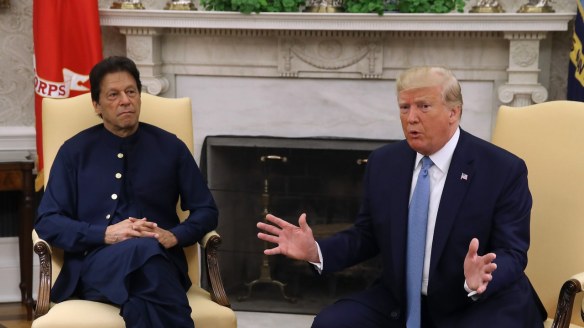
Donald Trump speaks to reporters during an Oval Office meeting with the military-backed Pakistani Prime Minister Imran Khan on July 22.

Brahma Chellaney, The Hindustan Times

The United States has quietly replaced its threat of sanctions against Pakistan with renewed engagement — and rewards. Desperate to finalize a “peace” deal with the brutal and thuggish Taliban, President Donald Trump is wooing its sponsor, Pakistan, to help the US “extricate ourselves” from Afghanistan. The courtship has been highlighted by a $6-billion International Monetary Fund (IMF) bailout for Islamabad, the US designation of the leading Baloch separatist group as “terrorist”, and Trump’s re-hyphenation of India with Pakistan, including offering to mediate the Kashmir conflict — the equivalent of a red rag to a bull.

Look at this paradox: The Taliban, despite countless attacks on US forces, are still absent from the US terrorism lists. Yet, to appease Pakistan and China (whose interests and citizens have been targeted), the US on July 2 listed the Baloch Liberation Army (BLA) as “terrorist” under Executive Order 13224. The action provides Pakistan international legitimacy to go after the group and step up its dirty war in Balochistan, even as it shields state-nurtured terrorist outfits.

By handing Pakistan a major diplomatic victory, BLA’s listing balances India’s gain from the earlier US-aided UN designation of the Pakistan-based Masood Azhar as a terrorist. Similarly, as if to balance its $10 million bounty on the India-sought Hafiz Saeed, America last year announced $11 million in reward money for information on three of Pakistan’s most-wanted men linked to Tehrik-e-Taliban Pakistan (TTP). It then assassinated TTP’s third consecutive chief, even as Saeed’s very public life continued.

Meanwhile, Trump, by hosting Pakistan’s Imran Khan at the White House, has bestowed legitimacy on a figure derisively called “selected prime minister”, a reference to how the military generals engineered his ascent to power. Indeed, Pakistan’s army chief and Inter-Services Intelligence head chaperoned Khan on his US visit and attended the White House meeting. Khan is one of the weakest PMs Pakistan has ever had. Almost servile in his fealty to the military, he has shown himself to be a willing puppet — more loyal than the king.

Pakistan, in the run-up to the White House meeting, made some seemingly right moves, including arresting Hafiz Saeed, agreeing to create the Kartarpur Corridor by November, and reopening its airspace to east-west overflights after more than 15 weeks — a closure that forced airlines to incur additional costs by taking detours but also cost a cash-strapped Pakistan $55 million in lost overflight fees. The new moves signal anything but behavioural change.

Take Pakistan’s revolving-door policy on Hafiz Saeed: Pakistan has enacted a catch-and-release drama eight times since 2001. Saeed will again be released once pressure on Pakistan eases. The real issue is not his detention but whether Saeed will be tried and convicted for international terrorism.

Make no mistake: America has ample leverage to reform Pakistan but is loath to exercise it. In contrast to Trump’s sanctions-heavy approach to Iran, preposterously labelled “the world’s leading state sponsor of terrorism”, he — like his predecessor — is relying on carrots to handle the real epicentre of global terror, his public threats notwithstanding. Trump’s suspension of security assistance to Pakistan and several other nations was intended to signal that there is no free lunch — much like his recent expulsion of India from the Generalized System of Preferences. Washington retains Pakistan as its “major non-NATO ally” and refuses to bring Pakistan’s military to account for exporting terrorism.

Hoping that Pakistan on its own would reform and be at peace with itself is akin to expecting a dog to straighten its tail. Coddling terrorists seems to be second nature for Pakistan’s generals. Refusing to bail out Pakistan’s economy could perhaps have yielded as good results as the use of military force. Instead the US, despite enjoying veto power over IMF decisions, has done the opposite. The IMF bailout actually opens billions of dollars more for Pakistan from other international lenders. And by freeing up Pakistani foreign exchange for debt repayments to Beijing, it also bails out China’s projects in Pakistan.

Narrow geopolitical interests guiding America’s Pakistan policy will likely continue to impose costs on India, as has been the case since the 1950s. Although US-India relations have been radically transformed, Washington’s engagement with Pakistan still gives it leverage it values over India. Significantly, the US-Pakistan relationship is on the mend just as Indo-US ties are being tested by Trump’s transactional approach, including punitively increased duties on 14.3% of India’s exports to America.

Another factor at play is Trump’s determination to pull out most US troops from Afghanistan before he seeks re-election. Under the US-initiated “peace” process, Trump is preparing to sell out democratic Afghanistan’s interests to the Pakistan-Taliban axis. India’s exclusion from this process is a blessing in disguise because India must stay away from the sellout, which will bring anything but peace. Indeed, Trump’s Faustian bargain with the Taliban will only embolden Pakistan’s military by proving that sponsoring cross-border terrorism pays.

Karl Marx famously said, “History repeats itself, first as tragedy, then as farce”. Nothing better validates that than America’s Pakistan policy.

Brahma Chellaney is a geostrategist.

© The Hindustan Times, 2019.

From Moon Walk to Space Wars

It is easy to get caught up in escalating strategic competition and conflict on Earth. But, 50 years after the Apollo 11 mission reached the Moon, guaranteeing the freedom to navigate the stars has become no less essential to global peace and security than safeguarding the freedom to navigate the seas.

Spacecraft In The Rays Of Sun. 3D Scene.

BRAHMA CHELLANEYProject Syndicate

Fifty years after astronauts first walked on the Moon, space wars have gone from Hollywood fantasy to looming threat. Not content with possessing enough nuclear weapons to wipe out all life on Earth many times over, major powers are rapidly militarizing space. Given the world’s increasing reliance on space-based assets, the risks are enormous.

As with the Cold War-era Space Race between the United States and the Soviet Union, the new global space race has an important symbolic dimension. And, given the lunar landing’s role in establishing US dominance in space, the Moon is a natural starting point for many of the countries now jostling for position there.

In January, China became the first country to land an unmanned robotic spacecraft on the far side of the Moon. India – which in 2014 became the first Asian country to reach Mars, three years after China’s own failed attempt to leave Earth’s orbit – is scheduled to launch an unmanned mission to the Moon’s uncharted south pole on July 22, a week after the first planned launch was called off at the last minute due to a helium fuel leak. Japan and even smaller countries like South Korea and Israel are also pursuing lunar missions.

But the US will not surrender its position easily. US President Donald Trump’s administration has vowed to “return American astronauts to the Moon within the next five years.” As US Vice President Mike Pence put it, “just as the United States was the first nation to reach the Moon in the 20th century,” it will be the first “to return astronauts to the Moon in the 21st century.”

This escalating space race is not just about bragging rights; countries are also making rapid progress on developing their military space capabilities. Some, like systems that can shoot down incoming ballistic missiles, are defensive. But others, such as anti-satellite (ASAT) weapons technologies that can target space assets, are offensive.

The ability to take advantage of such systems, while denying them to adversaries, is becoming central to military strategies. That is why Trump directed the US Department of Defense to establish the Space Force, an independent military branch that will undertake space-related missions and operations.

The US hopes that such a force can protect its “margin of dominance” in space. Before Patrick M. Shanahan resigned as acting defense secretary last month, he said that that margin is “quickly shrinking,” as newer powers become adept at militarizing commercial space technologies, including those first developed as part of civilian prestige projects. The most notable such powers are Russia and China.

China, which established an independent space force in 2016, is aiming for global leadership in space. And both China and Russia have demonstrated offensive space capabilities in the form of “experimental” satellites that can potentially aid military operations. According to a US Air Force report, the purpose of these countries’ orbiting offensive capabilities is to hold US space assets hostage in the event of conflict.

This highlights the tremendous vulnerability of these assets, and not just those belonging to the US. The existing space infrastructure comprises at least 1,880 satellites owned or operated by 45 countries. These assets support a wide range of activities, including telecommunications, navigation, financial-transaction authentication, connectivity, remote sensing, and weather forecasting. From a security perspective, they facilitate intelligence, surveillance, early warning, arms-control verification, and missile guidance, for example.

There is one more key player in this intensifying space race: India. In March, the country used a ballistic-missile interceptor to destroy one of its own satellites orbiting at nearly 30,000 kilometers (18,641 miles) per hour, making it the fourth power – after the US, Russia, and China – to shoot down an object in space. The test employed some of the same technologies the US used to shoot down an intercontinental ballistic missile in a test conducted just a couple of days before.

Unlike China’s 2007 demonstration of its ASAT capabilities – which left more than 3,000 pieces of debris in orbit – the Indian test faced no international criticism, largely because it was intended to blunt China’s edge in space-war capabilities. In fact, the head of US Strategic Command, General John E. Hyten, defended India’s test: Indians are “concerned about threats to their nation from space,” he said, and thus “feel they have to have a capability to defend themselves in space.”

This sounds a lot like the justification used to build today’s enormous nuclear arsenals, and we know where that logic leads. As with nuclear deterrence, countries continue to upgrade their offensive space capabilities, until “mutually assured destruction” becomes their best hope of protecting themselves and their assets.

Before that happens, international norms and laws must be strengthened. The 1967 Outer Space Treaty bans space-based weapons of mass destruction, but not other types of weapons or ASAT tests. A new treaty is needed to outlaw all use of force in space, with clearly delineated – and reliably enforced – consequences for violations. Likewise, norms for responsible behavior in space must be established, in order to deter ASAT weapons testing or other actions that endanger space assets.

It is easy to get caught up in the escalating strategic competition and conflict on Earth. Safeguarding, say, freedom of maritime navigation in places like the Persian Gulf and the South China Sea (where China continues to  the territorial status quo unilaterally) is vitally important. But guaranteeing the freedom to navigate the stars has become no less essential to global peace and security.

Arming without a clear strategic direction

republic-day_65e95afc-a14f-11e9-9ac0-125817c7848e

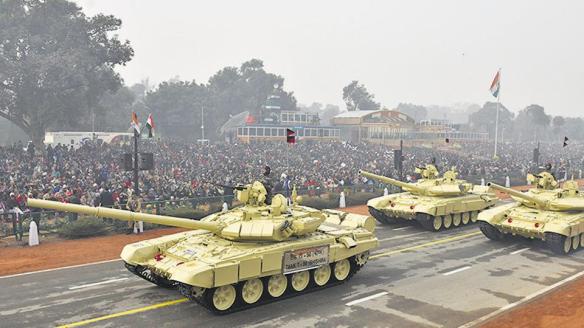
T-90 Bhishma tanks march down Rajpath in New Delhi during the Republic Day parade on January 26, 2016.

Brahma Chellaney, The Hindustan Times

India’s new national budget accentuates its stagnant defence spending. India’s defence spending figure of $46.3 billion contrasts starkly with China’s $177.5 billion, underscoring the yawning power gap between the two. Indeed, India’s defence budget is smaller than even China’s trade surplus with it, highlighting the extent to which India underwrites China’s hostile actions against it.

To be sure, national security has little relationship with the level of defence spending. Bigger military outlays do not mean greater security. What matters is how the money is spent to boost indigenous capabilities, deter adversaries and project power. As a relatively poor country, India must balance national security demands with pressing socioeconomic priorities.

The government has rightly sought to rein in defence spending. However, military modernization continues to lag due to stalled defence reforms, with two-thirds of the defence budget earmarked just for salaries and other day-to-day running costs. On top of that, pensions cost $16.4 billion, an amount not part of the defence budget. The Army’s spending on modernization, for example, has been a mere 14% of its budget.

Worse still, imports eat up the bulk of the modernization outlays. For many years, India has been one of the world’s top arms importers, spending billions of dollars yearly. Have such imports made India stronger and more secure?

The answer unequivocally is no. The imports, far from being part of a well-planned military build-up to make India regionally preeminent, have lacked a clear long-term direction. They have often been driven by the individual choices of the three services to meet pressing needs. In many cases, the imports have been influenced by foreign-policy and other non-military considerations. In fact, the initiative on some major systems came not from India but from selling countries.

India’s approach of importing conventional weapons without a clear strategic direction or forward planning is a recipe to keep the country perpetually import-dependent. Contrast the near-term considerations that often guide conventional-weapon imports with the strategic, long-term factors driving India’s nuclear, missile and anti-satellite capabilities. After Balakot, for example, India has rushed to buy stand-off weapons.

The paradox is that Narendra Modi, by launching the “Make in India” initiative in 2014, recognized the critical importance of industrial power for national security. And yet, little has changed significantly. In fact, the customs-duty waiver for arms imports in the latest budget not only confirms that Make in India has yet to take off but also promises to block domestic arms production from becoming competitive.

The threats India now confronts are largely unconventional in nature, yet it remains focused on importing conventional weapons. Without waging open war, regional adversaries are working to undermine India’s security, including disturbing the territorial status quo, mounting surrogate threats, sending in illicit arms, narcotics, terrorists or counterfeit Indian currency, and aiding Islamist or tribal militancy.

India, of course, needs to adequately arm itself for self-defense in an increasingly combustible region. But conventional weapons can scarcely be effective in countering unconventional or emerging threats, including from malware aimed at sabotaging power plants, energy pipelines and water supplies. Cyber warfare capabilities, underpinned by artificial intelligence, will be key for national security and future war-fighting. If India invested in this domain 10% of what it spends on importing arms, it could become a cyber superpower.

Make no mistake: No nation can build security largely through imports. Indeed, with its reliance on imported weapons, India can never be a power to contend with. In the past decade, India alone accounted for about 10% of global arms sales volumes. Yet its defensive mindset persists. Any imported platform or weapon makes India hostage to the supplier-nation for spares and service for years.

All the great powers are major arms exporters. Most of them view India as a cash cow. Arms imports actually corrupt the Indian democracy in unparalleled ways. The cancer of corruption caused by such imports has spread deep and wide. Even some journalists and “strategic analysts” have turned into salesmen for foreign vendors.

In fact, it is India’s dependence on arms imports — and their corrupting role — that are at the root of the Indian armed forces’ equipment shortages and the erosion in their combat capabilities. The more arms India imports, the more it lacks the capacity to decisively win a war. But where imports are not possible, as in the space, cyber, missile and nuclear realms, India’s indigenous capabilities are notable.

The capacity to defend oneself with one’s own resources is the first test a country must pass on the way to becoming a great power. India must think and act long term, spend its money wisely, ensure the success of Make in India and advance its capabilities in frontier areas — from space to missiles — where it already boasts impressive indigenous technologies.

Brahma Chellaney is a geostrategist.

© The Hindustan Times, 2019.