Asia Is the New Ground Zero for Islamist Terror

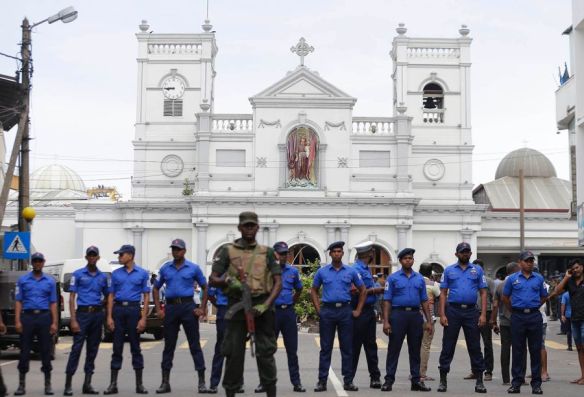
The murder of more than 250 churchgoers, tourists, and other civilians in Sri Lanka on Easter Sunday should serve as a reminder that Asia is now the world’s leading site of Islamist extremism. The region’s leaders must either address the problem at its source or prepare for more bloodshed in the coming years and decades.

2effebaa7dcd001375bd16feb8661d71.2-1-super.1

Brahma ChellaneyProject Syndicate

The Easter Sunday bombings in Sri Lanka rank among the deadliest terrorist attacks in modern history, and underscore the metastasizing scourge of Islamist violence in Asia. Radical Islamic groups, some affiliated with larger extremist networks, have been quietly gaining influence in an arc of countries extending from the Maldivian to the Philippine archipelagos, and the threat they pose can no longer be ignored.

In fact, the grisly Sri Lankan bombings are a reminder that Asia – not the Middle East – is the region most afflicted by terrorist violence. Home to the vast majority of the world’s Muslims, it is also host to multiple “terrorist safe havens,” owing to the rise of grassroots radical movements and years of complacency on the part of policymakers.

With a total of 253 people dead (and hundreds more wounded), the Sri Lanka bombings were five times deadlier than the March 15 massacre by a white supremacist at two mosques in Christchurch, New Zealand. The death toll is also higher than that of the 2008 Mumbai attacks, which involved ten Pakistan-based militants in one of the modern world’s longest-ever terrorist sieges.

By targeting international hotels and iconic churches, the Islamists behind the Sri Lankan blasts clearly intended to strike a blow against Sri Lanka’s fast-growing tourism industry, a mainstay of the country’s debt-ridden economy. Reduced tourism receipts will add to the burden of Sri Lanka’s high external interest payments, compounding a problem that has already forced the country to cede control of its strategic Indian Ocean port, Hambantota, to China (a signal achievement of the latter’s debt-trap diplomacy).

The attacks also mark the dawn of Islamist terrorism in Sri Lanka. Though suicide bombings were not uncommon during the country’s 26-year civil war, which pitted the ethnic Sinhalese majority against the minority Tamils, Sri Lanka has not previously experienced coordinated violence on this scale or a major attack by Islamist militants.

The civil war ended in 2009, when the Sri Lanka Army brutally crushed the last of the Tamil separatist rebels. But that outcome sowed the seeds of religious conflict between the country’s mainly Buddhist Sinhalese and a Muslim minority that constitutes one-tenth of the population.

Sri Lanka’s Muslim population is largely concentrated in the Eastern Province, where Saudi and other Gulf funding has fueled the rise of jihadist groups seeking to enforce sharia (Islamic law). The group suspected of carrying out the Easter bombings, the National Thowheed Jamaath, thrived in this setting. Like the similarly named outfit Sri Lanka Thawheed Jama’athand the rapidly growing Tamil Nadu Thoweed Jamath in southernmost India, its primary goal is to foment militant Islamic fundamentalism.

We now know that Indian intelligence had tipped off Sri Lankan security agencies about the Easter bombing plot, even identifying its alleged masterminds. Yet, owing to political infighting between Sri Lankan President Maithripala Sirisena and Prime Minister Ranil Wickremesinghe, the latter was kept in the dark. Accordingly, many are now blaming the failure on Sirisena, who oversees the security agencies (and who had previously attempted to remove Wickremesinghe in a constitutional coup, only to be overruled by the Supreme Court).

Though its extremist enclave in Syria and Iraq has crumbled and its leaders are on the run, the Islamic State (ISIS) has claimed responsibility for the bombings. Like al-Qaeda before it, ISIS wants to demonstrate its continued relevance by taking credit for attacks in areas where it has no presence. Most likely, the Sri Lanka attacks were not the direct work of ISIS. And yet they were inspired by the same toxic ideology espoused by ISIS: Wahhabi fanaticism.

Wahhabism, the austere, rigid version of Islam bankrolled by Saudi Arabia and other Gulf sheikhdoms, remains the driving force behind Islamist terrorism today. Its offspring include not just al-Qaeda and ISIS, but also the Taliban in Afghanistan, Lashkar-e-Taiba in Pakistan, Boko Haram in Nigeria, and al-Shabaab in Somalia. All of these groups are driven by a nihilistic rage born of hostility toward non-Sunnis and a rejection of modernity.

Unfortunately, as the Sri Lanka bombings and other attacks in Asia show, the defeat of ISIS in Syria and Iraq has only intensified the terrorism challenge, because battle-hardened fighters with the operational training to stage savage attacks are now returning home. The presence of such returnees in Sri Lanka explains how an obscure local group was able to carry out sophisticated, near-simultaneous strikes on three churches and three hotels, using military-grade explosives.

Returnees are present in many other Asian countries as well, from the Philippines and Indonesia to the Maldives and Uzbekistan. Like Osama bin Laden and other al-Qaeda leaders who cut their teeth in the US-backed war against the Soviet occupation of Afghanistan, this new generation of jihadist veterans could haunt the security of Asia, the Middle East, and the West for years to come.

To be sure, official discrimination against Muslims has contributed to Islamists’ growing influence, particularly in Myanmar’s Rakhine state, Thailand’s four southernmost provinces, and the southern Philippine island of Mindanao. But so have Saudi-funded madrasas (religious seminaries) and social-media platforms, which facilitate fundraising, recruitment, and dissemination of jihadist propaganda. Hence, jihadist violence has also come to threaten predominantly Muslim countries such as Indonesia, Malaysia, Bangladesh, and Kazakhstan. And in some cases – namely Pakistan – the state itself is abetting violent extremists.

If left unaddressed, this scourge could become the defining crisis of the century for Asian countries. To prevent that outcome, the fount of jihadist extremism – Wahhabi fanaticism – must be cut off. As the late Singaporean leader Lee Kuan Yew said, preventing terrorist attacks requires that we eliminate the “queen bees” (the preachers of hatred and violence) who are inspiring the “worker bees” (suicide bombers) to become martyrs. The global war on terror, launched by the United States after the attacks of September 11, 2001, is losing steam. Unless it is invigorated and prosecuted to the end, many more innocent lives will be lost.
© Project Syndicate, 2019.

Sri Lanka bombings carry a stark message for India

image (1)

Brahma Chellaney, The Hindustan Times

The Sri Lanka bombings — one of the world’s deadliest acts of terrorism — highlight the growing terrorist threat to democratic, secular states. Far from a concerted and sustained global war on terror, the anti-terrorism fight is being undermined by geopolitics. The global ideological movement fuelling terrorism is Wahhabi jihadism. Yet, the U.S.-ordered total ban on Iranian oil exports from May 3 will reward this jihadism’s main financiers.

Despite specific and detailed Indian intelligence warnings, Sri Lanka failed to avert the bombings, in large part because of a divided and dysfunctional government. However, in keeping with an international anti-terrorist practice, Sri Lanka was quick to detain the bombers’ family members for questioning once the suicide killers were identified. By contrast, the Pulwama bomber’s family members not only remained free but also gave media interviews rationalizing the suicide attack.

Sri Lanka has a blood-soaked history, but the scale and intensity of the latest attacks were unprecedented. The coordinated bombings, in less than 30 minutes, killed more people than the 2008 Mumbai terrorist siege, which lasted nearly four days. Actually, in terms of sophisticated methods and synchronized lethality, they were eerily similar to the 1993 serial bombings that targeted Mumbai landmarks. Jihadists have long used India as a laboratory: Major acts of terror first tried out in India and then replicated elsewhere include attacks on symbols of state authority, midair bombing of a commercial jetliner and coordinated strikes on a city transportation system.

The series of extraordinary steps Sri Lanka took after the bombings — blocking social media, imposing a daily dusk-to-dawn curfew, closing schools until April 29 and proclaiming an emergency law — may seem unthinkable in terrorism-scarred but rights-oriented India. But such measures were necessary to maintain control and to deter large-scale reprisal attacks against Muslims.

Ironically, in the days leading up to the Sri Lanka bombings, the 2008 Mumbai attacks were back in the news in India because of Bharatiya Janata Party candidate Pragya Thakur’s controversial comment on Hemant Karkare, the police officer gunned down in that siege. The irony of ironies is that those 26/11 attacks received more Indian attention this month than on their 10th anniversary five months ago. This underscores a troubling truth: Nothing draws the attention of Indians more than political controversy, however petty.

The Spanish-American philosopher George Santayana famously said, “Those who cannot remember the past are condemned to repeat it”. This is especially true of India, which — far from heeding the 26/11 lessons — doesn’t remember its martyrs. How many Indians know the name of Tukaram Omble, the “hero among heroes” of 26/11?  An ex-army soldier who became a police assistant sub-inspector, Omble — by ensuring terrorist Ajmal Kasab’s capture alive — provided the clinching evidence of Pakistan’s involvement in 26/11. Kasab was captured after the ambush killing of six cops, including Karkare and additional commissioner Ashok Kamte. Omble grabbed the barrel of Kasab’s AK-47 and took a volley of fired bullets, allowing others to seize Kasab.

All the 10 Pakistani terrorists involved in 26/11 wore red string wristbands for Hindus that Pakistani-American David Headley got for them from Mumbai’s Siddhivinayak Temple. But for Kasab’s capture (and confession) helping to indisputably establish Pakistan’s direct involvement, Pakistan’s wicked plan was to portray 26/11 as exemplifying the rise of Hindu terrorism by capitalizing on the then Manmohan Singh government’s classification of the 2006-07 blasts in Malegaon, Ajmer Sharif, Mecca Masjid and Samjhauta Express as “Hindu terror”.

Omble’s extraordinary bravery thus should never be forgotten. Nor the sacrifices of the other 26/11 martyrs awarded the Ashok Chakra — Sandeep Unnikrishnan, Gajender Singh, Vijay Salaskar, Karkare and Kamte. The 26/11 siege affected the national psyche more deeply than any other terrorist attack. Yet such is India’s lack of a sense of remembrance that it laid the Kartarpur Corridor’s cornerstone on the 10th anniversary of 26/11, with an oblivious Indian vice president calling it a “historic day”. The 26/11 perpetrator, Pakistan, couldn’t have received a better gift from India.

Moulvi-Zahran-Hashim-1

Suspected ringleader Zaharan Hashim

Make no mistake: The Sri Lanka attacks hold major implications for Indian security, in part because the main group behind the bombings, the National Thowheed Jamat (NTJ), is an ideological offspring of the rapidly growing, Saudi-funded Tamil Nadu Thowheed Jamat (TNTJ). The TNTJ, wedded to fanatical Wahhabism, rails against idolaters. It helped establish the Sri Lanka Thowheed Jamat, from which the bomber outfit NTJ emerged as a splinter.

Like the 2016 brutal Dhaka café attack, the Sri Lanka slaughter was carried out by educated Islamists from well-off families. And just as Bangladesh blamed Pakistan’s Inter-Services Intelligence (ISI) for the attack, the NTJ has ties with ISI’s front organization, Lashkar-e-Taiba, which, through its Sri Lanka operations, has sought links with the TNTJ in India. NTJ leader Zaharan Hashim was inspired by fugitive Indian preacher Zakir Naik’s sermons and received funds from Indian jihadists. It would be paradoxical if India, which tipped off Sri Lanka about the bombing plot, became a victim itself of Thowheed Jamat terror. First of all, it must outlaw the TNTJ.

Brahma Chellaney is a geostrategist.

© The Hindustan Times, 2019.

India’s elusive deterrence against Pakistani terror

In seeking to demonstrate resolve and strengthen deterrence, India ended up snatching defeat from the jaws of victory.

iaf

Brahma Chellaney, The Hindustan Times

Deterrence theorists have long underscored that a deterrent’s credibility is in the eye of the beholder — namely, is the target of deterrence (the potential aggressor) sufficiently convinced that the other side has both the capability and the will to act so as to make aggression not worth the risk? Whether a foe is deterred is thus a function of its understanding of the deterrer’s strengths and intentions.

Pakistan has waged a protracted proxy war by terror against the much-stronger India since the 1980s because it has repeatedly tested the will of successive Indian governments and found it wanting. No prime minister after Indira Gandhi has been willing to impose sufficient costs on Pakistan to dissuade it from continuing to inflict upon India death by a thousand cuts.

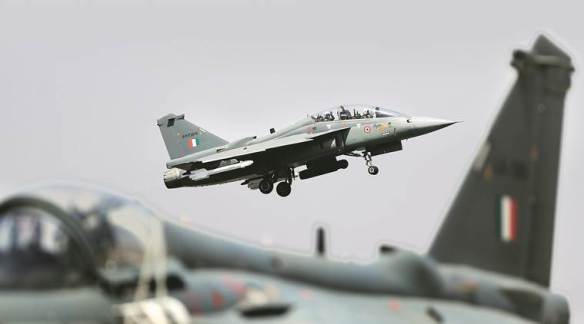
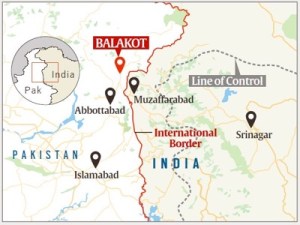
The February 26 Balakot airstrike was a potential game-changer. It revived bitter Pakistani memories of the 2011 US raid that killed Osama bin Laden. Even before India said a word, Pakistan admitted Indian warplanes struck at Balakot without being interdicted or challenged. That India struck a target in the Pakistani heartland with impunity was momentous. The extent of damage or the death toll was immaterial. However, boastful toll-related claims, starting with the foreign secretary’s statement that “a very large number” of terrorists were “eliminated”, generated partisan controversy that undercut the chilling message that the Indian Air Force (IAF) delivered to Pakistan’s terror masters — the military generals.

Worse still, India has allowed a defining moment to slip away by failing to retaliate against Pakistan’s aerial blitz. Pakistan’s military regards its terrorist surrogates as de facto special operations forces, employing them cost-effectively as a force multiplier against India. So, India’s contention that it struck a “non-military” target at Balakot did not wash with the Pakistani generals, who responded barely 30 hours later with a daring, daytime aerial onslaught, in which India lost a MiG-21 — and, in perhaps friendly fire, a Mi-17 helicopter.

Voltairenet-org_-_1-657-2fc4aThe F-16 downing issue has not only detracted from Balakot’s main message but also obscured the absence of Indian retribution for the Pakistani blitz. The IAF is sure its MiG-21 shot down an attacking F-16. What is remarkable is that a short, sketchy April 4 US news report, which quoted anonymous sources to claim a US inventory probe found none of Pakistan’s F-16s missing, attracted front-page Indian press coverage and was quickly seized upon by Prime Minister Narendra Modi’s critics at home and abroad — until the Pentagon said “we weren’t aware of any investigation like that”.
The intruding Pakistani warplanes brazenly tried to bomb Indian military sites. Although “no significant” damage was caused, according to the Indian military, Pakistan’s trans-border targeting of army formations opened a long-sought opportunity for the Indian armed forces to wreak massive punishment. Underscoring this opportunity is the fact that a near-bankrupt Pakistan cannot afford a military conflict. Indeed, such is Pakistan’s vulnerability to a punitive attack that, as this newspaper reported, only one Pakistani submarine currently is operational — that too partially.

Yet, India’s political leadership held back the armed forces from retaliating. New Delhi chose to defer to Washington’s assurances on Pakistan. Consequently, it was US President Donald Trump who signalled de-escalation, saying the tensions were “going to be coming to an end”. Hours after Trump’s announcement, an overcautious India finally allowed its armed forces to brief the media. But by then, parts of Pakistani propaganda had already taken hold internationally.

Modi has oddly relied on the ministry of external affairs to issue statements about a military crisis. Naturally, MEA has been out of its depth in that role, as was illustrated during the Doklam crisis, when India had no answer to China’s full-throttle information warfare. In the Balakot saga, MEA’s tardy, unforthcoming briefings ceded perception management to a mendacious Pakistani military, whose claim of downing two Indian warplanes dominated international news for days. Indeed, MEA’s February 26 statement inexcusably failed to identify where Balakot is located. This led the international media to wrongly assume it is in Pakistan-held Jammu and Kashmir and to spotlight the Kashmir dispute.

Despite Modi letting go the opportunity to wreak vengeance on Pakistan, the threshold-breaching Balakot strike after years of Indian inaction has helped sharpen his strong-leader image at election time. Pakistan, however, still fears Indian reprisals to its blitz, which explains why its airspace remains closed to most commercial overflights. It has reopened just one of its 11 airways for flights between Asia and Europe — that too a marginal route over Balochistan to Iran.

Meanwhile, international pressure on Pakistan to take verifiable actions to root out terrorist groups has started easing. The US lists North Korea, Iran, Sudan and Syria as “state sponsors of terrorism” but not the main sponsors — Pakistan and Saudi Arabia. Its latest action in designating Iran’s Islamic Revolutionary Guard Corps as “terrorist” but not the biggest terror-exporting force — Pakistan’s military — highlights the increasing politicization of the war on terror.

India, alas, has yet to build a reputation for resolve, which, as the social scientist and Nobel laureate Thomas Schelling wrote, is a prerequisite for deterrence. All the weapons India is frenetically importing can offer no effective deterrence in the absence of political will. India failed to capitalize on the Balakot strike to compel the Pakistani generals to start cleaning up their terror act. Far from imposing deterrent costs to prevent further terrorist attacks, India reinforced the Pakistani generals’ belief that its bark is worse than its bite. This is why the present lull is likely to prove only an interlude.

Brahma Chellaney is a geostrategist.

© The Hindustan Times, 2019.

Global Silence on China’s Gulag

Brahma Chellaney, an internationally syndicated column from Project Syndicate

In the absence of international censure, China has stepped up its systematic persecution of Muslims, under the dubious pretense that it is fighting “terrorism” and protecting its economic interests. But more than just an attack on human rights, the crackdown is representative of President Xi Jinping’s totalitarian ambitions.

p10-chellaney-a-20190410-870x570

For more than two years, China has waged a campaign of unparalleled repression against its Islamic minorities, incarcerating an estimated one-sixth of the adult Muslim population of the Xinjiang region at one point or another. Yet, with the exception of a recent tweet from US Secretary of State Mike Pompeo calling on China to “end its repression,” the international community has remained largely mute.

In its reliance on mass detention, the Communist Party of China (CPC) has followed the Soviet Union’s example. But China’s concentration camps and detention centers are far larger and more technologically advanced than their Soviet precursors; and their purpose is to indoctrinate not just political dissidents, but an entire community of faith.

Although independent researchers and human-rights groups have raised awareness of practices such as force-feeding Muslims alcohol and pork, the Chinese authorities have been able to continue their assault on Islam with impunity. Even as China’s security agencies pursue Uighurs and other Muslims as far afield as Turkey, Chinese leaders and companies involved in the persecution have not faced international sanctions or incurred any other costs.

Chief among the culprits, of course, is Chinese President Xi Jinping, who in 2014 ordered the policy change that set the stage for today’s repression of ethnic Uighurs, Kazakhs, Kyrgyz, Hui, and other Muslim groups. The forcible assimilation of Muslims into the country’s dominant Han culture is apparently a cornerstone of Xiism – or “Xi Jinping Thought” – the grand “ism” that Xi has introduced to overshadow the influence of Marxism and Maoism in China.

To oversee this large-scale deprogramming of Islamic identities, Xi, who has amassed more power than any Chinese leader since Mao Zedong, reassigned the notorious CPC enforcer Chen Quanguo from Tibet to Xinjiang and elevated him to the all-powerful Politburo. Though Chen’s record of overseeing human-rights abuses is well known, the Trump administration has yet to act on a bipartisan commission’s 2018 recommendation that he and other Chinese officials managing the gulag policy be sanctioned. In general, financial and trade interests, not to mention the threat of Chinese retribution, have deterred most countries from condemning China’s anti-Muslim policies.

With the exception of Turkey, even predominantly Muslim countries that were quick to condemn Myanmar for its treatment of Rohingya Muslims have remained conspicuously silent on China. While Pakistan’s military-backed prime minister, Imran Khan, has feigned ignorance about the Xinjiang crackdown, Saudi Arabia’s powerful crown prince, Mohammed bin Salman, has gone so far as to defend China’s right to police “terrorism.”

Emboldened by the muted international response, China has stepped up its drive to Sinicize Xinjiang by demolishing Muslim neighborhoods. In Urumqi and other cities, once-bustling Uighur districts have been replaced with heavily policed zones purged of Islamic culture.

9099340c-dd10-4392-80c6-8d7a1f90175eThe irony is that while China justifies its “reeducation hospitals” as necessary to cleanse Muslim minds at home of extremist thoughts, it is effectively supporting Islamist terrorism abroad. For example, China has repeatedly blocked UN sanctions against Masood Azhar, the head of the Pakistan-based, UN-designated terrorist group responsible for carrying out serial attacks in India, including on Parliament and, most recently, on a paramilitary police convoy. As Pompeo tweeted, “The world cannot afford China’s shameful hypocrisy toward Muslims. On one hand, China abuses more than a million Muslims at home, but on the other it protects violent Islamic terrorist groups from sanctions at the UN.”
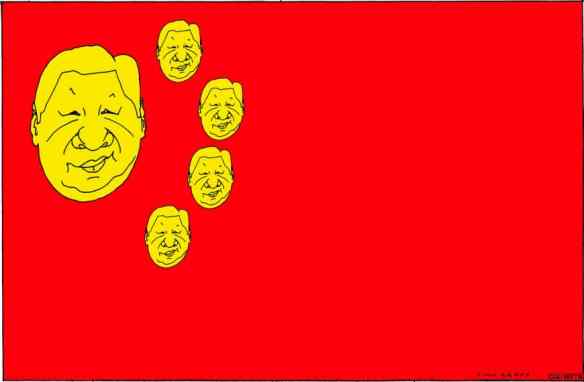
An added irony is that while China still harps on its “century of humiliation” at the hands of foreign imperial powers, it has for decades presided over the mass humiliation of minorities in Xinjiang and Tibet. Ominously, by systematically degrading Muslim populations, it could be inspiring white supremacists and other Islamaphobes around the world. For example, the Australian extremist arrested for the recent twin mosque massacres in Christchurch, New Zealand, declared an affinity for China’s political and social values.

There has been a good deal of reporting about how China has turned Xinjiang into a laboratory for Xi’s Orwellian surveillance ambitions. Less known is how Xi’s trillion-dollar “Belt and Road Initiative” is being used as a catalyst for the crackdown. According to Chinese authorities, the establishment of a surveillance state is necessary to prevent unrest in the province at the heart of the BRI’s overland route.

Like Marxism-Leninism, Nazism, Stalinism, and Maoism, which left millions of people dead, Xiism promises to impose significant long-term costs on untold numbers of innocent people. It is the impetus behind China’s ruthless targeting of minority cultures and communities, as well as its aggressive expansion into international waters and introduction of digital totalitarianism.

Thanks to Xiism, the world’s largest, strongest, and oldest autocracy finds itself at a crossroads. As the People’s Republic of China approaches its 70th birthday, its economy is slowing amid escalating capital flight, trade disruptions, and the emigration of wealthy Chinese. The Chinese technology champion Huawei’s international travails augur difficult times ahead.

The last thing China needs right now is more enemies. Yet Xi has used his unbridled power to expand China’s global footprint and lay bare his imperial ambitions. His repression of Muslim minorities may or may not lead to international action against China. But it will almost certainly spawn a new generation of Islamist terrorists, compounding China’s internal-security challenges. China’s domestic security budget is already larger than its bloated defense budget, which makes it second only to the United States in terms of military spending. The Soviet Union once held the same position – until it collapsed.

© Project Syndicate, 2019.

Why Tibet matters ever more in India-China ties

57921181

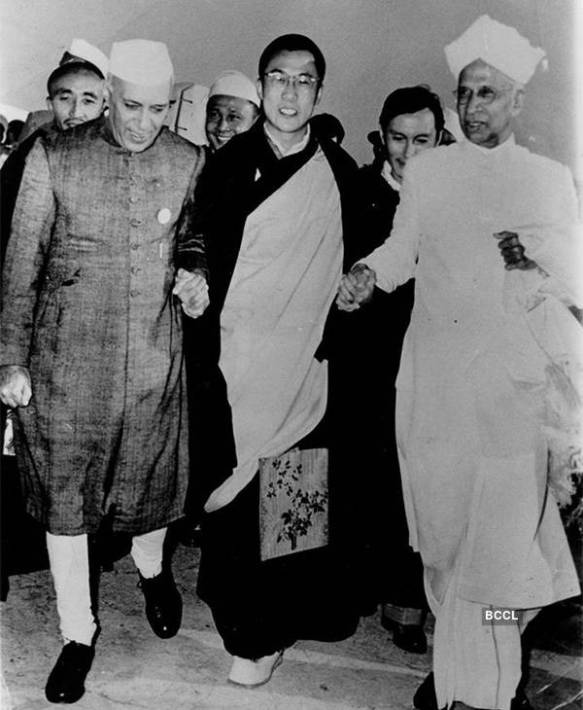
The Dalai Lama, after escaping to India in 1959, meets Indian Prime Minister Jawaharlal Nehru and President Sarvepalli Radhakrishnan (right). 

If Tibet is at the heart of the China-India divide, water is at the centre of the Tibet-India bond.

Brahma Chellaney, The Hindustan Times

Wars in space are not just Hollywood fiction but an emerging reality for defence planners. India’s successful “kill” with an anti-satellite (ASAT) weapon is a major milestone in its quest for effective deterrence. Without developing ASAT capability, India risked encouraging China to go after Indian space assets early in a conflict.

The test is meant as a warning shot across China’s bow for another reason: ASAT capability serves as a basic building block of a ballistic missile defence system, which can shoot down incoming missiles. The development thus holds implications also for China’s “all-weather” strategic ally, Pakistan, which maintains a nuclear first-use doctrine against India.

In this light, it is unconscionable that the development of India’s satellite-kill technologies was held up by Prime Minister Manmohan Singh’s government, which, as top scientists have said, refused to give the go-ahead. In the Indian system, no one is held to account, even for compromising national security.

India’s ASAT test should not obscure the fact that March 31 marked the 60th anniversary of the Dalai Lama’s entry into India after a gruelling two-week journey through his Chinese-occupied homeland. Dressed as a Chinese soldier, he escaped from his military-besieged Norbulinka Palace in Lhasa. He entered India as tens of thousands died in China’s brutal suppression of an uprising against its occupation of Tibet.

Today, Tibet remains at the centre of the India-China divide, fuelling territorial disputes, diplomatic tensions and riparian feuds. Indeed, the fall of Tibet represented the most far-reaching geopolitical development in modern India’s history. It gave China borders with India, Bhutan and Nepal for the first time, and opened the path to a Sino-Pakistan strategic axis. The impact has been exacerbated by serial Indian blunders.

When the Dalai Lama fled his homeland, India was the only country to have diplomatic representation in Tibet. In fact, India controlled Tibet’s postal, telegraph and telephone services and had military personnel at Yatung and Gyantse before it ceded those rights under the infamous Panchsheel Agreement of 1954.

Indeed, no sooner had Mao Zedong’s regime annexed the historical buffer of Tibet than New Delhi voluntarily began forfeiting all its extraterritorial rights and privileges there. In 1952, it replaced the 16-year-old Indian Mission in Lhasa (which maintained direct relations with Tibet) with a new consulate-general accredited to China. Nineteen months later, the Panchsheel accord gave its imprimatur to the “Tibet Region of China”, without Beijing’s recognition of the then existing Indo-Tibetan border. After China invaded India in 1962, it shut the Indian consulate in Lhasa.

Tibet enjoyed close transportation, trade and cultural links with India throughout history. But with Tibet now locked behind a Chinese “iron curtain”, the formerly integrated economies and cultures of the entire Himalayan region have broken apart.

In recent years, China has turned the resource-rich but ecologically fragile Tibetan Plateau into the centre of its mining and dam-building activities. The environmental crisis haunting the plateau threatens India’s ecological well-being. This is illustrated by the still turbid waters of the once-pristine Siang, the main artery of the Brahmaputra river system.

The more India has aligned its Tibet stance with China’s position, the more Beijing has upped the ante, including seeking to reengineer trans-boundary river flows, on which India is critically dependent. Beijing began calling Arunachal Pradesh “South Tibet” only after the then Prime Minister Atal Bihari Vajpayee in 2003 formally recognized Tibet as part of China.

Today, despite the ASAT test, India’s China policy seems adrift. The Dalai Lama is a strategic asset for India, yet current Indian policy doesn’t reflect that. Indeed, according to a leaked advisory, New Delhi changed course early last year to shun official relations with the Dalai Lama and other exiled Tibetan leaders — a shift that won Beijing’s tacit appreciation.

Prime Minister Narendra Modi’s first attempt in 2014 to “reset” ties with China boomeranged spectacularly. Undeterred, Modi persisted, even as China furtively expanded its military footprint in Doklam. The Wuhan summit represented Modi’s Reset 2.0. For China, however, Wuhan served as a cover to kill two birds with one stone. While encouraging Modi’s overtures to help instil greater Indian caution to openly challenge China, Beijing has embarked on a major border-force buildup. On Modi’s watch, Chinese exports have flooded India, with Beijing more than doubling its bilateral trade surplus.

Meanwhile, Tibet’s shadow over India-China relations is becoming longer. Beijing is waiting to install a marionette as the Dalai Lama’s successor. China’s increasing militarization of Tibet directly impinges on Indian security. Its punitive denial of hydrological data to India in 2017 was an early warning of the water card it is fashioning. If Tibet is at the heart of the China-India divide, water is at the centre of the Tibet-India bond.

To help curb China’s territorial and riparian revisionism, India must subtly reopen Tibet as an outstanding issue. By recalibrating its Tibet policy, India could elevate Tibet as a broader strategic and environmental issue that impinges on international security and climatic and hydrological stability. More than ASAT and other weapons, India needs political will and clarity to deter China.

Brahma Chellaney is a geostrategist.

© The Hindustan Times, 2019.