China ensnares vulnerable states in a debt trap

Easy loans are used to secure influence and grab control of strategic assets

20180219_china-Djibouti-ship_article_main_image

A ship departs a port in Zhanjiang, China, in July 2017 for Djibouti to dispatch members of the People’s Liberation Army to man a military base there. © Xinhua

Brahma Chellaney, Nikkei Asian Review

“There are two ways to conquer and enslave a country,” American statesman John Adams (U.S. president from 1797 to 1801) famously said. “One is by the sword. The other is by debt.”

China has chosen the second path. Aggressively employing economic tools to advance its strategic interests, Beijing has extended huge loans to financially-weak states and ensnared some in debt traps that greatly strengthen its leverage.

After establishing a growing presence in the South China Sea, Beijing seems increasingly determined to extend its influence in the Indian Ocean, not least in countries surrounding India, its regional strategic rival.

From Djibouti in Africa to the Indian Ocean island of Sri Lanka, China has converted big credits into political influence and even a military presence.

Now a political crisis in the Maldives has highlighted the fact that China has quietly acquired several islets in the heavily-indebted Indian Ocean archipelago.

Mohamed Nasheed, the nation’s first and only democratically elected president who was ousted at gunpoint, says the country cannot repay the $1.5bn-$2bn it owes China, equivalent to 80% of the total foreign debt. “Without firing a single shot, China has grabbed more land” in the Maldives than what Britain’s “East India Company did at the height of the 19th century.”

Among the unpopulated Maldivian islands China has acquired on lease are Feydhoo Finolhu, lying close to the capital Male and previously used for police training, and the seven-kilometer-long Kalhufahalufushi, with a magnificent reef. For Feydhoo Finolhu, it paid $4 million, which is what a luxury apartment in Hong Kong sells for; Kalhufahalufushi was even cheaper.

China is the only country to come out in support of Maldives’ embattled authoritarian president, Abdulla Yameen, who came to power in 2013. Beijing has also issued an open threat against India, which has traditionally been the dominant foreign influence in the Maldives since the islands were granted independence from Britain. Chinese state-controlled media has warned that if India militarily intervenes in the Maldives, Beijing won’t “sit idly by” but will “take action to stop” it.

To be sure, China claims sound commercial grounds for acquiring its Maldivian islands. But across the Indian Ocean, port projects that China insisted were purely commercial have acquired military dimensions.

After lending billions of dollars to Djibouti, China last year established its first overseas military base in that tiny but strategically important state, located on the northwestern edge of the Indian Ocean. In Pakistan, Beijing has deployed its warships for the security of the Chinese-built Gwadar port, whilst seeking to establish a military base nearby.

Beijing’s creditor diplomacy scored a major success in December when Sri Lanka formally handed over its strategically located Hambantota port to China under a 99-year lease valued at $1.12 billion. Earlier, after Sri Lanka’s $500-million, largely Chinese-owned Colombo Port container terminal opened in 2014, Chinese submarines arrived quietly and docked there.

Further east in Myanmar, there are concerns in India and the West that Kyauk Pyu, a deep-water port to be developed and financed largely by China, could eventually also serve military purposes.

In the Maldives, Beijing has shown interest in turning an uninhabited island into a naval base by cutting through the surrounding coral reefs to create passageways for its warships. Or it could create an artificial island and militarize it, as it has done in the South China Sea.

Underscoring Beijing’s strategic calculations, three Chinese frigates visited the Maldives about six months ago, docking in Male and at Girifushi Island and imparting special training to Maldivian troops.

Meanwhile, China’s stepped-up naval presence in the Indian Ocean in recent weeks might be intended to send a message to India, including seeking to deter it from militarily intervening in the Maldives, as New Delhi did with Western backing in 1988, when Indian paratroopers foiled a coup attempt. The action reinforced India’s claim to be the region’s peacekeeper.

The current ruler, Yameen, has facilitated China’s island acquisitions in his country by amending the constitution in 2015 to legalize foreign ownership of land. The amendment appeared tailored for China; the new rules for foreign ownership require a minimum $1 billion construction project that involves reclaiming at least 70% of the desired land from the ocean.

By also awarding Beijing major Chinese-financed infrastructure contracts, Yameen is saddling the Maldives with mounting debt that is likely to prove unserviceable.

Several countries that have fallen into, or risk slipping into, debt servitude to China are India’s immediate neighbors, including Bangladesh, the Maldives, Myanmar, Nepal, Pakistan and Sri Lanka. This holds major foreign-policy implications for India, which is seeing its influence erode in its backyard. By establishing a Djibouti-type naval base in the Maldives, China could open an Indian Ocean front against India in the same quiet way that it opened the trans-Himalayan threat under Mao Zedong by gobbling up Tibet, the historical buffer.

China’s strategy in southern Asia and beyond is aimed at fashioning a Sinosphere of trade, communication, transportation and security links. By financially shackling smaller states through projects it funds and builds, it is crimping their decision-making autonomy in a way that helps bring them within its strategic orbit. It is even replicating some of the practices that were used against it during the European-colonial period when, in the words of the Chinese nationalist revolutionary leader Sun Yat-sen, “India was the favored wife of Britain while China was the common prostitute of all powers.” One such practice is the long-term lease, an echo of the 99-year-lease through which 19th-century Britain secured control of the New Territories, expanding Hong Kong’s landmass by 90%.

The International Monetary Fund has warned that Chinese loans, offered at rates as high as 7 percent, are promoting unsustainable debt burdens. The price that such loans exact can extend to national sovereignty and self-respect. The handover of Hambantota was seen in Sri Lanka as the equivalent of a heavily indebted farmer giving away his daughter to the cruel money lender.

In Pakistan, Chinese state companies have secured energy contracts on terms that include ownership of the plants and 16% guaranteed yearly returns, very high by global standards. The “economic corridor” that China seems intent on building across Pakistan has become a vehicle for a deep Chinese penetration of the Pakistani state, with most of the investment going into energy, agricultural and security projects often unrelated to a corridor.

Against this background, the word “predatory” is increasingly being used internationally about China’s practices. U.S. Secretary of State Rex Tillerson has called China a “new imperialist power” whose practices are “reminiscent of European colonialism.”

Mao said, “Political power grows out of the barrel of a gun.” But with China emerging as the first major power in modern history without real allies, an additional principle is guiding its policy: buying friendship by opening a fat wallet. China is co-opting states into its sphere of influence by burying them in debt.

Brahma Chellaney is a geostrategist and the author of nine books, including the award-winning “Water, Peace, and War.”

© Nikkei Asian Review, 2018.

India’s Choice in the Maldives

72c3405b293d7d1dbbdc7e24438ace91.2-1-super.1

As the political situation in the Maldives deteriorates, peace and security in the Indian Ocean is increasingly in jeopardy. With China seeking to capitalize on its support for the authoritarian president, Abdulla Yameen, to expand its influence in the region, the crisis has become a defining moment for India.

BRAHMA CHELLANEY, Project Syndicate

The Maldives – that beautiful Indian Ocean country comprising more than 1,000 coral islands – is known the world over as a tranquil and luxurious travel destination. But the country is now being roiled by a political crisis so severe that international advisories are cautioning against travel there.

The rule of law in the Maldives has been steadily deteriorating ever since President Abdulla Yameen came to power in 2013. The situation escalated sharply earlier this month, when Yameen refused to comply with the Supreme Court’s unanimous order quashing the convictions, which he had engineered, of nine opposition figures – including the exiled former president, Mohamed Nasheed – on terrorism charges. Instead of freeing those whose sentences were nullified, Yameen declared a state of emergency and jailed two of the Supreme Court’s five judges, including the chief justice.

To be sure, authoritarianism is not new to the Maldives. Indeed, Nasheed is the only democratically elected, non-autocratic president the country has had since it gained independence from Britain in 1965. His tenure lasted just over three years, until, in 2012, he was forced at gunpoint to resign.

But the Maldives’ sordid politics is having an increasingly far-reaching impact, not least because it is closely linked to radical Islam. On the day Nasheed was overthrown, Islamists ransacked the Maldives’ main museum, smashing priceless Buddhist and Hindu statues and erasing all evidence of the country’s pre-Islamic roots. On a per capita basis, the Maldives has sent the highest number of foreign fighters to support terrorist groups in Syria and Iraq.

Moreover, the Maldives sits astride critical shipping lanes in the Indian Ocean, making it vital to security in the region. As a result, the country’s deteriorating political conditions are increasingly capturing the international community’s attention. Democratic powers, from the United States to India, are calling upon the United Nations to intervene in the crisis, while China, seeking to advance its own interests in the Indian Ocean, is defending the graft-tainted Yameen.

The increasingly close relationship between China and the Maldives represents a significant shift from the past, when India was the country’s primary regional partner. Maldivians are mainly of Indian and Sri Lankan origin, and have strong cultural and economic ties to those countries. Their country has traditionally been viewed as part of India’s sphere of influence.

But, in recent years, China has been eroding India’s influence in the Maldives, as part of its effort to build its “string of pearls”: a chain of military installations and economic projects aimed at projecting Chinese power in the Indian Ocean. Just as China recently secured the Sri Lankan port of Hambantota on a 99-year lease, it has, according to Nasheed, quietly acquired 17 islands in the heavily indebted Maldives for investment purposes.

But, betraying its strategic objectives, China has also sent warships to visit the Maldives. If China, which has stepped up military pressure on India along their Himalayan frontier, turned one of the Maldivian islands into a naval base, it would effectively open a maritime front against India – a milestone in China’s strategic encirclement of its neighbor.

The Maldivian crisis thus is a defining moment for India. Will India intervene militarily, as Nasheed and other Maldivian opposition leaders have requested, or will it allow Yameen to continue to enable China to pursue its strategic objectives in the region?

There is some precedent for an Indian military intervention in the Maldives. In 1988, India snuffed out a coup attempt against the autocratic Maumoon Abdul Gayoom engineered by a Maldivian businessman with the aid of armed mercenaries, especially Sri Lankan Tamil separatists. Thanks to India’s swift military action, Gayoom would hold onto power for another two decades.

Yet when the country’s first and only democratically elected president beseeched India in 2012 to rescue him from the Islamist forces laying siege to his office, India looked the other way. India’s government felt betrayed by Nasheed’s own burgeoning relationship with China. Not only had Nasheed awarded China its first infrastructure contracts; just three months before his ouster, he had inaugurated the new Chinese embassy in the capital, Malé, on the same day that India’s then-prime minister, Manmohan Singh, arrived for a regional summit.

Today, an Indian intervention could be dicey, not least because no legitimate authority is inviting India to send in forces. Indian paratroopers could gain effective control of Malé within a few hours. But what would the endgame be? Amid rising Islamist influence and shifting political allegiances among the handful of powerful families that dominate the Maldives’ economy and politics, finding reliable allies committed to – much less capable of – protecting democratic freedoms would prove a daunting challenge.

Moreover, even if Yameen were ousted and the country held a democratic election, it is unlikely that China’s influence could be contained. As the experiences of Bangladesh, Myanmar, Nepal, and Sri Lanka illustrate, China has outmaneuvered India diplomatically, even when dealing with democratically elected governments. Indeed, it did so in the Maldives itself, with Nasheed. Because the country’s debt will continue to rise, regardless of its leadership, China will retain its favorite source of leverage.

India, with its proximity and historical ties to the Maldives, may seem to hold a strong hand. But it has a lot to lose if it aggravates an already volatile political situation in its maritime backyard by intervening militarily.

India’s best option is to hold out a credible threat of military action, while imposing, together with other democratic powers, economic sanctions that undercut support for Yameen among the Maldivian elite, many of whom own the luxury resorts that now have far too many empty rooms. With them on side, perhaps the international community would be able to ensure that the presidential election scheduled for later this year is fair and inclusive – and supervised by the UN. That is the only way to end the crisis, and restore peace to an Indian Ocean paradise.

Brahma ChellaneyBrahma Chellaney, Professor of Strategic Studies at the New Delhi-based Center for Policy Research and Fellow at the Robert Bosch Academy in Berlin, is the author of nine books, including Asian JuggernautWater: Asia’s New Battleground, and Water, Peace, and War: Confronting the Global Water Crisis.
© Project Syndicate, 2018.

The Maldives: The moment of truth

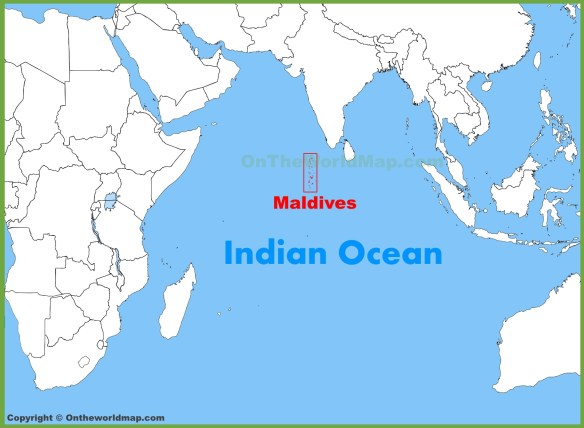
maldives-location-on-the-indian-ocean-map

Brahma Chellaney, The Hindustan Times

China, the sole defender of the Maldives’ embattled autocrat, Abdulla Yameen, has issued an open threat through a state mouthpiece: If India militarily intervenes in the Maldives, Beijing won’t “sit idly by” but will “take action to stop” it. This essentially is an empty threat because China has no credible capability to sustain a military operation far from its shores. Despite China’s rising naval power, taking on India in its own maritime backyard will be a fool’s errand.

India could call China’s bluff through quick military action that deposes Yameen and installs the jailed Supreme Court chief justice as the interim president to oversee fair elections under UN supervision. In truth, an Indian intervention is not on the cards, in part because such action would trample on the principles India has long championed.

India has carefully weighed all the factors and resolved not to intervene at present in the vicious politics of the increasingly radicalized Maldives. If the crisis there were to escalate to civil war-like conditions, with street clashes erupting in the capital Malé, where two-fifths of the nation’s total population lives, India could, of course, intervene in the name of “responsibility to protect”, the moral principle NATO invoked to counterproductively overthrow Libya’s Muammar Gaddafi.

India had a narrow window of opportunity to intervene immediately after Yameen declared a state of emergency and jailed many, including his elderly half-brother, Maumoon Abdul Gayoom, whose dictatorship lasted three decades largely because Indian paratroopers in 1988 salvaged his presidency from coup plotters who seized control of much of Malé. Before Yameen fell out with Gayoom, he actually ran a family dictatorship, with Gayoom’s daughter his foreign minister.

Beijing’s threat at this stage is not only Doklam-style psychological warfare against India but, more importantly, also an effort to curry favour with the internationally isolated Yameen. By claiming to shield him from India’s potential action, China wants to expand its strategic footprint in the Maldives, where it has already acquired several of the country’s 1,190 atolls for projects. The Maldives’ first and only democratically elected president, Mohamed Nasheed, who was ousted at gunpoint by Gayoom’s pro-Islamist cronies, claims China’s “land grab” has netted 17 islets.

While India has wisely refrained from any precipitous action in response to Yameen’s unbridled lurch toward authoritarianism, it faces a pressing foreign-policy challenge extending beyond the Maldivian crisis. Make no mistake: India’s rapidly eroding influence in its strategic backyard holds far-reaching implications for its security, underscoring the imperative for a more dynamic, forward-looking strategy. India’s inaction and missteps have aided China’s aggressive diplomacy, with Chinese clout increasingly on display even in countries symbiotically tied to India, such as Nepal, Sri Lanka and the Maldives. With Beijing seeking to establish a Djibouti-type naval base in the Maldives, China is opening an oceanic threat against India in the same quiet way that it opened the trans-Himalayan threat under Mao Zedong.

On the Maldives, India’s moment of truth came not with the latest emergency proclamation but in February 2012 when Nasheed made desperate phone calls to Prime Minister Manmohan Singh pleading for an Indian intervention against the Islamists besieging his office. Nasheed, however, had roiled New Delhi with his overtures to Beijing, including personally inaugurating the newly established Chinese Embassy on the day Singh arrived in Malé for a SAARC summit. India’s refusal to take a long-term strategic view and prevent Nasheed’s overthrow has had important consequences, including empowering the Islamists and ceding more space to China. Just months after Nasheed’s ouster, the Maldives expropriated its main international airport from India’s GMR Infrastructure.

In recent years, an emboldened Maldives has increasingly acted against India’s strategic interests with impunity. Six months ago, it sent New Delhi a chilling message by welcoming three Chinese frigates, which docked in Malé and Girifushi Island and imparted special training to Maldivian troops. Yameen amended the Constitution in 2015 to legalize foreign ownership of land in a way tailored for China, requiring a minimal $1-billion construction project that reclaims at least 70% of the desired land from the ocean. New Delhi’s carrots-only approach also encouraged Yameen more recently to sign a free-trade agreement with China that seems designed to use the Maldives as a conduit for the flow of Chinese goods to the Indian market.

India must now start wielding the stick. With other democratic powers, it should impose punishing sanctions. However, the right powers to militarily intervene in the Maldives are the U.S. and Britain because, unlike India, they have little to lose and democracy promotion is a legitimate foreign-policy plank for them. China’s growing presence in the Indian Ocean threatens not just India’s security but also the Diego Garcia-centred Anglo-American naval pre-eminence in the region.

Brahma Chellaney is a geostrategist and author.

© The Hindustan Times, 2018.