

Rohingya militancy poses a regional threat

p1686472-main

A screen shot from a video released on 15 August 2017, showing a top commander of the terrorist group, the Arakan Rohingya Salvation Army (ARSA), and four of his followers.

BY 

In Myanmar, one of the world’s most diverse, multiethnic nations, there is a rare consensus — the much-persecuted Rohingya Muslims are outsiders and not part of the country. A military operation to flush out Rohingya militants waging a hit-and-run campaign has led to an exodus of Rohingya residents from Rakhine state, creating a refugee crisis for Bangladesh and, to a smaller extent, India.

India, over the years, has generously admitted asylum seekers or refugees from a host of places, including Tibet, Afghanistan, Iran, Pakistan, Sri Lanka, Myanmar and China. But the illegal entry of tens of thousands of Rohingya is seen in India as an internal security challenge, in part because of the threat the Indian government perceives from Rohingya jihadist activities. Rohingya militants have a long history of violent jihadism, including recent attacks on non-Muslim civilians in Rakhine state.

The current international narrative on the Rohingya plight has actually failed to recognize the roots of the present crisis. Contrary to the perception that the Rohingya militancy has arisen from military repression in recent years, Myanmar’s jihad scourge is decades old, with Rohingya Islamist violence beginning even before Myanmar gained independence in 1948.

Rohingya militants have actually been in the vanguard of the global rise of Islamic radicalism since the early 1940s, when they joined the campaign to press the British to establish Pakistan by partitioning India. It was the British who more than a century ago moved large numbers of Rohingya from East Bengal to work on rubber and tea plantations in Burma, now Myanmar, which was administered as a province of India until 1937 before it became a separate, self-governing colony. Rohingya migrants settled mainly in Myanmar’s East Bengal-bordering Arakan region (now renamed Rakhine state).

It was the advance of the Imperial Japanese Army into Myanmar during World War II that first highlighted the country’s Rohingya problem. Communal hatred spilled into violence as the Japanese military swept into Arakan in 1942 and the British launched a counter-offensive, with the local Buddhists largely siding with the Japanese and the Rohingya with the British.

Britain recruited Rohingya Muslims into its guerrilla force — the “V” Force — to ambush and kill Japanese troops. When the British eventually regained control of Arakan in 1945, they rewarded Rohingya Muslims for their loyalty by appointing them to the main posts in the local government.

Emboldened by the open British support, Rohingya militants set out to settle old scores with the Buddhists. And in July 1946, they formed the North Arakan Muslim League to seek the Muslim-dominated northern Arakan’s secession from Myanmar. In the religious bloodletting that preceded and followed the 1947 partition of India, Rohingya attacks sought to drive out the Buddhists from northern Arakan as part of the militants’ campaign to join East Pakistan (which became Bangladesh in 1971).

Failure to join East Pakistan turned many Rohingyas to armed jihadism, with mujaheddin forces in 1948 gaining effective control of northern Arakan. Government forces suppressed the revolt only in the early 1950s, although intermittent mujaheddin attacks continued even subsequently until the early 1960s.

From the 1970s onward, Rohingya Islamist movements reemerged, with a series of insurgent groups rising and fading away. The aim of the groups was to establish an Islamist state within a Buddhist state through jihad and demographic change.

Now history has come full circle, with the Myanmar military being accused of driving the Rohingya out of Rakhine state. But in a development that carries ominous security implications for the region, especially Myanmar, India and Bangladesh, Rakhine is becoming a magnet for the global jihadist movement, with Rohingya radicals increasingly being aided by militant organizations in Saudi Arabia and Pakistan.

The new breed of Rohingya insurgents is suspected of having links with Islamic State, Lashkar-e-Taiba, al-Qaida and even Pakistan’s Inter-Services Intelligence agency. After the 2012 deadly communal riots in Rakhine, Ata Ullah, the Pakistani who heads the Rohingya terrorist group, the well-oiled Arakan Rohingya Salvation Army, reportedly returned to Pakistan from an extended stay in Saudi Arabia with millions of dollars to wage jihad against Myanmar.

Against this background, India is concerned about the illegal entry of over 40,000 Rohingya since 2012. The government has told the country’s Supreme Court that their arrival poses a “serious security threat” because of Rohingya militants’ links with terrorist outfits. Some Rohingya militants have become active even in India, according to the government.

What is particularly striking is the organized manner in which the Rohingya sneaked into India from multiple routes and then settled across the length and breadth of the country, including in communally sensitive places like Kashmir and Hyderabad. Rohingya settlements have come up even in New Delhi. Because they entered India unlawfully, the Rohingya are classified as illegal aliens, not refugees.

Normally those fleeing a conflict-torn zone tend to camp just across an international border. But the Rohingya entered India not through the long border the country shares with Myanmar but via a third nation, Bangladesh. After having crossed over into India, many Rohingya then dispersed from the Bangladesh-bordering West Bengal and Tripura states to different parts of the country. Large numbers of these arrivals, according to the government, have fraudulently obtained Indian identity cards, thus reinforcing security concerns.

In fact, the Rohingya have approached India’s Supreme Court against their possible deportation. Because they entered from Bangladesh, they can be deported only to that country, not to Myanmar. However, the Indian government has made no attempt thus far to deport any Rohingya.

India is already home to some 20 million illegal migrants from Bangladesh, a figure that is nearly double the number of Mexican immigrants — legal and illegal — living in the United States. But while the presence of the Mexican aliens is a hot political and judicial issue in the U.S., political correctness has inhibited any debate in India for years on how to deal with the illegal Bangladeshi settlers. The United Nations has described the influx of Bangladeshis into India as “the single largest bilateral stock of international migrants” in the eastern hemisphere.

A crowded India is in no mood to accommodate more illegal aliens. The specter of the Rohingya contributing to violent Islamism in India has made them feel unwelcome.

More broadly, the external forces fomenting jihadist attacks in Rakhine state bear considerable responsibility for the current plight of the Rohingya. It is ironic that the Islamic nations aiding jihad in Rakhine and slamming Myanmar are unwilling to give refuge to any of the fleeing Rohingya.

Brahma Chellaney is a geostrategist and the author of nine books.
© The Japan Times, 2017.

Abe propels a potential constellation of democracies

p7-chellaney-a-20171117-870x726
BY , The Japan Times

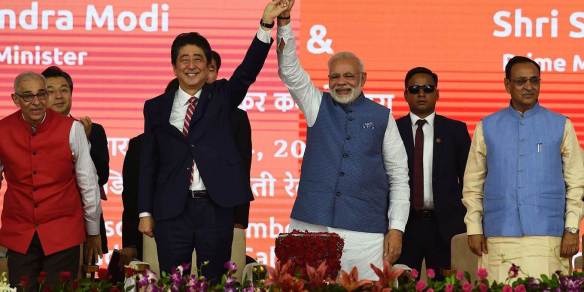
With the specter of a destabilizing power imbalance looming large in the world’s most dynamic region, the Indo-Pacific, the imperative to establish what Prime Minister Shinzo Abe once called a “democratic security diamond” has prompted Australia, India, Japan and the United States to renew efforts toward a strategic constellation of democracies.

Close strategic collaboration among key democracies can help institute power stability and contain the challenges that threaten to disrupt stability and impede economic growth in the Indo-Pacific, a region marked by the confluence of the Indian and Pacific oceans. At the core of a potential constellation of democracies is the strategic quadrilateral of Australia, India, Japan and the U.S.

On the sidelines of the East Asia Summit in Manila, U.S. President Donald Trump, Indian Prime Minister Narendra Modi, Australian Prime Minister Malcolm Turnbull and Abe held bilateral and trilateral meetings between themselves. Diplomatic officials from the four countries also held a joint meeting there to examine “ways to achieve common goals and address common challenges in the region,” with the quadrilateral partners agreeing to defend the rules-based order, according to the U.S. State Department.

Let’s be clear: The alternative to a liberal, inclusive, rules-based order is an illiberal, hegemonic order with Chinese characteristics. Few would like to live in such an order.

Yet this is precisely what the Indo-Pacific region might get if regional states do not work to counter the growing challenge to the rules-based order. China has prospered under the present order. But having accumulated economic and military power, it is now challenging that order, including by flouting established rules and norms on territorial, maritime and trade issues.

Before the Manila summit, U.S. Secretary of State Rex Tillerson pitched for a concert of democracies. “The world’s center of gravity is shifting to the heart of the Indo-Pacific,” a development that demands “greater engagement and cooperation” among democratic powers, Tillerson said in his first Asia-Pacific policy speech since taking office.

To succeed, such an endeavor must reckon with certain realities, including by drawing lessons from the failed effort a decade ago to sustain the exploratory Quadrilateral Initiative. After the “quad” held its inaugural meeting in May 2007, Beijing was quick to cry foul and see the apparition of an “Asian NATO.” Through intense diplomatic and economic pressure, Beijing sought to unravel the quad. Ultimately, it succeeded.

Australia appeared ill at ease in the quad, given that its economic boom was tied to China’s commodity imports. America’s support to the quad was less than unreserved, in light of its economic co-dependency with China. India was tacitly supportive of the quad but hesitant to do anything openly that could instigate China to step up direct or surrogate military pressure on it.

That left Japan as the only enthusiastic quad member. Indeed, the quad idea was conceived by Abe in his book “Utsukushii Kuni-e” (“Toward A Beautiful Country”), which was published before he became prime minister for the first time in 2006.

Eventually, the Kevin Rudd government in Australia pulled the rug from under the quad in a vain attempt to appease Beijing. With his visiting Chinese counterpart by his side, then-Foreign Minister Stephen Smith said, “I indicated when I was in Japan that Australia would not be proposing to have a dialogue of that nature” and labeled the inaugural quad meeting as “a one-off” affair.

Did the quad’s disbanding help change China’s behavior in a positive direction? Actually China’s behavior changed for the worse. Had the quad members stood up to the Chinese pressure, China would likely have had less space to strategically alter the status quo in the South China Sea in its favor. China’s success in extending its control in the South China Sea by artificially creating seven islands and militarizing them has only emboldened its aggressive designs in the Himalayas and the East China Sea.

The lost decade since the first quad experiment means that democratic powers cannot afford to fail again. They need to come together through meaningful collaboration and coordination because no single power on its own has been able to stop China’s territorial and maritime creep or rein in its increasingly muscular approach.

To be sure, a democratic coalition is unlikely to take the shape of a formal alliance. A loose coalition of democracies can draw strength from the concept of democratic peace, which holds special relevance for the region. Shared values and interests are likely to drive democratic powers to promote maritime security, stability, connectivity, freedom of navigation, respect for international law and the peaceful settlement of disputes in the region.

Democratic powers must proceed slowly but surely, without unduly publicizing their meetings or intentions, in view of their failed experiment a decade ago and the current geopolitical challenges that are largely centered on China.

Japan and India, facing direct Chinese military pressure, have a much greater interest in the formation of a concert of democracies than the geographically distant U.S. and Australia.

An ongoing political crisis in Australia could trigger an election early next year, potentially bringing to power the opposition Labor Party, which seemingly favors a China-friendly foreign policy. Turnbull’s job approval rating has hit a new low. Having caused the collapse of the first quad experiment, Australia is the weak link in the reconstituted quad.

Meanwhile, the praise Trump lavished on China and its neo-Leninist dictator, Xi Jinping, during his recent Beijing visit raises the question whether he fully shares Tillerson’s Indo-Pacific vision. Despite his praise and flattery, Trump failed to secure any important Chinese concession. In fact, his visit, far from highlighting U.S. leadership, unwittingly spotlighted China’s strength and power to potentially shape a post-American order in the Asia-Pacific region.

To be sure, the success of the reconstituted quad hinges on the U.S. being fully on board. Of course, major Asia-Pacific powers will continue to seek opportunities to balance against China, with or without the U.S. being on board. Two recent examples from the region — the revival of the quad and the movement toward concluding a final Trans-Pacific Partnership agreement among the 11 remaining members — indicate a clear determination to block the emergence of a China-led future.

Still, the absence of a joint statement after the Nov. 12 quad meeting in Manila underscores the challenge the nascent initiative faces. Each quad member-state issued its own statement.

The resurrected quad — the result of Abe’s diplomatic doggedness — is intended to serve as an initial framework to promote a four-way security dialogue and set in motion a web of interlocking partnerships among an expanding group of democracies.

Given that contrasting political values have become the main geopolitical dividing line in the Asia-Pacific region, establishing a community of values can help underpin regional stability and power equilibrium. Such a community can also ensure that China’s defiant unilateralism is no longer cost-free.

The plain fact is that the Indo-Pacific democracies are natural allies. The Japan-U.S.-India-Australia strategic trapezium is best placed to lead the effort to build freedom, prosperity and stability in the Indo-Pacific region and to make sure that liberalism prevails over illiberalism.

Brahma Chellaney is a geostrategist and the author of nine books.
© The Japan Times, 2017.

Asia-Pacific democracies’ new entente

816bd9a41245d46c0ac6be8a809023ff.2-1-super.1

Just as Germany’s rapid ascent prior to WWI spurred a “triple entente” among France, Russia, and the UK, China’s increasingly aggressive behavior is creating strong impetus for the Asia-Pacific democracies to build a more powerful strategic coalition. This goal should become the centerpiece of these countries’ regional policies.

Project Syndicate

PERTH – US President Donald Trump toured Asia at a moment when the region’s security situation was practically white-hot. US Secretary of State Rex Tillerson, recognizing that the world’s “center of gravity is shifting to the heart of the Indo-Pacific,” called on the region’s democratic powers to pursue “greater engagement and cooperation.” They – including Trump’s US – should heed that call. In fact, only an alliance of democracies can ensure the emergence of a strong rules-based order and a stable balance of power in the world’s most economically dynamic region.

In recent years, as Tillerson acknowledged, China has taken “provocative actions,” such as in the South China Sea, that challenge international law and norms. And this behavior is set to continue, if not escalate. Last month’s 19th National Congress of the Communist Party of China effectively crowned President Xi Jinping – who has spearheaded a more muscular foreign policy, in service of his goal of establishing China as a global superpower – as the country’s emperor.

Just as Germany’s rapid ascent prior to World War I spurred a “triple entente” among France, Russia, and the United Kingdom, China’s increasingly assertive behavior is creating strong impetus for the Asia-Pacific democracies to build a more powerful coalition. After all, as recent experience in the South China Sea has made clear, no single power can impose sufficient costs on China for its maritime and territorial revisionism, much less compel Chinese leaders to change course.

This is not to say that no country has been able to challenge China. Just this summer, India stood up to its muscle-flexing neighbor in a ten-week border standoff. China has been using construction projects to change the status quo on the remote Himalayan plateau of Doklam, just as it has so often done in the South China Sea. India intervened, stalling China’s building activity. Had US President Barack Obama’s administration shown similar resolve in the South China Sea, perhaps China would not now be in possession of seven militarized artificial islands there.

In any case, securing a broader shift in China’s foreign policy and stabilizing the Asia-Pacific region’s power dynamics will require more than one country holding the line on any one issue. A US that is willing to employ new tools, a more confident Japan and India, and an Australia vexed by China’s meddling in its domestic affairs must work together to constrain Chinese behavior.

The good news is that an entente has already begun to emerge among the region’s key democracies. America’s relationship with India, in particular, has been undergoing what Tillerson called a “profound transformation,” as the two countries become “increasingly global partners with growing strategic convergence.” The US now holds more joint defense exercises with India than with any other country. Such cooperation puts the two countries in a strong position to fulfill Tillerson’s vision of serving “as the eastern and western beacons of the Indo-Pacific.”

Engagement with Japan, too, has deepened. This year’s Malabar exercise – an annual naval exercise in the Indian Ocean involving the US, India, and Japan – was the largest and most complex since it began a quarter-century ago. Focused on destroying enemy submarines, it involved more than 7,000 personnel from the US alone, and featured for the first time aircraft carriers from all three navies: America’s nuclear-powered USS Nimitz, Japan’s Izumo helicopter carrier, and India’s aircraft carrier INS Vikramaditya.

As Tillerson pointed out, this trilateral engagement among the US, India, and Japan is already bringing important benefits. But “there is room to invite others, including Australia, to build on the shared objectives and initiatives.”

So far, Australia has sought to avoid having to choose between its security ally, the US, and its main economic partner, China. Despite Defense Minister Marise Payne’s recent declaration that “Australia is very interested in a quadrilateral engagement with India, Japan, and the United States,” the government seems to be hedging its bets. For example, while it sought this year to rejoin the Malabar exercise – from which it withdrew a decade ago to appease China – it sought to do so only as an “observer.”

This approach is untenable. If Australia is to free itself of Chinese meddling, it will need to go beyond implementing new domestic safeguards to take a more active role in defending rules and norms beyond its borders, both on land and at sea.

In the coming years, the Indo-Pacific power balance will be determined, first and foremost, by events in the Indian Ocean and East Asia. Containing China will therefore require, first, efforts to restrict the country’s maritime activities – such as measures to safeguard vital sea lines and build maritime domain awareness – and, second, geo-economic initiatives to counter China’s coercive leverage over smaller countries. All of Asia’s democratic powers must be on board.

Calls by the US for closer cooperation bode well for this process, though the US still needs to focus more on the globally ascendant and aggressive China than on a declining Russia. The overwhelming victory of Japanese Prime Minister Shinzo Abe – who has touted the idea of establishing a “democratic security diamond” in the Asia-Pacific – in his country’s recent general election is also likely to help to drive cooperation forward.

To be sure, any entente among Asian democracies is unlikely to take the shape of a formal alliance. Rather, the objective should be for democratic powers to reach a broad strategic understanding, based on shared values. It is those values, after all, that set them apart: as Tillerson recognized, while Trump’s upcoming visit to Beijing will undoubtedly draw much global attention, the US cannot have the kind of relationship with non-democratic China that it can have with a major democracy.

By pursuing cooperation, the Indo-Pacific’s democratic powers can shore up an inclusive, rules-based order that underpins peace, prosperity, stability, and freedom of navigation in the region. That is the only way to thwart China’s effort to establish itself as the hegemon of an illiberal regional order.

Brahma Chellaney

Brahma Chellaney, Professor of Strategic Studies at the New Delhi-based Center for Policy Research and Fellow at the Robert Bosch Academy in Berlin, is the author of nine books, including Asian JuggernautWater: Asia’s New Battleground, and Water, Peace, and War: Confronting the Global Water Crisis.

© Project Syndicate, 2017.