China Reveals How it Wages Psychological Warfare

The Sino-Indian troop standoff has underscored the centrality of propaganda in China’s foreign policy.

5a52d1ce-7040-11e7-9a9a-a7d2083b6658_1280x720_170533

A Chinese government handout photo of a live-fire military exercise in Tibet. The photo was released amid rising border tensions with India. It later came to light that the military exercise was conducted before the crisis began.

By , The Japan Times

Since a Sino-Indian troop standoff began at the border where Tibet, Bhutan and the Indian state of Sikkim meet, China’s warmongering has become so raucous and coarse that, to the casual observer, a Himalayan military conflict may seem imminent. In reality, Beijing is waging — in Chinese strategic tradition — full-throttle psychological warfare to compel India to back down without a shot being fired.

The current crisis, more significantly, has underscored the centrality of propaganda in China’s foreign policy — from the aggressor playing the victim to unremitting efforts to camouflage its intrusion into tiny Bhutan that precipitated the standoff. China’s vitriolic war rhetoric and unrealistic preconditions for holding talks stand out in stark contrast to India’s measured response and emphasis on diplomacy and dialogue to peacefully resolve the standoff. The U.S. has implicitly supported India’s stance by similarly calling for a dialogue to peacefully end the crisis.

The crisis, in fact, has highlighted how China blends psychological warfare (“psywar”), media warfare and the manipulation of legal arguments (“lawfare”) to undermine the opponent’s information-control capabilities and to buttress its strategic game plan. Disinformation and deceit are among the tools China is employing in its psywar to tame India without military combat, in Sun Tzu style.

Its psychological operations (psy-ops) have included mounting almost daily threats to teach India a lesson, unless it gives in. Indeed, the authoritarian regime in Beijing has shown itself adept at exploiting the political divisions in the world’s largest democracy, including reaching out to Indian Prime Minister Narendra Modi’s opponents and attacking his “Hindu nationalism” in order to help sow dissensions in India on its current China approach.

Given China’s rise as a praetorian state, its foreign ministry is probably the weakest government branch; yet that ministry has taken the lead to intimidate India in unbecoming and undiplomatic language. Beijing is also using its state media to threaten an “all out confrontation” along the entire, more than 4,000-kilometer-long Sino-Indian border and to warn India that it would suffer a humiliating rout greater than it did in the 1962 war. One Chinese state mouthpiece even called the Indian foreign minister a liar.

In the current crisis, the Chinese state and its media have worked in tandem to feed disinformation as part of the psy-ops. After all, media organizations, backed by an annual $10 billion budget from the state, have become integral to China’s global propaganda offensive. Chinese propaganda is getting smarter and more targeted, with some in the Indian media lapping up the disinformation, yet Beijing’s mendacity is becoming conspicuous.

Consider two examples. In mid-July, the Chinese state broadcaster CCTV telecast a video of live-fire military exercises in Tibet by a mountain brigade deployed against India. It later came to light that this was a routine annual drill conducted in early June before the crisis began. Shortly after the CCTV report, the Chinese military’s official newspaper, PLA Daily, said tens of thousands of tons of military hardware had been moved to Tibet in response to the troop standoff. This report too turned out to be part of China’s psywar, with Indian intelligence still finding no evidence of a Chinese military buildup in Tibet.

In this light, what can China hope to achieve through its psy-ops? India has a lot at stake: If it were to wilt under the Chinese pressure, it would impair its national security and potentially open the path to its long-term strategic subordination to China. In addition, China would be able to mount a stronger military threat against India’s hold on its far northeast.

India is a raucous democracy with poor public relations and media outreach. Yet China’s psywar has failed to obscure even the key facts, let alone achieve any political objective.

The crisis, which offers important insights to other countries on China’s psychological-warfare practices, was triggered in mid-June after days of growing local military tensions when People’s Liberation Army troops sought to unilaterally change the territorial status quo by beginning work on a strategic highway through Bhutan’s Doklam Plateau, which is located very close to the Tibet-Bhutan-Sikkim trijunction. (China contends that Doklam is its own territory in the way it claims the Japanese-controlled Senkaku Islands or the sprawling northeastern Indian state of Arunachal Pradesh.) The Chinese encroachment prompted the Indian army to swiftly intervene and halt the road construction, triggering the standoff.

The PLA has for years been quietly chipping away at strategic areas in Bhutan’s north and west. It has also waged an aggression by stealth to assert its claim over the Doklam Plateau, including by increasingly sending Tibetan herdsmen and armed patrols there and by turning some natural paths into small paved roads. Bhutan has long complained of Chinese encroachments. For example, it told its Parliament in 2009 that it had “protested many times to the Chinese regarding the road-construction activities.”

Bhutan, with just 8,000 men in its military, police and militia, has no means to resist Chinese encroachments. Its security partner, India, was previously loath to go beyond training and advising Bhutanese forces. But with China’s latest land grab also threatening Indian security, New Delhi decided that Bhutan’s fight was India’s fight. In a strategic miscalculation that has fueled its current fury, China anticipated Bhutan’s diplomatic protest over its latest road construction but not India’s rapid military intervention.

New Delhi cannot allow Beijing to gain control of Doklam because it will result in China fortifying its military positions around the border trijunction and bringing India’s territorial link with its northeastern states within Chinese artillery range. This link — the Siliguri Corridor — is just 27 kilometers wide at its narrowest point and is aptly known as the “Chicken Neck.” If China built the highway through Doklam, it would be able to transport heavy tanks to the trijunction and, in the event of a war, seek to implement its military plan to cut off mainland India from northeast India.

The risk that a frustrated China could escalate its current psy-ops to a military conflict cannot be discounted. Indeed, Beijing is signaling that it will brook no Indian “interference” in Bhutan’s external relations or national security, although Indo-Bhutanese relations are governed by a friendship treaty and defense arrangements. It wants India to leave Bhutan to its fate.

More fundamentally, China’s intrusion into Bhutan and its war rhetoric against India raise important larger issues. One issue is China’s disregard of international law, including the bilateral accords it has signed with Bhutan and India pledging not to alter the status quo unilaterally. As the South and East China seas also illustrate, Beijing signs agreements and treaties but does not comply with them.

Another issue is China’s abiding faith in propaganda, extending from fake history claims to other countries’ territories to disinformation operations intended to deceive and outmaneuver opponents. The reliance on propaganda blurs the line between fact and fiction to such an extent that, gradually, the Chinese state begins to believe its own propaganda and act upon it. This factor, along with its associated risks, is apparent in the Doklam standoff.

Brahma Chellaney is a geostrategist and the author of nine books, including “Water, Peace, and War” (Rowman & Littlefield).
© The Japan Times, 2017.

Turn the tables on China

China’s strategy is to subdue India by attacking its weak points and stymieing its rise to the extent possible.

china_dragon

Brahma Chellaney, The Hindustan Times, July 22, 2017

The current troop standoff with China at Doklam offers India important lessons that go far beyond the Chinese intrusion into this Bhutanese plateau. Unless India grasps the long-term threat posed by an increasingly muscular China and responds with an appropriate counter-strategy, it is sure to confront much bigger problems than Doklam. Unfortunately, institutional memory in India tends to be short, with a mindset of immediacy blurring the bigger picture.

For example, Jammu and Kashmir Chief Minister Mehbooba Mufti’s recent statement that China is “meddling” in her state was seen as signifying a new trend. In truth, China — occupying a fifth of the original princely state of J&K and now enlarging its strategic footprint in Pakistan-occupied J&K — has long been playing the Kashmir card against India. In 2010 it honed that card by aggressively adopting a stapled-visa policy for J&K residents.

To mount pressure, Beijing has tacitly questioned India’s sovereignty over the 45% of J&K under Indian control and officially shortened the length of the Himalayan border it shares with India by purging the 1,597-kilometre line separating Indian J&K from Chinese-held J&K. China’s Kashmir interference will only increase as a result of its so-called economic corridor through Pakistan-held J&K, where Chinese military presence is growing, including near Pakistan’s ceasefire line with India. India now faces Chinese troops on both flanks of its portion of J&K.

China, which fomented the Naga and Mizo insurgencies, taught its “all weather” client Pakistan how to wage proxy war against India. China still fans flames in India’s northeast. For example, Paresh Barua, the long-time fugitive commander-in-chief of ULFA, has been traced to Ruili, in China’s Yunnan province. Some other Indian insurgent leaders have been ensconced in Myanmar’s Yunnan-bordering region controlled by the China-backed Kachin Independence Army. This newspaper reported in 2015 that Chinese intelligence played “an active role” in assisting nine northeast Indian insurgent groups to form a united front. The illicit flow of Chinese arms to India, including to Maoists, was confirmed by Home Secretary G.K. Pillai in 2010. Meanwhile, the deepening China-Pakistan nexus presents India with a two-front theatre in the event of a war with either country.

China’s strategy is to subdue India by attacking its weak points, striking where it is unprepared, and stymieing its rise to the extent possible. As part of this strategy, it is waging a multipronged unconventional war without firing a single shot. It is closing in on India from multiple flanks, extending from Nepal to the Indian Ocean.

Sixty-six years after gobbling up buffer Tibet and mounting a Himalayan threat, China — with the world’s fastest-growing submarine fleet — is opening a threat from the seas against India. Its recently opened naval base in Djibouti, at the Indian Ocean’s north-western edge, constitutes just a first step in its game plan to dominate the region. For India, whose energy and strategic infrastructure is concentrated along a vulnerable, 7,600-kilometre coastline, this represents a tectonic shift in its threat calculus.

Add to the picture China’s economic warfare to undermine India’s strength in various ways, including stifling its manufacturing capability through large-scale dumping of goods. Artificially low prices of Chinese products also translate into India losing billions of dollars yearly in customs duties and tax revenue. Portentously, China, including Hong Kong, made up 22% of India’s imports in 2015, with the US just at 5% and Japan at 2%.

Yet India has yet to fully shed its policy blinkers. As India repeats the same old platitudes about conciliation and cooperation, China is making clear that there cannot be “two Suns in the sky” — or, as a Chinese idiom goes, “one mountain cannot accommodate two tigers”. With its rekindled, atavistic nationalism, China plainly wants to be Asia’s sole tiger.

Beijing is currently waging full-throttle psychological warfare over Doklam to tame India. Deception and mendacity are its tools. If India gives in, it will endure strategic subordination and ignominy forever. Foreign Minister Sushma Swaraj’s excellent rebuttal in Parliament of Chinese disinformation begs the question: Why has India been so slow in countering Beijing’s propaganda war?

New Delhi must play psychological hardball: Instead of appearing zealous for talks, it should insist that China first withdraw both its troops and preconditions, while leaving Beijing in no doubt that India will hold its ground, come what may. If India is to stop China’s creeping, covert encroachments and secure Himalayan peace, it must be ready to give Beijing a real bloody nose if it escalates the standoff to a conflict. Humiliating China even in a localized military engagement, in 1967 style, is vital to help destabilize its expansionist regime.

Brahma Chellaney is a geostrategist and author.

© The Hindustan Times, 2017.

China’s Bhutan land grab aims at bigger target

Beijing employs stealth aggression in territorial expansion

My map of Himalayan territorial disputes (NAR)

Brahma Chellaney, Nikkei Asian Review

China honed its “salami slicing” strategy in the Himalayan borderlands with India in the 1950s, when it grabbed the Switzerland-sized Aksai Chin plateau by surreptitiously building a strategic highway through that unguarded region. Aksai Chin, part of the original princely state of Jammu and Kashmir, has since provided China with the only passageway between its rebellious regions of Tibet and Xinjiang.

Now, the attempt by the People’s Liberation Army to replicate its seizure of Aksai Chin by building a military road through the Doklam plateau of tiny Bhutan has triggered one of the most serious troop standoffs in years between China and India, which is a guarantor of Bhutanese security.

The standoff involving hundreds of PLA and Indian troops, near where the borders of Tibet, Bhutan and India’s Sikkim state meet, has successfully halted the Chinese construction of the highway in Doklam, which Beijing claims as a “traditional pasture for Tibetans.” This is similar to Beijing’s claims in the South and East China seas, which are based on “traditional fishing grounds for Chinese.” The Indian intervention has triggered a furious reaction from China, which is warning India almost daily to back down or face reprisals, including a possible war. India has mobilized up to 10,000 troops for any contingency.

The Chinese defense ministry has warned India to learn the “historical lessons” from the major military reversals it suffered in 1962 when China carried out a surprise trans-Himalayan invasion just when the U.S. and the Soviet Union were locked in the Cuban missile crisis. Beijing has also stepped up diplomatic pressure on New Delhi, with the Chinese foreign ministry insisting that the “precondition for any meaningful dialogue” would be for Indian troops to “unconditionally” pull back from Doklam.

Beijing’s full-throttle campaign against India amounts to psychological warfare, from mounting daily threats to staging military drills in Tibet. For example, a recent “full combat readiness” exercise with tanks was aimed at delivering a clear warning to New Delhi, according to Chinese state media. However, the more China threatens India and the more it refuses to seek a compromise, the more it paints itself in a corner.

Beijing has no good options in emerging as a winner from this confrontation. Given the geography, military logistics, weapon deployments and the entrenched Indian positions, the PLA will find it hard to give India a bloody nose and seize Doklam. If it were to attack, it could suffer a setback. Just as Beijing’s intense propaganda war against India over the Dalai Lama’s April tour to the Chinese-claimed northeastern Indian state of Arunachal Pradesh achieved nothing, China risks losing face over the current troop standoff.

The central issue that China has sought to disguise is its intrusion into tiny Bhutan, which has less than 800,000 people. To cause a distraction, Beijing, in keeping with ancient military theorist Sun Tzu’s concept of strategic deception, has tried to shift the focus to India through a public relations blitzkrieg that presents China as the victim and India as the aggressor. Just as it has touted historical claims to much of the South China Sea, which have been dismissed by an international arbitral tribunal as groundless, Beijing contends that Doklam (or “Donglang” as China calls it) has belonged to it “since ancient times.”

Beijing’s dire warning

Besides launching a flurry of official denunciations of India, China has employed the state media in the psychological warfare campaign. “We firmly believe that the face-off in the Donglang area will end up with the Indian troops in retreat. The Indian military can choose to return to its territory with dignity or be kicked out of the area by Chinese soldiers,” China’s nationalist tabloid Global Times said on July 5. “This time we must teach New Delhi a bitter lesson.”

An article on the PLA’s English-language website, China Military Online, has warned that “if a solution isn’t reached through diplomatic or military communication or the issue isn’t handled properly, another armed conflict … is not completely out of the question.”

Despite the Indian army’s prompt actions to protect Bhutan’s territorial interests, the standoff has exposed some of India’s institutional weaknesses. In combating disinformation in war or peace, time is of the essence. Yet it took New Delhi more than four days to issue its first statement in response to China’s verbal attacks against India’s move to protect Bhutan, its longstanding strategic ally. The result was that after Beijing revealed the days-old troop standoff just hours before the June 26 meeting between Indian Prime Minister Narendra Modi and U.S. President Donald Trump at the White House, the Indian media was awash with Chinese propaganda, reporting only Beijing’s line on the standoff.

The current crisis has shown that New Delhi is ill-prepared to counter China’s grandstanding tactics. India’s response to the continuing barrage of hostile Chinese statements against it has been confined to a single statement issued by its foreign ministry on June 30. This is partly to do with India’s intrinsically defensive strategic mindset, including a reluctance to employ its natural economic leverage to rein in Chinese belligerence.

Since China has an almost $60 billion annual trade surplus with India currently, New Delhi has an opportunity to emulate Beijing’s use of trade as a political instrument in punishing South Korea, Mongolia, the Philippines, Japan and others. The flood of Chinese goods entering India is overwhelming. The lopsided trade balance not only rewards China’s strategic hostility but also foots the bill for its strategy of encircling India. Beijing thus has little incentive to moderate its behavior or avoid belligerence.

India also appears reluctant to reopen the Tibet issue, even though China is laying claim to Indian and Bhutanese territories on the basis of alleged Tibetan (not Han Chinese) historical links to these areas. Like Doklam, China claims Arunachal Pradesh, a territory almost three times larger than Taiwan that is famous for its virgin forests and soaring mountain ranges. To help curb such territorial revisionism, India needs to question China’s claim to Tibet itself.

Tibet, autonomous until China annexed it in 1951, enjoyed close historical transportation, trade and cultural links with India, exemplified by the fact that the main Tibetan cities are located close to the Indian border. But with Tibet now locked behind a Chinese “iron curtain,” the formerly integrated economies and cultures of the entire Himalayan region have broken apart.

Expansion drive

Modern China has come a long way since the Great Wall denoted the limits of the Han empire’s political frontiers, as during the Ming dynasty (1368-1644). Territorially, Han power is now at its zenith. With the exception of Mongolia, China is seeking to expand its frontiers beyond the conquests made by the Manchu Qing dynasty in the 17th and 18th centuries. By relying on stealth aggression in which no bullets or missiles need to be fired, China has mastered the art of creeping, covert warfare, as is apparent in the Himalayas and the South and East China seas. “Only vast lands can cradle great powers,” according to Chinese geographers Du Debin and Ma Yahua.

Recent events have offered clear evidence on how China uses history to justify its territorial ambitions. In the same week that it dusted off an 1890 colonial-era accord on the Tibet-Sikkim border to use in its propaganda war against India, even though the agreement was irrelevant to its intrusion into Bhutan, it mocked as worthless the legally binding 1984 pact with Britain that paved the way for Hong Kong’s handover in 1997 by guaranteeing the city’s rights and freedoms under China’s “one country, two systems” formula. By turning its back on the 1984 pact, Beijing indicated that “one country, two systems” was just a ruse to recover Hong Kong. Yet China will cling to colonial-era accords if they still serve its interests.

Unless Beijing reopens the door to diplomacy, the present military stalemate at Doklam could drag on until the arrival of the harsh winter forces the rival troops to retreat, thus ending the confrontation. This would restore the status quo ante by frustrating the PLA’s road-building plan. The brief July 7 meeting between Chinese President Xi Jinping and Modi at the G-20 summit in Hamburg has offered China an opening to save face through a possible mutual retreat from Doklam.

Whatever happens, the current crisis offers India important lessons, including how a clever China presents itself as the victim and feeds disinformation to the Indian media. This should, however, not have come as a surprise. It is standard Chinese strategy to play the victim in any conflict or dispute in an example of how China blends toughness, savvy, single-mindedness and deft propaganda to try to achieve its goals. Psychological warfare is integral to China’s military strategy. Yet India found itself taken by surprise.

More fundamentally, India must recognize that while caution is prudent, diffidence tends to embolden the aggressor. It should continue to err on the side of caution but must shed its reluctance to employ countervailing leverage against China so that it is not always in a reactive mode.

Brahma Chellaney is a geostrategist and the author of nine books, including “Water: Asia’s New Battleground,” the winner of the Bernard Schwartz Award.

© Nikkei Asian Review, 2017.

Asia’s colossus threatens a tiny state

In the latest chapter in China’s stealth wars, Bhutan is the target.

BY , The Japan Times, July 5, 2017

chickens-neck-India.jpg

Bhutan, one of the world’s smallest nations, has protested that the Asian colossus, China, is chipping away at its territory by building a strategic highway near the Tibet-India-Bhutan trijunction in the Himalayas. Bhutan has security arrangements with India, and the construction has triggered a tense standoff between Chinese and Indian troops at the trijunction, with the Chinese state media warning of the possibility of war.

Bhutan says “China’s construction of the road inside Bhutanese territory is a direct violation” of its agreements with Beijing. China, however, has sought to obscure its aggression by blaming India for not respecting either the trijunction points or the boundary between Tibet and the Indian state of Sikkim, which is also contiguous to Bhutan.

In the way an increasingly muscular China — without firing a single shot — has waged stealth wars to change the status quo in the South and East China seas, it has been making furtive encroachments across its Himalayan frontiers with the intent to expand its control meter by meter, kilometer by kilometer. It has targeted strategic areas in particular.

If its land grab is challenged, China tends to play the victim, including accusing the other side of making a dangerous provocation. And to mask the real issue involved, it chooses to wage a furious propaganda war. Both these elements have vividly been on display in the current troop standoff at the edge of the Chumbi Valley, a Chinese-controlled zone that forms a wedge between Bhutan and Sikkim, and juts out as a dagger against a thin strip of Indian territory known as the Chicken Neck, which connects India’s northeast to the rest of the country.

In recent years, China has been upgrading its military infrastructure and deployments in this highly strategic region so that, in the event of a war, its military blitzkrieg can cut off India from its northeast. Such an invasion would also leave Bhutan completely surrounded and at China’s mercy.

India-Bhutan defense ties

Bhutan, with a population of only 750,000, shares some of its national defense responsibilities with India under a friendship treaty. Indian troops, for example, assist the undersized Royal Bhutan Army in guarding the vulnerable portions of Bhutan’s border with China.

The 2007 Bhutan-India friendship treaty states that the two neighbors “shall cooperate closely with each other on issues relating to their national interests.” The 2007 pact — signed after the Himalayan kingdom introduced major political reforms to emerge as the world’s newest democracy — replaced their 1949 treaty under which Bhutan effectively was an Indian protectorate, with one of the clauses stipulating that it would be “guided by” India in its foreign policy.

Recently, after days of rising Sino-Indian tensions at the trijunction, the People’s Liberation Army on June 16 brought in heavy earth-moving equipment and began building a road through Bhutan’s Doklam Plateau, which China claims, including Sinicizing its name as Donglong. Indian troops intervened, leading to scuffles with PLA soldiers, with the ongoing standoff halting work at the 3,000-meter-high construction site.

Significantly, the standoff did not become public until June 26 when China released a complaint against India, just as Indian Prime Minister Narendra Modi was about to begin discussions with U.S. President Donald Trump at the White House. The statement — timed to cast a shadow over the Modi-Trump discussions and to remind Modi of the costs Beijing could impose on India for his pro-U.S. tilt — presented China as the victim by alleging that Indian troops had “intruded” into “China’s Donglong region” and halted a legitimate construction activity. It demanded India withdraw its troops or face retaliation.

This was followed by a frenzied Chinese public-relations blitzkrieg against India designed to obfuscate the real issue — the PLA’s encroachment on Bhutanese territory. Chinese officials and state media fulminated against India over the troop standoff but shied away from even mentioning Bhutan.

It was only after Bhutan’s ambassador to India publicly revealed on June 28 that his country had protested the PLA’s violation of its territorial sovereignty and demanded a return to status quo ante that Beijing finally acknowledged the involvement of a third party in the dispute. The fact that an insecure and apprehensive Bhutan (which has no diplomatic relations with China) took eight days to make public its protest to Beijing played into China’s hands.

China piles on the pressure

The Chinese attacks on India for halting the road construction, meanwhile, are continuing. For example, the Chinese defense ministry spokesperson, alluding to India’s defeat in the 1962 war with China, asked the Indian army on June 29 to “learn from historical lessons” and to stop “clamoring for war.” The Indian defense minister, in response, said the India of today was different from the one in 1962.

The same trijunction was the scene of heavy Sino-Indian military clashes in 1967, barely five years after China’s 1962 trans-Himalayan invasion led to major Indian reverses. But unlike in 1962, the Chinese side suffered far heavier casualties in the 1967 clashes, concentrated at Nathu-la and Cho-la.

Today, to mount pressure on India, China has cut off Indian pilgrims’ historical access to a mountain-and-lake site in Tibet that is sacred to four faiths: Hinduism, Buddhism, Jainism and the indigenous religion of Tibet, Bon. While Manasarovar is the world’s highest freshwater lake at 4,557 meters above sea level, Mount Kailash — the world’s legendary center — is worshipped by believers as the abode of the planet’s father and mother, the gods Shiva and Uma, and as the place where Lord Buddha manifested himself in his super-bliss form. Four important rivers of Asia, including the Indus and the Brahmaputra, originate from around this duo.

By arbitrarily halting the pilgrimages, Beijing is reminding New Delhi to review its Tibet policy. India needs to subtly reopen Tibet as an outstanding issue in order to fend off Chinese pressure. After all, China lays claim to Indian and Bhutanese territories on the basis of alleged Tibetan (not Han Chinese) links to them historically. India must start to question China’s purportedly historical claim to Tibet itself.

More broadly, by waging stealth wars to accomplish political and military objectives, China is turning into a principle source of strategic instability in Asia. The stealth wars include constructing a dispute and then setting in motion a jurisdictional creep through a steady increase in the frequency and duration of Chinese incursions — all with the intent of either establishing military control over a coveted area or pressuring the opponent to cut a deal on its terms.

This strategy of territorial creep is based not on chess, which is centered on securing a decisive victory, but on the ancient Chinese game of Go, aimed at steadily making incremental gains by outwitting the opponent through unrelenting attacks on its weak points.

China has long camouflaged offense as defense, in keeping with the ancient theorist Sun Tzu’s advice that all warfare is “based on deception.” Still, the fact that the world’s fourth largest country in area, after Russia, Canada and the United States, is seeking to nibble away at the territory of a tiny nation speaks volumes about China’s aggressive strategy of expansion.

Longtime Japan Times contributor Brahma Chellaney is a geostrategist and the author of nine books.

© The Japan Times, 2017.

Truth Beyond the Brotherhood

With the passage of time, the transactional elements in the U.S.-Indian partnership have become more conspicuous than the geostrategic dimensions, compounding India’s security dilemmas.

 Brahma Chellaney, Open magazine

donald-trump-with-pm-modi_650x400_51498518396

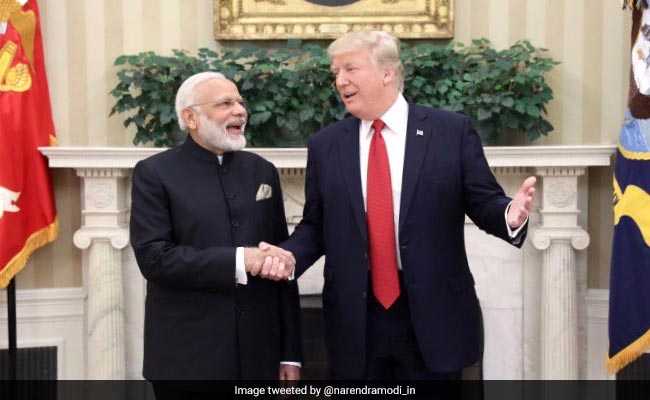
U.S. President Donald Trump made it known during his presidential election campaign that he likes India and Indians. Yet, in office, Trump has taken a series of steps in the immigration and trade realms that have adversely impacted India. Prime Minister Narendra Modi had a good first-ever meeting with Trump, although it yielded few deliverables. The two will have another opportunity to meet soon when Germany hosts the annual G-20 summit in Hamburg. Yet it is still not clear how salient India will be in the Trump foreign policy. This is largely because Trump’s larger geopolitical policy framework is still evolving.

The U.S.-India strategic partnership is essentially founded on two pillars — a U.S. commitment to assist, in America’s own interest, India’s rise; and a shared interest in building an inclusive, stable, rules-based Asian order to help manage China’s muscular rise. The hope in India has been that the U.S. would assist its rise in the way it aided China’s economic ascent since the 1970s. President Jimmy Carter, for example, sent a memo to various U.S government departments instructing them to help in China’s rise. Even China’s firing of missiles into the Taiwan Strait in 1996 did not change that policy. If anything, the U.S. has gradually loosened its close links with Taiwan, with no U.S. Cabinet member visiting that island since those missile manoeuvres.

U.S. policy, effectively, helped turn China into an export juggernaut, which today sells $4 worth of goods to the U.S. for each $1 of imports.  In the process, just as the U.S. inadvertently saddled the world with the jihadist scourge by training Afghan mujahedeen — the anti-Soviet guerrillas out of which Al Qaeda evolved — it unintentionally created a rules-violating monster by aiding China’s economic rise. Abusing free-trade rules, China has systematically subsidized its exports while impeding imports to shield domestic jobs and industry. In effect, China has grown strong and rich by quietly waging a trade war. Trump said he told Chinese President Xi Jinping during their Mar-a-Lago summit in April that “we’ve rebuilt China with the money you’ve taken out of the United States.”

India wants the U.S. to buttress the two central pillars of their strategic partnership. Washington’s China “opening” of 1970-1971, engineered by US National Security Adviser Henry Kissinger, was designed in the wake of the 1969 Sino-Soviet military clashes to exploit the rift in the Communist world by aligning China with America’s anti-Soviet strategy. The result was that China, in the second half of the Cold War, became Washington’s partner against the Soviet Union. By comparison, there is no tectonic geopolitical development or calculation motivating the U.S. to assist India’s rise. Rather, the main driver is a transactional calculation — that an economically booming India, just like China’s economic ascent, will be good for American businesses.

Make no mistake: U.S. foreign policy is inherently transactional, with commerce the central plank. Indeed, Trump’s recent visit to the world’s chief ideological sponsor of jihadism, Saudi Arabia, was a reminder that money speaks louder than the international imperative to counter a rapidly metastasizing global jihadist threat. The visit yielded business and investment deals for the U.S. valued at up to almost $400 billion, including a contract to sell $109.7 billion worth of arms to a country that Trump previously accused of being complicit in 9/11.

Trump’s immediate two predecessors, Barack Obama and George W. Bush, did not hide their transactional approach toward a warming relationship with India. For example, the landmark nuclear deal, unveiled in 2005, was pivoted on India boosting its defence transactions with the United States. Consequently, India has emerged as a top U.S. arms client in a matter of years, even as the 12-year-old nuclear deal remains a dud deal on the energy front, with not a single contract signed as yet.

Trump’s weakness, for which he has been widely lampooned, is that he is publicly mercantile and transactional in his foreign-policy approach. His being so commerce-oriented upfront, rather than quietly, as was the case under his predecessors, does not, of course, signify a shift in U.S. policy focus. For example, in the past, the American demand for Indian steps to correct India’s large trade surplus with the U.S. was made in private by a president or publicly by one of his Cabinet members. But Trump articulated that demand forthrightly in his opening remarks at the joint news conference with Modi. “It is important that barriers be removed to the export of U.S. goods into your markets, and that we reduce our trade deficit with your country,” he stated.

The mutual admiration on display during the visit — with Trump lavishing praise on Modi and calling him a “true friend,” and Modi returning the favour to laud Trump’s “vast and successful” business experience — could not obscure the U.S.-India divergence on regional security issues. The Modi visit speeded up Washington’s decision to fill the vacant position of U.S. ambassador to India by naming Kenneth Juster, a senior White House official. Hopefully, the visit will also accelerate the separate inter-agency reviews currently being conducted in Washington on America’s Pakistan and Afghanistan policies.

Take Afghanistan: For nearly 16 years, the U.S. has been stuck in Afghanistan in the longest and most expensive war in its history. It has tried several policies to wind down the war, including a massive military “surge” under Obama to compel the Taliban to sue for peace. Nothing has worked, in large part because the U.S. has continued to fight the war on just one side of the Afghanistan-Pakistan divide and refused to go after the Pakistan-based sanctuaries of the Taliban and its affiliate, the Haqqani network. As Gen. John Nicholson, the U.S. military commander in Afghanistan, acknowledged earlier this year, “It is very difficult to succeed on the battlefield when your enemy enjoys external support and safe haven.” Worse still, the Taliban is conspicuously missing from the U.S. list of Foreign Terrorist Organizations, while the procreator and sponsor of that medieval militia — Pakistan — has been one of the largest recipients of American aid since 2001, when the U.S. invasion of Afghanistan helped remove the Taliban from power.

India is concerned that the U.S. still seeks to preserve the option of reaching a Faustian bargain with the Taliban. No counterterrorism campaign has ever succeeded when militants have enjoyed cross-border havens. The Taliban are unlikely to be routed or seek peace as long as they can operate from sanctuaries in Pakistan, where their top leaders are ensconced. Their string of battlefield victories indeed gives them little incentive to enter into serious peace negotiations. U.S. Defence Secretary Jim Mattis in June signalled a potentially tougher approach to safe havens in Pakistan, saying the U.S. will hit the enemy where it is “fighting from,” which is “not just Afghanistan”. However, only time will be tell whether this was a rhetorical statement or more.

U.S. has long had a blind spot for Pakistan. Today, the key question for Trump on that front is whether to continue the carrots-only approach toward Pakistan of Obama and Bush or finally begin to wield the big stick against a country that defiantly remains wedded to terrorism. To be sure, the tough message to Pakistan in the joint U.S.-India joint statement on the occasion of Modi’s visit was music to Indian ears: “The leaders called on Pakistan to ensure that its territory is not used to launch terrorist attacks on other countries. They further called on Pakistan to expeditiously bring to justice the perpetrators of the 26/11 Mumbai, Pathankot, and other cross-border terrorist attacks perpetrated by Pakistan-based groups”. This was the clearest message to Pakistan that any Indo-U.S. joint statement has incorporated.

Indeed, the Trump-Modi statement also stated: “The leaders stressed that terrorism is a global scourge that must be fought and terrorist safe havens rooted out in every part of the world. They resolved that India and the United States will fight together against this grave challenge to humanity. They committed to strengthen cooperation against terrorist threats from groups including Al Qaida, ISIS, Jaish-e-Mohammad, Lashkar-e-Taiba, D-Company, and their affiliates. India appreciated the United States designation of the Hizbul Mujahideen leader as a Specially Designated Global Terrorist as evidence of the commitment of the United States to end terror in all its forms”.

The Pakistan-based Hizbul Mujahideen leader Syed Salahuddin, who held a joint public rally last December with Lashkar-e-Taiba chief Hafiz Saeed, is the first militant from India’s Jammu and Kashmir to be designated by the U.S. as a global terrorist. The action against Salahuddin, although belated and designed largely to play to the Indian gallery, adds to the number of Pakistan-based individuals designated as terrorists by the U.S. or the United Nations. It thus helps reinforce Pakistan’s image as a leading terrorist hub.

However, it is true that the U.S. has long been reluctant to take concrete action against Pakistan-based individuals that it has labelled “terrorists”, if their terrorism is directed only at India. Take Hafiz Saeed, the mastermind of the cataclysmic 2008 Mumbai terrorist strikes: The U.S. has yet to act five years after putting a $10 million bounty on Saeed’s head. Saeed, who founded the Inter-Services Intelligence agency’s largest front organization, Lashkar-e-Taiba, remains the Pakistani military’s darling, with his public life mocking both America’s bounty on his head and the UN’s inclusion of him on a terrorist list. Washington has refrained from even criticizing Pakistani authorities for aiding and abetting Saeed’s public rallies. The rallies seek to project him as some sort of messiah of the Pakistani people. Saeed’s public role adds insult to injury for India, reinforcing the imperative that it must on its own fight Pakistan’s jihad-inspired war, which shows no sign of abating. Indeed, with Pakistan’s ceasefire violations triggering a fierce Indian response, Pakistani generals since the beginning of 2016 are using their terrorist proxies to target security camps in J&K.

Through both policy inaction and generous aid, the U.S. has effectively turned Pakistan into its terrorist protégé, like Saudi Arabia. Pakistan is a valued asset for China to keep India boxed in, but why does Washington still shield that country? U.S. policy indeed plays into China’s hands by propping up Pakistan and unwittingly helping to cement the Sino-Pakistan nexus. Will Trump fix a broken Pakistan policy that permits the Pakistani military to keep nurturing transnational terrorists? It will be overly optimistic to believe that the U.S. under him will change course fundamentally and apply sustained pressure to encourage a reformed Pakistan at peace with itself.

Compounding matters for India is Trump’s lack of an Asia policy or a larger geostrategic vision that gives primacy to major Asian democracies like Japan and India so as to prevent the emergence of a Sino-centric Asia. Trump came to office vowing to end what he saw as China’s free ride on trade and security issues that has allowed Beijing to flex its muscles more strongly than ever. But in contrast to his tough talk during his presidential campaign, when he famously said he would not “allow China to rape our country,” Trump has sought a cooperative relationship with China grounded in reciprocity. Accordingly, Trump, far from seeking to challenge Beijing’s hegemonic ambitions, has stayed on the same China-friendly path as Obama.

In fact, underscoring how the U.S. still seeks to balance its bilateral relationships with important powers in Asia, Trump invited Xi to Mar-a-Lago — his private estate in Palm Beach, Florida, that he calls the “Southern White House” — because he wanted to offer the leader of the world’s largest autocracy the same hospitality that he extended to the prime minister of China’s archrival, Japan, which is Asia’s oldest democracy. In February, Trump brought Prime Minister Shinzo Abe to Mar-a-Lago on Air Force One for a weekend of working lunches and golf. And in April, he hosted Xi at Mar-a-Lago.

Those Indians getting carried away by Trump’s praise for Modi should know the kind of admiration the U.S. president publicly displayed for Xi. “We have a great chemistry together,” he said about Xi. “We like each other. I like him a lot.” Trump also added that “lots of very potentially bad problems will be going away,” owing to his relationship with the “terrific” Xi.

The mercurial Trump’s honeymoon with Xi (and China), however, appears to be coming to an end. In a stunning admission of failure, Trump tweeted that counting on Xi to address the North Korea challenge hasn’t worked. It was naïve of Trump to rely on Beijing because North Korea has been seeking to escape China’s clutches and pursue direct engagement with Washington. It is possible that Trump may now pursue a tougher line toward Beijing, especially on trade issues. But that may not necessarily be India’s gain, unless he develops a larger geostrategic plan for Asia, including fixing Obama’s unhinged “pivot” policy and treating India as an indispensable partner. At present, Trump scarcely shares India’s concern about Chinese expansionism in its neighborhood and beyond and appears reluctant to aggressively confront Pakistan on its support for terrorist groups.

The growing cosiness in India’s ties with Washington masks New Delhi’s increasing concerns about its deteriorating regional-security environment. China has stepped up strategic pressure on India from different fronts, including deepening its nexus with Pakistan. Even as a pro-U.S. tilt has become pronounced in Indian foreign policy over the past one decade, with India emerging as a leading U.S. arms client, the relationship with Washington offers no answers to New Delhi’s security dilemmas. Trump, besieged by allegations of collusion between his campaign associates and Russia, has little space to fundamentally revamp U.S. foreign policy, including on Pakistan and China. The more things change, the more they tend to stay the same in U.S. foreign policy. India has no choice but to address the security dilemmas — and the regional threats — on its own.

© Open, 2017.