
Japan’s Senkaku challenge

lee_photo_a2Japan Times


At a time of shifting power dynamics in Asia, Japan faces pressing security challenges. Of the 400 remote islands that serve as markers for determining Japan’s territorial waters, only about 50 are inhabited. But no group of islands poses a bigger challenge for its security than the Senkakus, a clutch of five uninhabited islets and three rocks.

This challenge is compounded by demographic and military trends. Japan has barely one-tenth the population of China’s. Moreover, its population is not just aging but also shrinking significantly; it declined by nearly a million just between 2010 and 2015.

About a decade ago, Japan’s defense budget was larger than China’s. But now China’s military spending surpasses the combined defense expenditure of Japan, Britain and France.

To make matters worse, China’s increasing territorial assertiveness and muscular foreign policy are contributing to a sense of insecurity in Japan.

President Xi Jinping declared much of the East China Sea, including the Senkakus, to be a Chinese air defense zone in 2013, and since then China has stepped up its challenge to Japan’s control over those islands, including through repeated intrusions by its military aircraft and warships. Beijing has hardened its stance by elevating its claim to the Senkakus to a “core interest,” while some in China have gone to the extent of questioning Japan’s sovereignty over even Okinawa.

Against this background, many Japanese have wondered whether the United States would come to Japan’s defense in the event of a Chinese attack on the Senkakus. The 1960 U.S.-Japan Security Treaty states that an armed attack on either country in the territories under Japan’s administration would prompt joint action “to meet the common danger.”

Then U.S. President Barack Obama’s contradictory rhetoric instilled a sense of skepticism in Japan. Obama publicly affirmed that the U.S.-Japan security treaty covered the Senkakus. But in the same breath he refused to take a position on the islands’ sovereignty and advised Tokyo and Beijing to sort out their dispute peacefully.

Obama said the U.S. security treaty with Japan covered the Senkaku Islands because they “are under Japanese jurisdiction,” yet “we also stress that we don’t take a position on the sovereignty of the Senkaku Islands.”

At his April 2014 joint news conference with Prime Minister Shinzo Abe in Tokyo, Obama, while unveiling his position on the Senkakus, urged Japan to refrain from “provocative actions” and emphasized that his administration was committed to encouraging China’s “peaceful rise.”

He stated: “We don’t take a position on final sovereignty determinations with respect to Senkakus, but historically they have been administered by Japan and we do not believe that they should be subject to change unilaterally … In our discussions, I emphasized with Prime Minister Abe the importance of resolving this issue peacefully — not escalating the situation, keeping the rhetoric low, not taking provocative actions, and trying to determine how both Japan and China can work cooperatively together. And I want to make that larger point. We have strong relations with China. They are a critical country not just to the region but to the world. Obviously, with a huge population, a growing economy, we want to continue to encourage the peaceful rise of China.”

How could such doublespeak reassure Japan? In fact, such statements sowed doubt over America’s willingness to go to war with China to back Japan’s territorial rights, in the event of a surprise Chinese invasion of the Senkakus. The Obama administration responded by simply saying that “we do not envision that this current tension will rise to that level in any foreseeable scenario.”

Add to the picture Obama’s conspicuous inaction and silence on China’s 2012 seizure of the disputed Scarborough Shoal from the Philippines, despite America’s longstanding mutual defense treaty with Manila. That development served as a wakeup call for Japan and other U.S. allies in Asia.

By contrast, the new U.S. administration led by President Donald Trump has taken a more clear-cut stance in reassuring Japan that the U.S. would defend it in any confrontation with China over the Senkakus. It has done so without the Obama-style caveat — that Washington does not take sides in the sovereignty dispute and calls on China and Japan to resolve their dispute peacefully through dialogue.

In fact, the recent Trump-Abe summit marked the first time that the U.S. commitment to defend Japan’s control over the Senkakus was recorded in a joint statement.

The Feb. 12 Trump-Abe joint statement came out strongly for Senkakus’ defense: “The two leaders affirmed that Article V of the U.S.-Japan Treaty of Mutual Cooperation and Security covers the Senkaku Islands. They oppose any unilateral action that seeks to undermine Japan’s administration of these islands … The United States and Japan oppose any attempt to assert maritime claims through the use of intimidation, coercion or force.”

This unambiguous commitment should be seen as an important success of Abe’s proactive diplomacy in seeking to build a personal connection with the new U.S. president. Abe was the first foreign leader Trump hosted at Mar-a-Lago, which he calls “The Southern White House.” Earlier, just after Trump’s unexpected election victory, Abe met face-to-face with him by making a special stop in New York en route to the Asia-Pacific Economic Cooperation summit in Peru.

Let’s be clear: The Senkaku issue is not just about a seven-square-kilometer real estate or the potential oil and gas reserves that lie around it. The strategically located Senkakus, despite their small size, are critical to maritime security and the larger contest for influence in the East China Sea and beyond.

China is seeking to wage a campaign of attrition against Japan over the Senkakus by gradually increasing the frequency and duration of its intrusions into Japan’s airspace and territorial waters. In doing so, it has made the rest of the world recognize the existence of a dispute and the risks of armed conflict.

To be sure, changing the territorial status quo is nothing new for Beijing. The People’s Republic of China has been doing that ever since it was founded in 1949. The early forcible absorption of the sprawling Xinjiang and Tibetan Plateau more than doubled China’s landmass.

In the 21st century, Chinese expansionism has increasingly relied upon “salami tactics” — a steady progression of small, furtive actions, none of which serves as a casus belli by itself, yet which help to incrementally change facts on the ground in China’s favor.

Unlike China’s success in expanding its frontiers in the South China Sea, it has found the going tough in the East China Sea. Indeed, Beijing’s actions have shaken Tokyo out of its complacency and diffidence and set in motion the strengthening of Japan’s defense capabilities, including arming its far-flung island chain in the East China Sea with a string of anti-ship, anti-aircraft missile batteries.

At his joint news conference with Trump at the White House, Abe pledged that Japan will play a “greater role” in East Asian security. It was as if he was responding to Trump’s campaign rhetoric that Japan, which hosts about 50,000 American troops, should do more to defend itself.

One effective way the Trump administration can encourage Japan to do more for its own defense is by lending full support to the Abe-initiated national security and constitutional reform process. Such reforms could help forestall the emergence of a destabilizing power imbalance in East Asia. Japan is already working to constrain China with its own version of Beijing’s “anti-access, area denial” doctrine against the U.S.

Brahma Chellaney is a geostrategist and the author of nine books, including “Water, Peace, and War.”
© The Japan Times, 2017.

Trump’s China Challenge

A column internationally syndicated by Project Syndicate.

Photo of Brahma ChellaneyOver the last eight years, as China’s posturing in Asia became increasingly aggressive, many criticized US President Barack Obama for failing to stand up to the Asian giant. It was on Obama’s watch, after all, that China captured the disputed Scarborough Shoal from the Philippines and built seven artificial islands in the South China Sea, on which it then deployed heavy weapons – all without incurring any international costs.
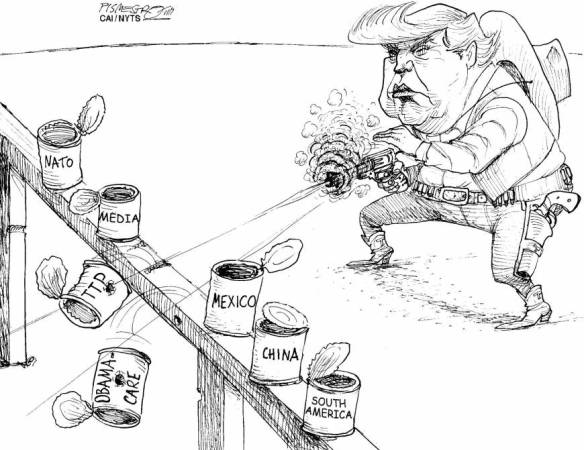
Many expect Obama’s tough-talking successor, Donald Trump, to change all of this. He is not off to a good start.

During the campaign, Trump threatened to retaliate against China for “raping” America on trade, to impose massive tariffs on Chinese imports, and to label China a currency manipulator on “day one.” Soon after his victory, Trump took a congratulatory phone call from the president of Taiwan, thereby breaking with nearly 40 years of diplomatic orthodoxy. Trump then took the matter a step further, publicly suggesting that he would use the “One China” policy as a bargaining chip in bilateral negotiations over contentious economic and security issues – from import taxes to North Korea.

But Trump backed down. Chinese President Xi Jinping made it clear that he would not so much as talk to Trump on the phone without assurance that the US president would pledge fidelity to the One China policy. The call happened, and Trump did exactly what Xi wanted, ostensibly without extracting anything in return. If China now perceives Trump to be all bark and no bite, he will undoubtedly find it harder to secure concessions from China on trade and security issues.

Trump is not the only figure in his administration to stake out a bold position on China, and then retreat meekly. During his Senate confirmation process, US Secretary of State Rex Tillerson declared that the US should “send China a clear signal” by denying it access to its artificial islands in the South China Sea. China’s expansionism in the region, Tillerson asserted, was “akin to Russia’s taking Crimea” from Ukraine – an implicit criticism of Obama for allowing the two developments.

But Tillerson, like his new boss, soon backed down. The US, he now claims, merely needs to be “capable” of restricting China’s access to the South China Sea islands, in the event of a contingency.

And yet China’s behavior merits stronger US action now. The country is attempting to upend the status quo not only in the South China Sea, but also in the East China Sea and the Himalayas. It is working to create a large sphere of influence through its “one belt, one road” initiative. And it is reengineering transboundary river flows. All of this is intended to achieve Chinese leaders’ goal of re-establishing the country’s mythical “Middle Kingdom” status.

Flawed US policy has opened the way for these efforts, in part by helping to turn China into an export juggernaut. The problem isn’t that China has a strong economy, but rather that it abuses free-trade rules to subsidize its exports and impede imports, in order to shield domestic jobs and industry. Today, China sells $4 worth of goods to the US for every $1 in imports.

Just as the US inadvertently saddled the world with the jihadist scourge by training Afghan mujahideen – the anti-Soviet fighting force out of which al-Qaeda evolved – it unintentionally created a rules-violating monster by aiding China’s economic rise. And it sustained its China-friendly trade policy even as China’s abuses became bolder and more obvious.

It is ironic that China, which has quietly waged a trade war for years, has responded to Trump’s threats to impose punitive tariffs by warning – notably, at this year’s World Economic Forum Annual Meeting in Davos – of the risks of protectionism and trade wars. But not everyone is falling for China’s story. A growing number of countries are recognizing that reciprocity should guide their relations with China.

Trump himself may yet challenge China. When he agreed to abide by the One China policy, he said that he had done so at Xi’s request, suggesting that his commitment to the policy should not be taken for granted.

Moreover, even without defying the One China policy, Trump has ample room to apply pressure. He could start by highlighting increasing Chinese repression in Tibet. He could also expand political, commercial, and military contacts with Taiwan, where the One China policy has had the paradoxical effect of deepening people’s sense of national identity and strengthening their determination to maintain autonomy.

In any case, as China continues to pursue its hegemonic ambitions, Trump will have little choice but to pivot toward Asia – substantively, not just rhetorically, as Obama did. To constrain China and bring stability to Asia, he will have to work closely with friends. His efforts to establish a personal connection with Japanese Prime Minister Shinzo Abe – the first foreign leader he hosted at Mar-a-Lago, his “Winter White House” – and the high priority his administration is assigning to relations with India and South Korea are positive signs.

By failing to provide strategic heft to his Asia pivot, Obama left it unhinged. Trump has the opportunity – and the responsibility – to change this. If he doesn’t, China will continue to challenge US allies and interests, with serious potential consequences for Asia and the world.

Taliban’s strange new foreign friends

Brahma Chellaney, DNA

dissolution-of-taliban-fe0331-embed2-wide

India has an important stake in the future of Afghanistan, its natural ally and close friend for long. India, under successive governments, has been a major aid donor to Afghanistan. As the U.S. military commander in Afghanistan, Gen. John Nicholson, recently told his country’s Senate Armed Services Committee, “With over $2 billion development aid executed since 2002, and another $1 billion pledged in 2016, India’s significant investments in Afghan infrastructure, engineering, training, and humanitarian issues will help develop Afghan human capital and long-term stability.” Recent developments, however, do not augur well for Indian or Afghan interests.

Despite being ravaged by successive wars for the past 36 years, Afghanistan remains a playground for the foreign powers that have fomented or engaged in hostilities there. The latest developments suggest that the Afghanistan-related geopolitics is only getting murkier. In the process, the Taliban is acquiring strange new friends.

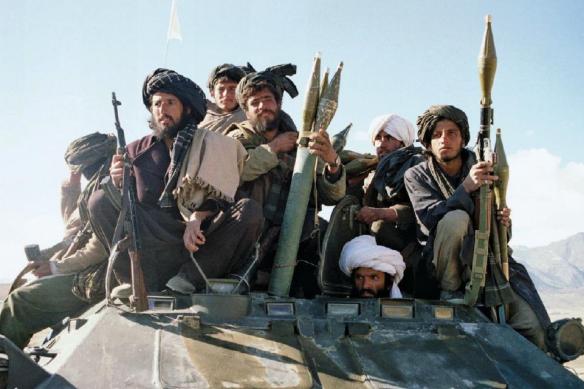
Russia and Iran, the traditional patrons of the Northern Alliance, are now openly mollycoddling the Taliban and giving it political succour. In this effort, they have the cooperation of China and Pakistan, thus creating a regional axis. This development represents a shot in the arm for the Taliban’s fight against U.S.-led forces in Afghanistan and the government in Kabul.

Pakistan, of course, fathered the Taliban and remains its principal benefactor, providing safe havens on its territory to the militia. China, for its part, was just one of three countries along with Saudi Arabia and Pakistan that recognized the Taliban regime in Kabul until it was overthrown in 2001 following the U.S. invasion. In fact, China and the Taliban announced a memorandum of understanding for economic and technical cooperation on the day two planes crashed into New York’s World Trade Center. Beijing is now again courting the Taliban. It has hosted at least one Taliban delegation and offered to mediate between Kabul and the rebels.

It is Russia’s U-turn on the Taliban, however, that stands out because it is strategically the most significant development. From a terrorist foe, the Taliban has become a potential ally for Moscow.

Russia’s apparent aim is to turn up the heat and raise the costs for the U.S. military’s continuing role in Afghanistan. It has even sought to obstruct the Afghan government’s U.S.-backed peace deal with a faded warlord, Gulbuddin Hekmatyar. While China has frustrated India’s moves to place the Pakistan-based terrorist Masood Azhar on the UN sanctions list, Moscow recently blocked Hekmatyar’s removal from the same list.

What makes the emerging regional axis more surprising is that Iran’s regional rival, Saudi Arabia, continues to bankroll the Taliban. Another paradox is that two of America’s allies, Pakistan and Saudi Arabia, are still aiding and abetting the U.S. military’s main battlefield enemy, the Taliban, which has killed hundreds of American soldiers.

As for Moscow, it has sought to underpin its policy shift by warming up to Pakistan. In order to cultivate ties with the Taliban, whose top leadership remains holed up in Pakistan’s Balochistan province, Russia is befriending Islamabad. Russia has held its first ever military exercise with Pakistan and is selling attack helicopters to it. Moscow is also negotiating a $2 billion natural gas pipeline contract with Islamabad.

The new developments in the Af-Pak belt carry major implications for Indian security.  Although India and the Afghan government were invited to a round of discussions in Moscow this month, Russia is shaping its new Afghanistan policy not in cooperation with New Delhi and Kabul. Indeed, at the Heart of Asia conference in Amritsar in December, Russia’s special envoy on Afghanistan, Zamir Kabulov, made some critical comments about New Delhi and Kabul. Subsequently, after discussions with Pakistan in Moscow, Russia and China called for  “flexible approaches” toward the Taliban and the removal of some its leaders from the UN sanctions list.

The Russian cooperation with the Taliban, while putting a damper on American efforts to reach a peace deal with that militia, is likely to exacerbate the security dynamics in the Afghanistan-Pakistan belt, which already boasts, as Gen. Nicholson pointed out, “the highest concentration of terrorist groups anywhere in the world.” Put simply, Moscow’s new stance represents a setback for counterterrorism and for India’s Afghanistan policy.

© DNA, 2017.

Engagement over Antagonism

Sanctions alone will not curb North Korea’s nuclear ambitions. A healthy dose of diplomacy is needed too.

Brahma Chellaney, Nikkei Asian Review, February 27-March 5, 2017

missile-test

For North Korea, reeling under severe United Nations sanctions, conducting missile tests has become a regular expression of political defiance and technological progress. Just last year, showing its continuing contempt for UN resolutions, it tested almost two dozen missiles, including a submarine-launched ballistic missiles. Yet its first missile test since Donald Trump won the U.S. presidential election in November has been speciously portrayed as a major challenge to the new administration in Washington, with some analysts like ex-CIA chief James Woolsey even calling North Korea the top national security problem at present.

The fact is that the Feb. 12 test did not involve a long-range ballistic missile, which North Korean dictator Kim Jong Un had said in his New Year’s Day speech was almost ready for launch. The fired missile, which traveled 500km, was just a medium-range type that Pyongyang has tested multiple times in different variants. And although North Korea said the test involved a new missile model with a solid fuel-powered engine — a technological advance that facilitates mobility and rapid launch — this is not the country’s first solid-fueled missile. As Pyongyang admits, the new surface-to-surface missile is based on its solid-fueled submarine-launched ballistic missile.

Lost in the alarmism over the new missile is the fact that the test occurred just after Trump called North Korea a threat. Kim had been on good behavior ever since Trump’s unexpected election triumph, hoping that the new American president would adopt a fresh tack, in keeping with what Trump had said during the campaign — that he would be willing to meet with the North Korean leader over a hamburger.

Kim — the world’s youngest head of state — tested a nuclear device, purportedly a hydrogen bomb, two days before his Jan. 8 birthday in 2016. International media speculated that this year Kim would celebrate his birthday by testing an intercontinental ballistic missile, although he had referred to a long-range missile, not an ICBM, in his New Year’s Day speech. Kim, however, delayed his first missile test since Trump’s victory until much later — conducting it less than 36 hours after Trump, in a joint news conference with Japanese Prime Minister Shinzo Abe at the White House, said that “defending against the North Korean missile and nuclear threat” was “a very, very high priority” for him.

Trump’s tempered response to the missile test drew cynical comments from critics citing his bombastic Jan. 3 tweet. Relying on misleading media reports that Kim had threatened to test an ICBM, Trump posted on Twitter: “North Korea just stated that it is in the final stages of developing a nuclear weapon capable of reaching parts of the U.S. It won’t happen!” Truth be told, North Korea is far from developing an ICBM, as the latest missile test underscores.

Still, Trump is being publicly advised to ratchet up military pressure on Pyongyang, prompting him to declare: “Obviously, North Korea is a big, big problem, and we will deal with that very strongly.”

BIG-PICTURE ISSUES  

The debate on how to tame North Korea’s nuclear and missile ambitions should not obscure the larger issues involved. Three key matters stand out.

Firstly, the sanctions-only approach toward North Korea spearheaded by the United States has been a conspicuous failure, encouraging Pyongyang to rapidly advance its nuclear and missile programs. With little to lose, North Korea has responded to heavy sanctions by testing nuclear devices in 2006, 2009, 2013 and twice in 2016. It has the dubious distinction of being the only country in the world to conduct nuclear tests in the 21st century. North Korea has also considerably enhanced its missile capabilities, though they remain subregionally confined in range.

Sanctions without engagement have never worked. In the North Korean case, the sanctions-only approach has done exactly the opposite of its intended goal — instead of halting or retarding nuclearization, slapping on additional sanctions after every major test has only egged Pyongyang on.

Secondly, Kim has repeatedly signaled that he wants his internationally isolated nation to escape from the clutches of its millennial rival, China. Significantly, he has not visited China since assuming power in 2011, although paying obeisance in Beijing was customary for his father and grandfather, who ruled before him.

Mao Zedong famously said China and North Korea were as close as lips are to teeth. But when China last March joined hands with the U.S. to approve the toughest new U.N. sanctions in two decades against North Korea, it highlighted its virtually ruptured relationship with Pyongyang.

At a time when China’s state media has accused Kim of pursuing “de-Sinification” and seeking improved ties with the U.S. and Japan, the fatal poisoning of Kim’s half brother, Kim Jong Nam, at Kuala Lumpur International Airport has increased the sense of alarm and frustration in Beijing. Kim Jong Nam, a reputed playboy with residences in Beijing and Macau, was a virtual Chinese pawn against Kim.

Yet, oddly, Washington has attempted to push Kim further into the Chinese dragnet, instead of seizing on the opportunity created by his desire to unlock frozen ties with America. Some U.S. scholars have even suggested a grand bargain with Beijing on North Korea. Given that North Korea has sought direct engagement with Washington to offset Chinese leverage over it, nothing is more galling to Pyongyang than U.S. efforts to use Beijing as a diplomatic instrument against it. In effect, American policy has handed Beijing the North Korea card to play against South Korea, Japan and the U.S. itself.

In truth, China is already putting the squeeze on North Korea, especially since that country carried out its most powerful nuclear test last September. But its enforcement of U.N. sanctions in a controlled way has failed to change Kim’s calculus. Beijing, of course, values North Korea as a buffer state and does not want a reunified and resurgent Korea allied with Washington, because that will open a new threat, including bringing American troops to China’s border. Make no mistake: Chinese and American interests diverge fundamentally.

And thirdly, the U.S. has no credible military option against North Korea. Any military strikes to degrade the North’s nuclear and missile capabilities will provoke Pyongyang to unleash its artillery-barrage power against the South, triggering widespread destruction and a full-fledged war involving America. The planned U.S. deployment in South Korea of the anti-missile Terminal High Altitude Area Defense, or THAAD — which has never been battle-tested — is no real answer to North Korea’s nuclearization or to the North’s artillery choke-hold on Seoul. China, with some justification, sees the THAAD plan as essentially directed against it.

If there is any credible U.S. option to deal with Pyongyang, it is to give diplomacy a chance, with the goal of forging a peace treaty with the North to formally end the Korean War — which has officially been in a state of cease-fire since 1953. Denuclearization should be integral to the terms of such a peace treaty. But if denuclearization is made the sole purpose of engagement with the North, diplomacy will not succeed. President Barack Obama’s administration simply refused to talk unless Pyongyang first pledged to denuclearize. The North’s only leverage is the nuclear card, which it will not surrender without securing a comprehensive peace deal.

When repeated rounds of tight sanctions not only fail to achieve their objectives but counterproductively trigger opposite effects, the need for a new approach becomes inescapable.

Through a carrot-and-stick approach of easing some sanctions and keeping more biting ones in place, diplomacy can, by persisting with what will be difficult and tough negotiations, clinch a deal to end one of the world’s longest-lingering conflicts and eliminate weapons of mass destruction.

Brahma Chellaney is a geostrategist and the author of nine books, including “Water: Asia’s New Battleground,” the winner of the Bernard Schwartz Award.

© Nikkei Asian Review, 2017.