India may be parched yet it is remarkably short-sighted on water resources

Brahma Chellaney, Mail Today, December 30, 2016

imagesThe inter-ministerial task force set up by Prime Minister Narendra Modi for correcting India’s under-utilization of its allocated share of waters under the Indus Waters Treaty (IWT) has just held its first meeting. The water-related issue facing India, however, is much larger: The continuing absence of institutionalized, integrated policymaking in India, which has prevented proper management of the country’s increasingly scarce water resources. Indeed, India stands out for its lack of a national action plan to build water security.

When the Indian Republic was established, the framers of its Constitution did not visualize water scarcity in the decades ahead, given the relative abundance of water resources then. Therefore, they left water as a state-level subject, rather than making it a federal issue.

Similarly, the IWT, under which India bigheartedly agreed in 1960 to the exclusive reservation of the largest three of the six Indus system rivers for Pakistan, was negotiated in a period when water shortages were uncommon in most parts of India. This led India to sign an extraordinary treaty whose terms commit India to indefinitely reserve over four-fifths of the total waters of the Indus system for Pakistan.

The treaty uniquely parceled out entire rivers to Pakistan. It granted Pakistan virtually exclusive rights to use the waters of the Chenab, the Jhelum, and the main Indus stream — known together as the “western rivers”. The average replenishable flows of the three western rivers total 167.2 billion cubic meters (BCM) per year. As its own share, India settled for a mere 40.4 BCM, or the total yearly flows of the three so-called eastern rivers — the Sutlej, the Beas, and the Ravi.

Four of these six rivers originate in India (three of them in Himachal Pradesh), and two (the main Indus stream and the Sutlej) originate in Tibet. Only the Jhelum originates in Jammu and Kashmir.
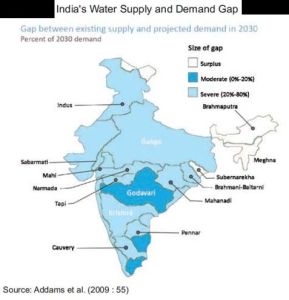
clipboard01Today, the national water situation in India is far worse than in China. China’s population is not even 10 per cent larger than India’s but its internally renewable water resources (2,813 BCM) are almost twice as large as India’s. In aggregate water availability, including external inflows (which are sizeable in India’s case), China boasts virtually 50 per cent larger resources than India.

Yet India serves as a case study of how a disjointed policy approach and lack of vision on managing water resources can exact serious costs by creating water shortages across much of the country. In a sense, India’s fragmented approach is exactly the opposite of China’s highly centralized approach centred on mega-projects.

The startling fact is that the responsibility for water issues is so fragmented within India’s central government that 12 different departments or ministries deal with different segments of water resources. To promote clear responsibility and accountability in national water management and to facilitate integrated policymaking, India must end its present fragmented approach on water issues.

As for India’s under-utilization of its IWT-allocated water share, the task facing the task-force is formidable. For example, the waters of the three eastern rivers not utilized by India aggregate to 10.37 BCM yearly according to Pakistan or, according to the UN, 11.1 BCM. These bonus outflows to Pakistan alone amount to six times Mexico’s total water share under its treaty with the US, and are many times greater than the total volumes spelled out in the Israel-Jordan water arrangements.

Although the IWT permits India to store 4.4 BCM of waters from the Pakistan-reserved rivers, a careless India has built no storage. And despite the treaty allowing India to build hydropower plants with no dam reservoir, India’s total installed generating capacity in J&K currently does not equal the size of a single new dam in Pakistan like the 4,500-megawatt Diamer-Bhasha, whose financing for construction was approved recently.

Against this background, the task force set up by Modi, with his principal secretary as its chairman, may be a step in the right direction. But constituting this committee is hardly an adequate response to fixing the anomaly as reflected in India’s under-utilization of its water share.

Made up of senior bureaucrats who are already busy attending to other tasks, the committee cannot by itself remove the bureaucratic hurdles in the proper utilization of water resources. India’s political negligence on this issue has been so deep and extensive that it can be remedied only through hands-on political direction and in coordination with the state chief ministers.

More fundamentally, water scarcity is a looming challenge across India. The water wars between various Indian states are highlighting how the competition over shared water resources is sharpening in an alarming manner.

India must treat water as a strategic resource for its own well-being. If the current compartmentalized approach to managing water resources persists, water shortages are going to exact growing economic and social costs in India.

© Mail Today, 2016.

From Russia With Unrequited Love

A column internationally syndicated by Project Syndicate

6773ae17d16b34e4c5c584fa8376943e-landscapelarge

Japanese Prime Minister Shinzo Abe has assiduously courted Russian President Vladimir Putin, meeting with him more than a dozen times in four years. This month he hosted Putin in Tokyo and in his hometown of Nagato (famed for its onsen, or natural hot springs). But Abe’s courtship has so far yielded little for Japan, and much for Russia.

Abe’s diplomatic overtures to Putin are integral to his broader strategy to position Japan as a counterweight to China, and to rebalance power in Asia, where Japan, Russia, China, and India form a strategic quadrangle. Abe has already built a close relationship with India, and he sees improved relations with Russia – with which Japan never formally made peace after World War II – as the missing ingredient for a regional power equilibrium.

But Abe’s trust-building efforts with Russia are not aimed only at checking Chinese aggression. He also wants Russia to return its southernmost Kuril Islands – a resource-rich area known as the Northern Territories in Japan – which the Soviet Union seized just after the United States dropped nuclear bombs on Hiroshima and Nagasaki in August 1945. In exchange, Abe has offered economic aid, investments in Russia’s neglected Far East, and major energy deals.

Abe has, however, encountered several obstacles. For starters, Japan is a participant in the US-led sanctions that were imposed on Russia after it annexed Crimea in March 2014. These sanctions have pushed Russia closer to its traditional rival, China; and Putin has publicly identified the sanctions as a hindrance to concluding a peace treaty with Japan.

In response to Abe’s overtures, Putin has doggedly tried to drive a hard bargain. Russia has bolstered its defenses on the four disputed islands, and, just prior to this month’s summit, he told the Japanese media that the current territorial arrangement suits Russian interests. “We think that we have no territorial problems,” he said. “It’s Japan that thinks that it has a territorial problem with Russia.”

The US-led sanctions regime and low oil prices have battered the Russian economy, which is expected to contract by 0.8% in 2016. Thus, Putin is more reluctant than ever to offer territorial concessions, lest it tarnish his domestic image as a staunch defender of Russian national interests.

Against this backdrop, it is not surprising that Abe left the recent “onsen summit” with dashed hopes of resolving the territorial dispute, while Putin returned home with 68 new commercial accords. Many of the new agreements are symbolic, but some are substantive, including deals worth $2.5 billion and an agreement to set up a $1 billion bilateral-investment fund.

Under the latter agreement, Japan and Russia are supposed create a “special framework” for joint economic activities on the disputed islands. But the plan has already run into trouble. Peter Shelakhaev, a senior Russian official who leads the government’s Far East Investment and Export Agency, has indicated that there are legal hurdles to establishing such a framework, and that Japanese firms doing business on the Kurils would have to pay taxes to Russia. If Japan did that, however, it would effectively be recognizing Russia’s jurisdiction over the islands.

Abe has thus been denied the legacy that he sought, while Putin has succeeded in easing Russia’s international isolation. Abe was the first G7 leader to hold a summit with Putin after Russia annexed Crimea, and now Russia has won Japan’s economic cooperation, too.

Japan is the only G7 country that has a territorial dispute with Russia, and it is clearly more eager to reach a deal than the Kremlin is. But this has only strengthened Russia’s hand. While Japan has softened its position, and signaled that it may accept only a partial return of the islands, Russia has grown only more intransigent. After the recent summit, Abe revealed that Putin now seems to be reneging on a 1956 agreement between Japan and the Soviet Union, which stipulates that the smaller two of the four islands will be returned to Japan after a peace treaty is signed.

As it happens, this year marks the 60th anniversary of that joint declaration, which was widely viewed as a breakthrough at the time. The Kremlin is now suggesting that its commitment to fulfilling the declaration was conditional on Japan not joining any security alliance against Russia. And Putin has expressed concerns that the 1960 Japan-US Security Treaty would extend to the disputed islands if they were returned, thus allowing the US to establish a military presence there.

Japan is in no position to address Russia’s concerns. It cannot opt out of the US-led sanctions regime; and it cannot exempt the disputed Kurils from its security treaty with the US, especially now that it has been urging the US to provide an explicit commitment to defend the Japanese-controlled Senkaku Islands, over which China claims sovereignty.

Putin, for his part, appears smugly content with his negotiating position. Not only did he arrive almost three hours late to the onsen summit, in keeping with his habit of leaving foreign leaders waiting; he also declined a Japanese government gift – a male companion for his native Japanese Akita dog, which Japan gave him in 2012.

There is little hope now that Abe will see tangible returns on the political capital he has invested in cultivating Putin. And Japan’s dilemma will only deepen. US President-elect Donald Trump’s desire to improve relations with Russia may give Abe leeway to continue wooing Putin; but if Russia gets the US in its corner, it won’t need Japan anymore.

The Great Water Folly

Brahma Chellaney, The Hindustan Times

imagesThe linkages between water stress, sharing disputes and environmental degradation threaten to trap Asia in a vicious cycle. In a continent where China’s unilateralism stands out as a destabilizing factor, only four of the 57 transnational river basins have a treaty on water sharing or institutionalized cooperation. Indeed, the only Asian treaties incorporating specific sharing formulas are between India and its downriver neighbours, Pakistan and Bangladesh.

When Pakistan was carved out of India as the first Islamic republic of the post-colonial era, the partition left the Indus headwaters in India, arming it with formidable water leverage over the newly-created country. Yet India ultimately agreed under World Bank and US pressure in 1960 to what still ranks as the world’s most generous (and lopsided) water-sharing pact.

The Indus Waters Treaty (IWT) reserved for Pakistan the largest three rivers that make up more than four-fifths of the Indus-system waters, leaving for India just 19.48% of the total waters. After gifting the lion’s share of the waters to the congenitally hostile Pakistan, India also contributed $173.63 million for dam and other projects there. The Great Water Folly — one of the major strategic problems bequeathed to future Indian generations by the Nehruvian era — began exacting serious costs within a few years.

Far from mollifying an implacable foe, the IWT whetted Pakistan’s territorial revisionism, prompting its 1965 military attack on India’s Jammu and Kashmir. The attack was aimed at gaining political control of the land through which the three largest rivers reserved for Pakistani use flowed, although only one of them originates in J&K. The 1965 attack was essentially a water war.

India’s naïve assumption that it traded water munificence for peace in 1960 has backfired, saddling it with an iniquitous treaty of indefinite duration and keeping water as a core issue in its relations with Pakistan. As for Pakistan, after failing to achieve its water designs militarily in 1965, it has continued to wage a water war against India by other means, including diplomacy and terrorism. Put simply, 56 years after the IWT was signed, Pakistan’s covetous, water-driven claim to India’s J&K remains intact.

Pakistan has cleverly employed the IWT to have its cake and eat it too. While receiving the largest quantum of waters reserved by any treaty for a downstream state, it uses the IWT to sustain its conflict and tensions with India. Worse still, this scofflaw nation repays the upper riparian’s unparalleled water largesse with blood by waging an undeclared, terrorism-centred war, with the Nagrota attack the latest example.

Pakistan has recently succeeded — for the second time in this decade — in persuading a partisan World Bank to initiate international arbitral proceedings against India. Seeking international intercession is part of Pakistan’s ‘water war’ strategy against India, yet it is the World Bank’s ugly role in the latest instance that sticks out. This should surprise few.

After all, it was the World Bank’s murky role that spawned the inherently unequal IWT. Whereas the British colonial government was the instrument in India’s 1947 land partition, the Bank served as the agent to partition the Indus-system rivers, floating the river-partitioning proposal and ramming it down India’s throat. India’s full sovereignty rights were limited to the smallest three of the six rivers, with the Bank uniquely signing a binational treaty as its guarantor.

Since then, World Bank support enabled Pakistan not only to complete mega-dams but also to sustain its ‘water war’ strategy against India by seeking to invoke international intercession repeatedly. Now, in response to Pakistan’s complaint over the design features of two midsized Indian hydropower projects, the World Bank has sought to initiate two concurrent processes that mock the IWT’s provisions for resolving any ‘questions’, ‘differences’ or ‘disputes’ between the parties: It is appointing both a court of arbitration (as sought by Pakistan) and a neutral expert (as suggested by India), while admitting that “pursuing two concurrent processes under the treaty could make it unworkable over time”.

India says it “cannot be party to actions” by the World Bank that breach the IWT’s terms, implying that it might not accept the arbitral tribunal. India’s bark, however, has always been worse than its bite. While protesting the Bank’s “legally untenable” move in the latest case, India has shown little inclination to respond through punitive counter-measures.

Had China been in India’s place, it would have sought to discipline the Bank and Pakistan. Indeed, it is unthinkable that China would have countenanced such an egregiously inequitable treaty. While mouthing empty rhetoric, India still allows Pakistan to draw the IWT’s full benefits even as Pakistan bleeds it by exporting terrorists.

The truth is this: The IWT symbolizes India’s enduring strategic naiveté and negligence. Despite water shortages triggering bitter feuds between Punjab and some other states, India has failed to tap even the allocated 19.48% share of the Indus Basin resources.

For example, the waters of the three India-earmarked rivers not utilized by India aggregate to 10.37 billion cubic metres (BCM) yearly according to Pakistan, and 11.1 BCM according to the UN. These bonus outflows to Pakistan alone amount to six times Mexico’s total water share under its treaty with the US, and are many times greater than the total volumes spelled out in the Israel-Jordan water arrangements. Although the IWT permits India to store 4.4 BCM of waters from the Pakistan-reserved rivers, a careless India has built no storage. And despite the treaty allowing India to build hydropower plants with no dam reservoir, its total installed generating capacity in J&K currently does not equal the size of a single new dam in Pakistan like the 4,500-megawatt Diamer-Bhasha, whose financing for construction was approved last week.

Brahma Chellaney is a geostrategist and author.

© The Hindustan Times, 2016.