BRAHMA CHELLANEY
A column internationally syndicated by Project Syndicate.
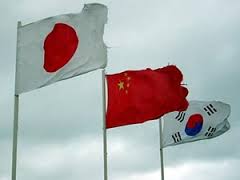 TOKYO – Diplomatic relationships in East Asia have long been held hostage by history. But the region’s “history problem” has been intensifying lately, with growing nationalism among major actors like China, Japan, and South Korea fueling disputes over everything from territory and natural resources to war memorials and textbooks. Can East Asian countries overcome their legacy of conflict to forge a common future that benefits all?
Consider the relationship between America’s closest East Asian allies, Japan and South Korea. Though historical disagreements have long hampered bilateral ties, the increasingly nationalistic stance of Japanese Prime Minister Shinzo Abe and South Korean President Park Geun-hye has aggravated festering tensions. If they fail to work together to stem the revival of bitter historical disputes, their relationship will remain frozen, playing into China’s hands.
And nobody plays the history card with quite as much relish as China, where President Xi Jinping is also relying on nationalism to legitimize his rule. Last year, China introduced two new national memorial days to commemorate China’s long battle against Japanese aggression in World War II: “War against Japanese Aggression Victory Day” on September 3 and “Nanjing Massacre Day” on December 13. What would happen if countries like Vietnam and India dedicated days to remembering China’s aggression toward them since 1949?
By reinforcing negative stereotypes of rival countries, such squabbles over history and remembrance sow fragmentation and instability, and have certainly fueled the region’s recent territorial disputes. Indeed, the politicization of history remains the principal obstacle to reconciliation in East Asia. Repeated attempts to rewrite history – sometimes literally, through textbook revisions – along nationalist lines make it nearly impossible to establish regional institutions.
This should not be the case. Japan and South Korea, for example, are vibrant democracies and export-oriented economic powerhouses, with traditionally close cultural ties and many shared values. In other words, they are ideal candidates for collaboration.
US President Barack Obama recognizes this potential, and has promoted increased strategic cooperation between South Korea and Japan in order to underpin a stronger trilateral security alliance with the US that can balance a rising China. But Japan and South Korea refuse to let go of history.
To be sure, there is some truth to South Korea’s accusation that Japan is denying some of its past behavior. But it is also true that Park – who has refused to meet formally with Abe until he addresses lingering issues over Japan’s annexation of Korea – has used history to pander to domestic nationalist sentiment. Indeed, adopting a hardline stance has enabled her to whitewash some inconvenient family history: Her father, the dictator Park Chung-hee, collaborated with the Japanese military while Korea was under colonial rule.
Abe, too, has stoked tensions, particularly by visiting Tokyo’s Yasukuni Shrine – a controversial memorial that honors, among others, Class A war criminals from World War II. Though Abe visited the shrine only once – in December 2013 – he felt compelled to do so in response to China’s unilateral declaration of an air-defense identification zone, covering territories that it claims but does not control.
Of course, the divergences between Japanese and South Korean historical narratives go back further than WWII. More than a century ago, the Korean activist Ahn Jung-geun assassinated Japan’s first prime minister, Hirobumi Ito, at the railway station in the Chinese city of Harbin, cementing Ahn’s status as a hero in Korea and a terrorist in Japan. Ito’s image can be seen on Japan’s 1,000-yen note; Ahn has appeared on a 200-won postage stamp in South Korea.
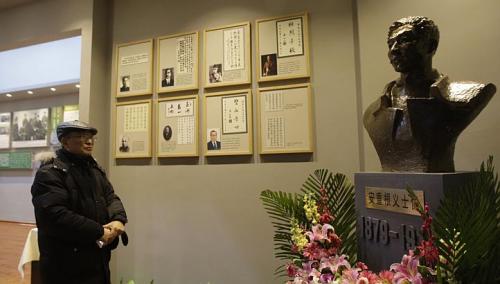
A visitor looking at exhibits at the Chinese memorial to the Korean assassin who killed Japan’s first PM. © AFP
Last year, Park asked Xi to honor Ahn. Xi seized the opportunity to drive a wedge between America’s two main Asian allies, and built a memorial to Ahn. Japan responded by blasting China for glorifying a terrorist and propagating a “one-sided” view of history – a move that, Japan asserted, was “not conducive to building peace and stability.”
Such conflicts have a clear catalyst: Asia’s rising prosperity. As their economies have expanded, Asian countries have gained the confidence to construct and exalt a new past, in which they either downplay their own aggressions or highlight their steadfastness in the face of brutal victimization.
All countries’ legitimizing narratives blend historical fact and myth. But, in some cases, historical legacies can gain excessive influence, overwhelming leaders’ capacity to make rational policy choices. That explains why Park has sought closer ties with China, even though South Korea’s natural regional partner is democratic Japan. One source of hope stems from Abe’s landslide victory in the recent snap general election, which gives him the political capital to reach out to Park with a grand bargain: If Japan expresses remorse more clearly for its militaristic past, South Korea will agree to leave historical grievances out of official policy.
Japan and South Korea cannot change the past. But they can strive to shape a more cooperative future. As a Russian proverb succinctly puts it, “Forget the past and lose an eye; dwell on the past and lose both eyes.”
 Stagecraft and Statecraft
You must be logged in to post a comment.