South Asia’s False Spring

Column internationally distributed by Project Syndicate.

From the armed coup that recently ousted the Maldives’ first democratically elected president, Mohamed Nasheed, to the Pakistani Supreme Court’s current effort to undermine a toothless but elected government by indicting Prime Minister Yousaf Raza Gilani on contempt charges, South Asia’s democratic advances appear to be shifting into reverse.

Nasheed’s forced resignation at gunpoint has made the Maldives the third country in the region, after Nepal and Sri Lanka, where a democratic transition has been derailed. The Maldives, a group of strategically located islands in the Indian Ocean, now seems set for prolonged instability.

Meanwhile, Pakistan has yet to begin a genuine democratic transition, because the chief of army staff remains its effective ruler. How can democratization begin if Pakistan’s army and Inter-Services Intelligence (ISI) agency are immune to civilian oversight and decisive power rests with military generals?

The Supreme Court’s move against Gilani makes matters worse. A constitutional – rather than a military – coup will be a win-win situation for the army and the ISI, allowing them to rule behind the scenes through a more pliable government, on which all of the blame can be pinned for civil disorder and economic turmoil.

Sri Lanka’s human-rights situation under President Mahinda Rajapaksa’s quasi-dictatorship also continues to evoke international concern. The recent end of the country’s 26-year civil war has left behind a militarized society and an emboldened Rajapaksa, who has curtailed media freedom and stepped up efforts to fashion a mono-ethnic identity for a multiethnic Sri Lanka.

In Nepal — a strategic buffer between India and restive Tibet, where China claims to be at “war against secessionist sabotage” — political disarray persists, with political parties bickering over a new constitution. Nepal is in danger of becoming a failed state, which would have major implications for India, with which it has an open border permitting passport-free passage.

Finally, the recent abortive coup attempt in Bangladesh has shown that the world’s seventh most populous country, struggling to remain a democracy under Prime Minister Sheikh Hasina Wajed, remains vulnerable to its unruly military. In its four decades of independence, Bangladesh has experienced 23 coup attempts, some of them successful.

Political developments in the region underscore the insufficiency of free, fair, and competitive elections for ensuring a democratic transition. Elections, by themselves, do not guarantee genuine democratic empowerment at the grassroots level or adherence to constitutional rules by those in power.

As a result of sputtering transitions elsewhere in South Asia, India is now the sole country in the region with a deeply-rooted pluralistic democracy. That is not in India’s interest, for it confronts the country with what might be called the “tyranny of geography” — that is, serious external threats from virtually all directions.

To some extent, it is a self-inflicted tyranny. India’s security concerns over Nepal, Bangladesh, Sri Lanka, and even Pakistan stem from the failures of its past policies. At the very least, the rollback of democracy in the region exposes India’s inability to influence political developments in its own backyard.

Today, political chaos and uncertainty in the region heighten the danger of spillover effects for India, threatening the country’s internal security. An increasingly unstable neighborhood also makes it more difficult to promote regional cooperation and integration, including free trade.

The rise of Islamist groups that has accompanied anti-democratic developments in South Asia represents a further threat to the region. In vandalism reminiscent of the Taliban’s demolition of the monumental Buddhas of Bamyan in Afghanistan in 2001, Islamists ransacked the Maldives’ main museum in Male, the capital, on the day Nasheed was ousted, smashing priceless Buddhist and Hindu statues made of coral and limestone, virtually erasing all evidence of the Maldives’ Buddhist past before its people converted to Islam in the twelfth century. “The whole pre-Islamic history is gone,” the museum’s director lamented.

Encouraged by opposition politicians, Islamist groups in the Maldives are “becoming more powerful,” according to Nasheed. Likewise, in Pakistan and Bangladesh, the military intelligence agencies have nurtured jihadist groups, employing them for political purposes at home and across national frontiers.

This follows a well-established pattern in the region: autocratic rule has tended to promote extremist elements, especially when those in power form opportunistic alliances with such forces. For example, Pakistan’s thriving jihadist factions arose under two military dictators: Muhammad Zia-ul-Haq, who used them to confront the Soviets in Afghanistan, and Pervez Musharraf, who fled to London in 2008 under threat of impeachment and was subsequently charged with involvement in the assassination of former Prime Minister Benazir Bhutto in 2007 — a milestone in Pakistan’s slide into chaos.

When a democratic experiment gains traction, as in Bangladesh under Sheikh Hasina, it crimps the extremists’ room for maneuver. But a broader lesson in much of the region is that democratic progress remains reversible unless the old, entrenched forces are ousted and the rule of law is firmly established.

For example, the Maldives’ 2008 democratic election, which swept away decades-old authoritarian rule, became a beacon of hope, which then dissipated in less than four years. As the freshly deposed Nasheed put it, “Dictatorships don’t always die when the dictator leaves office….[L]ong after the revolutions, powerful networks of regime loyalists can remain behind and can attempt to strangle their nascent democracies.”

As its tyranny of geography puts greater pressure on its external and internal security, India will need to develop more innovative approaches to diplomacy and national defense. Only through more vigorous defense and foreign policies can India hope to ameliorate its regional-security situation, freeing it to play a larger global role. Otherwise, it will continue to be weighed down by its region.

Brahma Chellaney, Professor of Strategic Studies at the New Delhi-based Center for Policy Research, is the author of Asian Juggernaut and Water: Asia’s New Battleground.

Copyright: Project Syndicate, 2012.
www.project-syndicate.org

More Project Syndicate columns by .

Arab Spring hijacked

By BRAHMA CHELLANEY  The Japan Times   February 20, 2012

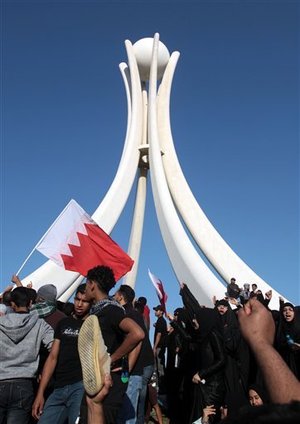
Bahrain’s Pearl Roundabout which authorities demolished with bulldozers.

A year after the Arab Spring came to symbolize the ascent of people’s power, hope has given way to a bleak sequel. The democratic awakening has fallen prey to murky geopolitics that has cleaved the Arab Spring into two parts, with the U.S.-backed kingdoms escaping change but the non-monarchical republics coming under varying degrees of pressure.

The promise of a new era of democracy has been blighted in much of the region by continuing political repression. Worse, war clouds have appeared on the horizon.

What began as protests against food prices, corrupt leaders and lack of government accountability has assumed ominous dimensions. From the rampant but largely unreported human-rights abuses in the post-Muammar Gaddafi Libya to the increasing bloodshed in multiethnic, autocratic Syria, the developments are making the future of the Middle East and North Africa more volatile and uncertain.

Bahrain, which hosts the U.S. Navy’s 5th Fleet, stands out for carrying out the region’s most-successful suppression of an Arab Spring movement, thanks to a Saudi-led military intervention and continuing Western backing. Whereas Cairo’s Tahrir Square has come to epitomize the power of ordinary people to rise up against tyranny, Bahrain’s Pearl Roundabout was simply obliterated with bulldozers — an action that was followed up with arrest and torture of activists as well as of the doctors and nurses who treated the injured. Yet a year later, family-run Bahrain’s future looks anything but stable.

Exacerbating the regional instability is the escalating U.S. geopolitical confrontation with Iran, with both sides currently engaged in a psychological war. U.S. Defense Secretary Leon Panetta’s warning of a looming Israeli attack on Iran and Tehran’s threat to shut down the world’s most important oil-export route — the Strait of Hormuz — are part of this war of nerves. Israel has stepped up its own “shadow war” with Iran, with the two sides ratcheting up a blame game over targeted assassinations and bomb incidents.

The danger that this show of threats could escalate to military hostilities has been underscored by the U.S. declaration of an indirect war against Iran — the imposition of an oil-export embargo to financially throttle Tehran. Given that energy exports account for 80 percent of Iran’s foreign-exchange earnings, the U.S. (and European Union) oil embargo and freeze on Iranian Central Bank assets increase the risks of a military confrontation — the very development these sanctions are meant to avert.

History attests to the linkage between an oil embargo and military hostilities. Although the 1941 Pearl Harbor attack took the United States by surprise, the attack was triggered in some measure by a U.S.-British-Dutch oil-import embargo against Japan as part of a larger economic squeeze that began in 1939. The U.S. move to choke off Iranian oil exports, however, is faltering: India, Japan, China and South Korea — accounting for three-fifths of Iran’s oil sales — have given Washington a polite brushoff.

Four trends in the Arab world have become pronounced.

● The first is the way the Arab Spring movements are reopening traditional fault lines along sectarian and tribal divides and fomenting new internal conflict.

Even as intertribal politics threatens the future of post-Gaddafi Libya, sectarian battle lines are hardening in conflict-battered Syria, where the armed opposition claims to represent the Sunni Arab majority and the besieged Alawite-led regime has cleverly played to the fears of the minorities, which account for almost two-fifths of the national population and include the Alawites, Christians, Kurds and Druze. Similarly, the Bahraini regime, seeking to justify its large-scale repression, has stirred fears among the country’s Sunni elite of an Iranian-backed takeover by the disempowered Shiites, who make up 70 percent of the population.

If the once-peaceful, secular Syria becomes another Lebanon or Afghanistan, a sectarian division of that country is not inconceivable, given that the Sunni Arab and minority populations are largely concentrated in geographically separate areas.

● A second trend has exposed a vein of religious extremism and promoted the ascendancy of Islamist influence, including in the states that have experienced regime change. New opportunities have been opened up for Islamist movements to exert influence and bring themselves to the center-stage, as in Morocco, Kuwait, Libya, Egypt, Yemen, Jordan and Syria.

The new Islamist influence is apparent even in Tunisia, hailed as a model for revolution. In Egypt, the Muslim Brotherhood, which initially collaborated with Gamal Abdel Nasser after his 1952 coup, is again developing close ties with the military that still holds the reins of power, raising concerns of a military-Islamist nexus in Pakistan style.

The oil sheikhdoms, in any case, are theocratic states, which today are aiding Islamist causes in their own backyard.

This is best exemplified by Saudi Arabia and its new avatar, Qatar, which has developed cozy ties with the Muslim Brotherhood in its various incarnations across the Arab world. Qatar — the seat of current U.S. secret talks with the Taliban — indeed has leveraged its natural-gas wealth and unbridled ambition to emerge as a leading backer of Islamist causes, in parallel to the role Saudi Arabia has long played.

● The third trend is represented by the increasingly ugly regional geopolitics, which pits the powerful “Sunni Crescent” led by Turkey, Saudi Arabia, Qatar and the United Arab Emirates against the beleaguered “Shiite Crescent” states — Iran, Iraq, Syria and Lebanon.

Turkey, after being rebuffed in its efforts to join the European Union, has turned its attention to the Arab world, seeking to carve a role for itself as the regional hegemon. To help mend ties with Arab countries — which had long been suspicious of Ankara’s close relationship with Israel, as exemplified by the 1996 Military Training Cooperation Agreement and an unconsummated accord to export Turkish bulk water — Turkey has turned against its ally Israel.

Turkey also has come full circle on Syria. Ankara had accused the regime of Hafez al-Assad — Syrian President Bashar al-Assad’s father — of seeking to build leverage on their bilateral water disputes by actively aiding the Kurdish insurgency in Turkey. But now Turkey is waging a proxy war of its own by providing sanctuary and arms to the Free Syrian Army, besides reverting to hardline anti-Kurdish policies, including military incursions into northern Iraq in pursuit of alleged guerrillas.

Today, the regional contest for geopolitical influence between Turkey and Iran — the inheritors of the Ottoman and Persian Empires — has cast a lengthy shadow over the Arab Spring. This shadow has been made darker by the interventionist impulse of the Saudi and Qatari monarchies, which have sought to create puritanical Islamist surrogates in some other Arab states.

Tiny Qatar, for example, has played an important role in the past year in ousting the Qaddafi regime (including by covertly deploying hundreds of troops in Libya), aiding the Sunni insurrection in Syria, backing Tunisia’s Islamist party leader Rachid Ghannouchi, and brokering the departure of Yemen’s brutal dictator Ali Abdullah Saleh, who, instead of being tried for the killing of hundreds of demonstrators, was recently granted entry into the U.S., in keeping with the foreign-policy maxim, “He may be a bastard, but he is our bastard.”

● A fourth trend is that the Arab Spring has become a springboard for playing great-power geopolitics. Syria, at the center of the region’s sectarian fault lines, has emerged as the principal battleground for such Cold War-style geopolitics. Whereas Russia is intent on keeping its only military base outside the old Soviet Union in Syria’s Mediterranean port of Tartus, the U.S. seems equally determined to install a pro-Western regime in Damascus.

This goal prompted Washington to set up of a London-based television station that began broadcasting to Syria a year before major protests began there. The U.S. campaign, which includes assembling a coalition of the willing, has been boosted by major Turkish, Saudi, Qatari and UAE help, including cross-border flow of arms into Syria and the establishment of two new petrodollar-financed, jihad-extolling television channels directed at Syria’s majority Sunni Arabs.

Moscow continues to arm and politically shield the Assad regime, while Washington has just announced the resumption of military aid to despotic Bahrain, after rewarding Saudi Arabia with a massive arms package. Iran, for its part, wants democracy in Bahrain but status quo in Syria. The Arab League — still the world’s premier organization of tyrants — sent a delegation headed by a tainted military general to monitor Syria’s human-rights situation.

The harsh reality is that such geopolitics has effectively hijacked the Arab Spring.

Today, it is the Arab states with a presidential form of government that are at the center of the ongoing profound changes, which, paradoxically, are sought to be influenced by the iron-fisted but deep-pocketed oil monarchies. Their already-swelling coffers — thanks to the U.S. energy embargo against Iran and rising oil prices — are set to overflow, increasing their leverage in the region and beyond.

The experience of the past half a century shows that the greater the transfer of oil wealth to these monarchies, the more they have funded fundamentalism and extremism, thereby contributing to the rise of international terrorism. In fact, the more wealth they have accumulated, the more the price of freedom has risen in the region.

In this light, the U.S. attempt to give international effect to its new Iran-sanctions law constitutes a double whammy for its close partners, Japan and India. It will sabotage their energy-import-diversification strategy by making them place all its eggs in the basket of the wrong regimes — the ones that bankroll Islamist groups. And, at a time when America is quickening its Afghanistan disengagement with little regard for Indian interests, it will rupture India’s relations with the very country central to its Afghanistan strategy — Iran.

More broadly, the Arabs’ democratic aspirations will likely remain unrealized unless the sharpening geopolitics backfires and the oil sheikhdoms’ insulation from change wears away. Given the way well-entrenched autocratic presidents have fallen from power in Tunisia, Egypt and Yemen, the durability of the region’s monarchs is anything but assured.

Brahma Chellaney is an Asian geostrategist and the author of six books.

(c) Japan Times, 2012.

A double whammy for India

Brahma Chellaney

India’s energy and diplomatic dilemmas have been compounded by murky big-power geopolitics, which has allowed the oil monarchies to ride out the Arab Spring but brought the region’s two remaining anti-Western regimes in Iran and Syria under intensifying pressure. The sharpening U.S.-Israeli geopolitical confrontation with Iran risks escalating to military hostilities. After all, even as Israel steps up its “shadow war” with Tehran, the U.S. has declared indirect war through an oil embargo designed to financially throttle Iran.

The risks of India getting sucked into this geopolitical fight or becoming a proxy battleground are real. Israel’s instant accusation that Iran was behind the New Delhi car bombing serves as a reminder. Why would Iran target someone unimportant — an Israeli diplomat’s wife — just when the West is breathing down India’s neck to cease importing Iranian oil? This is the worst possible time for Iran to alienate one of its last-remaining economic lifelines, India. Despite the explosive device’s sophistication, the car incident in New Delhi (like the one in Tbilisi) bore the characteristics of an amateurish job.

If Iran indeed was behind the attack, it connotes sheer recklessness and incompetence. There has been no instance of Iranian terrorism in India in the past but several instances of Pakistan-based terrorists targeting Israelis or other Jews in areas ranging from Jammu and Kashmir to Mumbai. Yet, with Israeli Prime Minister Benjamin Netanyahu blaming Iran even before the police in New Delhi could complete the initial examination of the car-blast scene and consequently the media following just that angle, a possible link between Pakistan-aided terrorists and the attack has escaped public scrutiny. Significantly, the U.S., while condemning the bomb incidents in New Delhi, Tbilisi and Bangkok, has stopped short of endorsing the Netanyahu-led claims that Iran is behind the bombings.

Still, even as India faces the spectre of a proxy war between Israel and Iran on its soil, the blast incident only adds to the external pressures on New Delhi to break its energy ties with Iran.

More broadly, the narrow logic driving U.S. and Israeli policies has trumped larger considerations. Instead of seeking to reap long-term benefits by promoting genuine democratic transition across the Arab world, the U.S., for example, has deepened its alliance with oil monarchies, including the tyrannical House of Saud and the ambitious Qatari royalty, and winked at Bahrain’s brutal suppression of its Arab Spring movement. The long-term risks of aiding Islamist rulers or groups also have been overlooked.

This explains why the Arab Spring has brought no change to the oil monarchies. It is the Arab states with a presidential form of government that are at the centre of the ongoing profound changes, which, paradoxically, are sought to be influenced by the iron-fisted but deep-pocketed oil sheikhdoms.

Their already-swelling coffers — thanks to the U.S. energy embargo against Iran and rising oil prices — are set to overflow, increasing their leverage in the region and beyond.

The experience of the past half a century shows that the greater the transfer of oil wealth to these monarchies, the more they have funded fundamentalism and extremism, thereby contributing to the rise of international terrorism. In fact, the more wealth they have accumulated, the more the price of freedom has risen in the region.

In this light, the U.S. attempt to give international effect to its new Iran Sanctions Act threatens a double whammy for strategic-partner India. First, it will sabotage India’s energy-import-diversification strategy by making it place most of its eggs in the basket of the Islamist-bankrolling oil monarchies. India will become overly reliant on the wrong types of regimes and thus exposed to the games they play.

Over the years, the share of Iranian crude in India’s total oil imports has declined to barely 11 percent as part of a conscious Indian effort to reduce supply-disruption risks linked with the lurking potential for conflict. Given India’s soaring oil imports and search for new sources of supply, the Iranian share — even if the total quantity remains constant — will likely decline further. Still, as the nearest oil source for India, Iran offers lower shipment costs.

If India joins the total U.S. oil embargo against Iran, Indian refineries with a technical capacity to process only Iranian crude will be left high and dry. Oils from different countries vary in terms of two basic properties — specific gravity and sulphur content. Retrofitting those old refineries to process crude from other countries will be uneconomical.

Second, at a time when the U.S. is quickening its Afghanistan disengagement and seeking to cut a deal with the Taliban with little regard for Indian interests, jumping on the American sanctions bandwagon will rupture India’s relations with the very country central to its Afghanistan strategy — Iran, a conduit for the substantial Indian aid flow to Afghanistan. America’s Afghanistan-exit strategy — which is beginning to look like a sprint — only reinforces Iran’s geopolitical importance for India.

It should not be forgotten that India already has paid a heavy price for taking America’s side on some critical issues in its long-running battle against Iran, even though Washington doesn’t take India’s side in its disputes with China or Pakistan.

The Bush administration persuaded India not to conclude any new long-term oil and gas contracts with Iran and — in return for a civil nuclear deal with the U.S. — abandon the idea of a gas pipeline from Iran. By voting against Iran at the International Atomic Energy Agency’s governing board in 2005 and 2006, New Delhi invited Iranian reprisal in the form of cancellation of a 25-year, $22-billion liquefied natural gas deal which had terms highly favourable to India. That deal’s scrapping alone left India poorer by several billion dollars.

Now the U.S. embargo against Iran — the world’s third-largest net exporter of oil — has pushed international oil prices higher, increasing the oil-import bill of India and a number of other countries, while undercutting civil society in Iran and strengthening the clerical regime there. The embargo indeed is having a negative impact on the global economy by placing additional strain on oil supplies and threatening to slow economic growth.

Significantly, those states in favour of the total oil embargo on Iran (including the U.S., Britain, France and Germany) buy little oil from that country, while those countries advising caution (such as India, Japan, South Korea and China) are important importers of Iranian oil. These four Asian economies account for 60 percent of Iran’s oil sales. The U.S., in fact, stopped importing Iranian oil way back in 1987. The international division thus is between those that have nothing to lose and those that have much to lose.

Yet without offering any credible alternatives, Washington is mounting more pressures related to oil sourcing and payments that strike at the heart of energy-poor India’s efforts to secure stable, assured supplies. The Iran issue, in effect, has turned into a diplomatic litmus test as to whether India will stand up for its energy and geopolitical interests in the region or be co-opted to serve the short-term interests of its friends, particularly the U.S. and Israel.

A version of this article appeared in the Mint, February 17, 2012.

India’s near-abroad: Democracy in retreat

Brahma Chellaney

Mohamed Nasheed who was ousted at gunpoint as president of the Maldives

From the virtual coup d’état that deposed Maldives’ first democratically elected president to the undermining of an elected but toothless government in Pakistan by its Supreme Court, South Asia is witnessing a backsliding on democratic advances, just as the democratic awakening triggered by the “Arab Spring” movements has brought not democratic empowerment but more human-rights abuses in much of the Arab world.

The recent abortive coup attempt in Bangladesh has served as a warning that the world’s seventh most-populous country — while struggling to remain a democracy — is vulnerable to renewed army intervention. In its four-decade-long history, Bangladesh has experienced 23 coup attempts — some successful.

The forced resignation at gunpoint of its president, Mohamed Nasheed, a week ago has made the Maldives the third country in the region after Nepal and Sri Lanka where a democratic transition has gone wrong. The Maldives now seems in for prolonged instability.

A fourth country, Pakistan, has yet to begin a genuine democratic transition because the army chief remains its effective ruler. How can democratization begin if Pakistan’s army and Inter-Services Intelligence stay outside civilian oversight and decisive power remains with military generals?

To make matters worse, Pakistan’s Supreme Court seems to be playing the army’s game in moving to ease the prime minister out of office. A constitutional coup, instead of a military coup, will be a win-win situation for the army and ISI, allowing them to rule from behind the curtain through a more-pliable government, on which all the blame can be pinned for the violence and economic mess.

Sri Lanka’s human-rights situation under President Mahinda Rajapaksa’s quasi-dictatorship continues to evoke international concern. Reversing the militarization of society, ending the control of information as an instrument of state policy, and promoting political and ethnic reconciliation remain daunting tasks in Sri Lanka.

The end of the 26-year civil war actually has emboldened Rajapaksa to step up attempts to fashion a mono-ethnic identity for a multiethnic Sri Lanka. This has important strategic implications for India in terms of the plight of Tamil civilians, refugee flows, and the potential for renewed civil strife.

In Nepal — a strategic buffer between India and restive Tibet, where China says it is launching a “war against secessionist sabotage” — the political disarray persists, with parties continuing to bicker over a new constitution. Nepal remains in danger of becoming a failed state, a development that will have major implications for India’s security.

More broadly, the political developments in the region underscore that regular elections, as in Pakistan or Sri Lanka, are no measure of progress on democratic transition. Genuine democratic empowerment at the grassroots demands more than the holding of elections.

The backsliding on democratization leaves India as the sole country in the region with a deeply rooted democracy and pluralism. But it also seriously weakens India’s interests.

India’s neighbourhood remains so chronically troubled that it confronts what can be called a tyranny of geography. As a result, India faces serious external threats from virtually all directions.

To some extent, this tyranny of a combustible neighbourhood is self-inflicted. If India faces security concerns over Nepal, Bangladesh, Sri Lanka or even Pakistan, it is because of failures of past policy. And the rollback of democracy in South Asia only exposes India’s lack of clout to influence political developments in its backyard.

Today, the political chaos and uncertainty in the neighbourhood heighten the danger of spillover effects for India. It is no accident that India’s internal security is coming under growing pressure. An increasingly unstable neighbourhood also makes it more difficult to promote institutionized cooperation and integration in the region, including free trade.

Institutions are products — not drivers — of the political environment. In any continent, institutions have flourished only if there is political and economic compatibility between their member-states. When member-states have conflicting political and economic systems, the institutions have stunted. Divergent political systems are a major reason why Asia has failed to build real institutions. In South Asia, the underdeveloped SAARC, as a retarded institution, is more a hindrance than a help to regional cooperation. If all South Asian states became real democracies, the present barriers to open trade would erode.

More fundamentally, the rise of Islamist groups in several South Asian countries poses a direct challenge to Indian security. In 2001, the Taliban destroyed the monumental Buddhas of Bamiyan in Afghanistan. And on the day Nasheed was ousted, Islamists ransacked Maldives’ main museum in Male, the capital, and smashed priceless Buddhist statues. By destroying the 12th-century artefacts made of coral stone and limestone, they erased virtually all evidence of Maldives’ pre-Islamic past.

Encouraged by opposition politicians, Islamist groups in the Maldives are “getting more powerful,” according to Nasheed. And in Pakistan and Bangladesh, the military intelligence agency has nurtured jihadist groups, employing them for political purposes at home and across the national frontiers.

Regional experience has shown that autocratic rule, due to the absence of public accountability, tends to promote extremist elements, especially when those in power form opportunistic alliances with such forces. For example, Pakistan’s descent into a jihadist dungeon occurred not under civilian rule, but under two military dictators — one who nurtured and let loose jihadist forces, and another who took his country to the very edge of the precipice. Even today, the scourge of Pakistani terrorism emanates more from the country’s Scotch whisky-sipping generals than from the bead-rubbing mullahs.

When a democratic experiment gains traction, as in Bangladesh under Prime Minister Sheikh Hasina, it crimps the extremist forces’ room for manoeuvre.

A broader lesson that the regional retreat of democracy holds is that democratic progress will remain tenuous and reversible unless the old entrenched forces are cut to size and the rule of law firmly established.

For example, Maldives’ 2008 democratic election, which swept away decades-old authoritarian rule, became a beacon of hope, only to dissipate in less than four years. As Nasheed reminded all after being deposed, “Dictatorships don’t always die when the dictator leaves office … long after the revolutions, powerful networks of regime loyalists can remain behind and can attempt to strangle their nascent democracies.”

In fact, Nasheed has a message for the Arab Spring movements: “The problems we are facing in the Maldives are a warning for other Muslim nations undergoing democratic reform. At times, dealing with the corrupt system of patronage the former regime left behind can feel like wrestling with a Hydra: when you remove one head, two more grow back. With patience and determination, the beast can be slain. But let the Maldives be a lesson for aspiring democrats everywhere: the dictator can be removed in a day, but it can take years to stamp out the lingering remnants of his dictatorship.”

With India’s tyranny of geography only getting worse and putting greater pressure on its external and internal security, India has to evolve more-dynamic and innovative approaches to diplomacy and national defence. For example, if it is to advance its national interest by supporting democracy and pluralism in its neighborhood and beyond, it will need to go beyond government-to-government channels for disbursing its increasingly large aid. Its aid diplomacy must reach out to civil-society groups and other liberal constituencies that can take on retrograde elements. Only through forward thinking and more-vigorous defence and foreign policies can India hope to ameliorate its regional-security situation and play a bigger role on the world stage.

Brahma Chellaney, Professor of Strategic Studies at the Center for Policy Research, is the author, mostly recently, of Water: Asia’s New Battleground.

A version of this article appeared in The Economic Times, February 14, 2014.

China’s Drive to Lock Up Long-Term Supply of Strategic Resources

Date of the hearing: January 26, 2012

Title of the hearing: China’s Global Quest for Resources and Implications for the United States

Name of panelist: Brahma Chellaney

Panelist’s title and organization: Professor of Strategic Studies, Center for Policy Research, New Delhi

Testimony by Professor Brahma Chellaney before the U.S.-China Economic and Security Review Commission

Dirksen Senate Office Building, Room 562
Washington, DC 20510

China has pursued an aggressive strategy to secure (and even lock up) supplies of strategic resources like water, energy and mineral ores. Gaining access to or control of resources has been a key driver of its foreign and domestic policies. China, with the world’s most resource-hungry economy, is pursuing the world’s most-assertive policies to gain control of important resources.

Much of the international attention on China’s resource strategy has focused on its scramble to secure supplies of hydrocarbons and mineral ores. Such attention is justified by the fact that China is seeking to conserve its own mineral resources and rely on imports. For example, China, a major steel consumer, has substantial reserves of iron ore, yet it has banned exports of this commodity. It actually encourages its own steel producers to import iron ore. China, in fact, has emerged as the largest importer of iron ore, accounting for a third of all global imports. India, in contrast, remains a major exporter of iron ore to China, although the latter has iron-ore deposits more than two-and-half times that of India.

But while buying up mineral resources in foreign lands, China now supplies, according to one estimate, about 95 percent of the world’s consumption of rare earths — a precious group of minerals vital to high-technology industry, such as miniaturized electronics, computer disk drives, display screens, missile guidance, pollution-control catalysts, and advanced materials. In a calculated way, Beijing has cornered the international market for these strategic minerals, which include cerium, neodymium, lanthanum, yttrium and dysprosium. It built its virtual monopoly by first quietly making some major foreign investments to get hold of important processing and manufacturing technologies for rare earths, which it mines largely in Inner Mongolia.

The international focus on China’s hydrocarbon and mineral-ore acquisition strategy, however, obscures the way it has systematically sought to corner the resources of international rivers. Its aggressive water strategy has resulted in water becoming a new divide in its relations with several of its neighbors, including India, Russia, Kazakhstan, and Vietnam.

Much of Asia is now at or near water-stressed conditions. This stress holds important implications for Asia’s continued rapid economic growth, socioeconomic stability, and environmental sustainability. China’s aggressive strategy is only helping to compound Asia’s water challenges.

While China can scour the world for oil, natural gas, and mineral ores to keep its economic machine humming, it does not have the same choice on water, which cannot be secured through international trade deals. So, it has started damming international rivers in a major way.

To be sure, China faces a growing gap between water supply and demand. In the Han heartland, the south is water-rich but the north is plagued by serious water shortages. The north is largely semiarid, yet the introduction of large-scale irrigated agriculture has turned the north into a breadbasket. This has created a strange paradox: the north now is seeking to rely on water transfers from the south via the Great South-North Water Diversion Project while remaining a food exporter to the south.

China’s over-damming of internal rivers and its inter-river and inter-basin water transfer projects are exacting heavy environmental costs, besides causing river depletion and pollution of water. With China now shifting its focus to transnational rivers that flow to neighboring countries, there is a serious risk that these international rivers could also become seriously degraded.

Some water-related facts about China stand out. China, the geographical hub of Asia, is the source of transboundary-river flows to the largest number of countries in the world — from Russia to India, and from Kazakhstan to the Indochina Peninsula. It is thus an upper riparian vis-à-vis almost all its neighbors. This unique status is rooted in China’s forcible absorption since 1949 of sprawling ethnic-minority homelands, which make up 60 percent of its landmass and are the origin of all the important international rivers flowing out of Chinese territory. The Tibetan Plateau, for example, is the world’s largest freshwater repository and the source of Asia’s greatest rivers, including those that are the lifeblood for mainland China and South and Southeast Asia.

Getting this preeminent riparian power to accept water-sharing arrangements or other cooperative institutional mechanisms has proved unsuccessful so far in any basin. Instead, its construction of upstream dams on several major international rivers, including the Mekong, Salween, Brahmaputra, Arun, Irtysh, Illy, and Amur, shows that China is increasingly headed in the opposite direction — toward unilateralist actions impervious to the concerns of downstream nations.

By building giant dams near the borders on the major rivers flowing to Southeast Asia, South Asia, and Central Asia, China is acquiring the capability to control cross-border flows and fashion water into a potential political weapon. Water is as essential as the air we breathe, and China is acquiring the capability to control the lion’s share of Asia’s cross-border river flows. This will give it tremendous leverage over its neighbors. In fact, with the rapid accumulation of Chinese economic and military power and the growing regional power asymmetry, Beijing has been emboldened to embark on water-diversion plans.

China’s frenzied dam building, far from slowing, has only picked up more momentum in the name of increasing its renewable-energy capacity. Even with 25,800 of the world’s approximately 50,000 large dams, China remains on a dam-building spree, with a plan to boost its hydropower-generating capacity from 170 gigawatts to 250 gigawatts by 2020. Renewable energy now serves as a useful plank to pursue what China has been doing for long — over-damming its rivers. The silting of the reservoir of the world’s biggest dam, Three Gorges, has only prompted the construction of more dams upstream, including in ecologically sensitive areas, to help flush the silt.

The plain fact is no country in history has been a greater dam builder than China. The dam-building spree started under Mao Zedong but it has accelerated in the post-Mao period. Although China already boasts more dams than the rest of the world put together, it has recently unveiled a mammoth 4-trillion-yuan ($635-billion) fresh investment in water infrastructure over the next decade, more than a third of which will be utilized for building dams, reservoirs, and other water-supply structures. Its vice minister of water resources announced October 12, 2011, that the new investment would be aimed at harnessing the waters of the country’s rivers, rebuilding or reinforcing more than 46,000 reservoirs, and extending the irrigation networks. The vice minister also admitted China’s uncontrolled economic growth has left up to 40 percent of its rivers badly polluted and that the country faced “huge pressures” on supplies of water. “Industrialization and urbanization, including ensuring grain and food security, are exerting higher demands on water supplies … while our water use remains crude and wasteful,” Jiao Yong said at a press briefing.

Yet, China has stepped up its reengineering of river flows in two ways: by portentously shifting its focus from internal rivers to international rivers; and by graduating from building large dams to building mega-dams. For example, its newest dams on the Mekong River are the 4,200-megawatt Xiaowan — taller than Paris’s Eiffel Tower and producing more electricity than the installed hydropower-generating capacity of all of the lower Mekong countries together — and the 5,850-megawatt Nuozhadu, which when complete will be even bigger in storage volume but not in height.

In mid-2010, China’s state-run hydropower industry published a map of major new dams approved for construction, including one on the Brahmaputra River at Metog (or “Motuo” in Chinese) that is to be twice larger than the 18,300-megawatt Three Gorges Dam, which Beijing likes to trumpet as the greatest architectural feat since the Great Wall was built despite the dam’s increasingly damaging effects on the Yangtze River system. The Metog site is close to the disputed border with India.

Daduqia, almost on the border with India, has been officially identified as the site for another mega-dam to impound the Brahmaputra’s waters. Both Metog and Daduqia are to harness the force of a nearly 3,000-meter drop in the river’s height as it takes a sharp southerly turn from the Himalayan range into India. This area is in the Brahmaputra’s “Great Bend,” so called because the river there makes a hairpin-style turn around Mount Namcha Barwa, forming the world’s longest and steepest canyon in the process. The Brahmaputra Canyon — twice as deep as the Grand Canyon in the U.S. — holds Asia’s greatest untapped water reserves.

China’s state-owned media has not tried to conceal the linkage between the ongoing infrastructure development in this remote, high-altitude region around the canyon and official plans to harness the Brahmaputra’s resources. For example, Xinhua has quoted a tourism official as saying that the new highway from Metog to Bomi, which links up with the Sichuan-Tibet highway, will permit the tapping of the rich water resources in the Brahmaputra canyon. A high-altitude airport in Nyangtri city not far from these two dam sites has also been built. The next goal is to build a railroad to the region.

In addition, China has planned the “Great Western Route,” the proposed third leg of the Great South-North Water Diversion Project, whose first two legs in the Han heartland are scheduled to be completed in 2014. The “Great Western Route,” by contrast, is centered on the Tibetan Plateau. It is designed to take the waters of the Brahmaputra, the Salween, the Mekong, and three Yangtze tributaries to the Yellow River, the main river of northern China which also originates in Tibet. Work on the Great Western Route — or least some components of it — is likely to begin after the first two legs of the Great South-North Water Diversion Project are complete. Despite their staggering environmental and social costs, China is fast completing the first two legs. Along the middle route, which starts in Hubei Province and snakes 1,300 kilometers to Beijing, about 350,000 villagers are being relocated to make way for this diversion.

Yet another fact sticks out: In the next one decade, according to international projections, the number of dams in the developed countries is likely to remain about the same, while much of the dam building in the developing world, in terms of aggregate storage-capacity buildup, will be concentrated in just one country — China.

The consequences of such frenetic construction are already visible. First, China is now involved in water disputes with almost all its riparian neighbors, even North Korea, with which it shares two border rivers. Beijing reacted angrily to the recent decision of the government in Burma (Myanmar) to halt a controversial Chinese-led dam project on Burmese territory. The now-stalled $3.6 billion Myitsone Dam, located at the headwaters of Burma’s largest river, the Irrawaddy, was designed to pump electricity into China’s power grid, despite the fact that Burma suffers daily power outages. The State-Owned Assets Supervision and Administration Commission of China’s State Council, in fact, had hailed Myitsone as a model overseas project serving Chinese interests. The Burmese decision thus shocked China’s government, which had begun treating Burma as a reliable client state (one where it still has significant interests, including the construction of a multibillion-dollar oil and natural-gas pipeline).

China’s upstream dam building on the Mekong on a massive scale has rightly attracted a lot of attention. The Mekong, whose watershed is shared by six countries, is the lifeblood for continental Southeast Asia. Ignoring the concerns of downstream states, China has continued work on a cascade of giant dams in Yunnan Province just before the river enters the area where the borders of Burma, Thailand, and Laos converge. Through a cascade of 12 planned dams, China has sought the tap the river’s hydropower reserves as it gushes from the high gorges on its route from the Tibetan Plateau to lower Yunnan. Transparency has become an important interstate issue, with the governments in Southeast Asia calling upon Beijing to shed its opacity and provide detailed technical information on its existing and upcoming dams.

Dam building on the Mekong, of course, extends beyond China. Emulating the example set by China, Laos and Cambodia have proposed building several dams either on the Mekong or its tributaries. In fact, Laos, whose catchment region generates 35 percent of the Mekong’s annual flows, has drawn an ambitious program to power its development through hydropower exports by becoming “the battery of Asia.” Interestingly, the majority of the planned Laotian and Cambodian dams involve Chinese financial, design, or engineering assistance, with the projects designed to export electricity to China. Yet it is China’s cascade of upstream mega-dams that promises to wreak the greatest ecological damage, besides affecting cross-border flows.

China’s increasing exploitation of the resources of the Irtysh, Illy, and Amur rivers has turned water into a major bone of contention with downstream Kazakhstan and Russia. The Amur River (known as Heilong Jiang in Chinese) separates the Chinese and Russian parts of Manchuria. The Irtysh is the main tributary of the Ob River, which traverses the Omsk Region in southwestern Siberia. China has pursued a series of canals, dams, and hydropower stations on the Irtysh and Illy rivers as part of its western development program, spurring Russian and Kazakh concern. Kazakhstan has officially expressed deep concern that the Chinese projects on the Illy River, for example, could turn Kazakhstan’s Lake Balkhash into another Aral Sea, which has shrunk to less than half its original size.

As part of its new renewable-energy drive unveiled in the recent five-year plans for 2011-2015, China has clearly signaled that mega-dams on the Salween and Brahmaputra would be taken up as priority strategic projects, in addition to dams on the Arun River, which flows into Nepal before becoming a major tributary of the Ganges in India.

The concerns over the Chinese dam building on the Salween, known as Gyalmo Ngulchu in Tibetan, Thanlwin in Burmese, and Nu Jiang (“the Angry River”) in Chinese, have centered on the threat to the Three Parallel Rivers area, which was added to the World Heritage List by UNESCO in 2003. But no sooner had that decision been made by UNESCO than China announced plans to build 13 mega-dams on the Salween in Yunnan, nine of them in its National Nature Reserves. That led to an international uproar, which prompted the Chinese government to shelve the dam-building plans. But since last year, in the name of boosting renewable energy and combating climate change, the same plans are being revived. The Three Parallel Rivers area, located on the southeastern rim of the Tibetan Plateau in Yunnan Province, is inhabited by 16 different ethnic groups and is rated as one of the world’s most biologically diverse temperate regions.

China has dammed the Salween in Tibet — where it originates on the outer Himalayan rim — as exemplified by its 34-meter-high dam at Chalong in Nagchu Prefecture. It has also completed half of the 88 planned water projects, many of them small or medium-size hydropower plants, on the Salween and its tributaries in Yunnan Province’s Nujiang Lisu Autonomous Prefecture. The current concern is focused on the cascade on giant dams it intends to build on the Salween in Yunnan near the Three Parallel Rivers area, where the Salween, the Mekong, and the Jinsha (a Yangtze tributary) run roughly parallel, north to south.

China already has built 11 dams on the Brahmaputra River, which flows from Tibet to Bangladesh via northeastern India. Most of these dams are modest in size, with some of them linked to the Three Rivers Development Project involving the Brahmaputra and its two key tributaries, the Kyichu (or the Lhasa River) and the Nyangchu. In March 2009, however, the chairman of the Tibet Autonomous Regional Government unveiled plans for major new hydropower stations on the Brahmaputra. A series of six major dams will now come up in the upper-middle reaches of the Brahmaputra, to the southeast of Lhasa, with construction of the first — the run-of-the-river Zangmu hydropower project — beginning in 2009 itself. India, through its technical-intelligence capability, however, has identified 24 Chinese projects in progress on the Brahmaputra, a majority of them small- to medium-size dams. The larger dams are coming up at Jiacha, Lengda, Zhongda, Langzhen, and Jiexu.

If China proceeds to build a dam twice larger than the Three Gorges Dam at Metog, it will have a devastating impact on Bangladesh, whose very future is threatened by environmental and climate change. The Chinese diversion would mean environmental devastation of large parts of Bangladesh, which is not a small state but the world’s seventh most populous nation, with more than 167 million citizens. Although tiny Monaco boasts the world’s highest population density, the country with the greatest population density other than a microstate is Bangladesh.

The Brahmaputra is the most important river of Bangladesh. With its indigenous renewable water resources estimated at just 105 cubic kilometers (km3) per year — of which the groundwater part is limited to 21.1 km3 — Bangladesh heavily depends on the inflowing rivers from India that originate either there or in Tibet. That the waters of the Brahmaputra are the lifeblood for the largest number of Bangladeshis can be seen from the fact that more than half of Bangladesh’s total quantity of transboundary waters is delivered by this river alone.

The People’s Liberation Army remains an enthusiastic backer of the plan to divert the waters of the Brahmaputra. The plan comprises two projects: the construction at the river’s “Great Bend” of a dam more than twice as large as the Three Gorges Dam, and the Brahmaputra’s diversion northward as part of the so-called Great Western Route. PLA generals were the first to encourage federal authorities to examine the idea of rerouting the Brahmaputra’s waters northward. The mega-plan proposal not only received the support of a number of PLA generals, but the technical assessments that had been carried out until then prompted the influential General Zhao Nanqi in October 2000 to declare: “Even if we do not begin this water diversion project, the next generation will. Sooner or later it will be done.”

In 2006 Li Ling, the author of Tibet’s Waters Will Save China (Xizang Zhi Shui Jiu Zhongguo: Da Xi Xian Zai Zao Zhongguo Zhan Lue Nei Mu Xiang Lu) and an ex-army officer himself, was quoted as saying that PLA generals support the diversion project. In fact, the publication of Li Ling’s book Tibet’s Waters Will Save China in November 2005 and its government-sponsored distribution among policy and engineering circles signaled an official interest in launching the Greater Western Route project. The book details the ambitious Brahmaputra-to-Tianjin diversion plan. Li’s plan has sought to overcome the obstacles posed by the tall mountains and the world’s longest, steepest canyon at the “Great Bend” by moving the main diversion point farther upstream.

Domestically, China new focus on water megaprojects in the traditional homelands of ethnic minorities has triggered fresh tensions along ethnic fault lines over displacement and submergence at a time when the Tibetan Plateau, Xinjiang, and Inner Mongolia have all been wracked by protests against Chinese rule. The projects, as mentioned earlier, threaten to replicate in international rivers the serious degradation haunting China’s internal rivers. Having extensively contaminated its own major rivers through reckless industrialization and overexploitation of resources, China now threatens the ecological viability of river systems tied to other Asian nations in its bid to meet its thirst for water and energy.

Significantly, China is also the largest dam builder overseas. From Pakistan-held Kashmir to Burma’s troubled Kachin and Shan states, China has widened its dam building to disputed or insurgency-torn areas, despite local backlash. Units of the People’s Liberation Army are engaged in dam and other strategic projects in the restive, Shiite region of Gilgit-Baltistan in Pakistan-held Kashmir.

Thirty-seven Chinese financial and corporate entities are currently involved in more than 100 major dam projects in the developing world. Some of these entities are very large and have multiple subsidiaries. For instance, Sinohydro Corporation, the world’s largest hydroelectric-equipment exporter, boasts 59 overseas branches.

For downriver countries, a key concern is China’s opacity on its hydroengineering projects. It usually begins work quietly, almost furtively, and then presents the project as an unalterable fait accompli and as holding transboundary flood-control benefits.

Worse still, China rejects the very notion of a water-sharing arrangement or treaty with any riparian neighbor. The terms “water sharing,” “shared water resources,” “treaty” and “common norms and rules” are an anathema to it. It is one of only three countries that voted against the 1997 United Nations Convention that lays down rules on the shared resources of international watercourses.

So, there are water treaties among states in South and Southeast Asia, but not between China and any of its neighbors. That the country with a throttlehold over the headwaters of major Asian rivers is also a rising superpower, with a muscular confidence increasingly on open display, only compounds the regional security challenges.

China is willing to share hydrological data with riparian neighbors (that is, the statistics on river water flows) but not their waters. In fact, China deflects attention from its refusal to share water, or to enter into institutionalized cooperation to manage common rivers sustainably, by flaunting the accords that it has signed on sharing flow statistics with riparian neighbors. These are not agreements to cooperate on shared resources, but rather commercial accords to sell hydrological data that other upstream countries provide free to downriver states.

Yet, despite such a record, China continues to employ public diplomacy to try and assuage concerns in neighboring countries. Its public-relations machine keeps repeating the message that China has no intention of pursuing projects that would be “detrimental” to the interests of neighboring countries. Even as it builds new dams on international rivers, it speciously contends that they are not detrimental to downriver countries’ interests.

Jiao Yong, the Chinese vice minister of water resources, said on September 12, 2011: “The Yarlung Tsangpo [Brahmaputra] river flows across China’s Qinghai-Tibet Plateau. Many Chinese citizens have been calling for greater usage of this river. However, considering the technical difficulties, the actual need of diversion, and the possible impact on the environment and state-to-state relations, the Chinese government has no plans to conduct any diversification project in this river.” Although the vice minister spoke of no “diversification” plan on Brahmaputra, some Indian newspapers misinterpreted his remark as no “diversion” plan. The minister, in his terse and inscrutable comment, began by emphasizing “the actual need of diversion.” The point is that China usually begins quietly on any project and then presents the project as an unalterable reality.

Against this background, there is a significant risk of greater inter-riparian tensions and politicization of water in Asia. The time has come to exert concerted external pressure on China to rein in its dam frenzy and embrace international environmental standards and water-sharing arrangements.

In March 2010, the State Department rightly upgraded water as “a central U.S. foreign policy concern,” noting that as rising populations face diminishing water resources, “the probability of conflict will increase.” The State Department must now spotlight the threat to Tibetan waters from China’s hydroengineering projects and its refusal to accept institutionalized cooperation with co-riparian states. Water, in fact, is a geopolitical weapon in China’s hands that it can potentially use against lower-riparian countries, whose economies depend on the flow of river waters from the Tibetan Plateau.

(c) U.S.-China Economic and Security Review Commission.

No Escape from Empire’s Graveyard

Column internationally syndicated by Project Syndicate, February 2012

With the stage set for secret talks in Qatar between the United States and the Taliban, US President Barack Obama’s strategy for a phased exit from war-ravaged Afghanistan is now being couched in nice-sounding terms that hide more than they reveal. In seeking a Faustian bargain with the Taliban, Obama risks repeating US policy mistakes that now haunt regional and international security.

Since coming to office, Obama has pursued an Afghan strategy that can be summed up in three words: surge, bribe, and run. The military mission has now entered the “run” part, or what euphemistically the administration began calling the “transition to 2014.” But with the White House recently deciding to end combat operations in Afghanistan by 2013 — a year earlier — the “run” part is starting to look like a sprint.

The central objective is to cut a deal with the Taliban so that the US and its NATO partners exit the “graveyard of empires” without losing face. This approach — aimed more at withdrawing forces as soon as possible than at ensuring enduring peace and regional stability — is being dressed up as “reconciliation,” with Qatar, Germany, and the United Kingdom getting lead roles in facilitating a settlement.

Yet what stands out is how little the US has learned from the past. In critical respects, it is beginning to repeat its own mistakes, whether by creating or funding new local militias in Afghanistan, or by striving to come to terms with the Taliban. As with the covert war that the US waged in the 1980’s in Afghanistan against Soviet military intervention, so, too, have short-term interests driven US policy in the current overt war.

To be sure, any leader must work to extricate his country from a protracted war, so Obama is right to seek an end to this one. But he was not right in laying out his cards in public and emboldening the enemy.

Within weeks of assuming office, Obama publicly declared his intention to withdraw US forces from Afghanistan, before he even asked his team to work out a strategy. A troop surge that lasted up to 2010 was designed not to rout the Taliban militarily, but to strike a political deal with the enemy from a position of strength. Yet, even before the surge began, its purpose was undercut by the exit plan, followed by a publicly announced troop drawdown, stretching from 2011 to 2014.

A withdrawing power that first announces a phased exit and then pursues deal-making with the enemy undermines its regional leverage. It speaks for itself that the sharp deterioration in US ties with the Pakistani military has occurred since the drawdown timetable was unveiled. The phased exit encouraged Pakistani generals to play hardball. Worse, there is still no clear US strategy on how to ensure that the endgame does not undermine Western interests or further destabilize the region.

The US envoy to the region, Marc Grossman, has already held a series of secret meetings with the Taliban. Qatar has been chosen as the seat of fresh US-Taliban negotiations in order to keep the still-skeptical Afghan government at arm’s length (despite the pretense of “Afghan-led” talks), and to insulate the Taliban negotiators from Pakistani and Saudi pressure. Meanwhile, even as a civil-military showdown in Pakistan compounds Washington’s regional challenges, the new US push to contain Iran threatens to fuel greater turbulence in neighboring Afghanistan.

In truth, US policy on the Taliban, at whose birth the CIA played midwife, is coming full circle for the second time in little more than 15 years. The Clinton administration acquiesced in the Taliban’s ascension to power in 1996 and turned a blind eye as that thuggish militia, in league with Pakistan’s Inter-Services Intelligence, fostered narcotics trafficking and swelled the ranks of Afghan war alumni waging transnational terrorism. With the terror attacks of September 11, 2001, however, the chickens came home to roost. In declaring war on the Taliban, US policy came full circle.

Now, US policy, with its frantic search for a deal with the Taliban, is about to complete another orbit. Indeed, the Qatar-based negotiations highlight why the US political leadership has deliberately refrained from decapitating the Taliban. The US military has had ample opportunities (and still has) to eliminate the Taliban’s Rahbari Shura, or leadership council, often called the Quetta Shura because it relocated to that Pakistani city.

Yet, tellingly, the US has not carried out a single drone, air, or ground strike in or around Quetta. All of the US strikes have occurred farther north, in Pakistan’s tribal Waziristan region, although the leadership of the Afghan Taliban and of its allied groups, like the Haqqani network and the Hekmatyar band, is not holed up there.

Like the US occupation of Iraq, the NATO war in Afghanistan will leave behind an ethnically fractured country. Just as Iraq today is, for all intents and purposes, ethnically partitioned, it will be difficult to establish a post-2014 government in Kabul whose writ runs across Afghanistan. And, just as the 1973 US-North Vietnam agreements were negotiated after the South Vietnamese regime was shut out of the talks, the US today is shutting out the Afghan government, even as it compels President Hamid Karzai to lend support and appears ready to meet a Taliban demand to transfer five incarcerated Taliban leaders from Guantánamo Bay.

These negotiations, in which the US is seeking the creation of ceasefire zones to facilitate its forces’ withdrawal, can only undercut the legitimacy of the Karzai government and bring the Quetta Shura back to center stage. But Afghanistan is not Vietnam. An end to NATO combat operations will not mean the end of the war, because the enemy will target Western interests wherever they may be. America’s fond hope to contain terrorism regionally promises instead to ensure that Afghanistan and Pakistan remain a festering threat to regional and global security.

Brahma Chellaney is Professor of Strategic Studies at the Center for Policy Research in New Delhi and the author of Asian Juggernaut.

Copyright: Project Syndicate, 2012.
www.project-syndicate.org

You might also like to read more from  or return to Project Syndicate’s home page.

Els aliats naturals a l’àsia

Brahma Chellaney

Democràcies marítimes com el Japó i l’índia han de cooperar per crear a l’àsia un ordre estable i liberal Els dos països han iniciat un diàleg estratègic amb els EUA al qual és possible que també s’afegeixi Austràlia

La Vanguardia (Català), 30 ene 2012

EB. CHELLANEY, n un moment en què l’ascens econòmic, diplomàtic i militar de la Xina projecta l’ombra d’un desequilibri de poder sobre l’àsia, la visita fa poques setmanes del primer ministre japonès, Yoshihiko Noda, a l’índia ha consolidat una relació que s’està intensificant ràpidament entre dos aliats naturals. Ara la tasca del Japó i l’índia és afegir un contingut estratègic concret als seus vincles.

L’equilibri de poder que està sorgint a l’àsia estarà determinat principalment pels esdeveniments a l’àsia oriental i a l’oceà Índic. Així, doncs, el Japó i l’índia tenen un paper important per exercir en la preservació de l’estabilitat i la contribució a la salvaguarda de rutes marines d’importància decisiva a la regió indopacífica, en sentit més ampli, caracteritzada no només per la confluència dels oceans Índic i Pacífic, sinó també per la seva importància per al comerç mundial i els subministraments energètics.

Les regions d’àsia amb auge econòmic són costaneres, per la qual cosa democràcies marítimes com el Japó i l’índia han de cooperar per tal de crear a l’àsia un ordre estable, liberal i basat en les normes. Com va dir el primer ministre indi, Manmohan Singh, a la reunió de la cimera de l’àsia oriental celebrada a Bali, l’ascens continu d’àsia no està automàticament assegurat i “depèn de l’evolució d’una estructura cooperativa”.

El Japó i l’índia, com a països amb pocs recursos energètics i dependents en gran manera de les importacions de petroli del golf Pèrsic, estan profundament preocupats pels afanys mercantilistes encaminats a assegurar-se el domini dels subministraments energètics i les rutes de transport per a aquests. Així, doncs, el manteniment d’un àmbit marítim pacífic i legal, incloent-hi una llibertat de navegació sense traves, és decisiu per a la seva seguretat i benestar econòmics. Aquesta és la raó per la qual han acordat iniciar maniobres aèries i navals conjuntes a partir del 2012; un dels senyals del pas d’una actitud encaminada a subratllar els valors compartits cap a una altra d’encaminada a protegir interessos compartits.

De fet, malgrat la seva complicada política interna i els seus escàndols endèmics, l’índia i el Japó tenen la relació bilateral que s’intensifica més ràpidament a l’àsia actual. Des que van anunciar una “associació estratègica i global” l’any 2006, el seu compromís polític i econòmic s’ha intensificat notablement. Una congruència en augment d’interessos estratègics va propiciar la Declaració Conjunta sobre Seguretat i Cooperació del 2008, una fita important en la creació d’un ordre asiàtic estable, en el qual una constel·lació d’estats vinculats per interessos comuns ha arribat a ser decisiva per garantir l’equilibri en un moment en què els canvis actuals en el poder incrementen les amenaces a la seguretat.

La declaració conjunta va seguir el model de l’acord de cooperació en matèria de defensa del 2007 amb Austràlia, l’altre país amb el qual el Japó, aliat militar dels Estats Units, té un acord de cooperació en matèria de seguretat. La declaració sobre seguretat de l’índia i el Japó va engendrar, al seu torn, un acord similar entre l’índia i Austràlia el 2009.

El mes d’agost passat va entrar en vigor un acord de lliure comerç entre el Japó i l’índia, abans conegut com a acord d’associació econòmica general i, en resposta a la utilització punitiva per part de la Xina del seu monopoli a la producció procedent de terres rares per interrompre aquesta classe d’exportacions al Japó durant la tardor del 2010, els dos països han acordat cooperar en matèria de desenvolupament de terres rares, que tenen una importància decisiva per a una gran diversitat de tecnologies energètiques ecològiques i les aplicacions militars.

Actualment, el nivell i la freqüència del compromís bilateral oficial són extraordinaris. La visita de Noda a Nova Delhi va formar part d’un compromís per part dels dos països de celebrar una cimera anual, a la qual assistiran els seus primers ministres.

Més important encara és que el Japó i l’índia mantinguin ara diversos diàlegs ministerials anuals: un diàleg estratègic entre els ministres d’afers Exteriors, un altre sobre seguretat entre els ministres de Defensa, un altre de normatiu entre el ministre de Comerç i Indústria de l’índia i el ministre d’economia, Comerç i Indústria del Japó i d’altres més sobre afers econòmics i energètics.

I, per acabar de completar tot això, el Japó, l’índia i els Estats Units van iniciar un diàleg estratègic trilateral a Washington el 19 de desembre. La incorporació dels Estats Units ha de reforçar la cooperació entre l’índia i el Japó. Com va dir recentment el ministre d’afers Exteriors del Japó, Koichiro Gemba, “El Japó i els Estats Units estan intensificant una relació estratègica amb l’índia” i el diàleg trilateral és “un exemple concret de col·laboració” entre les tres democràcies principals d’àsia i el Pacífic. És probable que la cooperació esmentada esdevingui quadrilàtera amb la inclusió d’austràlia.

El Japó i l’índia han d’enfortir la seva encara incipient cooperació estratègica fent seves dues idees que requereixen un canvi subtil en el pensament i la política japonesos. Una és la de crear la interoperabilitat entre les seves formidables forces navals que, en cooperació amb altres armades amigues, pot reforçar la pau i l’estabilitat a la regió indopacífica. Com va dir l’ex primer ministre japonès, Shinzo Abe, en un discurs recent a Nova Delhi, la finalitat ha de ser que “aviat abans que tard, l’armada del Japó i la de l’índia estiguin perfectament interconnectades”. Actualment, el Japó només té interoperabilitat naval amb les forces dels Estats Units.

La segona idea és la de desenvolupar en comú sistemes de defensa. L’índia i el Japó cooperen en matèria de defensa mitjançant míssils amb Israel i els Estats Units, respectivament. No hi ha motius perquè no ho facin en matèria de defensa amb míssils i altres tecnologies per a la seguretat mútua. La cooperació esmentada ha de ser completa i no s’ha de limitar al diàleg estratègic, la cooperació marítima i les maniobres navals ocasionals.

A la Constitució del Japó, imposada pels Estats Units, no hi ha una prohibició d’exportacions d’armes, sinó només una decisió governamental adoptada ja fa molt i que, en qualsevol cas, s’ha relaxat. De fet, la decisió original es referia a armes, no a tecnologies.

Les associacions econòmiques més estables del món, incloent-hi la comunitat atlàntica i l’associació entre el Japó i els Estats Units, descansen sobre la col·laboració en matèria de seguretat. Els vincles econòmics que manquen del suport de les associacions estratègiques solen ser menys estables i fins i tot inestables, com es fa palès en les relacions econòmiques que l’índia i el Japó tenen amb la Xina. Mitjançant una estreta col·laboració estratègica, el Japó i l’índia han d’encapçalar l’afany de crear llibertat, prosperitat i estabilitat a la regió indopacífica.