President Donald Trump meets with Emir of Qatar Sheikh Tamim bin Hamad al-Thani aboard Air Force One. AP Photo
For decades, Washington treated the Gulf monarchies as the immovable pillars of American power in the Middle East. The U.S. military presence there evolved into a vast, interconnected web of bases and infrastructure stretching across Qatar, Saudi Arabia, the United Arab Emirates, Bahrain, Kuwait and Oman.
These states hosted U.S. troops, bought American weapons and aligned themselves with Washington’s regional priorities. In return, they expected the ultimate prize: protection under the American security umbrella.
That bargain is now fraying — and perhaps breaking.
The most important geopolitical shift in the Middle East today is not happening in Tehran, Tel Aviv or Ankara. It is happening quietly inside the royal courts of the Gulf sheikhdoms, which are reassessing whether the U.S. is still a reliable security guarantor or merely a power that uses their territory while leaving them exposed to retaliation.
When the U.S., in concert with Israel, launched war on Iran earlier this year, Gulf Arab states cooperated. American warplanes operated from bases on their soil. Trump singled out Saudi Arabia, Qatar and the UAE as “excellent” partners while deriding NATO allies and Indo-Pacific partners for refusing to participate.
But the praise concealed a deeper problem: The Gulf states discovered that supporting American military operations carried potentially catastrophic costs for them, as their energy facilities and desalination plants became targets of Iranian reprisals. Gulf rulers watched as the U.S. deployed enormous military resources (including Aegis-equipped destroyers and advanced interceptors) to shield Israel from Iranian retaliation while Gulf states absorbed the payback for enabling American strikes.
That experience appears to have fundamentally altered their calculations.
Another turning point came recently when Trump announced “Project Freedom,” a U.S. naval initiative to escort commercial shipping through the Strait of Hormuz after Iran disrupted maritime traffic. Washington viewed the mission as a demonstration of resolve. Tehran viewed it as an escalation. The Gulf monarchies viewed it as a potential disaster.
In effect, Gulf states vetoed a major American military initiative — something that would have been almost unthinkable only a year ago. Only after Trump paused the operation did Gulf governments restore U.S. access to basing and overflight rights, underscoring that such cooperation is no longer automatic but conditional.
Washington had long operated under the assumption that Gulf bases were essentially available on demand during crises in return for American military protection. Now, however, Gulf states are increasingly asking a different question: Protection for whom?
From their perspective, the current arrangements look dangerously asymmetric. The U.S. can launch operations, rotate forces and eventually withdraw. But the six Gulf states remain geographically trapped beside Iran permanently. In any confrontation between Washington and Tehran, the Gulf monarchies become the frontline targets.
The lesson these states appear to have learned from recent hostilities is stark: They are platforms for American power, not equal partners in American protection. That realization is driving a profound strategic shift.
The Gulf states no longer appear willing to practice automatic alignment with Washington. Instead, they are moving toward what might be called “transactional neutrality.” In effect, they are applying Trump’s own worldview back onto the U.S. itself.
“America First” is increasingly being answered with “the Gulf First.”
That means Gulf monarchs are becoming far more selective about which American operations they support. The shift extends beyond military access. Major Gulf states are diversifying their defense partnerships, purchasing non-American technologies and exploring alternative security arrangements. Some Gulf governments are also intensifying diplomatic outreach to regional rivals, including Iran itself.
For them, de-escalation is no longer simply diplomacy; it is strategic self-preservation.
This should deeply concern Washington. The entire architecture of American regional dominance — air operations, naval deployments, intelligence coordination and energy security — has depended on nearly unconditional Gulf cooperation. That era may be ending.
Ironically, Trump himself has helped accelerate the process. His transactional approach to alliances convinced Gulf rulers that relationships with Washington are no longer rooted in enduring strategic commitments but in fluctuating cost-benefit calculations.
Once alliances become transactional, partners naturally begin asking whether the transaction remains worthwhile. The Gulf monarchies increasingly seem to believe it is not.
The implications extend far beyond the current Iran crisis. If Gulf states become reluctant hosts for American military operations, Washington’s ability to project power across the Middle East will shrink dramatically. The U.S. may still possess unmatched military hardware, but hardware alone is insufficient without reliable access, basing and political support.
This is the strategic paradox now confronting Washington. In alienating NATO and Indo-Pacific allies while simultaneously alarming Gulf partners, Washington risks discovering that even a superpower cannot operate effectively in isolation.
The Gulf monarchies are not abandoning the U.S., but they are redefining the relationship on narrower terms. The age of blank-check cooperation is over. Gulf allies are no longer willing to be the lightning rods for U.S. military campaigns while relying on uncertain protection when retaliation arrives.
And once allies learn they can say “no” to Washington, they rarely return to automatic obedience.
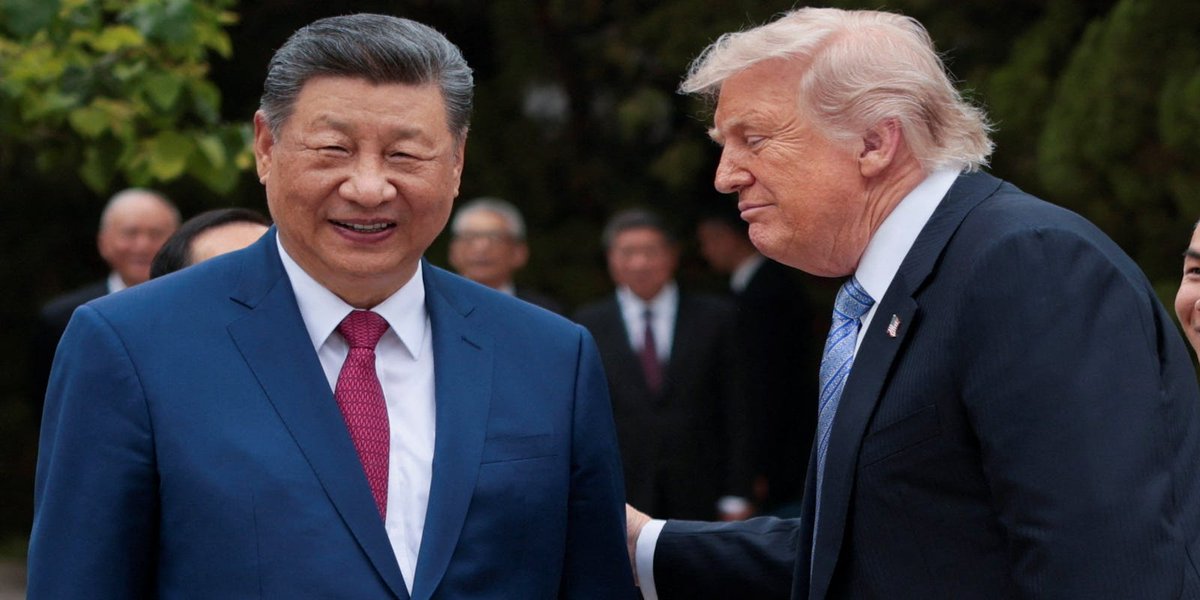
Beijing no longer behaves like a rising power seeking acceptance into an American-led order. It behaves like a co-owner of the international system. And increasingly, Washington treats China that way.
For years, Washington comforted itself with a reassuring phrase: China was a “near-peer competitor.” Near-peer implied China was close but not equal. It was a challenger still climbing the ladder while America remained securely at the top.
The visit showed that the world’s largest autocratic state is no longer America’s near-peer. It is America’s peer.
The symbolism alone was striking. Trump arrived in Beijing not as the triumphant leader of an unchallenged superpower, but as the head of a country increasingly constrained abroad, economically vulnerable at home, and struggling to impose its will even on far weaker adversaries.
Xi understood the moment perfectly. The carefully choreographed summit was designed to project parity: two leaders, two superpowers, two equals managing global stability together. Beijing no longer behaves like a rising power seeking acceptance into an American-led order. It behaves like a co-owner of the international system. And increasingly, Washington is treating China that way.
Trump’s tone during the visit reflected the altered realities. The same president who routinely berates allies as freeloaders adopted a strikingly deferential posture toward America’s principal geopolitical rival. He praised Xi lavishly, calling it “an honor” to be his friend.
Equally striking was what Trump did not say. There was no mention of China’s human rights abuses – not of the mass incarceration and surveillance of Uyghur Muslims in Xinjiang, not of the crushing of freedoms in Hong Kong, not of tightening repression in Tibet or Inner Mongolia. A decade ago, such silence from an American president visiting Beijing would have been politically unthinkable.
Today, it reflects a deeper reality: Washington increasingly treats China less as a wayward authoritarian state to be lectured and more as a peer superpower whose cooperation it needs and whose sensitivities it must manage.
In Trump’s first term, Washington still believed it could fundamentally reshape China’s behavior through tariffs, sanctions and technological pressure. The assumption was that America possessed overwhelming leverage. That confidence has eroded.
Most importantly, Beijing has demonstrated that interdependence cuts both ways.
When Trump last year escalated tariffs, China retaliated by tightening rare-earth exports, exposing America’s deep dependence on Chinese supply chains. Suddenly, the world’s strongest economy looked vulnerable to industrial choke points controlled by Beijing.
The most telling aspect of Trump’s Beijing visit was that both sides emphasized “stability” in their relationship. This is no longer a relationship defined by American primacy. It is one increasingly defined by mutual constraint.
But peer competition does not require symmetry. The Soviet Union was America’s peer despite being economically weaker. Britain was once Germany’s peer despite Germany’s larger industrial base. The defining characteristic is the ability to resist coercion and shape global outcomes independently.
China can now clearly do both.
Indeed, the summit underscored how much Washington’s ambitions have narrowed. Trump once talked about decoupling from China. Now the goal appears far more modest: managed coexistence, stabilized trade and guardrails against open conflict.
That is what peer rivalry looks like.
The danger for the U.S. lies in refusing to adapt to the new reality. Much of Washington still oscillates between complacency and denial, either dismissing China as fundamentally fragile or assuming America can easily restore uncontested dominance.
Yet China’s message during the summit was unmistakable: It no longer seeks admission into an American-led order. It seeks acknowledgment as an equal center of power.
And despite all the pageantry, Trump’s visit ultimately conveyed something Xi desperately wanted the world to see: The U.S. may still be the world’s strongest country but it no longer stands alone at the apex of global power.
Effective diplomacy depends on credibility, consistency, and a clear alignment with national interests. The US administration’s personalized, opaque, and venal shadow diplomacy delivers none of that, and it will leave the US less respected, less trusted, and less effective on the world stage.
In most democracies, a leader outsourcing high-stakes diplomacy to family members and business associates would provoke outrage. But US President Donald Trump has faced little pushback for doing so, with many downplaying his crony diplomacy as mere “heterodoxy.” The long-term consequences will be severe.
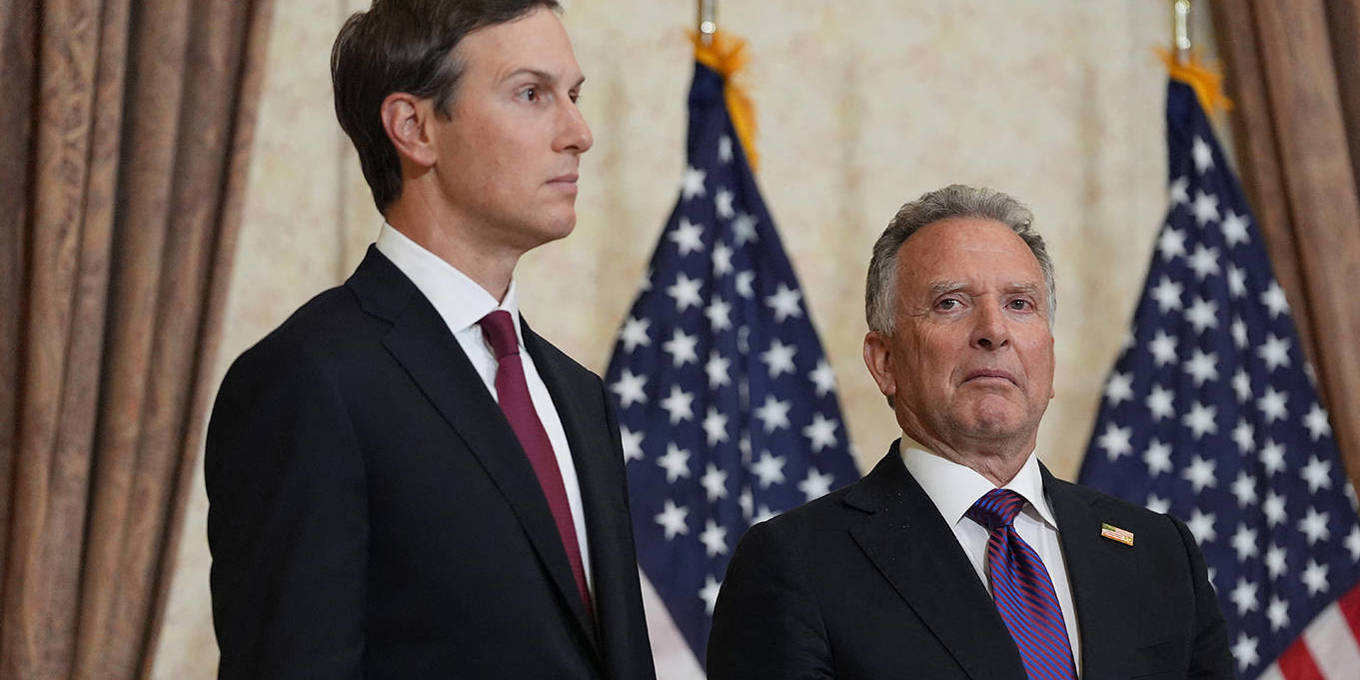
Instead of relying on the secretary of state and the professional diplomatic corps, Trump has placed pivotal diplomacy largely in the hands of his son-in-law, Jared Kushner, and his business partner, the Manhattan real-estate mogul Steve Witkoff. Kushner was a senior adviser in Trump’s first administration, responsible for helping to broker the Abraham Accords between Israel and four Arab states, and is now, like Witkoff, a Special Envoy for Peace.
Together, Kushner and Witkoff have spearheaded negotiations on Ukraine, Gaza, and Iran. Yet neither had any diplomatic experience before Trump tasked them with resolving some of the thorniest and highest-stakes foreign-policy challenges of our time, and both have glaring conflicts of interest.
Start with Witkoff. Last year, Pakistan signed a controversial investment deal with World Liberty Financial, a cryptocurrency firm whose CEO is Witkoff’s son, Zach, and in which the Trump and Witkoff families hold a dominant ownership stake. This past January, a WLF affiliate reached another deal with Pakistan—this time, to introduce the company’s stablecoin for use in cross-border transactions.
But Pakistan has also been the site and, to an extent, the broker of talks between the United States and Iran. When actors are negotiating geopolitical outcomes and pursuing business opportunities in the same arena, diplomacy begins to resemble a marketplace: access, influence, and profit are tightly interwoven.
As for Kushner, after leaving Trump’s first administration, he set up a private-equity firm, Affinity Partners, and took billions of dollars from Gulf monarchies, including about $2 billion from Saudi Arabia’s sovereign wealth fund. In other words, Kushner is dependent on Saudi capital. Yet he is now expected to negotiate a détente with Iran, even as Saudi Crown Prince Mohammed bin Salman reportedly urges Trump to continue the war.
And it is not just Iran. Kushner’s “New Gaza” proposal, unveiled at Davos this past January, has been widely criticized as “real-estate diplomacy,” as it effectively recasts reconstruction as a business venture while ignoring questions of sovereignty and rights.
Kushner and Witkoff’s conflicts of interest, together with their lack of foreign-policy credentials, explain why Trump has not sought to appoint them to official diplomatic positions. Special envoys avoid Senate confirmation hearings, as well as the disclosure requirements, ethics rules, and congressional oversight that bind professional diplomats. Kushner and Witkoff are thus able to exercise influence without transparency, and to negotiate on behalf of the US without accountability.
Of course, Kushner and Witkoff are hardly the only figures capitalizing on their proximity to Trump. Prominent allies and donors, such as Oracle’s Larry Ellison, have won big from their investment in the majority American-owned TikTok venture that Trump effectively forced the Chinese parent company to create, supposedly over national-security concerns.
Moreover, Trump’s sons, Eric and Donald, Jr., recently joined a drone company Powerus, and are attempting to sell drone interceptors to the Gulf states to ward off attacks from Iran as it retaliates for their father’s war. Foundation Future Industries, a robotics startup where Eric is chief strategy adviser, was recently awarded a $24 million Pentagon contract.
Now, reports are emerging of possible insider trading around the Iran war, with large bets being made right before market-moving public statements from Trump. Yet the American public, whether desensitized to Trump’s breaking of norms or simply unable to keep up with the pace and scale of the violations, hardly reacts to such news. Scandals that would have brought any past US administration down—or at least prompted urgent investigation—have become routine under Trump.
With a Republican Party that bows to Trump’s every whim and justifies his every crime—while controlling both houses of Congress—a kind of resignation has taken hold. But as outrage fades, so does the restraining power of political norms. As a result, abuses become increasingly blatant and egregious, and trust is eroded. Even if Trump’s cronies did manage to reach a peace deal, it would warrant suspicion, with every concession raising questions about who really benefits—and who is compromised.
This undercuts not only specific agreements, but also US global leadership more broadly. With US foreign policy now guided by personal loyalty, informal networks, and private gain, whatever credibility the US had as a reliable partner, good-faith negotiator, and champion of the rule of law has been decimated. None of this will be easily restored.
In the meantime, if foreign governments want to influence US policy or secure the country’s geopolitical cooperation, they must make it worth Trump’s while. Nowhere is that more apparent than in Trump’s so-called Board of Peace—a putative alternative to the United Nations where a permanent seat carries a billion-dollar price tag. This is less a multilateral institution than a pay-to-play geopolitical franchise, but some countries appear willing to cough up the cash to stay in the US president’s good graces.
Others seeking to shape US policy head to Trump’s Mar-a-Lago resort in Florida, which he increasingly uses for official diplomatic engagements. And, of course, there are those who go there to get in on the self-dealing, making business deals with Trump’s inner circle. Meanwhile, wars continue to rage, with far-reaching human and economic consequences.
Trump’s defenders argue that unconventional actors can produce breakthroughs where conventional processes have failed. But diplomacy is not merely deal-making; it depends on credibility, consistency, and a clear alignment with national interests. The personalized, opaque, and venal shadow diplomacy being pursued by Kushner and Witkoff can deliver none of that. What it can and will do is ensure that the US is less respected, less trusted, and less effective on the world stage.
Brahma Chellaney, Professor of Strategic Studies at the New Delhi-based Center for Policy Research and Fellow at the Robert Bosch Academy in Berlin, is the author of nine books, including Water: Asia’s New Battleground (Georgetown University Press, 2011), for which he won the 2012 Asia Society Bernard Schwartz Book Award.
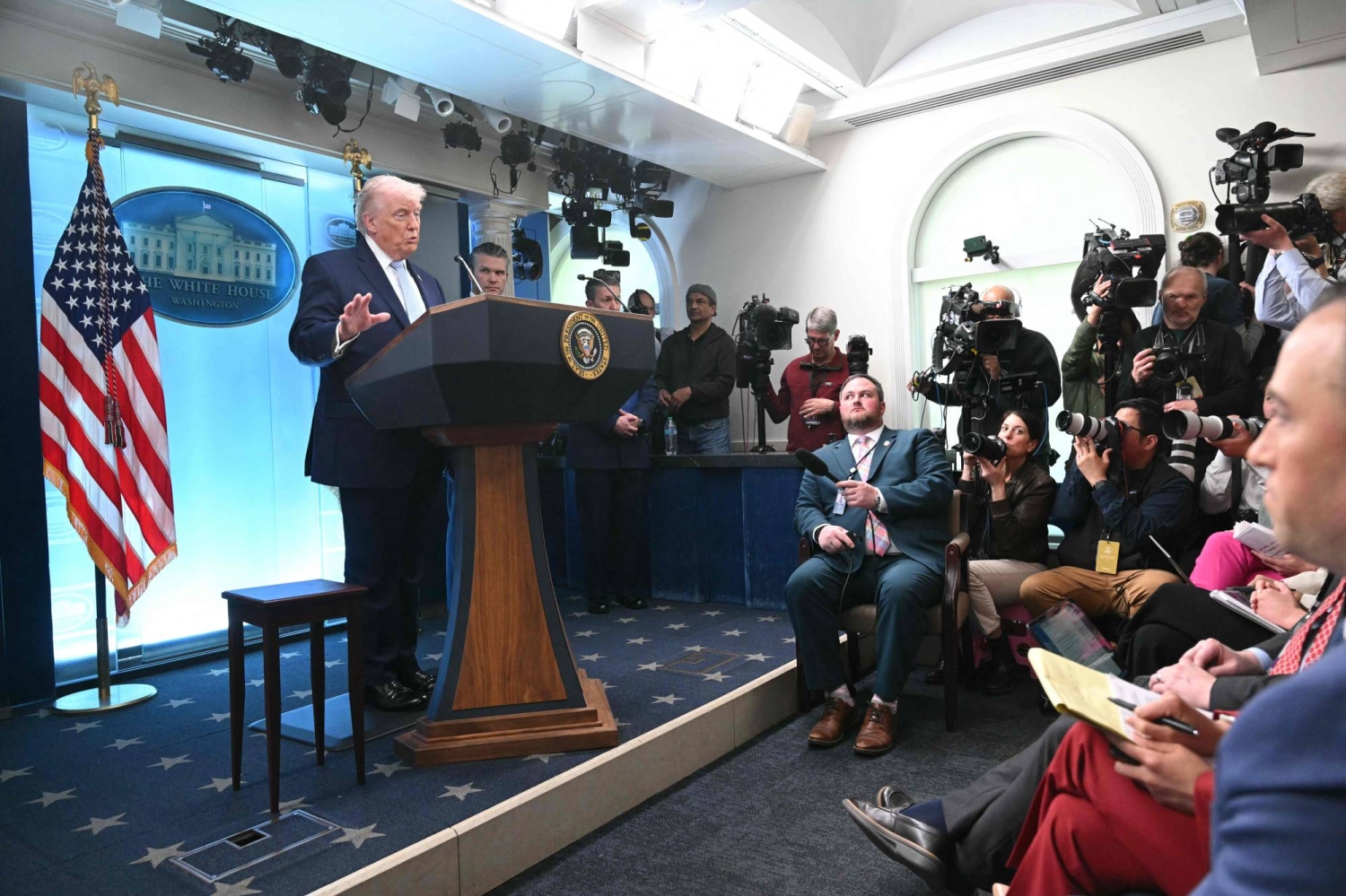
US President Donald Trump speaks about the conflict in Iran in the James S. Brady Press Briefing Room of the White House on April 6, 2026, in Washington, DC. (Photo by AFP)
In barely 15 months, U.S. President Donald Trump has generated more global upheaval than most leaders do in a lifetime.
By eroding international norms, unleashing cascading crises and roiling world markets, he has emerged as a principal driver of global instability. And he still has 33 months left.
There is no modern precedent for what is now unfolding. A single leader — at the helm of the superpower that built and sustained the post-World War II international order — is dismantling it at speed, while openly mocking the very rules that once underpinned American power.
Since returning to the White House, Trump has cast aside longstanding legal norms, authorized military strikes across multiple sovereign states and weaponized economic interdependence against allies and adversaries alike. From the slow strangulation of Cuba through blockade-induced deprivation to a war on Iran that has triggered worldwide turmoil, his actions have pushed the international system into uncharted territory.
Trump launched his war on Iran, as he did his military intervention in Venezuela weeks earlier, in the language of dominance. But its consequences unfolded globally in the language of scarcity — of fuel, food and even survival.
Iran and Venezuela account for almost one-third of global proven oil reserves. Bringing both into Washington’s strategic orbit would give the U.S. an unprecedented lever over global energy markets — one that could be used not merely to influence prices and supply, but to discipline rivals and steer the economic and foreign-policy trajectories of partners.
Trump’s vision of America’s global “energy dominance” was on display again at his April 6 news conference, where he pointed to Venezuela as a model for dealing with Iran, citing his seizure of Venezuelan oil. Describing himself as a businessman, Trump said he wants to likewise take Iran’s energy resources once the conflict is over. “To the victor belong the spoils,” he declared.
It was a revealing admission: Control over Iran’s vast energy wealth lies at the heart of his war of aggression.
What began on Feb. 28 as a joint U.S.-Israeli assault on Iran, however, quickly metastasized into the most consequential energy shock in modern history. Unlike the oil crises of 1973 and 1979, driven largely by political embargoes, the current upheaval stems from the physical destruction of energy infrastructure and the breakdown of critical supply routes.
Because energy underpins the global economy, the shock could not be contained. It rippled outward — destabilizing food systems, straining financial markets and hitting the poorest countries the hardest.
In terms of global impact, the Ukraine conflict pales by comparison. What began as a regional war with global implications evolved into a globe-spanning crisis driven by a single regional conflict. That is the enduring lesson of the Iran war.
More fundamentally, Trump’s neoimperial impulse is no longer latent; it is hardening into an expansionist doctrine that echoes the playbook of colonial empires rather than the norms of the post-1945 order. His push to increase already massive U.S. defense spending by over 50%, to $1.5 trillion, underscores the scale of that ambition.
From renewed pressure for U.S. control over Greenland and the Panama Canal to open-ended military interventions in Venezuela and Iran — and even talk of redrawing borders or relocating populations — Trump has revived a logic more familiar to the age of empires. The Monroe Doctrine, once regional, has effectively been globalized.
The question is no longer whether Trump is disrupting the international order. It is whether there is any historical parallel for such systematic disruption from within. There is not.
The U.S. was the principal architect of the current system. The rules governing trade, sovereignty and collective security were largely American designs, forged after World War II to prevent precisely the kind of instability now unfolding.
What makes this moment unique is not simply that these rules are being broken, but that they are being dismantled by an American president.
History offers examples of destructive leaders — such as Mao Zedong, Pol Pot, Idi Amin and Moammar Gadhafi — but they operated on the margins of the international system or in opposition to it. Trump is different. He is tearing down the house from inside.
Nowhere is this more evident than in his weaponization of interdependence. Trade, once treated as a stabilizing force, has been recast as an instrument of coercion. Tariffs are no longer just economic tools; they are strategic weapons.
By linking military protection to trade concessions and tribute-like payments, Trump has transformed alliances into transactional arrangements — security for sale. The postwar idea of collective defense is giving way to something closer to protection racketeering.
This shift signals a profound reordering of international relationships, in which commitments are perpetually subject to renegotiation.
Equally consequential is the erosion of sovereignty. U.S. military strikes have extended across the Middle East, Africa and even into the Caribbean, targeting states without clear legal justification under the U.N. Charter.
Earlier eras did see U.S. expansionist doctrines — from Theodore Roosevelt’s “Big Stick” diplomacy to William McKinley’s imperial ventures. But those belonged to a pre-1945 world, before the current international norms took shape. Today’s actions carry greater weight precisely because they defy a system the U.S. itself helped build.
The war on Iran marked a particularly dangerous gamble. Trump is the first leader to trigger a global energy crisis through direct military action of his own making.
At the same time, his administration is hollowing out multilateralism — the connective tissue of the international system. Just weeks before launching the Iran war, the U.S. withdrew from 66 international organizations in a single stroke, including the World Health Organization, while sanctioning International Criminal Court officials.
Other leaders have challenged international norms, including Saddam Hussein and Vladimir Putin, but as outsiders. Trump’s approach is more destabilizing because it represents an insider threat. By abandoning agreements like the Paris climate accord, while openly entertaining territorial ambitions from Greenland and Canada to the Panama Canal, his administration has signaled that it no longer considers itself bound by the rules Washington once championed.
If the international system’s principal guarantor no longer believes in it, what remains?
To find even a loose historical analogy, one must look further back. Napoleon reshaped Europe through force; Bismarck discarded alliances in pursuit of advantage. Yet neither operated within a global order they themselves had constructed and sustained. What we are witnessing is something unprecedented: a great power dismantling its own architecture of order.
The consequences are already visible. Alliances are fragmenting. Markets are volatile. Smaller states are hedging, recalibrating or simply absorbing the shocks. The world is moving beyond Pax Americana — but not toward a stable alternative. Instead, it is drifting into uncertainty.
Today, the greatest threat to international peace and security is not a rising challenger. It is the transformation of the international system’s central pillar — the U.S. — into its principal destabilizer.
From rising fuel and food prices in Africa to fiscal stress across Asia and Latin America, the costs of Trump’s ambitions are being borne far from the corridors of power where they were conceived.
Brahma Chellaney, a longtime contributor to The Japan Times, is the author of nine books, including “Water: Asia’s New Battleground.”
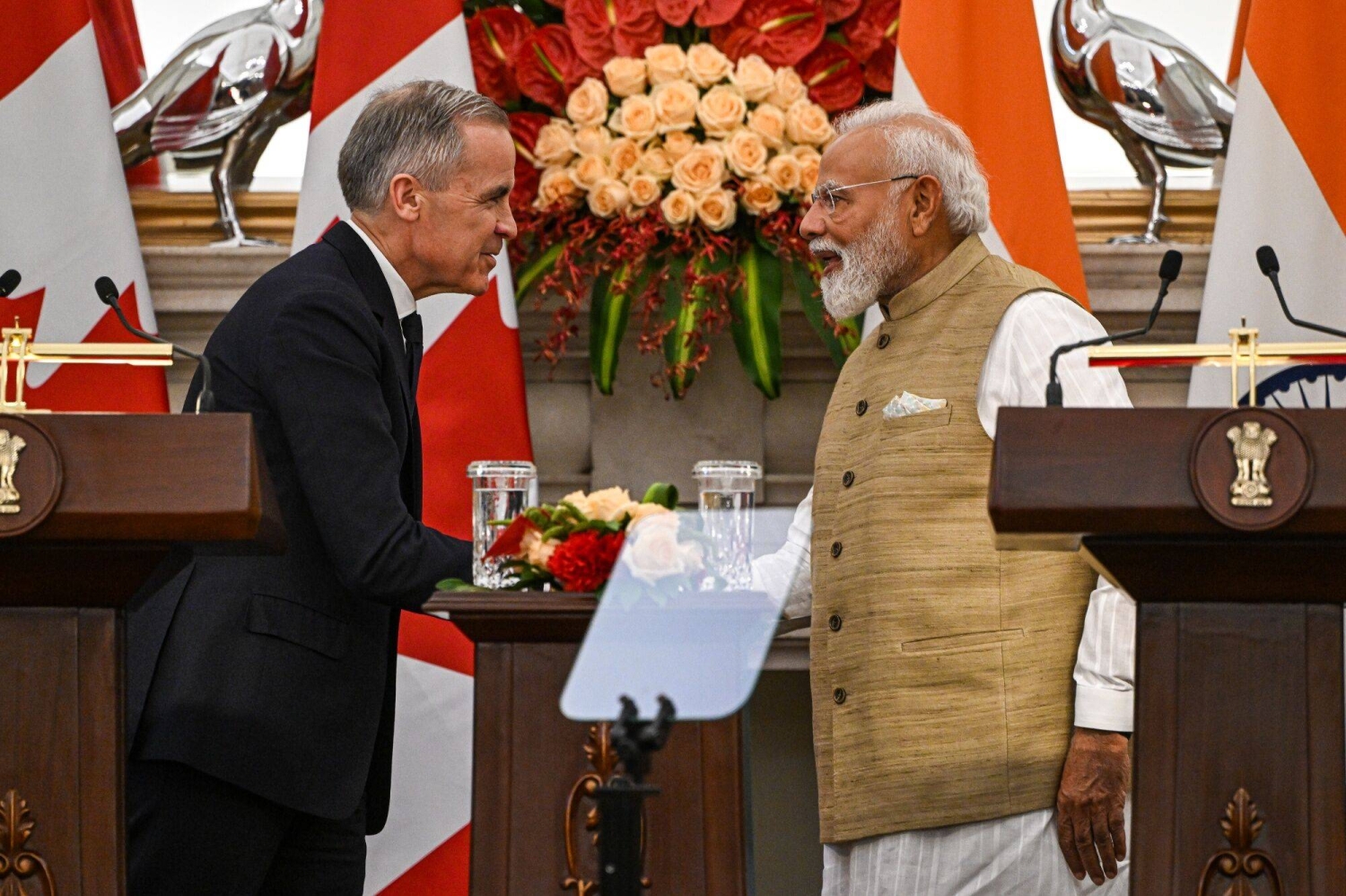
Narendra Modi, India’s prime minister, right, shakes hands with Mark Carney, Canada’s prime minister, during a news conference at Hyderabad House in New Delhi, India, on March 2, 2026. Photo: Bloomberg
Prime Minister Mark Carney’s visit to India is intended to close one of the most acrimonious diplomatic chapters between two major democracies in recent memory and inaugurate a more pragmatic, interest-driven partnership for an age of geopolitical uncertainty.
Rarely have Canada and India found themselves so publicly at odds as they did in 2023-24, when the relationship sank to its lowest point ever. Then-prime minister Justin Trudeau’s allegation of a potential link between the Indian government and the killing of a Sikh-Canadian on Canadian soil triggered a spiral of recriminations, expulsions, visa suspensions and nationalist outrage.
The dispute also exposed a deeper structural fault line: Canada’s permissive approach toward Sikh separatist activism versus India’s zero-tolerance view of Khalistan militancy. For New Delhi, the issue has not been merely diaspora politics but national security, shaped by the memory of the deadly 1985 Air India bombing by Canada-based Sikh terrorists. For Ottawa, the challenge has been to balance civil liberties with public safety in a diverse democracy.
Mr. Carney’s visit signals that both governments have decided the costs of continued estrangement are too high.
The visit’s strategic logic is rooted in a shared reassessment of the global order. Both Canada and India are hedging against the volatility of great-power rivalry. Mr. Carney’s emerging “middle-power” doctrine emphasizes building networks of trusted relationships beyond Washington’s orbit. India, for its part, has long sought diversified partnerships to avoid overdependence on any single pole.
In this sense, the visit is not just a bilateral reset but part of a broader pattern: a quiet consolidation among middle powers seeking resilience in a fragmenting world. Both Canada and India, though, are walking a tightrope. They want to diversify away from an unpredictable U.S. without triggering further retaliation from Washington.
At the heart of the visit lies a concrete economic agenda. The most eye-catching initiative is a 10-year, US$2.8-billion uranium supply agreement, which could be signed during Mr. Carney’s visit. For India, Canadian fuel offers a pathway to reduce reliance on both Russian imports and coal. For Canada, it secures a long-term market at a moment when Western demand is uncertain.
Canada, which sees more than 90per cent of its energy exports go to the U.S., is seeking to become a major oil and liquefied natural gas supplier to India, the world’s fastest-growing major energy consumer, with demand expected to double by 2045. India is already the world’s third-largestenergy consumer.
Alongside energy, the two sides are accelerating negotiations on a Comprehensive Economic Partnership Agreement (CEPA), with a target of doubling bilateral trade to $70-billion in four years. The scope extends well beyond tariffs: services trade, digital commerce, labour mobility, agriculture and critical minerals are all on the table. A CEPA would anchor a supply-chain corridor linking Canada’s resource base with India’s manufacturing and technological capacity.
This economic agenda reflects a shared desire to “derisk” from China-centric supply chains without embracing full decoupling, and to hedge against shifting currents of U.S. policy.
Yet the economic reset cannot stand without a parallel security understanding. Both governments recognize that another crisis over extremism or sovereignty could derail the entire project.
In Canada, Bill C-9, the Combatting Hate Act, would, if passed, criminalize the public display of terrorist symbols. It could signal to New Delhi that Canada is taking more seriously the issue of Sikh militancy.
At the same time, both countries are expected to revive and upgrade their Joint Working Group on Counter-Terrorism, shifting toward real-time intelligence sharing and more streamlined extradition processes. India, for its part, is reaffirming respect for Canadian sovereignty after the controversies of 2023-24.
The aim is to create institutional “guardrails”: mechanisms that allow co-operation to continue even when sensitive issues arise.
Mr. Carney’s challenge, however, is as much domestic as diplomatic. Bill C-9 faces strong resistance from civil-liberties advocates, and parliamentary delays have already stalled its progress. Mr. Carney thus faces a delicate balancing act – demonstrating to India that Ottawa will act against extremist activity, while convincing Canadians he will not dilute constitutional freedoms or bow to external pressure.
More fundamentally, Mr. Carney’s India visit marks a transition from an emotionally charged relationship to a transactional one. The bitterness of the Trudeau era is being set aside in favour of a sober recognition of mutual interests.
If the uranium and hydrocarbon deals advance and CEPA negotiations stay on track, February, 2026, may be remembered as the moment Canada-India ties matured into a modern strategic partnership. For two pluralistic democracies navigating an uncertain century, this may prove to be the most sustainable foundation of all.
Brahma Chellaney is a geostrategist and the author of nine books, including the award-winning Water: Asia’s New Battleground.
The election marks the arrival of a Japan that will be more assertive, more strategically self-confident and less inclined to subordinate its interests to shifting currents of U.S. policy.
Japan’s Feb. 8 election was not merely an electoral landslide. It was a geopolitical turning point.
Prime Minister Sanae Takaichi’s Liberal Democratic Party secured a two-thirds supermajority — an outcome that finally gives Tokyo something it has lacked for decades: a political mandate to redefine its postwar identity and act as a proactive security power.
For Washington, this is both a gift and a challenge. The U.S. can now deepen collaboration with its most important and capable ally in Asia. Japan hosts the largest concentration of U.S. forces anywhere in the world. Its geographic position is uniquely strategic, and its naval and air capabilities are the most sophisticated among U.S. allies in the Indo-Pacific, with interoperability unmatched by any regional partner.
But the election also signals Japan’s strategic reawakening. It marks the arrival of a Japan that will be more assertive, more strategically self-confident and less inclined to subordinate its interests to shifting currents of U.S. policy. Tokyo is no longer content to be a U.S.-protected power. It intends to be a shaping power.
For almost eight decades, Japan operated within self-imposed limits — constitutional pacifism, restrained defense budgets and a preference for economic statecraft over hard power. Takaichi’s mandate alters that trajectory. With a supermajority, she can pursue constitutional revision, formalize the status of the Self-Defense Forces and accelerate defense spending to 2 percent of gross domestic product.
Japan is set to shift from merely reacting to Chinese military pressure to imposing costs for it. Nowhere is this clearer than in the southwestern island chain stretching toward Taiwan. Tokyo is building the capacity to deny access, complicate Chinese planning and ensure that no “fait accompli” seizure of territory or coercive maritime gambit goes unanswered.
For American strategists concerned about U.S. overreach, this is a structural upgrade to the regional balance. A Japan capable of defending its southwestern approaches will reduce the burden on U.S. forces while disrupting Chinese war-planning.
Beijing’s pressure campaign was meant to deter Japan’s rightward drift. Instead, it helped bring about Takaichi’s landslide. Chinese economic restrictions, maritime incursions and thinly veiled threats did not fracture Japanese politics; they consolidated it. Voters concluded that dependence invites coercion and that resilience requires strength.
Japan’s push to rewire supply chains toward India, Southeast Asia and trusted partners is not just industrial policy — it is counter-coercion doctrine.
Takaichi has described a Taiwan contingency as an “existential threat” to Japan. That language would once have been politically radioactive. Now it carries electoral legitimacy and, if sustained, will alter the military geometry of the Taiwan Strait. In a crisis, Japanese bases, surveillance networks and maritime forces would become integral to a U.S. response.
For the U.S., this reinforces a broader trend: Chinese pressure is accelerating, not halting, the formation of balancing coalitions. A stronger Japan becomes the anchor of that process in East Asia.
Takaichi’s strategy also involves alliance diversification. She is building stronger economic and defense links with Australia, South Korea, Vietnam, the Philippines and especially India, alongside the U.S. treaty alliance — insurance against volatility in American politics.
Japanese policymakers have drawn a sober conclusion: that resilience requires options. Fluctuating U.S. trade policy, tariff threats, periodic talk of retrenchment and transactional approaches to alliances have convinced many in Tokyo that Japan must insure itself against strategic volatility in Washington.
For the U.S., this is not a loss of influence but a redistribution of responsibility. A Japan that leads within the Quad, shapes regional trade architecture and invests in defense industrial cooperation strengthens a stable Indo-Pacific order — provided Washington treats Tokyo as a strategic partner rather than a junior ally.
Takaichi’s economic program — “Sanaenomics” — fuses industrial policy with national defense. Supply-chain resilience, semiconductor co-development, critical-mineral stockpiles and shipyard revitalization are designed to reduce Japan’s vulnerability to “weaponized interdependence.”
This aligns with Washington’s emphasis on economic security but also introduces potential friction. A more nationalist “Japan First” posture could collide with U.S. tariff policies or technology controls if not coordinated. The opportunity lies in building a shared defense-industrial ecosystem.
For years, American policymakers urged Japan to do more for its own defense. Takaichi’s victory answers that call.
But greater capability brings greater autonomy. Tokyo will expect a more important voice in alliance strategy — from Taiwan contingencies to regional trade architecture — and will not accept policies that expose it to coercion without consultation.
Alliances endure not because one side dominates, but because both sides see them as vehicles for advancing national strategy. A stronger Japan will strengthen the alliance if Washington treats Tokyo as a co-architect rather than a subordinate.
The most consequential implication of Japan’s election is regional. Across the Indo-Pacific, middle powers increasingly see a stronger Japan as a stabilizing “strategic ballast” amid uncertainty about both China’s trajectory and America’s staying power. Japan is reentering history as a security actor, not merely an economic one.
Washington should recognize what just happened. Japan did not simply elect a new government. It chose strategic normalization — deterrence over hesitation — and signaled that the era of passive alliance management is over.
For Washington, the message is clear: The most important geopolitical shift in Asia is not China’s rise alone, but Japan’s return. The alliance must evolve accordingly.
Trump might have done India a favor. By exposing the raw transactionalism at the core of his foreign policy, he has left no doubt that, under his leadership, the US is not a reliable strategic partner.
For over two decades, the United States has regarded India as a “natural partner” – a rising power whose geography, military capabilities, and democratic credentials made it indispensable to America’s strategy in the Indo-Pacific. Five successive US administrations, Republican and Democratic alike, invested heavily in strengthening that partnership, treating India not just as a market, but as a long-term strategic bet.
But the goodwill that the US built up with India over that period has been rapidly eroded since Donald Trump’s return to the presidency last year. Trump’s second presidency has brought repeated public insults and a bruising trade war, with the US using tariffs as tools of geopolitical coercion. The interim trade deal announced on February 2 may have halted the economic confrontation, but trust – the essential currency of any strategic partnership – is unlikely to be restored any time soon.
By reducing the effective US tariff burden on Indian goods from 50% to 18%, the newly announced deal will deliver short-term relief for India. But it comes with plenty of strings attached, including the requirement that India move toward near-zero tariffs on US industrial products and a wide range of agricultural goods. India’s decision to open its sensitive agricultural sector – the country’s largest employer – to a flood of imports from the US is already sparking a domestic backlash.
But that is not all. India has also agreed to purchase a whopping $500 billion worth of American goods over the next five years, and to replace discounted Russian oil with US energy at market prices, which also implies additional transport costs. Meanwhile, the US offered no binding commitments to India. This lopsided bargain looks nothing like a stable, reciprocal, rules-based trade partnership, and underscores how far US trade policy has drifted from World Trade Organization norms. It is probably best understood as a tactical de-escalation, not a strategic reconciliation.
The way the deal was announced reinforces this interpretation. Typically, bilateral agreements or joint statements are announced simultaneously in both capitals to signal equal partnership. The free-trade agreement India recently concluded with the European Union, which created a trade corridor encompassing roughly 25% of global GDP and one-third of world trade, was touted by both sides as the “mother of all deals.”
The US-India agreement, by contrast, was announced first by Trump, who portrayed it on his social-media platform as a favor to Prime Minister Narendra Modi, whose “request” for an agreement Trump had granted “out of friendship and respect.” Days later, the White House released a “joint statement” outlining the terms of the agreement at 5:00 a.m. Indian Standard Time.
The Trump administration then added injury to insult, announcing a presidential executive order authorizing reimposition of punitive tariffs if the US deems India to have violated its commitment to halt all direct and indirect imports of Russian oil. By framing Indian energy imports as a US national-security issue, the administration has turned economic engagement into a compliance test. The message to India is unmistakable: autonomy will be tolerated only within US-approved limits.
India’s leaders have framed the agreement as a win, noting that India now faces lower tariffs than China or Vietnam. But this is a low bar for a relationship that successive US administrations described as “defining.” And they are probably well aware that Trump could still pull the rug out from under them. The arrangement’s details have not yet been finalized, and Trump has a long history of changing his mind, scrapping deals, and layering on new demands.
Whatever happens next, India will not quickly forget Trump’s past betrayals. Nor will it overlook his slights, such as branding India, whose GDP growth outpaces all other major economies, as a “dead economy” last July.
In a sense, Trump might have done India a favor. By exposing the raw transactionalism at the core of his foreign policy, he has left no doubt that, under his leadership, the US is not a reliable strategic partner. As a result, India’s government is committed to diversifying India’s economic relationships away from the US, as underscored by its FTAs with the EU and the United Kingdom – an effort that will likely continue, regardless of the new trade agreement with the US.
Markets, too, are unlikely to put too much faith in the US. News of the trade deal did trigger a stock-market rally in India, but the gains are likely to be short-lived.
Strategic partnerships are sustained not by tariffs and threats, but by predictability, mutual respect, and restraint – qualities that have been conspicuously absent from Trump’s presidency. The US should beware. Whatever short-term concessions Trump secures through bullying and coercion will be dwarfed by the long-term costs of destabilizing a partnership that, as previous administrations recognized, is vital to American interests in the Indo-Pacific and beyond.
Brahma Chellaney, Professor of Strategic Studies at the New Delhi-based Center for Policy Research and Fellow at the Robert Bosch Academy in Berlin, is the author of nine books, including Water: Asia’s New Battleground (Georgetown University Press, 2011), for which he won the 2012 Asia Society Bernard Schwartz Book Award.
The “rules-based international order” was never a set of neutral rules. It was a story the U.S. told — about itself, its power and its right to bend norms when convenient.
In January, that story finally collapsed when Canadian Prime Minister Mark Carney called that order what many governments have long known it to be: a useful “fiction,” sustained less by universal law than by American power and selective enforcement.
For decades, when U.S. officials invoked a “rules-based international order,” they were not describing universal principles, but defending a flexible set of rules largely devised in Washington and adjusted whenever American interests required it. Now, as President Trump openly revives territorial expansion and economic coercion as tools of U.S. statecraft, that phrase no longer commands belief, even among America’s closest allies.
Carney, speaking in Davos, did what no major Western leader had previously dared to do: He called the bluff. The “rules-based order,” Carney said, was a convenient illusion — one the West itself knew was only partially true, tolerated for as long as U.S. hegemony delivered enough public goods to make the hypocrisy worthwhile. That bargain, he concluded, no longer works.
Carney’s candor marks a watershed. By naming the fiction out loud, he validated a critique long voiced by the Global South and quietly acknowledged across Western capitals. More importantly, he signaled that the era of polite silence surrounding American exceptionalism has ended.
Any international order must, by definition, rest on rules. Modern global life — trade, finance, aviation, maritime navigation — cannot function without shared norms and procedures. The real question has never been whether rules matter, but which rules matter most, and to whom they apply.
For many Western governments, the core norm underpinning the international order is the prohibition on territorial conquest. That is why Russia’s invasion of Ukraine was framed as a civilizational rupture. As then-Secretary of State Antony Blinken put it, the war challenged the principle that borders cannot be changed by force.
International law is indeed clear on this point: the U.N. Charter prohibits the use of force against the territorial integrity of states, and the Geneva Conventions forbid the demographic transformation of occupied territories.
Yet the selective invocation of this norm has gradually eroded its credibility. The U.S. has repeatedly violated the territorial integrity of other states — not by annexing land, but by overthrowing governments and installing new ones that remain formally sovereign while substantively dependent on Washington. This maneuver allows Washington to deny conquest while achieving many of its effects.
Nor is Ukraine’s defense best understood as a pure defense of the norm against conquest. Great powers rarely act primarily to uphold norms. They intervene to prevent adverse shifts in the balance of power. The rallying of NATO behind Ukraine may have aligned with international law, but it was driven at least as much by strategic calculation as by legal fidelity.
The fiction of moral clarity was further strained by the rhetoric that cast the conflict as a battle between democracy and autocracy. Under Volodymyr Zelensky, Ukraine has lurched toward authoritarianism. As in past U.S. interventions, “fighting for freedom” has remained a narrative convenience rather than a consistent standard.
If the Biden administration strained the fiction, Trump has shattered it. Trump has openly re-embraced territorial expansion as a legitimate tool of statecraft. His second term has featured military intervention in Venezuela, renewed demands for U.S. control over Greenland and the Panama Canal, and an unapologetic revival of “Manifest Destiny.” Unlike his predecessors, Trump does not bother cloaking ambition in the language of universalism. He says the quiet part out loud.
Trump is not unique in expanding American power; because of his predecessors’ global expansion, there are about 750 U.S. military bases today in at least 80 countries. What is new is the abandonment of euphemism. By openly praising 19th-century imperial precedents and refusing to rule out coercion even against allies, Trump has made it impossible to pretend that the U.S. is merely the custodian of a rules-based order.
Norms survive not on consistency alone but on credibility. When enforcement is asymmetric, rules become tools rather than constraints. The same applies to the norm of non-interference, which has never prevented cyber operations, sanctions, covert actions or targeted killings. No major power — whether the U.S., Russia or China — fully abides by it. What differs is how honestly that reality is acknowledged.
Carney’s comments matter precisely because they strip away the last vestiges of moral theater. By admitting that Western allies knowingly participated in a ritualized fiction, he reframed the present moment not as a transition, but as a “rupture.” The old bargain — accept U.S. primacy in exchange for stability and public goods — is unraveling. What replaces it will be messier and more transactional.
The “rules-based order” endured not because it was universally respected, but because it was useful — and because American power made it impolite to ask questions. With that politeness gone, what remains is not the collapse of order, but the collapse of pretense. This may allow for a more honest reckoning with power, interest and responsibility.
The upcoming election is shaping up to be one of the most consequential political contests Japan has faced in decades, largely because it will determine whether Japan decisively locks in a new strategic orientation at home and abroad. The vote will effectively function as a referendum on whether Prime Minister Sanae Takaichi’s more assertive approach to economic security, global engagement and China receives a democratic mandate or stalls amid political fragmentation.
The election outcome will also signal whether China’s model of economic coercion is effective against a major U.S. ally. Beijing has deployed a full-spectrum pressure campaign against Takaichi’s four-month administration — punitive measures designed to hurt Japanese business interests and undermine domestic support for her government.
A Takaichi victory would represent a significant setback for China, signaling that Japanese voters are prepared to absorb real economic pain in exchange for greater strategic autonomy. Reducing exposure to Chinese economic pressure is also essential for navigating a more coercive global order, one in which U.S. President Donald Trump has shown little hesitation in pressuring even close allies.
Equally important is how the election intersects with Japan’s international role, especially in the Global South. Under Takaichi, engagement with key developing countries has become a core pillar of economic resilience. The campaign has elevated “Sanaenomics,” a strategy that emphasizes supply-chain diversification, technological co-creation and reduced dependence on China. Countries such as India, Vietnam and the Philippines are positioned not only as alternative manufacturing hubs under a “China-plus-one” strategy, but also as long-term partners in energy, AI governance and critical infrastructure.
The election thus has implications far beyond Japan. A clear mandate would accelerate Japan’s shift toward a more forward-leaning, technology-driven diplomacy, aimed at out-competing — rather than accommodating — Chinese influence. Conversely, a weaker or divided outcome would slow this transition, as Japan enters an era of fragmented, coalition-based bargaining.
In short, the vote will help determine whether Japan emerges as a more autonomous strategic actor or remains vulnerable to external pressure in an era of weaponized interdependence.
Brahma Chellaney is a professor of strategic studies at the independent New Delhi-based Centre for Policy Research and fellow at the Robert Bosch Academy in Berlin.
When Donald Trump returned to the White House, many foreign governments assumed his second term would simply mirror the first—more noise, more tariffs, more brash moves, but no fundamental break. They misjudged him. In its first year itself, Trump’s second presidency has redefined the norms, institutions and expectations that have governed international politics since the end of the Cold War.
What once looked like impulsive theatre has hardened into a governing philosophy. Unpredictability is no longer a quirk of Trump’s personality; it is a strategic tool he deploys openly. Norm violations are no longer tactical deviations; they have become a defining feature of American policy.
The result is a more transactional, coercive and personalized global order. In this order, power is asserted directly, institutions are circumvented or stripped of authority, and stability is offered only in exchange for submission.
More fundamentally, Trump is not simply eroding the international order. He is attempting to construct an alternative in its place.
From disruption to doctrine
During Trump’s first term, allies and adversaries alike learned to discount much of what he said. Tweets contradicted policy. Threats were issued and withdrawn. In his second term, however, the pattern has changed. Disruption itself has become US doctrine. His administration now treats uncertainty not as a risk to be managed, but as leverage to be exploited.
This shift is visible across domains. Trade policy is no longer governed primarily by economic logic but wielded as an instrument of political coercion. Diplomacy is no longer mediated through institutions but centralized in the president himself—his whims and fancies, and his efforts to expand an already-sprawling personal business empire. Military power is no longer restrained by concerns of legitimacy but openly deployed to assert control over other states’ resources and territory. Soft power—the quiet, accumulative influence of norms, culture and credibility—has been dismissed as weakness.
The pattern is unmistakable. Trump no longer seeks to lead the international system; he seeks to dominate it, transaction by transaction, deal by deal.
Nowhere is this shift clearer than in trade. By weaponizing tariffs, Trump has ushered in an era of what Western executives now call “tariff roulette.”
Tariffs have been moved from the margins of economic policy to the centre of American statecraft. On April 2, 2025—branded by the White House as “Liberation Day”—he invoked America’s International Emergency Economic Powers Act to impose a universal 10% tariff on all imports. This was not a negotiating tactic aimed at reforming rules; it was a unilateral assertion of power.
Targeted tariffs have gone even further. These measures are not calibrated responses to unfair trade practices but punitive tools meant to force capitulation. Worse still, they are unpredictable. Announcements are frequently made with little warning, often through social media, leaving governments and firms scrambling to respond.
Months after concluding a trade agreement with South Korea, Trump abruptly raised US tariffs on South Korean goods from 15% to 25%. His tariffs on India now exceed even those imposed on China, America’s principal strategic rival. Agreements offer no insulation; strategic partnerships provide no security.
The economic effects are already evident in the US. Business confidence has been shaken by the inability to plan investment or supply chains amid sudden policy reversals. Inflationary pressures have intensified, with US personal consumption expenditures projected to rise by more than three per cent. Confronted with policy-driven volatility, the Federal Reserve has kept interest rates on hold to avoid amplifying uncertainty.
The deeper damage, however, is systemic. The global trading system depends less on low tariffs than on credible commitments. Trump has shattered the expectation that the US will adhere to predictable, norms-based processes. In its place, he has delivered a stark message: stability is available only through direct, bilateral concessions to Washington. Multilateral rules no longer protect; they merely delay punishment.
Rules give way to raw power
If weaponized trade represents the economic pillar of Trump’s new order, the creation of the “Board for Peace” is its institutional centrepiece. Launched at the World Economic Forum in Davos in January, the Board is presented as a bold alternative to what Trump calls the United Nations’ “permanent failure” to resolve modern conflicts.
The contrast could not be sharper. The UN, for all its flaws, derives legitimacy from process: universal membership, formal rules and a (sometimes paralyzing) commitment to sovereignty and law. The Board for Peace rejects this model entirely. Membership is selective, reportedly contingent on substantial financial contributions. Decision-making authority is centralized. Trump himself holds absolute veto power over its agenda, decisions and membership—and even the designation of his successor. In other words, the Board is effectively a one-man show.
What is being set up is privatized global governance. Conflict resolution becomes a pay-to-play enterprise, overseen by personal authority. Trump has said the Board will “work with” the UN. Yet he has also openly suggested that it could replace it. In practice, the Board is already a mechanism to bypass international law rather than enforce it.
Actions speak louder than words.When Trump arbitrarily rescinded Canada’s invitation to join the Board soon after its launch, he revealed its true nature: not a forum governed by rules, but a court governed by favour. The message to the world is that peace is no longer a collective good. It is a commodity, dispensed at the discretion of Washington.
Another dramatic shift in Trump’s second term has occurred in the Western Hemisphere. Long portrayed as an isolationist, Trump has in fact embraced a form of aggressive expansionism. The US is no longer merely asserting influence in the Americas; it is asserting ownership.
On January 3, American forces abducted Venezuelan President Nicolás Maduro by carrying out the first bombing of a South American capital in modern history. Trump subsequently declared that the US would “run the country and take its oil.” The statement was not a gaffe. It was a declaration of intent that is now being implemented. Proceeds from selling stolen oil are being deposited in a US bank account in Qatar, to be spent without US congressional approval. Venezuelan oil worth $500 million has already been sold, according to the White House.
The military action against Venezuela followed America’s large-scale naval deployments in the Caribbean, its unilateral renaming of the Gulf of Mexico as the “Gulf of America,” and renewed discussions about annexing Greenland and reasserting direct control over the Panama Canal. These moves reflect a coherent worldview of the Trump administration: North and South Americas constitute a privileged zone of US control.
Trump has revived the Monroe Doctrine not as a warning to external powers, but as a license for military intervention or political interference in other nations’ domestic affairs. Sovereignty, in this framework, belongs not to states but to those strong enough to enforce it. The language of partnership has been replaced by the language of possession.
As hard power has been elevated, US soft power has been systematically dismantled. Funding for USAID has been slashed. Voice of America has been effectively shuttered. Cultural diplomacy has withered.
Soft power does not coerce, but it shapes preferences. It reduces the cost of leadership by making influence appear legitimate. The Trump administration, however, does not regard soft power as an asset.
The US withdrawal from the World Health Organization in January is emblematic. For decades, global health was one domain in which US leadership was uncontested. That leadership is now gone, surrendered not after debate, but by presidential decree.
America’s relations with Europe have also deteriorated sharply. The 2025 US National Security Strategy describes Europe as a victim of “civilizational erasure” and calls for alignment with “patriotic” movements there rather than mainstream governments. Such ideological interference signals that, even in the Western bloc, shared values no longer bind. What matters is ideological affinity and transactional utility.
A world remade
Taken together, these shifts amount to more than a change in tone. They represent a transformation in how power is exercised and justified. Trump’s second term has accelerated the erosion of an international system built on norms, institutions and predictability. In fact, he has stepped up efforts to replace it with one organized around coercion, personal authority and short-term gain.
In effect, Trump has not merely taken the world by storm; he is reshaping the environment in which global politics operates. And unlike the social-media posts that signal these changes, the consequences of his reshaping of international relations will endure.
It is against this backdrop that Canadian Prime Minister Mark Carney became the star at this year’s World Economic Forum at Davos with his remarkable candour in exposing longstanding Western hypocrisy and describing what a Trump-reshaped world meant.
Delivering a prepared speech, Carney declared, “We knew the story of the international rules-based order was partially false. That the strongest would exempt themselves when convenient. That trade rules were enforced asymmetrically. And we knew that international law applied with varying rigor depending on the identity of the accused or the victim. This fiction was useful. And American hegemony, in particular, helped provide public goods: open sea lanes, a stable financial system, collective security and support for frameworks for resolving disputes. So, we placed the sign in the window. We participated in the rituals. And we largely avoided calling out the gaps between rhetoric and reality. This bargain no longer works. Let me be direct: We are in the midst of a rupture, not a transition.”
The plain fact is that the new, Trump-driven order is not stable. It invites emulation by other strongmen. It encourages pre-emptive defiance by smaller states. It fragments global cooperation into spheres of influence governed by fear rather than trust. Yet it is coherent. And that coherence is precisely what makes it dangerous.
The most consequential legacy of Trump’s second term may not be the policies he enacts, but the precedents he sets. Even if a future US administration seeks to restore the old order, it will confront a world that has already adapted to its absence. Once credibility is lost, it cannot simply be reclaimed by presidential proclamation.
India as the pivotal swing state
No country is more exposed to—or more consequential for—the world Trump is remaking than India. As the world’s largest democracy, its fastest-growing major economy, and a central node in Indo-Pacific strategy, India now finds itself cast not as a partner in a US-led order, but as a swing state in a coercive, transactional system.
Trump’s second term presents India with a paradox. On one hand, Washington sees New Delhi as indispensable to balancing China. On the other, it treats India less as a strategic partner than as a negotiable asset—subject to tariffs, pressures and episodic favours. The result is a relationship marked by simultaneous courtship and coercion.
Trade policy illustrates the dilemma starkly. India has sought deeper economic integration with the US but instead it has faced some of the steepest tariffs imposed by the Trump administration—higher even than those levied on China. Market access is dangled not through long-term accords, but through ad hoc bargaining. Stability in the bilateral relationship is conditional.
Strategically, India is being pulled into a vision of order that sits uneasily with its own traditions. Trump’s disdain for multilateral institutions and his open embrace of unilateral force clash with India’s longstanding emphasis on strategic autonomy and international law. The creation of new international bodies such as the “Board for Peace,” governed by personal veto rather than collective legitimacy, places India in an awkward position: participation may offer influence, but at the cost of endorsing a precedent that weakens the very norms India has relied upon as a post-colonial power.
There is also a deeper reputational risk. As Trump reframes global politics as a contest among civilizational strongmen, democracies are valued less for their institutions than for their utility. India is courted not as a democracy, but as a counterweight. This instrumentalization erodes the moral capital that once distinguished democratic alignment from mere alliance.
Trump’s second term is also reshaping the triangular dynamic among China, India and the US—a strategic triangle that is central to Indian interests. Washington now frames its India policy almost exclusively through the prism of countering Beijing, while simultaneously undermining the norms and institutions that once sought to constrain Chinese power. The contradiction is stark: the US asks India to assist American strategy in Asia even as it legitimizes unilateral pressures on New Delhi to compel shifts in trade, energy and strategic policies.
For China, Trump’s unilateralism is an opportunity to step up its own coercive and expansionist policies, especially against its neighbours, including India. It is also an opportunity for China to quietly expand its influence in institutions the US has vacated.
For India, the triangle is more perilous. It faces sustained pressures from China along the Himalayas and via surrogate Pakistan, yet it is being asked by Washington to align with an American strategy that normalizes spheres of influence and transactional dominance. In such a world, today’s partner can become tomorrow’s pressure point.
The erosion of a norms-based order challenges all middle powers like India that rely on predictability to balance asymmetry. As China’s immediate neighbour, India’s challenge is also to navigate this triangle without becoming locked into a logic where raw power becomes the only currency that matters.
India is not without agency. Precisely because Trump’s world is transactional, India’s choices carry outsized weight. Accommodation would signal that even the world’s largest democracy and most-populous country sees no alternative to coercive bilateralism. Resistance—through diversification of partnerships, renewed investment in multilateral forums, and strategic patience—would suggest that the erosion of the old order is not yet complete.
More broadly, Trump has made one reality unmistakably clear: the post-World War II international order is no longer being quietly eroded; it is being openly displaced. Norms are giving way to deals. Institutions are yielding to personalities. Predictability is being replaced by leverage. This is a structural shift, which could gain permanence.
In this emerging order, the world’s future direction will not be determined solely by Washington or Beijing. It will also be shaped by the choices of key states that still retain strategic autonomy. Among them, none matters more than India.
India’s response to Trump’s world will signal whether the country that is home to 18% of the global population believes that power without restraint is inevitable—or whether it still sees value in preserving norms that protect the weak from the strong. Alignment driven purely by fear or expediency would accelerate the very transformation that leaves all democracies more vulnerable. Strategic patience, diversification and selective resistance are likely to slow it.
Whether the 21st century tilts decisively toward coercion or retains space for constraint and norms may well depend on middle powers like India. India is no longer merely rising. It is deciding—by its economic and strategic partnerships and policy choices alike—what kind of world will rise with it.
Brahma Chellaney is a geostrategist and the author of two award-winning books.






 Stagecraft and Statecraft

You must be logged in to post a comment.