The Resistible Rise of Asia?

A favorite theme in international debate nowadays is whether Asia’s rise signifies the West’s decline. But the current focus on economic malaise in Europe and the United States is distracting attention from the many serious challenges that call into question Asia’s continued success.

To be sure, today’s ongoing global power shifts are primarily linked to Asia’s phenomenal economic rise, the speed and scale of which have no parallel in world history. With the world’s fastest-growing economies, fastest-rising military expenditures, fiercest resource competition, and most serious hot spots, Asia obviously holds the key to the future global order.

But Asia faces major constraints. It must cope with entrenched territorial and maritime disputes, such as in the South China Sea; harmful historical legacies that weigh down its most important interstate relationships; increasingly fervent nationalism; growing religious extremism; and sharpening competition over water and energy.

Moreover, Asia’s political integration badly lags behind its economic integration, and, to compound matters, it has no security framework. Regional consultation mechanisms remain weak. Differences persist over whether a security architecture or community should extend across Asia, or be confined to an ill-defined “East Asia.”

One central concern is that, unlike Europe’s bloody wars of the first half of the twentieth century, which made war there unthinkable today, the wars in Asia in the second half of the twentieth century only accentuated bitter rivalries. Several interstate wars have been fought in Asia since 1950, when both the Korean War and the annexation of Tibet started, without resolving the underlying Asian disputes.

To take the most significant example, China staged military interventions even when it was poor and internally troubled. A 2010 Pentagon report cites Chinese military preemption in 1950, 1962, 1969, and 1979 in the name of strategic defense. There was also China’s seizure of the Paracel Islands from Vietnam in 1974, and the 1995 occupation of Mischief Reef in the Spratly Islands, amid protests by the Philippines. This history helps to explain why China’s rapidly growing military power raises important concerns in Asia today.

Indeed, not since Japan rose to world-power status during the reign of the Meiji Emperor (1867-1912) has another non-Western power emerged with such potential to shape the global order. But there is an important difference: Japan’s rise was accompanied by the other Asian civilizations’ decline. After all, by the nineteenth century, Europeans had colonized much of Asia, leaving in place no Asian power that could rein in Japan.

Today, China is rising alongside other important Asian countries, including South Korea, Vietnam, India, and Indonesia. Although China now has displaced Japan as the world’s second largest economy, Japan will remain a strong power for the foreseeable future. On a per capita basis, Japan remains nine times richer than China, and it possesses Asia’s largest naval fleet and its most advanced high-tech industries.

When Japan emerged as a world power, imperial conquest followed, whereas a rising China’s expansionist impulses are, to some extent, checked by other Asian powers. Militarily, China is in no position to grab the territories that it covets. But its defense spending has grown almost twice as fast as its GDP. And, by picking territorial fights with its neighbors and pursuing a muscular foreign policy, China’s leaders are compelling other Asian states to work more closely with the US and each other.

In fact, China seems to be on the same path that made Japan an aggressive, militaristic state, with tragic consequences for the region – and for Japan. The Meiji Restoration created a powerful military under the slogan “Enrich the country and strengthen the military.” The military eventually became so strong that it could dictate terms to the civilian government. The same could unfold in China, where the Communist Party is increasingly beholden to the military for retaining its monopoly on power.

More broadly, Asia’s power dynamics are likely to remain fluid, with new or shifting alliances and strengthened military capabilities continuing to challenge regional stability. For example, as China, India, and Japan maneuver for strategic advantage, they are transforming their mutual relations in a way that portends closer strategic engagement between India and Japan, and sharper competition between them and China.

The future will not belong to Asia merely because it is the world’s largest, most populous, and fastest-developing continent. Size is not necessarily an asset. Historically, small, strategically oriented states have wielded global power.

In fact, with far fewer people, Asia would have a better balance between population size and available natural resources, including water, food, and energy. In China, for example, water scarcity has been officially estimated to cost roughly $28 billion in annual industrial output, even though China, unlike several other Asian economies, including India, South Korea, and Singapore, is not listed by the United Nations as a country facing water stress.

In addition to its growing political and natural-resource challenges, Asia has made the mistake of overemphasizing GDP growth to the exclusion of other indices of development. As a result, Asia is becoming more unequal, corruption is spreading, domestic discontent is rising, and environmental degradation is becoming a serious problem. Worse, while many Asian states have embraced the West’s economic values, they reject its political values.

So make no mistake. Asia’s challenges are graver than those facing Europe, which embodies comprehensive development more than any other part of the world. Despite China’s aura of inevitability, it is far from certain that Asia, with its pressing internal challenges, will be able to spearhead global growth and shape a new world order.

Brahma Chellaney, Professor of Strategic Studies at the New Delhi-based Center for Policy Research, is the author of Asian Juggernaut and Water: Asia’s New BattlegroundFull profile

(c) Project Syndicate, May 2012.

Arab Spring hijacked

By BRAHMA CHELLANEY  The Japan Times   February 20, 2012

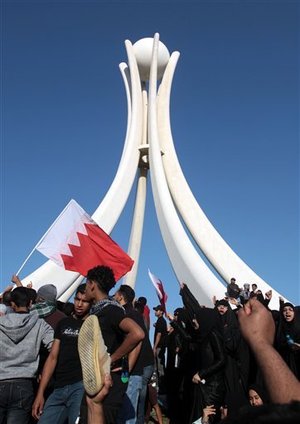
Bahrain’s Pearl Roundabout which authorities demolished with bulldozers.

A year after the Arab Spring came to symbolize the ascent of people’s power, hope has given way to a bleak sequel. The democratic awakening has fallen prey to murky geopolitics that has cleaved the Arab Spring into two parts, with the U.S.-backed kingdoms escaping change but the non-monarchical republics coming under varying degrees of pressure.

The promise of a new era of democracy has been blighted in much of the region by continuing political repression. Worse, war clouds have appeared on the horizon.

What began as protests against food prices, corrupt leaders and lack of government accountability has assumed ominous dimensions. From the rampant but largely unreported human-rights abuses in the post-Muammar Gaddafi Libya to the increasing bloodshed in multiethnic, autocratic Syria, the developments are making the future of the Middle East and North Africa more volatile and uncertain.

Bahrain, which hosts the U.S. Navy’s 5th Fleet, stands out for carrying out the region’s most-successful suppression of an Arab Spring movement, thanks to a Saudi-led military intervention and continuing Western backing. Whereas Cairo’s Tahrir Square has come to epitomize the power of ordinary people to rise up against tyranny, Bahrain’s Pearl Roundabout was simply obliterated with bulldozers — an action that was followed up with arrest and torture of activists as well as of the doctors and nurses who treated the injured. Yet a year later, family-run Bahrain’s future looks anything but stable.

Exacerbating the regional instability is the escalating U.S. geopolitical confrontation with Iran, with both sides currently engaged in a psychological war. U.S. Defense Secretary Leon Panetta’s warning of a looming Israeli attack on Iran and Tehran’s threat to shut down the world’s most important oil-export route — the Strait of Hormuz — are part of this war of nerves. Israel has stepped up its own “shadow war” with Iran, with the two sides ratcheting up a blame game over targeted assassinations and bomb incidents.

The danger that this show of threats could escalate to military hostilities has been underscored by the U.S. declaration of an indirect war against Iran — the imposition of an oil-export embargo to financially throttle Tehran. Given that energy exports account for 80 percent of Iran’s foreign-exchange earnings, the U.S. (and European Union) oil embargo and freeze on Iranian Central Bank assets increase the risks of a military confrontation — the very development these sanctions are meant to avert.

History attests to the linkage between an oil embargo and military hostilities. Although the 1941 Pearl Harbor attack took the United States by surprise, the attack was triggered in some measure by a U.S.-British-Dutch oil-import embargo against Japan as part of a larger economic squeeze that began in 1939. The U.S. move to choke off Iranian oil exports, however, is faltering: India, Japan, China and South Korea — accounting for three-fifths of Iran’s oil sales — have given Washington a polite brushoff.

Four trends in the Arab world have become pronounced.

● The first is the way the Arab Spring movements are reopening traditional fault lines along sectarian and tribal divides and fomenting new internal conflict.

Even as intertribal politics threatens the future of post-Gaddafi Libya, sectarian battle lines are hardening in conflict-battered Syria, where the armed opposition claims to represent the Sunni Arab majority and the besieged Alawite-led regime has cleverly played to the fears of the minorities, which account for almost two-fifths of the national population and include the Alawites, Christians, Kurds and Druze. Similarly, the Bahraini regime, seeking to justify its large-scale repression, has stirred fears among the country’s Sunni elite of an Iranian-backed takeover by the disempowered Shiites, who make up 70 percent of the population.

If the once-peaceful, secular Syria becomes another Lebanon or Afghanistan, a sectarian division of that country is not inconceivable, given that the Sunni Arab and minority populations are largely concentrated in geographically separate areas.

● A second trend has exposed a vein of religious extremism and promoted the ascendancy of Islamist influence, including in the states that have experienced regime change. New opportunities have been opened up for Islamist movements to exert influence and bring themselves to the center-stage, as in Morocco, Kuwait, Libya, Egypt, Yemen, Jordan and Syria.

The new Islamist influence is apparent even in Tunisia, hailed as a model for revolution. In Egypt, the Muslim Brotherhood, which initially collaborated with Gamal Abdel Nasser after his 1952 coup, is again developing close ties with the military that still holds the reins of power, raising concerns of a military-Islamist nexus in Pakistan style.

The oil sheikhdoms, in any case, are theocratic states, which today are aiding Islamist causes in their own backyard.

This is best exemplified by Saudi Arabia and its new avatar, Qatar, which has developed cozy ties with the Muslim Brotherhood in its various incarnations across the Arab world. Qatar — the seat of current U.S. secret talks with the Taliban — indeed has leveraged its natural-gas wealth and unbridled ambition to emerge as a leading backer of Islamist causes, in parallel to the role Saudi Arabia has long played.

● The third trend is represented by the increasingly ugly regional geopolitics, which pits the powerful “Sunni Crescent” led by Turkey, Saudi Arabia, Qatar and the United Arab Emirates against the beleaguered “Shiite Crescent” states — Iran, Iraq, Syria and Lebanon.

Turkey, after being rebuffed in its efforts to join the European Union, has turned its attention to the Arab world, seeking to carve a role for itself as the regional hegemon. To help mend ties with Arab countries — which had long been suspicious of Ankara’s close relationship with Israel, as exemplified by the 1996 Military Training Cooperation Agreement and an unconsummated accord to export Turkish bulk water — Turkey has turned against its ally Israel.

Turkey also has come full circle on Syria. Ankara had accused the regime of Hafez al-Assad — Syrian President Bashar al-Assad’s father — of seeking to build leverage on their bilateral water disputes by actively aiding the Kurdish insurgency in Turkey. But now Turkey is waging a proxy war of its own by providing sanctuary and arms to the Free Syrian Army, besides reverting to hardline anti-Kurdish policies, including military incursions into northern Iraq in pursuit of alleged guerrillas.

Today, the regional contest for geopolitical influence between Turkey and Iran — the inheritors of the Ottoman and Persian Empires — has cast a lengthy shadow over the Arab Spring. This shadow has been made darker by the interventionist impulse of the Saudi and Qatari monarchies, which have sought to create puritanical Islamist surrogates in some other Arab states.

Tiny Qatar, for example, has played an important role in the past year in ousting the Qaddafi regime (including by covertly deploying hundreds of troops in Libya), aiding the Sunni insurrection in Syria, backing Tunisia’s Islamist party leader Rachid Ghannouchi, and brokering the departure of Yemen’s brutal dictator Ali Abdullah Saleh, who, instead of being tried for the killing of hundreds of demonstrators, was recently granted entry into the U.S., in keeping with the foreign-policy maxim, “He may be a bastard, but he is our bastard.”

● A fourth trend is that the Arab Spring has become a springboard for playing great-power geopolitics. Syria, at the center of the region’s sectarian fault lines, has emerged as the principal battleground for such Cold War-style geopolitics. Whereas Russia is intent on keeping its only military base outside the old Soviet Union in Syria’s Mediterranean port of Tartus, the U.S. seems equally determined to install a pro-Western regime in Damascus.

This goal prompted Washington to set up of a London-based television station that began broadcasting to Syria a year before major protests began there. The U.S. campaign, which includes assembling a coalition of the willing, has been boosted by major Turkish, Saudi, Qatari and UAE help, including cross-border flow of arms into Syria and the establishment of two new petrodollar-financed, jihad-extolling television channels directed at Syria’s majority Sunni Arabs.

Moscow continues to arm and politically shield the Assad regime, while Washington has just announced the resumption of military aid to despotic Bahrain, after rewarding Saudi Arabia with a massive arms package. Iran, for its part, wants democracy in Bahrain but status quo in Syria. The Arab League — still the world’s premier organization of tyrants — sent a delegation headed by a tainted military general to monitor Syria’s human-rights situation.

The harsh reality is that such geopolitics has effectively hijacked the Arab Spring.

Today, it is the Arab states with a presidential form of government that are at the center of the ongoing profound changes, which, paradoxically, are sought to be influenced by the iron-fisted but deep-pocketed oil monarchies. Their already-swelling coffers — thanks to the U.S. energy embargo against Iran and rising oil prices — are set to overflow, increasing their leverage in the region and beyond.

The experience of the past half a century shows that the greater the transfer of oil wealth to these monarchies, the more they have funded fundamentalism and extremism, thereby contributing to the rise of international terrorism. In fact, the more wealth they have accumulated, the more the price of freedom has risen in the region.

In this light, the U.S. attempt to give international effect to its new Iran-sanctions law constitutes a double whammy for its close partners, Japan and India. It will sabotage their energy-import-diversification strategy by making them place all its eggs in the basket of the wrong regimes — the ones that bankroll Islamist groups. And, at a time when America is quickening its Afghanistan disengagement with little regard for Indian interests, it will rupture India’s relations with the very country central to its Afghanistan strategy — Iran.

More broadly, the Arabs’ democratic aspirations will likely remain unrealized unless the sharpening geopolitics backfires and the oil sheikhdoms’ insulation from change wears away. Given the way well-entrenched autocratic presidents have fallen from power in Tunisia, Egypt and Yemen, the durability of the region’s monarchs is anything but assured.

Brahma Chellaney is an Asian geostrategist and the author of six books.

(c) Japan Times, 2012.

China’s Drive to Lock Up Long-Term Supply of Strategic Resources

Date of the hearing: January 26, 2012

Title of the hearing: China’s Global Quest for Resources and Implications for the United States

Name of panelist: Brahma Chellaney

Panelist’s title and organization: Professor of Strategic Studies, Center for Policy Research, New Delhi

Testimony by Professor Brahma Chellaney before the U.S.-China Economic and Security Review Commission

Dirksen Senate Office Building, Room 562
Washington, DC 20510

China has pursued an aggressive strategy to secure (and even lock up) supplies of strategic resources like water, energy and mineral ores. Gaining access to or control of resources has been a key driver of its foreign and domestic policies. China, with the world’s most resource-hungry economy, is pursuing the world’s most-assertive policies to gain control of important resources.

Much of the international attention on China’s resource strategy has focused on its scramble to secure supplies of hydrocarbons and mineral ores. Such attention is justified by the fact that China is seeking to conserve its own mineral resources and rely on imports. For example, China, a major steel consumer, has substantial reserves of iron ore, yet it has banned exports of this commodity. It actually encourages its own steel producers to import iron ore. China, in fact, has emerged as the largest importer of iron ore, accounting for a third of all global imports. India, in contrast, remains a major exporter of iron ore to China, although the latter has iron-ore deposits more than two-and-half times that of India.

But while buying up mineral resources in foreign lands, China now supplies, according to one estimate, about 95 percent of the world’s consumption of rare earths — a precious group of minerals vital to high-technology industry, such as miniaturized electronics, computer disk drives, display screens, missile guidance, pollution-control catalysts, and advanced materials. In a calculated way, Beijing has cornered the international market for these strategic minerals, which include cerium, neodymium, lanthanum, yttrium and dysprosium. It built its virtual monopoly by first quietly making some major foreign investments to get hold of important processing and manufacturing technologies for rare earths, which it mines largely in Inner Mongolia.

The international focus on China’s hydrocarbon and mineral-ore acquisition strategy, however, obscures the way it has systematically sought to corner the resources of international rivers. Its aggressive water strategy has resulted in water becoming a new divide in its relations with several of its neighbors, including India, Russia, Kazakhstan, and Vietnam.

Much of Asia is now at or near water-stressed conditions. This stress holds important implications for Asia’s continued rapid economic growth, socioeconomic stability, and environmental sustainability. China’s aggressive strategy is only helping to compound Asia’s water challenges.

While China can scour the world for oil, natural gas, and mineral ores to keep its economic machine humming, it does not have the same choice on water, which cannot be secured through international trade deals. So, it has started damming international rivers in a major way.

To be sure, China faces a growing gap between water supply and demand. In the Han heartland, the south is water-rich but the north is plagued by serious water shortages. The north is largely semiarid, yet the introduction of large-scale irrigated agriculture has turned the north into a breadbasket. This has created a strange paradox: the north now is seeking to rely on water transfers from the south via the Great South-North Water Diversion Project while remaining a food exporter to the south.

China’s over-damming of internal rivers and its inter-river and inter-basin water transfer projects are exacting heavy environmental costs, besides causing river depletion and pollution of water. With China now shifting its focus to transnational rivers that flow to neighboring countries, there is a serious risk that these international rivers could also become seriously degraded.

Some water-related facts about China stand out. China, the geographical hub of Asia, is the source of transboundary-river flows to the largest number of countries in the world — from Russia to India, and from Kazakhstan to the Indochina Peninsula. It is thus an upper riparian vis-à-vis almost all its neighbors. This unique status is rooted in China’s forcible absorption since 1949 of sprawling ethnic-minority homelands, which make up 60 percent of its landmass and are the origin of all the important international rivers flowing out of Chinese territory. The Tibetan Plateau, for example, is the world’s largest freshwater repository and the source of Asia’s greatest rivers, including those that are the lifeblood for mainland China and South and Southeast Asia.

Getting this preeminent riparian power to accept water-sharing arrangements or other cooperative institutional mechanisms has proved unsuccessful so far in any basin. Instead, its construction of upstream dams on several major international rivers, including the Mekong, Salween, Brahmaputra, Arun, Irtysh, Illy, and Amur, shows that China is increasingly headed in the opposite direction — toward unilateralist actions impervious to the concerns of downstream nations.

By building giant dams near the borders on the major rivers flowing to Southeast Asia, South Asia, and Central Asia, China is acquiring the capability to control cross-border flows and fashion water into a potential political weapon. Water is as essential as the air we breathe, and China is acquiring the capability to control the lion’s share of Asia’s cross-border river flows. This will give it tremendous leverage over its neighbors. In fact, with the rapid accumulation of Chinese economic and military power and the growing regional power asymmetry, Beijing has been emboldened to embark on water-diversion plans.

China’s frenzied dam building, far from slowing, has only picked up more momentum in the name of increasing its renewable-energy capacity. Even with 25,800 of the world’s approximately 50,000 large dams, China remains on a dam-building spree, with a plan to boost its hydropower-generating capacity from 170 gigawatts to 250 gigawatts by 2020. Renewable energy now serves as a useful plank to pursue what China has been doing for long — over-damming its rivers. The silting of the reservoir of the world’s biggest dam, Three Gorges, has only prompted the construction of more dams upstream, including in ecologically sensitive areas, to help flush the silt.

The plain fact is no country in history has been a greater dam builder than China. The dam-building spree started under Mao Zedong but it has accelerated in the post-Mao period. Although China already boasts more dams than the rest of the world put together, it has recently unveiled a mammoth 4-trillion-yuan ($635-billion) fresh investment in water infrastructure over the next decade, more than a third of which will be utilized for building dams, reservoirs, and other water-supply structures. Its vice minister of water resources announced October 12, 2011, that the new investment would be aimed at harnessing the waters of the country’s rivers, rebuilding or reinforcing more than 46,000 reservoirs, and extending the irrigation networks. The vice minister also admitted China’s uncontrolled economic growth has left up to 40 percent of its rivers badly polluted and that the country faced “huge pressures” on supplies of water. “Industrialization and urbanization, including ensuring grain and food security, are exerting higher demands on water supplies … while our water use remains crude and wasteful,” Jiao Yong said at a press briefing.

Yet, China has stepped up its reengineering of river flows in two ways: by portentously shifting its focus from internal rivers to international rivers; and by graduating from building large dams to building mega-dams. For example, its newest dams on the Mekong River are the 4,200-megawatt Xiaowan — taller than Paris’s Eiffel Tower and producing more electricity than the installed hydropower-generating capacity of all of the lower Mekong countries together — and the 5,850-megawatt Nuozhadu, which when complete will be even bigger in storage volume but not in height.

In mid-2010, China’s state-run hydropower industry published a map of major new dams approved for construction, including one on the Brahmaputra River at Metog (or “Motuo” in Chinese) that is to be twice larger than the 18,300-megawatt Three Gorges Dam, which Beijing likes to trumpet as the greatest architectural feat since the Great Wall was built despite the dam’s increasingly damaging effects on the Yangtze River system. The Metog site is close to the disputed border with India.

Daduqia, almost on the border with India, has been officially identified as the site for another mega-dam to impound the Brahmaputra’s waters. Both Metog and Daduqia are to harness the force of a nearly 3,000-meter drop in the river’s height as it takes a sharp southerly turn from the Himalayan range into India. This area is in the Brahmaputra’s “Great Bend,” so called because the river there makes a hairpin-style turn around Mount Namcha Barwa, forming the world’s longest and steepest canyon in the process. The Brahmaputra Canyon — twice as deep as the Grand Canyon in the U.S. — holds Asia’s greatest untapped water reserves.

China’s state-owned media has not tried to conceal the linkage between the ongoing infrastructure development in this remote, high-altitude region around the canyon and official plans to harness the Brahmaputra’s resources. For example, Xinhua has quoted a tourism official as saying that the new highway from Metog to Bomi, which links up with the Sichuan-Tibet highway, will permit the tapping of the rich water resources in the Brahmaputra canyon. A high-altitude airport in Nyangtri city not far from these two dam sites has also been built. The next goal is to build a railroad to the region.

In addition, China has planned the “Great Western Route,” the proposed third leg of the Great South-North Water Diversion Project, whose first two legs in the Han heartland are scheduled to be completed in 2014. The “Great Western Route,” by contrast, is centered on the Tibetan Plateau. It is designed to take the waters of the Brahmaputra, the Salween, the Mekong, and three Yangtze tributaries to the Yellow River, the main river of northern China which also originates in Tibet. Work on the Great Western Route — or least some components of it — is likely to begin after the first two legs of the Great South-North Water Diversion Project are complete. Despite their staggering environmental and social costs, China is fast completing the first two legs. Along the middle route, which starts in Hubei Province and snakes 1,300 kilometers to Beijing, about 350,000 villagers are being relocated to make way for this diversion.

Yet another fact sticks out: In the next one decade, according to international projections, the number of dams in the developed countries is likely to remain about the same, while much of the dam building in the developing world, in terms of aggregate storage-capacity buildup, will be concentrated in just one country — China.

The consequences of such frenetic construction are already visible. First, China is now involved in water disputes with almost all its riparian neighbors, even North Korea, with which it shares two border rivers. Beijing reacted angrily to the recent decision of the government in Burma (Myanmar) to halt a controversial Chinese-led dam project on Burmese territory. The now-stalled $3.6 billion Myitsone Dam, located at the headwaters of Burma’s largest river, the Irrawaddy, was designed to pump electricity into China’s power grid, despite the fact that Burma suffers daily power outages. The State-Owned Assets Supervision and Administration Commission of China’s State Council, in fact, had hailed Myitsone as a model overseas project serving Chinese interests. The Burmese decision thus shocked China’s government, which had begun treating Burma as a reliable client state (one where it still has significant interests, including the construction of a multibillion-dollar oil and natural-gas pipeline).

China’s upstream dam building on the Mekong on a massive scale has rightly attracted a lot of attention. The Mekong, whose watershed is shared by six countries, is the lifeblood for continental Southeast Asia. Ignoring the concerns of downstream states, China has continued work on a cascade of giant dams in Yunnan Province just before the river enters the area where the borders of Burma, Thailand, and Laos converge. Through a cascade of 12 planned dams, China has sought the tap the river’s hydropower reserves as it gushes from the high gorges on its route from the Tibetan Plateau to lower Yunnan. Transparency has become an important interstate issue, with the governments in Southeast Asia calling upon Beijing to shed its opacity and provide detailed technical information on its existing and upcoming dams.

Dam building on the Mekong, of course, extends beyond China. Emulating the example set by China, Laos and Cambodia have proposed building several dams either on the Mekong or its tributaries. In fact, Laos, whose catchment region generates 35 percent of the Mekong’s annual flows, has drawn an ambitious program to power its development through hydropower exports by becoming “the battery of Asia.” Interestingly, the majority of the planned Laotian and Cambodian dams involve Chinese financial, design, or engineering assistance, with the projects designed to export electricity to China. Yet it is China’s cascade of upstream mega-dams that promises to wreak the greatest ecological damage, besides affecting cross-border flows.

China’s increasing exploitation of the resources of the Irtysh, Illy, and Amur rivers has turned water into a major bone of contention with downstream Kazakhstan and Russia. The Amur River (known as Heilong Jiang in Chinese) separates the Chinese and Russian parts of Manchuria. The Irtysh is the main tributary of the Ob River, which traverses the Omsk Region in southwestern Siberia. China has pursued a series of canals, dams, and hydropower stations on the Irtysh and Illy rivers as part of its western development program, spurring Russian and Kazakh concern. Kazakhstan has officially expressed deep concern that the Chinese projects on the Illy River, for example, could turn Kazakhstan’s Lake Balkhash into another Aral Sea, which has shrunk to less than half its original size.

As part of its new renewable-energy drive unveiled in the recent five-year plans for 2011-2015, China has clearly signaled that mega-dams on the Salween and Brahmaputra would be taken up as priority strategic projects, in addition to dams on the Arun River, which flows into Nepal before becoming a major tributary of the Ganges in India.

The concerns over the Chinese dam building on the Salween, known as Gyalmo Ngulchu in Tibetan, Thanlwin in Burmese, and Nu Jiang (“the Angry River”) in Chinese, have centered on the threat to the Three Parallel Rivers area, which was added to the World Heritage List by UNESCO in 2003. But no sooner had that decision been made by UNESCO than China announced plans to build 13 mega-dams on the Salween in Yunnan, nine of them in its National Nature Reserves. That led to an international uproar, which prompted the Chinese government to shelve the dam-building plans. But since last year, in the name of boosting renewable energy and combating climate change, the same plans are being revived. The Three Parallel Rivers area, located on the southeastern rim of the Tibetan Plateau in Yunnan Province, is inhabited by 16 different ethnic groups and is rated as one of the world’s most biologically diverse temperate regions.

China has dammed the Salween in Tibet — where it originates on the outer Himalayan rim — as exemplified by its 34-meter-high dam at Chalong in Nagchu Prefecture. It has also completed half of the 88 planned water projects, many of them small or medium-size hydropower plants, on the Salween and its tributaries in Yunnan Province’s Nujiang Lisu Autonomous Prefecture. The current concern is focused on the cascade on giant dams it intends to build on the Salween in Yunnan near the Three Parallel Rivers area, where the Salween, the Mekong, and the Jinsha (a Yangtze tributary) run roughly parallel, north to south.

China already has built 11 dams on the Brahmaputra River, which flows from Tibet to Bangladesh via northeastern India. Most of these dams are modest in size, with some of them linked to the Three Rivers Development Project involving the Brahmaputra and its two key tributaries, the Kyichu (or the Lhasa River) and the Nyangchu. In March 2009, however, the chairman of the Tibet Autonomous Regional Government unveiled plans for major new hydropower stations on the Brahmaputra. A series of six major dams will now come up in the upper-middle reaches of the Brahmaputra, to the southeast of Lhasa, with construction of the first — the run-of-the-river Zangmu hydropower project — beginning in 2009 itself. India, through its technical-intelligence capability, however, has identified 24 Chinese projects in progress on the Brahmaputra, a majority of them small- to medium-size dams. The larger dams are coming up at Jiacha, Lengda, Zhongda, Langzhen, and Jiexu.

If China proceeds to build a dam twice larger than the Three Gorges Dam at Metog, it will have a devastating impact on Bangladesh, whose very future is threatened by environmental and climate change. The Chinese diversion would mean environmental devastation of large parts of Bangladesh, which is not a small state but the world’s seventh most populous nation, with more than 167 million citizens. Although tiny Monaco boasts the world’s highest population density, the country with the greatest population density other than a microstate is Bangladesh.

The Brahmaputra is the most important river of Bangladesh. With its indigenous renewable water resources estimated at just 105 cubic kilometers (km3) per year — of which the groundwater part is limited to 21.1 km3 — Bangladesh heavily depends on the inflowing rivers from India that originate either there or in Tibet. That the waters of the Brahmaputra are the lifeblood for the largest number of Bangladeshis can be seen from the fact that more than half of Bangladesh’s total quantity of transboundary waters is delivered by this river alone.

The People’s Liberation Army remains an enthusiastic backer of the plan to divert the waters of the Brahmaputra. The plan comprises two projects: the construction at the river’s “Great Bend” of a dam more than twice as large as the Three Gorges Dam, and the Brahmaputra’s diversion northward as part of the so-called Great Western Route. PLA generals were the first to encourage federal authorities to examine the idea of rerouting the Brahmaputra’s waters northward. The mega-plan proposal not only received the support of a number of PLA generals, but the technical assessments that had been carried out until then prompted the influential General Zhao Nanqi in October 2000 to declare: “Even if we do not begin this water diversion project, the next generation will. Sooner or later it will be done.”

In 2006 Li Ling, the author of Tibet’s Waters Will Save China (Xizang Zhi Shui Jiu Zhongguo: Da Xi Xian Zai Zao Zhongguo Zhan Lue Nei Mu Xiang Lu) and an ex-army officer himself, was quoted as saying that PLA generals support the diversion project. In fact, the publication of Li Ling’s book Tibet’s Waters Will Save China in November 2005 and its government-sponsored distribution among policy and engineering circles signaled an official interest in launching the Greater Western Route project. The book details the ambitious Brahmaputra-to-Tianjin diversion plan. Li’s plan has sought to overcome the obstacles posed by the tall mountains and the world’s longest, steepest canyon at the “Great Bend” by moving the main diversion point farther upstream.

Domestically, China new focus on water megaprojects in the traditional homelands of ethnic minorities has triggered fresh tensions along ethnic fault lines over displacement and submergence at a time when the Tibetan Plateau, Xinjiang, and Inner Mongolia have all been wracked by protests against Chinese rule. The projects, as mentioned earlier, threaten to replicate in international rivers the serious degradation haunting China’s internal rivers. Having extensively contaminated its own major rivers through reckless industrialization and overexploitation of resources, China now threatens the ecological viability of river systems tied to other Asian nations in its bid to meet its thirst for water and energy.

Significantly, China is also the largest dam builder overseas. From Pakistan-held Kashmir to Burma’s troubled Kachin and Shan states, China has widened its dam building to disputed or insurgency-torn areas, despite local backlash. Units of the People’s Liberation Army are engaged in dam and other strategic projects in the restive, Shiite region of Gilgit-Baltistan in Pakistan-held Kashmir.

Thirty-seven Chinese financial and corporate entities are currently involved in more than 100 major dam projects in the developing world. Some of these entities are very large and have multiple subsidiaries. For instance, Sinohydro Corporation, the world’s largest hydroelectric-equipment exporter, boasts 59 overseas branches.

For downriver countries, a key concern is China’s opacity on its hydroengineering projects. It usually begins work quietly, almost furtively, and then presents the project as an unalterable fait accompli and as holding transboundary flood-control benefits.

Worse still, China rejects the very notion of a water-sharing arrangement or treaty with any riparian neighbor. The terms “water sharing,” “shared water resources,” “treaty” and “common norms and rules” are an anathema to it. It is one of only three countries that voted against the 1997 United Nations Convention that lays down rules on the shared resources of international watercourses.

So, there are water treaties among states in South and Southeast Asia, but not between China and any of its neighbors. That the country with a throttlehold over the headwaters of major Asian rivers is also a rising superpower, with a muscular confidence increasingly on open display, only compounds the regional security challenges.

China is willing to share hydrological data with riparian neighbors (that is, the statistics on river water flows) but not their waters. In fact, China deflects attention from its refusal to share water, or to enter into institutionalized cooperation to manage common rivers sustainably, by flaunting the accords that it has signed on sharing flow statistics with riparian neighbors. These are not agreements to cooperate on shared resources, but rather commercial accords to sell hydrological data that other upstream countries provide free to downriver states.

Yet, despite such a record, China continues to employ public diplomacy to try and assuage concerns in neighboring countries. Its public-relations machine keeps repeating the message that China has no intention of pursuing projects that would be “detrimental” to the interests of neighboring countries. Even as it builds new dams on international rivers, it speciously contends that they are not detrimental to downriver countries’ interests.

Jiao Yong, the Chinese vice minister of water resources, said on September 12, 2011: “The Yarlung Tsangpo [Brahmaputra] river flows across China’s Qinghai-Tibet Plateau. Many Chinese citizens have been calling for greater usage of this river. However, considering the technical difficulties, the actual need of diversion, and the possible impact on the environment and state-to-state relations, the Chinese government has no plans to conduct any diversification project in this river.” Although the vice minister spoke of no “diversification” plan on Brahmaputra, some Indian newspapers misinterpreted his remark as no “diversion” plan. The minister, in his terse and inscrutable comment, began by emphasizing “the actual need of diversion.” The point is that China usually begins quietly on any project and then presents the project as an unalterable reality.

Against this background, there is a significant risk of greater inter-riparian tensions and politicization of water in Asia. The time has come to exert concerted external pressure on China to rein in its dam frenzy and embrace international environmental standards and water-sharing arrangements.

In March 2010, the State Department rightly upgraded water as “a central U.S. foreign policy concern,” noting that as rising populations face diminishing water resources, “the probability of conflict will increase.” The State Department must now spotlight the threat to Tibetan waters from China’s hydroengineering projects and its refusal to accept institutionalized cooperation with co-riparian states. Water, in fact, is a geopolitical weapon in China’s hands that it can potentially use against lower-riparian countries, whose economies depend on the flow of river waters from the Tibetan Plateau.

(c) U.S.-China Economic and Security Review Commission.

No Escape from Empire’s Graveyard

Column internationally syndicated by Project Syndicate, February 2012

With the stage set for secret talks in Qatar between the United States and the Taliban, US President Barack Obama’s strategy for a phased exit from war-ravaged Afghanistan is now being couched in nice-sounding terms that hide more than they reveal. In seeking a Faustian bargain with the Taliban, Obama risks repeating US policy mistakes that now haunt regional and international security.

Since coming to office, Obama has pursued an Afghan strategy that can be summed up in three words: surge, bribe, and run. The military mission has now entered the “run” part, or what euphemistically the administration began calling the “transition to 2014.” But with the White House recently deciding to end combat operations in Afghanistan by 2013 — a year earlier — the “run” part is starting to look like a sprint.

The central objective is to cut a deal with the Taliban so that the US and its NATO partners exit the “graveyard of empires” without losing face. This approach — aimed more at withdrawing forces as soon as possible than at ensuring enduring peace and regional stability — is being dressed up as “reconciliation,” with Qatar, Germany, and the United Kingdom getting lead roles in facilitating a settlement.

Yet what stands out is how little the US has learned from the past. In critical respects, it is beginning to repeat its own mistakes, whether by creating or funding new local militias in Afghanistan, or by striving to come to terms with the Taliban. As with the covert war that the US waged in the 1980’s in Afghanistan against Soviet military intervention, so, too, have short-term interests driven US policy in the current overt war.

To be sure, any leader must work to extricate his country from a protracted war, so Obama is right to seek an end to this one. But he was not right in laying out his cards in public and emboldening the enemy.

Within weeks of assuming office, Obama publicly declared his intention to withdraw US forces from Afghanistan, before he even asked his team to work out a strategy. A troop surge that lasted up to 2010 was designed not to rout the Taliban militarily, but to strike a political deal with the enemy from a position of strength. Yet, even before the surge began, its purpose was undercut by the exit plan, followed by a publicly announced troop drawdown, stretching from 2011 to 2014.

A withdrawing power that first announces a phased exit and then pursues deal-making with the enemy undermines its regional leverage. It speaks for itself that the sharp deterioration in US ties with the Pakistani military has occurred since the drawdown timetable was unveiled. The phased exit encouraged Pakistani generals to play hardball. Worse, there is still no clear US strategy on how to ensure that the endgame does not undermine Western interests or further destabilize the region.

The US envoy to the region, Marc Grossman, has already held a series of secret meetings with the Taliban. Qatar has been chosen as the seat of fresh US-Taliban negotiations in order to keep the still-skeptical Afghan government at arm’s length (despite the pretense of “Afghan-led” talks), and to insulate the Taliban negotiators from Pakistani and Saudi pressure. Meanwhile, even as a civil-military showdown in Pakistan compounds Washington’s regional challenges, the new US push to contain Iran threatens to fuel greater turbulence in neighboring Afghanistan.

In truth, US policy on the Taliban, at whose birth the CIA played midwife, is coming full circle for the second time in little more than 15 years. The Clinton administration acquiesced in the Taliban’s ascension to power in 1996 and turned a blind eye as that thuggish militia, in league with Pakistan’s Inter-Services Intelligence, fostered narcotics trafficking and swelled the ranks of Afghan war alumni waging transnational terrorism. With the terror attacks of September 11, 2001, however, the chickens came home to roost. In declaring war on the Taliban, US policy came full circle.

Now, US policy, with its frantic search for a deal with the Taliban, is about to complete another orbit. Indeed, the Qatar-based negotiations highlight why the US political leadership has deliberately refrained from decapitating the Taliban. The US military has had ample opportunities (and still has) to eliminate the Taliban’s Rahbari Shura, or leadership council, often called the Quetta Shura because it relocated to that Pakistani city.

Yet, tellingly, the US has not carried out a single drone, air, or ground strike in or around Quetta. All of the US strikes have occurred farther north, in Pakistan’s tribal Waziristan region, although the leadership of the Afghan Taliban and of its allied groups, like the Haqqani network and the Hekmatyar band, is not holed up there.

Like the US occupation of Iraq, the NATO war in Afghanistan will leave behind an ethnically fractured country. Just as Iraq today is, for all intents and purposes, ethnically partitioned, it will be difficult to establish a post-2014 government in Kabul whose writ runs across Afghanistan. And, just as the 1973 US-North Vietnam agreements were negotiated after the South Vietnamese regime was shut out of the talks, the US today is shutting out the Afghan government, even as it compels President Hamid Karzai to lend support and appears ready to meet a Taliban demand to transfer five incarcerated Taliban leaders from Guantánamo Bay.

These negotiations, in which the US is seeking the creation of ceasefire zones to facilitate its forces’ withdrawal, can only undercut the legitimacy of the Karzai government and bring the Quetta Shura back to center stage. But Afghanistan is not Vietnam. An end to NATO combat operations will not mean the end of the war, because the enemy will target Western interests wherever they may be. America’s fond hope to contain terrorism regionally promises instead to ensure that Afghanistan and Pakistan remain a festering threat to regional and global security.

Brahma Chellaney is Professor of Strategic Studies at the Center for Policy Research in New Delhi and the author of Asian Juggernaut.

Copyright: Project Syndicate, 2012.
www.project-syndicate.org

You might also like to read more from  or return to Project Syndicate’s home page.

Asia’s New Tripartite Entente

Column internationally syndicated by Project Syndicate, January 2012 

The launch of trilateral strategic consultations among the United States, India, and Japan, and their decision to hold joint naval exercises this year, signals efforts to form an entente among the Asia-Pacific region’s three leading democracies. These efforts — in the world’s most economically dynamic region, where the specter of a power imbalance looms large — also have been underscored by the Obama administration’s new strategic guidance for the Pentagon. The new strategy calls for “rebalancing toward the Asia-Pacific” and support of India as a “regional economic anchor and provider of security in the broader Indian Ocean region.”

At a time when Asia is in transition and troubled by growing security challenges, the US, India, and Japan are seeking to build a broader strategic understanding to advance their shared interests. Their effort calls to mind the pre-World War I Franco-British-Russian “Triple Entente” to meet the threat posed by the rapid rise of an increasingly assertive Germany.

This time, the impetus has been provided by China’s increasingly muscular foreign policy. But unlike the anti-German entente a century ago, the aim is not to contain China. Rather, US policy is to use economic interdependence and China’s full integration into international institutions to dissuade its leaders from aggressively seeking Asian hegemony.

Indeed, the intention of the three democratic powers is to create an entente cordiale without transforming it into a formal military alliance, which they recognize would be counterproductive. Yet this entente could serve as an important strategic instrument to deter China’s rising power from sliding into arrogance. The three partners also seek to contribute to the construction of a stable, liberal, rules-based regional order.

After their recent first round of strategic dialogue in Washington, the US, Japan, and India will hold more structured discussions in Tokyo, aimed at strengthening trilateral coordination. Over time, the trilateral initiative could become quadrilateral with Australia’s inclusion. A parallel Australia-India-US axis, however, is likely to precede the formation of any quadrilateral partnership, especially in view of the earlier failure to launch such a four-party coalition.

Important shifts in American, Japanese, and Indian strategic preferences and policies, however, are needed to build meaningful trilateral collaboration. Japan, America’s treaty ally, has established military interoperability only with US forces. Following its 2008 security-cooperation declaration with India, Japan must also build interoperability with Indian naval forces, so that, as former Japanese Prime Minister Shinzo Abe has said, “Japan’s navy and the Indian navy are seamlessly interconnected.”

American and Indian forces have conducted dozens of joint exercises in recent years, but some US analysts complain that India still hews to “nonalignment” in power politics by guarding its strategic autonomy. In reality, India is just being more cautious, because it is more vulnerable to direct Chinese pressure from across a long, disputed Himalayan border. Whereas Japan is separated from China by an ocean and the US is geographically distant, China has sharply escalated border violations and other incidents in recent years to increase pressure on India, even as the US has maintained tacit neutrality on Sino-Indian disputes.

But, in view of America’s dire fiscal challenges, the Obama administration has just announced plans for a leaner military and greater reliance on regional allies and partners. This demands that the US transcend its Cold War-era hub-and-spoke system, whose patron-client framework is hardly conducive to building new alliances (or “spokes”). India for example, cannot be a Japan to the US. Indeed, the US has worked to co-opt India in a “soft alliance” devoid of treaty obligations.

The hub-and-spoke system, in fact, is more suited to maintain Japan as an American protectorate than to allow Japan to contribute effectively to achieving the central US policy objective in Asia: a stable balance of power. A subtle US policy shift that encourages Tokyo to cut its overdependence on America and do more for its own defense can more effectively contribute to that equilibrium.

Such a shift is likely to be dictated by the US imperative to cut defense expenditure further, in order to focus on the comprehensive domestic renewal needed to arrest the erosion in its relative power. If the US is to rely less on prepositioned forward deployments and more on acting as an offshore balancer, it will need to make fundamental changes in its post-1945 security system.

The three entente parties must also understand the limits of their partnership. The broad convergence of their strategic objectives in the Asia-Pacific region does not mean that they will see eye-to-eye on all issues. Consider, for example, their earlier contrasting approaches toward Burma, or their current differences over the new US energy sanctions against Iran.

Building true military interoperability within the entente will not be easy, owing to the absence of a treaty relationship between the US and India, and to their forces’ different weapon systems and training. But, given that no formal tripartite alliance is sought, limited interoperability may mesh well with this entente cordiale’s political objectives. Indeed, the entente’s political utility is likely to surpass its military value.

Even so, the deepening cooperation between the US, India, and Japan can help to strengthen maritime security in the Indo-Pacific region — the world’s leading trade and energy seaway — and shape a healthy and stable Asian power equilibrium.

Brahma Chellaney, a professor of strategic studies at the independent Center for Policy Research in New Delhi, is the author of Asian Juggernaut: The Rise of China, India, and Japan.

Copyright: Project Syndicate, 2012.

You might also like to read more from or return to our home page.

Reprinting this material without written consent from Project Syndicate is a violation of international copyright law. To secure permission, please contact distribution@project-syndicate.org.

Asia’s Natural-Born Allies

A Project Syndicate column

At a time when China’s economic, diplomatic, and military rise casts the shadow of a power disequilibrium over Asia, the just-concluded visit of Japanese Prime Minister Yoshihiko Noda to India cemented a fast-growing relationship between two natural allies. Now the task for Japan and India is to add concrete strategic content to their ties.

Asia’s emerging balance of power will be determined principally by events in East Asia and the Indian Ocean. Japan and India thus have an important role to play in preserving stability and helping to safeguard vital sea-lanes in the wider Indo-Pacific region — a region defined not only by the confluence of the Indian and Pacific Oceans, but also by its significance for world trade and energy supplies.

Asia’s booming economies are coastal, so maritime democracies like Japan and India must work together to help build a stable, liberal, rules-based order in Asia. As Indian Prime Minister Manmohan Singh said at the East Asia Summit (EAS) meeting in Bali last month, Asia’s continued rise is not automatically assured, and is “dependent on the evolution of a cooperative architecture.”

Japan and India — as energy-poor countries heavily reliant on oil imports from the Persian Gulf — are seriously concerned by mercantilist efforts to assert control over energy supplies and the transport routes for them. So the maintenance of a peaceful and lawful maritime domain, including unimpeded freedom of navigation, is critical to their security and economic well-being. That is why they have agreed to start holding joint naval and air exercises from 2012 — just one sign of a shift from emphasizing shared values to seeking to protect shared interests.

Indeed, despite their messy domestic politics and endemic scandals, India and Japan have the fastest-growing bilateral relationship in Asia today. Since they unveiled a “strategic and global partnership” in 2006, their political and economic engagement has deepened remarkably.

A growing congruence of strategic interests led to their 2008 Joint Declaration on Security Cooperation, a significant milestone in building a stable Asian order, in which a constellation of states linked by common interests has become critical to ensuring equilibrium at a time when ongoing power shifts accentuate security challenges.

The joint declaration was modeled on Japan’s 2007 defense-cooperation accord with Australia — the only other country with which Japan, a US military ally, has a security-cooperation arrangement. The India-Japan security declaration, in turn, spawned a similar Indian-Australian accord in 2009.

A free-trade agreement between Japan and India, formally known as the Comprehensive Economic Partnership Agreement (CEPA), entered into force in August. And, in response to China’s punitive use of its monopoly on rare-earths production to cut off such exports to Japan during the fall of 2010, Japan and India have agreed to joint development of rare earths, which are vital for a wide range of green-energy technologies and military applications.

Today, the level and frequency of official bilateral engagement is extraordinary. Noda’s visit to New Delhi was part of a commitment by the two countries to hold an annual summit, attended by their prime ministers.

More important, Japan and India now conduct several annual ministerial dialogues: a strategic dialogue between their foreign ministers; a security dialogue between their defense ministers; a policy dialogue between India’s commerce and industry minister and Japan’s minister of economy, trade and industry; and separate ministerial-level energy and economic dialogues.

And, to top it off, Japan, India, and the US initiated a trilateral strategic dialogue in Washington on December 19. Getting the US on board can only bolster India-Japan cooperation. As Japanese Foreign Minister Koichiro Gemba said recently, “Japan and the US are deepening a strategic relationship with India,” and the trilateral dialogue is “a specific example of collaboration” among the three leading Asia-Pacific democracies. Such collaboration is likely to become quadrilateral with Australia’s inclusion.

Japan and India need to strengthen their still-fledgling strategic cooperation by embracing two ideas, both of which demand a subtle shift in Japanese thinking and policy. One is to build interoperability between their formidable naval forces, which, in cooperation with other friendly navies, can undergird peace and stability in the Indo-Pacific region. As former Japanese Prime Minister Shinzo Abe put it in a recent speech in New Delhi, the aim should be that “sooner rather than later, Japan’s navy and the Indian navy are seamlessly interconnected.” Currently, Japan has naval interoperability only with US forces.

The second idea is to co-develop defense systems. India and Japan have missile-defense cooperation with Israel and the US, respectively. There is no reason why they should not work together on missile defense and other technologies for mutual security. Their defense cooperation must be comprehensive and not be limited to strategic dialogue, maritime cooperation, and occasional naval exercises.

There is no ban on weapon exports in Japan’s US-imposed Constitution, only a longstanding government decision, which in any case has just been relaxed. In fact, the original decision related to weapons, not technologies.

The most-stable economic partnerships in the world, including the Atlantic community and the Japan-US partnership, have been built on the bedrock of security collaboration. Economic ties that lack the underpinning of strategic partnerships tend to be less stable and even volatile, as is apparent from the economic relationships that India and Japan have with China. Through close strategic collaboration, Japan and India must lead the effort to build freedom, prosperity, and stability in the Indo-Pacific region.

Brahma Chellaney, Professor of Strategic Studies at the Center for Policy Research, is the author of Water: Asia’s New Battleground.

Copyright: Project Syndicate, 2011.

You might also like to read more from  or see our home page.

‘Our’ Islamists

Project Syndicate — Column internationally syndicated

“These gentlemen are the moral equivalent of America’s founding fathers”—Ronald Reagan told reporters after meeting the Afghan mujahedeen leaders at the White House in 1985

Following the death of Libya’s Muammar el-Qaddafi, Libya’s interim government announced the “liberation” of the country. It also declared that a system based on sharia (Islamic law), including polygamy, would replace the secular dictatorship that Qaddafi ran for 42 years. Swapping one form of authoritarianism for another seems a cruel letdown after seven months of NATO airstrikes in the name of democracy.

In fact, the Western powers that brought about regime change in Libya have made little effort to prevent its new rulers from establishing a theocracy. But this is the price that the West willingly pays in exchange for the privilege of choosing the new leadership. Indeed, the cloak of Islam helps to protect the credibility of leaders who might otherwise be seen as foreign puppets.

For the same reason, the West has condoned the rulers of the oil sheikhdoms for their longstanding alliance with radical clerics. For example, the decadent House of Saud, backed by the United States, not only practices Wahhabi Islam – the source of modern Islamic fundamentalism – but also exports this fringe form of the faith, gradually snuffing out more liberal Islamic traditions. Yet, when the Saudi Crown Prince died recently, the US stood by silently as the ruling family appointed its most reactionary Islamist as the new heir to the throne.

So intrinsic have the Arab monarchs become to US interests that the Americans have failed to stop these cloistered royals from continuing to fund Muslim extremist groups and madrasas in other countries. From Africa to South and Southeast Asia, Arab petrodollars have played a key role in fomenting militant Islamic fundamentalism that targets the West, Israel, and India as its enemies. The US interest in maintaining pliant regimes in oil-rich countries trumps all other considerations.

With Western support, the oil monarchies, even the most tyrannical, have been able to ride out the Arab Spring, emerging virtually unscathed. For the US, the sheikhdoms that make up the Gulf Cooperation Council – Saudi Arabia, Kuwait, Bahrain, Qatar, the United Arab Emirates, and Oman – are critical for geostrategic reasons as well. After withdrawing its forces from Iraq, the US is considering using Kuwait as a new military hub to expand its military presence in the Persian Gulf region and foster a US-led “security architecture,” under which its air and naval patrols would be regionally integrated.

NATO-led regime change in Libya – which holds the world’s largest reserves of the light sweet crude oil that American and European refineries prefer – was not really about ushering in an era of liberal democracy. The new Libya faces uncertain times. The only certain element is that its new rulers will remain beholden to those who helped to install them. US Senator John McCain has already announced that the new Libyan rulers are “willing to reimburse us and our allies” for the costs of effecting regime change.

America’s troubling ties with Islamist rulers and groups were cemented in the 1980’s, when the Reagan administration used Islam as an ideological tool to spur armed resistance to the Soviet occupation of Afghanistan. In 1985, at a White House ceremony attended by several Afghan mujahideen – the jihadists out of which the Taliban and al-Qaeda evolved – Reagan gestured toward his guests and declared, “These gentlemen are the moral equivalent of America’s Founding Fathers.”

Yet the lessons of the anti-Soviet struggle in Afghanistan have already been forgotten, including the need to focus on long-term goals rather than short-term victories. The Obama administration’s current effort to strike a Faustian bargain with the Taliban, for example, ignores America’s own experience of the consequences of following the path of expediency.

Another lesson that has been ignored is the need for caution in training Islamic insurgents and funneling lethal arms to them to help overthrow a regime. In Libya, bringing the myriad rebel militias under government control is likely to prove difficult, potentially creating a jihadist citadel at Europe’s southern doorstep.

Exponents of US policy argue that in war it is sometimes necessary to choose the lesser of two evils. Unsavory allies – ranging from Islamist militias to regimes that bankroll militant Islamic fundamentalism overseas – may be an unavoidable price to be paid in the service of larger interests.

Paradoxically, the US practice of propping up malleable Islamist rulers in the Middle East often results in strong anti-US sentiment, as well as support for more independent and “authentically” Islamist forces. When elections are held, it is such autonomous Islamists who often emerge as winners, as in Gaza and Tunisia.

The fight against Islamist terrorism can succeed only by ensuring that states do not strengthen those forms of Islamic fundamentalism that extol violence as a religious tool. Unfortunately, with the US willfully ignoring the lessons of the recent past, the extremists are once again waiting in the wings.

Brahma Chellaney, Professor of Strategic Studies at the New Delhi-based Center for Policy Research, is the author of Asian Juggernaut and the newly released Water: Asia’s New Battleground.

Copyright: Project Syndicate, 2011.
http://www.project-syndicate.org

Asia’s Growth: The China-India-Japan Strategic Triangle

With its demography and economy, Asia will be able to help shape the future process of globalization. But it must first deal with its festering territorial disputes and acute competition over natural resources.

By Brahma Chellaney
Vanguardia Dossier, Number 41, October-December 2011, pages 78-82
(Original in Spanish)

https://i0.wp.com/www.china-briefing.com/news/wp-content/uploads/2009/03/string-of-pearls1.jpg

Asia, home to more than half of the global population, is likely to help mold the future course of globalization. In fact, with the world’s fastest-growing economies, the fastest-rising military expenditures, the fiercest resource competition and the most-serious hot spots, Asia holds the key to the future global order.

Asia has come a long way since the time two Koreas, two Chinas, two Vietnams and India’s partition occurred. It has risen dramatically as the world’s main creditor and economic locomotive. The ongoing global power shifts indeed are primarily linked to Asia’s phenomenal economic rise, the speed and scale of which has no parallel in world history.

How fast Asia has come up can be gauged from the 1968 book, Asian Drama: An Inquiry Into the Poverty of Nations, by Swedish economist and Nobel laureate Gunnar Myrdal, who bemoaned the manner impoverishment, population pressures and resource constraints were weighing down Asia. The story of endemic poverty has become a tale of spreading prosperity.

Yet, Asia faces major challenges. It has to cope with entrenched territorial and maritime disputes, harmful historical legacies that weigh down all important interstate Asian relationships, sharpening competition over scarce resources, especially energy and water, growing military capabilities of important Asian actors, increasingly fervent nationalism, and the rise of religious extremism. Diverse transborder trends — from terrorism and insurgencies, to illicit refugee flows, and human trafficking — add to its challenges.

Asia, however, is becoming more interdependent through trade, investment, technology and tourism. The economic renaissance has been accompanied by the growing international recognition of Asia’s soft power, as symbolized by its arts, fashion and cuisine.

But while Asia is coming together economically, it is not coming together politically. If anything, with the gulf between the politics and economics widening, Asia is becoming more divided politically. In some respects, China’s rise has contributed to making Asia more divided.

To compound matters, there is neither any security architecture in Asia nor a structural framework for regional security. The regional consultation mechanisms remain weak. Differences persist over whether any security architecture or community should extend across Asia or just be confined to an ill-defined regional construct, East Asia. The United States, India, Japan, Vietnam and several other countries wish to treat the Asian continent as a single entity. China, on the other hand, has sought a separate “East Asian” order.

One important point is that while the bloody wars in the first half of the 20th century have made wars unthinkable today in Europe, the wars in Asia in the second half of the 20th century did not resolve matters and have only accentuated bitter rivalries. A number of interstate wars were fought in Asia since 1950, the year both the Korean War and the annexation of Tibet started. Those wars, far from settling or ending disputes, have only kept disputes lingering. China, significantly, was involved in a series of military interventions, even when it was poor and internally troubled.

A Pentagon report released last year has cited examples of how China carried out military preemption in 1950, 1962, 1969 and 1979 in the name of strategic defense. The report states: “The history of modern Chinese warfare provides numerous case studies in which China’s leaders have claimed military preemption as a strategically defensive act. For example, China refers to its intervention in the Korean War (1950-1953) as the ‘War to Resist the United States and Aid Korea.’ Similarly, authoritative texts refer to border conflicts against India (1962), the Soviet Union (1969), and Vietnam (1979) as ‘Self-Defense Counter Attacks’.” The seizure of Paracel Islands from Vietnam in 1974 by Chinese forces was another case of preemption in the name of defense. Against that background, China’s rapidly accumulating power raises important concerns today.

In fact, it is the emergence of China as a major power that is transforming the geopolitical landscape in Asia like no other development. Not since Japan rose to world-power status during the reign of the Meiji Emperor (1867-1912) has another non-Western power emerged with such potential to impact the global order as China today.

But there is an important difference: When Japan rose as a world power, the other Asian civilizations, including the Chinese, Indian and Korean, were in decline. After all, by 19th century, much of Asia, other than Japan and Taiwan, had been colonized by Europeans. So, there was no Asian power that could rein in Japan.

Today, China is rising when other important Asian countries are also rising, including South Korea, Vietnam, India and Indonesia. Although China now has displaced Japan as the world’s second biggest economy, Japan will remain a strong power for the foreseeable future, given its more than $5 trillion economy, Asia’s largest naval fleet, high-tech industries, and a per-capita income still nine times greater than China’s.

When Japan emerged as a world power, its rise opened the path to imperial conquests. However, the expansionist impulses of a rising China are, to some extent, checkmated by the rise of other Asian powers. Militarily, China is in no position to grab the territories it covets, although its defense spending has grown almost twice as fast as its GDP.

Today, as China, India and Japan maneuver for strategic advantage, they are transforming relations between and among themselves in a way that portends closer strategic engagement between New Delhi and Tokyo, and sharper competition between China on one side and Japan and India on the other.

Yet, given the fact that India and China point across the mighty Himalayas in very different geopolitical directions and that Japan and China are separated by sea, they need not pose a threat to each other, especially if they were to abstain from hostile actions against one another and strive to avoid confrontation. The interests of the three powers are getting intertwined to the extent that the pursuit of unilateral solutions by any one of them will disturb the peaceful diplomatic environment on which their continued economic growth and security depend.

Ensuring that the Japan-China and China-India competition does not slide into strategic conflict will nonetheless remain a key challenge in Asia. That, in turn, demands that a strong China, a strong Japan and a strong India find ways to reconcile their interests in Asia so that they can peacefully coexist and prosper.

Never before in history have all three of these powers been strong at the same time. In fact, there is no previous history of the three powers having been involved in a bilateral or trilateral contest for preeminence across Asia.

China’s ascent, however, is dividing Asia, not bringing Asian states closer. By picking territorial fights with its neighbors and pursuing a muscular foreign policy, China is compelling several other Asian states to work closer together with the United States and with each other.

If the Chinese leadership were forward-looking, it would utilize 2011 — the year of the rabbit — to make up for the diplomatic imprudence of 2010 that left an isolated China counting only the problems states of North Korea, Pakistan and Burma as its allies. The onus now is clearly on a rising China to show that it wants to be a responsible power that seeks rules-based cooperation and acts with restraint and caution.

But the People’s Liberation Army’s growing political clout and the sharpening power struggle in the run-up to the major leadership changes scheduled to take place from next year raise concerns that the world will likely see more of what made 2010 a particularly tiger-like year when China frontally discarded Deng Xiaoping’s dictum, tao guang yang hui (conceal ambitions and hide claws).

A tiger’s claws are retractable, but China has taken pride more in baring them than in drawing them in. While manipulating patriotic sentiment, it has pursued hardline policies even at home, tightening its controls on the Internet and media and stepping up repression in Tibet and Xinjiang. China’s domestic policy has a bearing on its external policy, because how it treats its own citizens is an internal dynamic likely to be reflected in the way it deals with its neighbors and other states.

On a host of issues — from diplomacy and territorial claims to trade and currency — China spent 2010 staking out a more-muscular role that only helped heighten international concerns about its rapidly accumulating power and unbridled ambition. But nothing fanned international unease and alarm more than Beijing’s disproportionate response to the Japanese detention of a fishing-trawler captain in September 2010. While Japanese Prime Minister Naoto Kan’s standing at home took a beating for his meek capitulation to Chinese coercive pressure, the real loser was China, in spite of having speedily secured the captain’s release.

Japan’s passivity in the face of belligerence helped magnify Beijing’s hysterical and menacing reaction. In the process, China not only undercut its international interests by presenting itself as a bully, but it also precipitately exposed the cards it is likely to bring into play when faced with a diplomatic or military crisis next — from employing its trade muscle to inflict commercial pain to exploiting its monopoly on the global production of a vital resource, rare-earth minerals.

Its resort to economic warfare, even in the face of an insignificant provocation, has given other major states advance notice to find ways to offset its leverage, including by avoiding any commercial dependency and reducing their reliance on imports of Chinese rare earths. A more tangible fallout has been that China is already coming under greater international pressure to play by the rules on a host of issues where it has secured unfair advantage — from keeping its currency substantially undervalued to maintaining state subsidies to help its firms win major overseas contracts.

No less revealing has been the gap between China’s words and the reality. For example, China persisted with its unannounced rare-earth embargo against Japan for weeks while continuing to blithely claim the opposite in public — that no export restriction had been imposed. Like its denials last year on two other subjects — the deployment of Chinese troops in Pakistani-held Kashmir to build strategic projects and its use of Chinese convicts as laborers on projects in some countries too poor and weak to protest — China has demonstrated a troubling propensity to obscure the truth.

In fact, the more overtly China has embraced capitalism, the more indigenized it has become ideologically. By progressively turning their back on Marxist dogma —imported from the West — the country’s ruling elites have put Chinese nationalism at the center of their political legitimacy. The new crop of leaders, including President Hu Jintao’s putative successor, Xi Jinping, will bear a distinct nationalistic imprint. Xi is known to be a more assertive personality than Hu.

That suggests that China’s increasingly fractious relations with its neighbors, the U.S. and Europe will likely face new challenges.

More broadly, a fast-rising Asia has become the fulcrum of global geopolitical change. Asian policies and challenges now help shape the international economy and security environment.

Yet major power shifts within Asia are challenging the continent’s own peace and stability. With the specter of strategic disequilibrium looming large in Asia, investments to help build geopolitical stability have become imperative.

China’s lengthening shadow has prompted a number of Asian countries to start building security cooperation on a bilateral basis, thereby laying the groundwork for a potential web of interlocking strategic partnerships. Such cooperation reflects a quiet desire to influence China’s behavior positively, so that it does not cross well-defined red lines or go against the self-touted gospel of its “peaceful rise.”

While the U.S. is thus likely to remain a key factor in influencing Asia’s strategic landscape, the role of the major Asian powers will be no less important. If China, India, and Japan constitute a scalene strategic triangle in Asia, with China representing the longest side, side A, the sum of side B (India) and side C (Japan) will always be greater than A. Not surprisingly, the fastest-growing relationship in Asia today is probably between Japan and India.

If this triangle turned into a quadrangle with the addition of Russia, China would be boxed in from virtually all sides. Japan plus Russia plus India, with the U.S. lending a helpful hand, would not only extinguish any prospect of a Sino-centric Asia, but would create the ultimate strategic nightmare for China. However, a Russian-Japanese rapprochement remains far off.

Against this geopolitical background, Asia’s power dynamics are likely to remain fluid, with new or shifting alliances and strengthened military capabilities continuing to challenge the prevailing regional order.

Brahma Chellaney is the author, most recently, of “Asian Juggernaut: The Rise of China, India and Japan” (HarperCollins, 2010) and “Water: Asia’s New Battlefield” (Georgetown University Press, 2011).

Copyright: Vanguard Dossier

Building resistance to China’s dams

Export of hydropower projects triggering local backlash

https://i0.wp.com/media.washtimes.com/media/image/2011/10/06/b4a-10-7-jc_s160x123.jpg
Illustration: China’s dams by
John Camejo for The Washington Times

By Brahma Chellaney — The Washington Times, Thursday, October 7, 2011

China’s frenzied dam-building at home and abroad is emerging as a flash point in interstate and intrastate relations in Asia. The latest case is Burma’s decision to suspend work on a controversial Chinese-funded dam that has become a symbol of China’s resource greed and a trigger for renewed ethnic insurgency in northern Myanmar areas.

The Myitsone Dam, where work is being halted, is one of seven dam projects in northern Burma sponsored by China to generate electricity for export to its own market, even as much of Burma suffers from long power outages every day. China also has been erecting dams on its side of the border on the rivers flowing to Burma and other countries, ranging from Russia to India.

The projects have drawn attention to their mounting environmental and human costs. In Burma, the submergence of vast tracts of land and the forced displacement of thousands of residents have instigated new intrastate disputes, leading to renewed fighting and ending a 17-year cease-fire between the Kachin Independence Army and government forces.

The giant, 3,200-megawatt Myitsone Dam – at the headwaters of the Irrawaddy River, the cradle of the Myanmar civilization – was conceived as a Chinese project for China. Burma’s suspension of work on the largest of the dam projects as a means of stemming a groundswell of public anger represents a blow to China and a victory for local communities, which had battled to protect their livelihoods and environment.

Burma is just one of several countries where hydropower projects financed and built by China have triggered local backlashes. China – the world’s biggest dam builder at home and abroad – is erecting giant dams in a number of countries in Asia, Africa and Latin America besides damming transnational rivers on its territory and thereby spurring growing concerns in downstream countries.

China contends that its role as the global leader in exporting dams has created a “win-win” situation for the host countries and its companies. Yet evidence from a number of project sites shows that with Chinese dam builders yet to embrace environmental sustainability standards, those dams are imposing serious social and environmental costs.

Indeed, China is demonstrating that it has no qualms about building dams in disputed territories, such as Pakistani-held Kashmir, in areas torn by ethnic separatism such as northern Burma, or in other human rights-abusing countries. In Pakistani-held Kashmir, it even has deployed thousands of People’s Liberation Army troops at dams and other strategic projects. Yet it loudly protests when foreign firms seek to explore for oil in areas offered by Vietnam and other nations in the disputed South China Sea.

China’s declaratory policy of “noninterference in domestic affairs” actually serves as a virtual license to pursue dam projects that flood ethnic-minority lands and forcibly uproot people in other countries, just as it is doing at home by shifting its dam-building focus from internal rivers to international rivers that originate in the Tibetan Plateau, Xinjiang, Inner Mongolia and Manchuria.

Today, as many as 37 Chinese financial and corporate entities are involved in more than 100 dam projects in the developing world. Some of these entities are very large and have multiple subsidiaries. For instance, Sinohydro Corp., which is under the supervision of the State-Owned Assets Supervision and Administration Commission of China’s State Council and is made up of 10 holding companies and 18 wholly owned subsidiaries, boasts 59 overseas branches.

The hyperactive dam-building at home and abroad has spawned two developments: First, Chinese companies dominate the global hydropower-equipment export market. Sinohydro alone claims to control half the market.

Second, the growing clout of the state-run hydropower industry in policymaking has led China to seek dam projects aggressively overseas by offering attractive low-interest loans and to increasingly tap the resources of rivers flowing to other countries from Chinese-ruled territories. It was HydroChina, the country’s largest dam builder, that last year revealed government-approved sites for new megadams, including one larger than the Three Gorges Dam, to be built virtually on the disputed border with India.

In a number of nations, ranging from Burma and Congo to Laos and Zambia, Chinese dam construction also is aimed at creating the energy infrastructure for extracting mineral ores and other resources to feed voracious demand in China.

Burma is not the only place where Chinese dam-building has triggered violence. From Sudan to the restive, Shiite-dominated areas of Pakistani-held Kashmir, such projects have sparked violent clashes and even police shootings. In Burma, however, the violence spread from the Myitsone Dam – where several small bombs went off in April 2010 – to other Chinese projects, including the Dapein and Shweli dams.

For China, dam projects in the developing countries showcase its growing economic ties with them. In reality, however, these projects often serve to inflame growing anti-Chinese sentiment in those countries.

China has contributed to such sentiment by refusing to abide by international standards or its own regulations, including the State Council’s 2006 directives that Chinese overseas businesses, among other things, “pay attention to environmental protection” and “support local community and people’s livelihood cause.”

The perception that China is engaged in exploitative practices abroad has been reinforced by the fact that it brings much of the work force from home to build dams and other projects. This practice runs counter to the Chinese Commerce Ministry’s 2006 regulations – promulgated after anti-Chinese riots in Zambia – that called for “localization,” including hiring local workers and respecting local customs.

China can stop its dam builders from further undermining its image by enforcing its regulations and embracing internationally accepted standards.

Brahma Chellaney is professor of strategic studies at the independent Center for Policy Research in New Delhi and the author of the newly released “Water: Asia’s New Battleground” (Georgetown University Press, 2011).

© Copyright 2011 The Washington Times, LLC.

Chilling Echoes From 26/11

Brahma Chellaney
The Economic Times, May 24, 2011
https://i0.wp.com/graphics8.nytimes.com/images/2011/05/23/world/524Pakistan_cnd/524Pakistan_cnd-popup.jpg
Pakistan, the world’s leading terror sponsor and haven, loves to calls itself a victim of terrorism, with President Asif Ali Zardari going to the extent of saying his country is “perhaps the world’s greatest victim of terrorism.” More than $3.2 billion in annual U.S. aid has not been enough to persuade Pakistan to sever its rogue links with terrorists or slow down its rapidly expanding rogue nuclear-weapons programme. Instead, Pakistan has created a convenient narrative of victimhood at home to help cloak its self-deception.

The terrorist assault on Pakistan’s main naval air base is a chilling reminder that those who play with fire will get burnt and, ultimately, be consumed by fire. The attack was carried out in the coldblooded, professional style taught by Inter-Services Intelligence to its proxies, including those that struck Mumbai in November 2008. Having created a terrorist manual and a sprawling terror infrastructure, the Pakistani military and its spy agency are now reaping a bitter harvest.

The Pakistani Taliban, which staged the attack on the naval base in Karachi, is the illegitimate child, like the Afghan Taliban, of the Pakistani military establishment. The difference is that the Pakistani Taliban has become the principal nemesis of the Pakistani military, whose favourite proxies now are the Afghan Taliban headed by the one-eyed Mullah Omar, Sirajuddin Haqqani, head of the eponymous network aligned with the Afghan Taliban, and Hafiz Saeed and his Laskhar-e-Taiba.

While continuing to provide succour and sanctuary to the Afghan Taliban, the Pakistani military has waged offensives in Bajaur, Mohmand, Buner and other tribal districts against the Pakistani Taliban. It was at Pakistan’s instance that a U.S. missile strike killed that group’s chief, Baitullah Mehsud, in August 2009 — a slaying that prompted his successor, Hakimullah Mehsud, to orchestrate a suicide bombing of a CIA base in southeast Afghanistan in late 2009 that killed five agency officers and two American contractors.

The more the Pakistani military has gone after the Pakistan Taliban, the more the latter has retaliated against the former, staging daring attacks on Pakistani military and ISI facilities across the country, including on the army headquarters in Rawalpindi in 2009.

More important, these attacks, including the latest, have been aided by elements within the Pakistani military establishment. Without such insider support, the attackers simply would not been able to deeply penetrate the naval air base, easily locate key targets, and systematically wreck installations and aircraft, including two P-3C maritime surveillance planes. The P-3C aircraft, along with Harpoon anti-ship missiles and F-16s, have been supplied by the U.S. to help counterbalance conventional Indian military power.

The insiders’ role highlights a larger concern — the jihadist threat to Pakistan’s nuclear weapons (its “crown jewels”) comes not from non-state actors but from within the jihadist-infiltrated military, nuclear and intelligence establishments. In fact, the more Pakistan has begun to look like a failing state, the more it has accelerated its nuclear-weapons programme.

Nuclear weapons are for deterrence, they are not an answer to failed national-building, which is what Pakistan confronts. Yet Pakistan values nuclear weapons more for their political utility than their military utility.

Let’s be clear: Nuclear weapons have not prevented Pakistan’s slide into a jihadist dungeon. Nor can they stop Pakistan from imploding. Today, the very viability of Pakistan as a nation-state is at stake. In its existing frontiers, Pakistan has proven an ungovernable and unmanageable state.

China and the U.S., however, continue to prop up the Pakistani state in different ways. A reminder of that was the presence at the Karachi naval base of six Americans and 11 Chinese aviation engineers who escaped unharmed during the terrorist assault.

To ensure that the Pakistani state does not unravel, the U.S. has kept sending more money to Islamabad, turning it into the largest recipient of American aid in the world.

China has played a more dubious game. This is best illustrated by its actions in the aftermath of the Osama bin Laden affair, which caught the Pakistani military with pants down. To blunt U.S. pressure on Pakistan and tie down India, it has decided to gift Islamabad a second batch of 50 JF-17 fighter jets and agreed to run Gwadar port, which Pakistan now says will double up as a Chinese-built naval base. After repeated denials by Islamabad and Beijing that the Gwadar project had any military or strategic significance, the mask has finally fallen.

Brahma Chellaney is the author of Asian Juggernaut (Harper, New York) and Water: Asia’s New Battlefield (Georgetown University Press, forthcoming).

(c) Economic Times, 2011.