Singh’s cricket diplomacy

Mocking the memory of 26/11

Brahma Chellaney
The Economic Times, April 1, 2011
https://i0.wp.com/www.toonpool.com/user/739/files/manmohan_singh_166075.jpg
In a fundamentally competitive world marked by assertive advancement of national interest, India has stood out over the past six decades for not learning from mistakes and continuing to operate on ingenuous premises. Spanish-born US philosopher George Santayana’s saying is particularly applicable to India: “Those who cannot remember the past are condemned to repeat it.” Ad hoc, personality-driven policymaking has long been India’s curse.

Pakistan, although widely perceived to be a failing state, is still able to outwit India diplomatically. It is India, not Pakistan, that has climbed down diplomatically and sought a cricket-inspired thaw in bilateral relations.

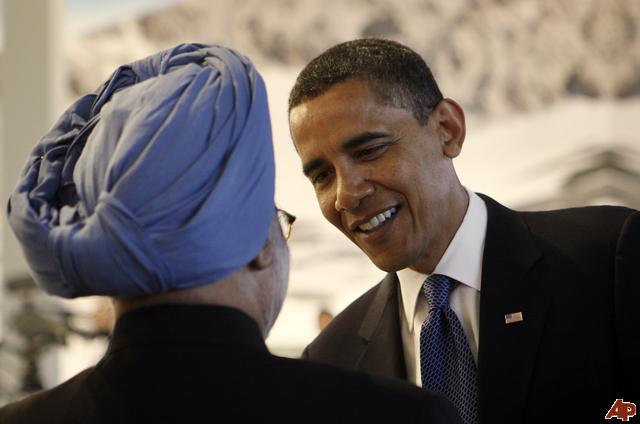
In fact, India has again demonstrated its inability to stick to its stated position. The new bonhomie with Pakistan in the form of cricket diplomacy actually mocks the memory of those killed in the 2008 Mumbai terrorist siege that was planned on Pakistani soil. Pakistan not only has done nothing to bring the perpetrators of the Mumbai attacks to justice, but has also managed to get India to unconditionally resume dialogue at the highest level.

Singh was clearly motivated by a desire to divert attention away from a series of scandals that have destabilized his government and tarnished his reputation. So desperate was Singh to get a Pakistani leader to come to Mohali that he invited both President Asif Ali Zardari and Prime Minister Yousaf Raza Gilani. Although Gilani effectively ranks No. 4 in the Pakistani power hierarchy after the Army chief, ISI chief and president, Singh and Sonia Gandhi leaned over backward to treat him as if he were Pakistan’s real power wielder.

Gushy expectations and wishful thinking have long blighted Indian foreign policy. In dealing with Pakistan, a succession of Indian leaders have assumed that the others do what they often do — jettison beliefs, perceptions and policies overnight. Singh’s initiative indeed serves as more evidence for Pakistan that Indian policy is inconsistent and confused and that there are no real costs to be paid for continuing to wage a “war of a thousand cuts” against India.

Few things stir greater public passions in India than cricket and politics. And yet Mohali represented the third occasion when an Indian prime minister blended cricket and politics to court Pakistan since it launched a proxy war against India. It was Rajiv Gandhi who first politicized cricket by playing host to Pakistani military dictator Zia ul-Haq at an India-Pakistan match in Jaipur in 1987. That example prompted Singh to similarly invite another Pakistani dictator, Pervez Musharraf, to a match in New Delhi in 2005. Tellingly, only India has practiced cricket diplomacy — that too to propitiate Pakistani rulers.

Singh’s shifting policy on Pakistan has actually drawn encouragement from the record of his sphinx-like predecessor, Atal Bihari Vajpayee, under whose leadership there was a troubling lack of both consistency and clarity on how to deal with Pakistan. India’s roller-coaster policy on Pakistan between 1998 and 2004 exacted a heavy toll.

In that period, personal rather than professional characteristics defined India’s shifting Pakistan stance, as the policy jarringly traversed through Lahore, Kargil, Kandahar, Agra, Parliament House, Srinagar and Islamabad. In a situation with no parallel in modern world history, much of the Indian military was kept in war-ready position for nearly 10 months by Vajpayee and then demobilized without any results to show.

Vajpayee’s swinging policy pendulum undermined professionalism and institutionalized policy-making, and exposed India’s glaring inadequacy to set and unwaveringly pursue clear, long-term goals. Instead of replacing the cynicism that has now crept into the Indian system with a clearheaded, goal-oriented policy, Singh has gladly chosen to follow in Vajpayee’s footsteps.

In fact, at a time when multiple scandals have engulfed his government, Singh was eager to shift the public spotlight to a big diplomatic initiative. So the entry of India and Pakistan into the World Cup semi-finals came as a godsend opportunity for him, although he is no great cricket fan.

Singh’s unexpected gambit caught everyone by surprise, although impulsive moves (as Sharm el-Sheikh and Havana showed) are usually counterproductive to national interest. In diplomacy, preparatory work is a must.

For example, the ping-pong diplomacy that jumpstarted US-China relations in the early 1970s was part of careful, two-year policy groundwork. Ping-pong with China, in fact, was just a cover for the US to quietly initiate an alliance with Beijing to contain the Soviet Union.

Mohali, by contrast, represented a meeting of beleaguered leaders, bringing together two prime ministers that are politically wounded at home. The Indian and Pakistani governments are both battered by allegations of corruption, mismanagement and poor administration. Indeed, there is little prospect of any kind of breakthrough in India-Pakistan relations, given that Pakistan’s real power broker — army chief Ashfaq Parvez Kayani — is considered one of the most anti-India generals in his country’s history.

Peace on the subcontinent thus remains as far off as ever. Dialogue between the two countries, in any case, is founded on conflicting expectations. India’s premise is that the process of dialogue will persuade Pakistan to cease sending armed terrorists into India and start building good-neighbourly ties. Pakistan, in contrast, has viewed the process as a means to nudge India to ‘make progress on Kashmir,’ a euphemism for Indian concessions.

Singh, for his part, has refused to learn from his past blunders at Sharm el-Sheikh (where he included Baluchistan) and Havana (where he turned the terror sponsor into a fellow victim of terror by setting up the infamous Joint Anti-Terror Mechanism). But if he thought he could use the Mohali hoopla to distract the Indian public from the swirling scandals, he is likely to be disappointed. No political stunt can help defuse the public anger in India over mega-corruption.

Brahma Chellaney; geoestratega, analista internacional experto en países emergentes

Brahma Chellaney; geoestratega, analista internacional experto en países emergentesVictor-M Amela, Ima Sanchís, Lluís Amiguet
“Los indios queremos ser europeos”
31/01/2011 – 00:14 | Actualizada a las

Dos predicciones
Chellaney es maestro en vislumbrar el futuro en las contradicciones del presente: los europeos tememos a los asiáticos, porque trabajan más que nosotros por mucho menos, pero ellos aspiran no sólo al sueldo; sino también a nuestro sistema de bienestar y libertades. Así que Chellaney predice que nosotros tendremos que esforzarnos más por menos, pero los asiáticos a su vez deberán invertir parte de su crecimiento en crear su Estado del bienestar. La democracia ‘con sus corruptelas’ es válvula de escape salvadora para los conflictos en India, pero es una dictadura la que saca a China de la pobreza. Así que China tendrá que democratizarse para canalizar sus conflictos en alza o estallará.

Aquí les tenemos mucho miedo a los asiáticos, porque trabajan por la mitad de sueldo…
Pues deberían tenerles menos miedo y alegrarse de que prosperen, porque ¿sabe por qué hay hoy menos guerras en el mundo que hace cien años?

¿…?
Porque hay mucha menos gente pobre. La creación de prosperidad es el primer factor para la disminución de las guerras. Porque si usted se está muriendo de hambre: ¿qué interés tiene en mantener la paz?

Más bien poco.
En cambio, si usted se gana la vida y tiene un futuro, se convierte en accionista de la paz mundial y estará interesado en mantenerla en su país. Por eso, hoy hay menos guerras en el planeta que hace un siglo.

Ojalá tenga cada vez más razón.
Además, a esos españoles que tienen tanto miedo de que, para competir con los asiáticos, les obliguen a trabajar más por menos, también les diré otra cosa… ¡Que se animen!

Pues falta nos hace últimamente.
¡Si son ustedes ejemplo del mundo! Los asiáticos y los africanos quieren vivir como ustedes, los ciudadanos de la Unión Europea…

Yo creí que todos querían irse a EE.UU.
La Unión Europea es hoy –mucho más que Estados Unidos– el ejemplo al que les gustaría llegar a los ciudadanos de los países emergentes. Los indios queremos ser como europeos de la Unión Europea. Así que corrijan lo necesario, pero defiendan ustedes su modelo, porque no hay otro mejor.

En España estamos casi en recesión y con más del 20 por ciento de paro.
El desarrollo es mucho más que la cifra del crecimiento del PIB: es la igualdad social, la protección de los más débiles, una cobertura sanitaria universal de calidad, educación superior competitiva, protección del medio ambiente y una administración honesta.

Estamos de acuerdo.
Pues lo han hecho ustedes mejor en todo eso que nadie, incluido EE.UU., y en Asia lo sabemos. Los asiáticos quieren los estándares de bienestar y democracia de la Unión Europea: nadie quiere vivir como los chinos o como los emiratos árabes, por muy ricos que sean. Y si ustedes crecen menos hoy, es porque ya tienen cierto desarrollo…

¿Quién crece mejor: China o India?
China crece algo más, el 10 por ciento, e India, el 9, pero creo que, pese a la enorme corrupción y la triste inoperancia del Estado indio, la democracia hace más estable a India y eso acabará siendo una ventaja definitiva para India incluso a medio plazo.

¿No es más estable una dictadura?
¡Mire a Túnez y ahora Egipto! La democracia es mayor garantía de estabilidad que cualquier autoritarismo. Los indios lo sabemos bien, porque nuestra democracia no es un ideal, es ante todo una necesidad: es la válvula de escape de las inevitables tensiones étnicas, lingüísticas, clasistas y territoriales de un país inmenso. Sin la democracia estaríamos en permanente guerra civil.

Pues la dictadura comunista chinamantiene el orden en el suyo con eficacia.
¿Por cuánto tiempo? Su 10 por ciento de crecimiento económico tiene un inquietante correlato que no se difunde: ¡el número de manifestaciones callejeras también se ha disparado un 10 por ciento!

Pero el PC chino aún lo controla todo.
Al partido le gusta dar la impresión de que la población china es homogénea étnica y socialmente, pero eso es falso. Además de las crecientes desigualdades sociales, fruto del crecimiento, el 60 por ciento de los chinos son de etnias diversas. No podrán resolver esas diferencias sin democracia.

Tienen los tanques.
Los tanques pueden reprimir un día una revuelta, como en Tíbet o Tiananmen, pero no pueden reprimir cada día todas las revueltas. O el régimen encuentra el modo de hacer una transición suave hacia una democracia más o menos abierta, o llegará el día en que una de esas revueltas catalizará todos los malestares hasta otra guerra civil.

Esperemos que encuentren la fórmula.
Más nos vale a todos, porque si China acaba siendo la primera potencia mundial sin ser una democracia, todas las relaciones internacionales y el sentido de la historia cambiarán: la democracia y el respeto a la ley internacional dejarán de ser la aspiración y la norma de los países y serán sustituidos por el equilibrio del terror al poder militar.

¿Qué intuye?
De momento, los militares mandan cada día más en China.

Inquietante.
Tienen más desafíos abiertos: ¿logrará China pasar de una economía de la imitación a otra de la innovación? Si no, se estancará.

Japón lo consiguió a medias.
Japón imitaba en los 70 como imitan los chinos hoy y logró transformarse luego en un país más inventor, pero me temo que China no podrá convertirse en innovadora aún…

¿Por qué?
Porque el autoritarismo impide la innovación, que surge en el libre flujo horizontal de ideas en equipo. Así que sin democracia en una sociedad abierta nadie inventa nada.

¿Tiene pruebas?
Los laboratorios americanos tienen dos grandes grupos de becarios: chinos e indios. Los chinos son mejores en dar escala a innovaciones existentes, pero no inventan nada nuevo; en cambio, los indios son innovadores, porque conviven con la diversidad y sus exigencias desde que nacen.

El Pais interview

ENTREVISTA: BRAHMA CHELLANEY Consejero del Gobierno indio
“La revuelta de la calle se extenderá hasta Pakistán”
GEORGINA HIGUERAS – Madrid – 02/02/2011
Profesor de Estudios Estratégicos en el Centro de Investigación Política de India y colaborador de distintas universidades de EE UU, Brahma Chellanay es consejero del Gobierno indio en cuestiones de seguridad internacional, terrorismo y control de armas.

Profesor de Estudios Estratégicos en el Centro de Investigación Política de India y colaborador de distintas universidades de EE UU, Brahma Chellanay es consejero del Gobierno indio en cuestiones de seguridad internacional, terrorismo y control de armas. En una entrevista realizada durante su reciente estancia en Madrid, Chellanay sostiene que la falta de futuro de los jóvenes árabes “ha llenado las calles de ira” en una protesta que no hay quien pare. Y afirma: “En 10 años, la revuelta de la calle habrá cambiado la faz de los regímenes despóticos contra los que se han levantado”.

Pregunta. ¿Cómo ve lo que está sucediendo en Egipto?

Respuesta. Es una crisis muy fuerte para el mundo árabe y para Estados Unidos. Es la revuelta de la calle -en la que los jóvenes han volcado su frustración y odio- contra los palacios -donde se refugian los tiranos que les gobiernan-. La calle es antiamericana y los palacios los sostiene EE UU. De ahí, las consecuencias que también puede tener en EE UU.

P. ¿Es otro episodio del llamado choque de civilizaciones?

R. No, no es una cuestión de musulmanes contra Occidente. El mundo árabe vive un levantamiento político movido por la ira contra los dirigentes corruptos y por el abismo creado entre esos gobernantes y una juventud sin futuro. Es una protesta legítima nacida en la rabia por creciente hundimiento de la clase media y de sus esperanzas de una vida digna.

El Pais

P. ¿Cree que la revuelta se extenderá más allá de Egipto?

R. El enfrentamiento entre la calle y los palacios se esparcirá por el norte de África y Oriente Próximo hasta llegar a Pakistán. En 10 años, la revuelta habrá cambiado la faz de los regímenes despóticos contra los que se ha levantado. Acabará con la mayoría de estos, incluida la monarquía saudí.

P. ¿Considera que el efecto dominó barrerá las dinastías del Golfo?

R. Esos países son incluso más frágiles que el norte de África por la enorme cantidad de extranjeros que viven en ellos y porque son naciones que encierran contradicciones étnicas o sociales. Por ejemplo, la monarquía de Bahrein y sus principales autoridades son suníes cuando la mayoría de la población es chií.

P. ¿Ve como uno de los detonantes de la revuelta la decisión de Mubarak de entronizar a su hijo Gamal para dirigir Egipto?

R. Las dinastías tienen pocas posibilidades de supervivencia en esta situación volcánica. El despotismo es una olla a presión sin válvula de seguridad, cuando su interior comienza a hervir estalla sin control. No hay escape. La democracia, por el contrario, sí que tiene válvula de seguridad por la que se puede canalizar la rabia.

P. La gente no grita contra EE UU ¿Por qué le va a afectar?

R. Hay un sentimiento de que los dictadores son corruptos y déspotas porque tienen el apoyo de EE UU. Su actuación se seguirá muy de cerca.

P. ¿Será positiva la retirada de las tropas de Afganistán?

R. La retirada será positiva para EE UU que ha librado dos guerras sin sentido, aunque si abandonan Afganistán no se librarán del terror en sus ciudades. Sin embargo, desde el punto de vista de la estabilidad regional es negativa, porque los talibanes no podrán controlar todo Afganistán y el país se romperá en base a la división étnica. Con ello, se expandirá la inestabilidad a toda Asia Central cuyas fronteras se han trazado precisamente dividiendo las etnias.

Rebalancing India’s diplomacy

Behind the geopolitical hugs


Instead of being content with doling out multibillion-dollar contracts to other powers, India must learn the art of aggressively pushing commercial interests as a central driver of diplomacy, says Brahma Chellaney


Brahma Chellaney

The Economic Times, January 7, 2011 http://j.mp/eVPNaH


In a recent span of five months, the head of government or state from each of the five powers with a permanent seat on the UN Security Council visited India. Accompanied by a delegation of business leaders, each came with a similar objective — to secure billions of dollars in new Indian contracts. New Delhi was more than happy to oblige. Each left flaunting the new export contracts.


The summit hugs actually point to a worrying trend: India seems to measure success of its diplomacy by how many billions of dollars of business it gives to a visiting foreign dignitary. In a world in which trade still follows the flag, India functions as if imports can help hoist its flag.


Foreign governments have been aggressively courting India to try to get a slice of its rapidly growing market. With Western and Japanese markets racked by economic troubles, other powers’ export machines avariciously seek a larger market share in India, the world’s second fastest-growing economy currently. Also, with India now the world’s second-largest arms buyer, wooing New Delhi as a defence and strategic partner has become necessary to sell military wares. The $150 billion worth of potential contracts opened up by the nuclear deal are yet another magnet.


The beeline to New Delhi began when Prime Minister David Cameroon arrived with Britain’s largest-ever trade delegation. He also hawked defence wares, managing to clinch one weapon deal worth over $1 billion. US exports to India have expanded five-fold in the past decade, yet President Barack Obama marketed his Indian tour as primarily a mission to create American jobs. He left India mightily pleased, with some $15 billion worth of export deals in his bag and assured of new arms contracts.  


To help France win India’s first contract under the nuclear deal, the environmental clearance of the Jaitapur plant site was rushed through in record 80 days. French President Nicholas Sarkozy’s visit yielded $13 billion worth of deals for him. Besides agreeing to buy high-priced Areva reactors of unproven design and safety, India has promised France a contract to upgrade its 52 Mirage fighters — an upgrade for which Paris has quoted a ridiculous price of $2.6 billion, which is as good as the cost of new warplanes of equivalent capability from Russia. Sarkozy’s take-home goodies also included an agreement-in-principle on coproduction of a short-range surface-to-air French missile system, to be called “Maitri.”


Just as Chinese President Hu Jintao came to New Delhi in 2006 after Beijing resurrected the Arunachal Pradesh card, Premier Wen Jiabao’s recent stopover on his way to Pakistan followed China’s unsheathing of a new instrument of leverage against India — Kashmir. In fact, Wen arrived after his standing at home had been weakened in the twilight of his political career, with the state-run national press censoring on three separate occasions his remarks on political reforms. Yet he came with some 400 businessmen to fortify an asymmetrical trade relationship that has turned India into the raw-material appendage of a neocolonial Chinese economy. While conserving its own natural resources, China is sourcing primary commodities from Africa and India and exporting refined goods to them in return. While its foreign direct investment in India remains minuscule ($52 million in the past decade) and it continues to impede Indian corporations from entering its market, China is undercutting Indian manufacturing through large-scale dumping.


As long as China can continue to strengthen such lopsided economic ties and reap a ballooning trade surplus, it will have little incentive to bridge the yawning political divide. Wen, in fact, did not even seek to address any of India’s security concerns. Yet he wrapped up his visit with a bagful of contracts worth some $23 billion.


At the year-end, when Russian President Dmitry Medvedev came calling, India signed a number of economic and defence agreements worth billions of dollars to shore up its relationship with an old ally. In a changing world, sticking with an old, “tried and tested” friend makes a lot of sense for India.


India, though, needs to recognize that reciprocity and leverage are the twin pillars on which sound diplomacy is founded. Dispensing contracts without reciprocity is a path neither to leverage building nor to developing comprehensive national power. Even when the prime minister travels overseas, he awards contracts to his hosts, instead of returning home with lucrative contracts. Little surprise India is the only major global economy that is import-dependent, not export-oriented. India relies predominantly on domestic consumption to fuel its economic growth.


High import dependency, however, puts an undue burden on the domestic consumer and taxpayer and acts as the main impediment to building comprehensive national power. It also lubricates big-bucks corruption because import deals often offer alluring kickbacks, usually routed directly to offshore bank accounts. More fundamentally, doling out multibillion-dollar contracts as a tool of diplomacy — even as India has gained notoriety for the scale of its stolen national wealth stashed in international financial safe havens — only undermines India’s rising strength.


The import dependency in various sectors has created strong business lobbies seeking to influence foreign-policy options so as to safeguard practices that threaten to pauperize the Indian economy. Such entrenched interests, for example, wish to perpetuate the inequitable trade with China, including the stripping of Indian resources. Also illustrative is defence spending, which India has doubled over the past six years, ploughing more and more funds into arms imports, but without an appraisal of the country’s long-term deterrent requirements. The more arms India has imported, the more it appears to lack the capability to decisively win a war thrust upon it by even the smaller of its two regional adversaries.


India must learn the way foreign leaders aggressively push commercial interests as a central driver of their diplomacy. Promoting exports has to become a key part of Indian foreign policy. Without meaningful political support, Indian industry will remain at a serious disadvantage to its Western and Chinese competitors.  And the country will stay mired in debilitating import dependencies. The next time the PM goes abroad, he should strive to come back with contracts for Indian industry.


(c) The Economic Times, 2011.

China’s new squeeze-India strategy

India’s faint attempt at playing Chinese checkers

A bully goes only after the timid: the more feckless and fearful a policy, the more pressure it will invite


Brahma Chellaney

Mint, December 28, 2010

http://bit.ly/fMJGEB


With the political clout of its military growing, China has displayed increasing assertiveness with its neighbors. But no neighbor is feeling the heat more than India. China’s more muscular policy has injected greater turbulence in the already-fraught bilateral ties.


In recent years, the New Delhi visit of any major Chinese leader has been ominously preceded by a new instrument of leverage being unsheathed against India. On the eve of President Hu Jintao’s 2006 visit, China resurrected its long-dormant claim to Arunachal Pradesh, nearly three times larger than Taiwan.  Premier Wen Jiabao’s recent visit was preceded by China fashioning a sharp-edged Kashmir card against India.


Having raked up the Arunachal issue, Beijing has embarked on a three-pronged strategy to build pressure on India over Kashmir. First, it has sought to challenge Indian sovereignty over Jammu and Kashmir both by excluding the western sector from the length of the border it claims to share with India and by stapling a separate paper visa for any J&K resident applying to travel to China. Second, shrinking the length of the Sino-Indian frontier paves the way for Beijing to limit the territorial dispute to what it claims (Arunachal), while what it occupies (the Switzerland-sized Aksai Chin) would be taken up only after an Indo-Pakistan Kashmir settlement — the very formulation China applies to the dispute over Pakistan’s 1963 ceding of a trans-Karakoram tract to it. And three, China’s deployment of military troops in Pakistan-held Kashmir, ostensibly to build strategic projects, means that India now faces Chinese troops on both flanks of J&K.


During his visit, Wen cynically sought to harness China’s new squeeze-India strategy as a source of leverage. He proactively suggested that Chinese and Indian officials begin “in-depth discussions” to sort out one aspect of this strategy — the stapled-visa matter. While the proposal, on the face of it, may seem reasonable, it actually demands that India negotiate with the stick wielder. Since negotiations cannot be one-sided, it also means the Chinese intend to discard this new stick only on the basis of give-and-take. Wen’s stress on the adjective “in-depth” indeed signals that the Chinese will drive a hard bargain.


Yet New Delhi, unable to grasp the full implications of China’s Machiavellian new strategy, has risen to the Chinese bait. Having publicly said that “the ball is now in China’s court” — meaning Beijing must, on its own, “unstaple” an issue it created — New Delhi in private agreed to the opposite. According to the Chinese foreign ministry, “There was an understanding that officials will meet and this would be appropriately resolved.”

This is just the latest example of how Chinese diplomacy is able to run rings round India, successfully deflecting attention from the core issues to the new issues it creates. It is also an example of Indian diplomacy compounding its own challenges. Instead of simply repaying China in the same coin by issuing visas on a separate leaf to the Han migrants that now dominate the Tibetan plateau, Indian officials have begged China to give up its visa policy. Beijing knew the Indians would come running. And that it would then be able to extract some concession on an unconnected matter. Will India also enter into give-and-take to escape the other sticks China now brandishes, from purging the western sector to stepping up cross-border military incursions in this very sector?


Wen came to New Delhi empty-handed, yet he left for his country’s all-weather ally Pakistan with $23 billion worth of Indian economic contracts. Such was his nimble diplomacy that Wen first agreed to a joint communiqué incorporating a “firm commitment” to resolve the border issue “at an early date.” He then delivered a public speech effectively asking that the issue be left to future generations because sorting it out “will take a fairly long period of time.”  


While India did well not to reiterate its usual ritualistic commitment to a one-China policy, it has pegged that move not to China’s refusal to accept the territorial status quo but to the lowest possible threshold — the stapled-visa issue. The implication is that if China abandons that small stick even while continuing to wave bigger sticks, India will happily go back to openly declaring that Tibet and Taiwan are part of China. In fact, despite the absence of a direct reference to “one China,” the latest joint communiqué affirms a commitment to “abide by the basic principles” enshrined in the 2003, 2005, 2006 and 2008 joint statements — all of which contain India’s pledge to a “one China” without a reciprocal Chinese commitment to a “one India.”


China’s hardening approach has unfolded at a time when sinologists are in charge of Indian policy. The national security adviser and foreign secretary have both served as ambassador to China. In truth, sinologists since before the1962 war have been the weak link in India’s China policy — too absorbed in narrow, arcane issues and unable to dispassionately assess China, or India’s options, in a larger strategic context.


Make no mistake: A bully goes only after the timid. The more feckless and fearful a policy, the more pressures it will invite on the country. Over caution and pusillanimity actually can make the bully more brazen. China’s new squeeze strategy is a reminder India must avoid that trap.


Brahma Chellaney is professor of strategic studies at the Centre for Policy Research in New Delhi.

Comment at views@livemint.com

A bully goes only after the timid

Delhi Trades While Kashmir Burns

Increased trade is no panacea for sharpening geopolitical rivalry

By BRAHMA CHELLANEY

Wall Street Journal, December 20, 2010


The summit last week between Chinese Premier Wen Jiabao and Indian Prime Minister Manmohan Singh was a disappointment that signals more turbulence ahead in relations between the two Asian giants. True, the meeting resulted in the usual platitudes about friendship and cooperation. But it’s telling that the two neighbors were unable to make progress on resolving any of their current disputes.


During the first visit of a major Chinese leader to India in more than four years, some easing of political tensions should have been accomplished. Instead the two sides decided to kick all contentious issues down the road and expand bilateral trade by two-thirds over the next five years. However, increased trade is no panacea for the sharpening geopolitical rivalry.


First of all, while trade may benefit both sides, the perception in India is that China gains more. India’s trade deficit with China is ballooning, and it largely exports raw materials to China and imports finished products. The focus on trade, even as political disputes fester, plays into the Chinese agenda to secure new markets in India while continuing with a strategy to regionally contain that country.


In the last decade, bilateral trade has risen 20-fold, making it the only area where relations have thrived. But far from helping to turn the page on old rifts, this commerce has been accompanied by greater Sino-Indian geopolitical rivalry and military tensions.


India-China relations have been going through an exceptionally frosty spell in recent years, with New Delhi’s warming relationship with Washington emboldening Beijing to up the ante through border provocations, resurrection of its long-dormant claim to the northeastern Indian state of Arunachal Pradesh (which it has been calling "southern Tibet" since 2006), and other diplomatic needling. Beijing had initially sought to improve ties with New Delhi so that it could dissuade it from moving closer to Washington. But after the two democracies cemented a civilian nuclear deal in mid-2005, China turned more coercive toward its southern neighbor.


In 2009, relations sank to their lowest political point in more than two decades when Beijing unleashed a psychological war upon New Delhi, employing its state-run media and nationalistic Web sites to warn of another armed conflict. It was a throwback to the coarse rhetoric China had used in the buildup to the 32-day war in 1962. The Chinese Communist Party’s main mouthpiece, the People’s Daily, berated India for "recklessness and arrogance" and asked it to weigh "the consequences of a potential confrontation with China."


Ignoring the lesson that booming trade by itself is no guarantee of moderation or restraint between states, China and India have left their political rows to future generations to clear up, with Mr. Wen bluntly stating that sorting out the Himalayan border disputes "will take a fairly long period of time."


Even as these old rifts remain, new problems have arisen, roiling relations further. China (which occupies one-fifth of the original princely state of Jammu and Kashmir) has started a troubling three-pronged policy to build pressure on New Delhi over Kashmir, where the disputed borders of India, Pakistan and China converge. It has sought to enlarge its footprint in Pakistani-held Kashmir through new strategic projects; it has attempted to question India’s sovereignty over the Indian-controlled part of Kashmir by issuing visas on a separate leaf to Kashmiri residents holding Indian passports; and it has officially shortened the length of the Himalayan border it shares with India by purging the 1,597-kilometer line separating Indian Kashmir from Chinese-held Kashmir.


Chinese strategic projects around India, including ports in Sri Lanka and Pakistan and new transportation links with Burma, Nepal and Pakistan, have been seriously unnerving India. The recently reported Chinese military presence in Pakistani-held Kashmir means that India faces Chinese troops on both flanks of its portion of Kashmir. The deepening China-Pakistan nexus—Mr. Wen’s next stop after India was to his country’s "all-weather" ally Pakistan—presents India with a two-front theater in the event of a war with either country.


The deterioration in China-India relations clearly demonstrates that rapidly expanding trade is no measure of progress in bilateral relations. Unless estranged neighbors fix their political relations, economics alone will not be enough to create goodwill or stabilize their relationship.


Clearly, China is unwilling to accept the territorial status quo. Yet it pushes for a free-trade agreement. With Western and Japanese markets racked by economic troubles, the Chinese export juggernaut needs a larger market share in India, the world’s second fastest-growing economy.


India must recognize the difference between being cautious and being meek: The former helps avert problems, while the latter symbolizes weakness and invites more pressure. To its credit, New Delhi last week refused to reaffirm its support for Beijing’s sovereignty over Tibet and Taiwan, hopefully bringing an end to a futile diplomatic giveaway: India had since the late 1980s been periodically renewing its commitment to a "one China" policy, even as Beijing not only declined to make a reciprocal one-India pledge, but also openly scoffed at India’s territorial integrity. New Delhi needs more such gumption.


Mr. Chellaney is the author, most recently, of "Asian Juggernaut" (HarperCollins, 2010).


Copyright 2010 Dow Jones & Company, Inc. All Rights Reserved 

Dealing with Burma: It’s the economy, stupid

The Japan Times, November 23, 2010

Let trade transform Burma

 
The election process in Burma has altered its political landscape, giving birth to new institutions and players, triggering a generational change in the armed forces, bringing to power the military-backed Union Solidarity and Development Party (USDP), and facilitating the release of prodemocracy leader Aung San Suu Kyi from seven years of isolation in her lakeside villa in Rangoon.
 

In addition to the emergence of a bicameral national Parliament, 14 regional parliaments, a president and a civilian federal government, the country has a new flag, a new national anthem, a new capital and a new official name, with the "Union of Myanmar" tag giving way to the "Republic of the Union of Myanmar."

While several ethnic-minority parties have done well, especially the Shan Nationalities Democratic Party and the Rakhine Nationalities Development Party, the election results have confirmed that the military will continue to rule through its proxy, USDP, led by Prime Minister U Thein Sein.

This is no surprise: After being in power for more than 48 years, the military has become too fat to return to the barracks. In fact, it won’t fit in the barracks. Still, the holding of the election has forced the armed forces to assume a civilian mask, a process that has witnessed the elevation of younger military officers to replace those who resigned to run for legislative seats.

At 65, Aung San Suu Kyi faces a difficult situation, with her party disbanded, the opposition splintered and the military’s grip on power as firm as ever. To compound matters, there are deep divisions among her followers over whether to confront the country’s rulers or emulate the example of Nelson Mandela who negotiated with South Africa’s then apartheid regime.

A breakaway faction of her party took part in the elections, but did not fare well. With no hope of a "color revolution" in Burma, demilitarization of the polity can at best be a step-by-step process. While the revived political process has created some space for the democracy movement, Suu Kyi cannot hope to bring about tangible democratic reforms without co-opting influential elements within the armed forces.

With Burma now in transition, the United States and its European partners must moderate their sanctions policy to influence developments within and create incentives for greater political openness. Indeed, there is no reason why a weak, impoverished Burma should continue to be held to a higher human rights standard than an increasingly assertive China.

Why deny Burma the international-trade opportunities that have allowed the world’s biggest executioner, China, to prosper?

The defining events that led to the crushing of prodemocracy forces in Burma and China actually occurred around the same time more than two decades ago, yet the West responded to the developments in the two countries in very different ways. China’s spectacular economic rise owes a lot to the Western decision not to sustain trade sanctions after the 1989 Tiananmen Square massacre of prodemocracy protesters. That the choice made was wise can be seen from the baneful impact of the opposite decision in favor of sustained sanctions against Burma, which brutally suppressed prodemocracy demonstrators 10 months before Tiananmen Square and later refused to honor the outcome of a national election in 1990.

Had the Burma-type approach (centered on escalating sanctions) been applied against China internationally, the result would have been a less prosperous and a potentially destabilizing China today.

By contrast, the continuation of sanctions and their subsequent expansion against Burma snuffed out any prospect of that country emulating China’s example of blending economic openness with political authoritarianism. Indeed, the military’s exploratory efforts to open up the Burmese economy in the early 1990s fizzled out quickly in the face of Western penal actions.

The sanctions policy now needs to be recalibrated by drawing on the lessons of the past two decades. The first lesson is that the economic sanctions, even if justified, have produced the wrong political results. Years of sanctions have left Burma without an entrepreneurial class or civil society but saddled with an all-powerful military as the sole functioning institution.

A second lesson is that the expansion of sanctions has not only further isolated Burma, but also made that country overly dependent on China, to the concern of the nationalistic Burmese military.

At a time when the U.S. is courting Communist-ruled Vietnam as part of its "hedge" strategy against a resurgent China, it makes little sense to continue with an approach that is pushing a strategically located Burma into China’s lap.

Yet another lesson is that the sanctions have hurt not their intended target — the military. By cutting off investment and squeezing vital sectors of the Burmese economy — from tourism to textiles — the sanctions have lowered the living conditions of ordinary Burmese and shut out liberalizing influences.

Now is the time, with Burma in some flux, for the U.S. and its allies to get out of a self-perpetuating cycle of sanctions and help carve out greater international space in Burma in the hope of building a civilian institutional framework for a democratic transition. Each step toward greater political openness in Burma, including Suu Kyi’s release, ought to be suitably rewarded.

More broadly, democracy promotion should not become a geopolitical tool wielded only against the weak and the marginalized. Going after the small kids on the global block but courting the most-powerful autocrats is hardly the way to build international norms or ensure positive results.

As the Nobel Committee bluntly pointed out while awarding the 2010 Nobel Peace Prize to jailed Chinese dissident Liu Xiaobo, "China is in breach of several international agreements to which it is a signatory, as well as of its own provisions concerning political rights."

U.S. President Barack Obama began on the right note by exploring the prospect of a gradual U.S. re-engagement with Burma, with his envoys meeting with the Burmese foreign minister and other officials. Yet on his recent India visit, Obama attacked Burma three times, reflecting his frustration with the painfully slow movement to create a real democratic opening in that nation.

U.S. and European policy must recognize that the seeds of democracy will not take root in a stunted economy. Trade is likely to prove more effective than sanctions.

Encouraging Western investment, trade and tourism will help undercut Chinese influence and aid civil-society development in a critically weak country.

Brahma Chellaney is the author, most recently, of "Asian Juggernaut" (HarperCollins USA).
 

The Japan Times: Tuesday, Nov. 23, 2010
(C) All rights reserved

A tactless Indian foreign minister

The Undiplomatic Krishna
 
Brahma Chellaney
 

Krishna is continuing the tradition of Indians in high office messing up the country’s China policy.

Guest Column, India Today, December 6, 2010


At a time when there are a number of disturbing parallels between the situation leading up to the 1962 Chinese invasion of India and the conditions prevailing now, External Affairs Minister S.M. Krishna stands out for his diplomatic naïveté. Sidelining China’s aggressive resurrection of its long-dormant claim to Arunachal Pradesh and its continued occupation of one-fifth of the original princely state of Jammu and Kashmir, Krishna has made repeated pleas to Beijing to stop issuing visas on a separate sheet to residents of Indian Jammu and Kashmir. Predictably, Beijing has again rebuffed him by peremptorily declaring that its position remains unchanged. It ill behoves the minister to appear as a supplicant before the mythical “Middle Kingdom,” that too on a secondary issue. 


If New Delhi wants Beijing to give up its devious visa practice of portraying Jammu and Kashmir as distinct and independent from India, it must repay China in the same coin by issuing visas to Tibet residents on a separate sheet of paper. That includes all the Tibetans (who, in any event, have never accepted being part of China) and the Han who have settled across Tibet as it existed before the 1951 annexation. China has hived off about half of Tibet. With the annexation severing India’s civilizational relationship with Tibet and extinguishing its extra-territorial rights there, New Delhi has every right to treat Tibet as a distinct entity in its visa policy. Once such a visa policy has been implemented, you can bet that Beijing will approach New Delhi to work out a compromise.


Now consider Krishna’s bigger gaffe: At the recent Russia-India-China (RIC) trilateral meeting in the Chinese city of Wuhan, the minister told his Chinese counterpart that Jammu and Kashmir is a “core issue” for India just as Tibet and Taiwan are core national interests for Beijing. And, in that context, he urged China to show sensitivity to Indian concerns over Jammu and Kashmir — an entreaty that fell on deaf ears. In fact, as if to underline Beijing’s dismissive approach towards Indian concerns, it was announced that Chinese Premier Wen Jiabao will combine his forthcoming India visit with a stop in Pakistan.


By placing Jammu and Kashmir on a par with Tibet, Krishna, in effect, was labelling his country an occupying power in Kashmir the way China is in Tibet. While China forcibly absorbed buffer Tibet, Jammu and Kashmir acceded on the same legal principles that governed the transition of other princely states from colonial rule to union with an independent India. Also, by drawing a parallel between Jammu and Kashmir and China’s claim to Taiwan, Krishna made a preposterous analogy between a state that is part of the Indian federation and an autonomous entity under a permanent threat of force from China.


Taiwan may be far from Indian shores but its political future matters to India. Just as Beijing lays claim to Arunachal, unmindful of the wishes of its 1.3 million people, China seeks to absorb Taiwan, irrespective of what the majority there want. In strategic terms, Taiwan can be to India what Pakistan is to China. Translated into policy that could entail close strategic collaboration between India and Taiwan, with the goal to aid each other’s security and build strategic equilibrium in Asia.


In fact, whether Taiwan — a vibrant democracy — continues to prosper under self-governance, or is beaten into submission by the world’s largest autocracy, will determine the future make-up of Asian security. Taiwan, sitting astride vital sea lanes, truly holds the key to whether China rises peacefully or becomes an arrogant power seeking unchallenged ascendancy in Asia. Yet through his ill-advised comparison, Krishna conceded that Taiwan is to China what the rump Jammu and Kashmir is to India.


Krishna actually is continuing an illustrious tradition since 1950 of Indians in high office messing up the country’s China policy. Even the 1962 “stab in the back” and the more-recent Chinese assertiveness have not helped discipline such waywardness.


The sphinx-like, weak-in-the-knees Atal Bihari Vajpayee, for example, built an unflattering linkage between peaceful Sikkim and troubled Tibet during a 2003 Beijing visit, remembered for his notorious kowtow on Tibet — recognizing it to “part of the territory of the People’s Republic of China.” Now another elderly gentleman is demonstrating an uncanny knack of playing into China’s hands.


Brahma Chellaney is the author, most recently, of Asian Juggernaut (HarperCollins).


(c) India Today, 2010.

http://indiatoday.intoday.in/site/Story/121323/Guest%20Column/the-undiplomatic-krishna.html

Myanmar: Time to recalibrate Western sanctions policy

Why Single Out Myanmar for Sanctions?

By BRAHMA CHELLANEY

International Herald Tribune, November 18, 2010

http://www.nytimes.com/2010/11/18/opinion/18iht-edchellaney.html?ref=global


NEW DELHI — With the release of Daw Aung San Suu Kyi from prolonged house detention, it is time for the United States and its European partners to moderate their sanctions policy against Myanmar (Burma) so as to create incentives for greater political openness and to insulate its citizens from the rigors of the punitive actions.

There is no reason why a weak, impoverished Myanmar should continue to be held to a higher human-rights standard than an increasingly assertive China. Why deny Myanmar the international-trade opportunities that have allowed the world’s biggest executioner, China, to prosper?

The defining events that led to the crushing of pro-democracy forces in Myanmar and China actually occurred around the same time more than two decades ago, yet the West responded to the developments in the two countries in very different ways.

China’s spectacular economic rise owes a lot to the Western decision not to sustain trade sanctions after the 1989 Tiananmen Square massacre of pro-democracy protestors. The Cold War’s end facilitated Washington’s pragmatic approach to shun trade sanctions and help integrate China with global institutions through the liberalizing influence of foreign investment and trade.

That the choice made was wise can be seen from the baneful impact of the opposite decision in favor of sustained sanctions against Myanmar, which brutally suppressed pro-democracy demonstrators 10 months before Tiananmen Square and subsequently refused to honor the outcome of a national election in 1990. Had the Myanmar-type approach of escalating sanctions been applied against China internationally, the result would have been a less prosperous and a potentially destabilizing China today.

By contrast, the continuation of sanctions and their subsequent expansion against Myanmar snuffed out any prospect of that country emulating China’s example of blending economic openness with political authoritarianism. Indeed, the military’s attempts to open up the Myanmar economy in the early 1990s fizzled out quickly in the face of Western penal actions.

Today, the release of Aung San Suu Kyi offers the U.S. and Europe an opportunity to recalibrate the sanctions policy by drawing on the lessons of the past two decades.

The first lesson is that the economic sanctions, even if justified, have produced the wrong political results. Years of sanctions have left Myanmar without an entrepreneurial class or civil society and saddled with an all-powerful military as the sole functioning institution.

A second lesson is that the expansion of sanctions has not only further isolated Myanmar, but also made that country overly dependent on China, to the concern of the nationalistic Myanmar military. At a time when the United States is courting Communist-ruled Vietnam as part of its “hedge” strategy against a resurgent China, it makes little sense to continue with an approach that is pushing a strategically located Myanmar into China’s strategic lap.

Yet another lesson is that the sanctions have hurt not their intended target — the military — but ordinary citizens. By cutting off investment and squeezing vital sectors of the Myanmar economy, from tourism to textiles, the sanctions have lowered the living conditions of the Burmese and shut out liberalizing influences.

The blunt fact is that after being in power for nearly half a century, the military has become too fat to return to the barracks. In fact, it won’t fit in the barracks.

With no hope of a “color revolution” in Myanmar, demilitarization of the polity can at best be a step-by-step process. In that context, the recent elections, although far from being free or fair, have helped revive a long-dormant political process, given birth to new political players and institutions (including a bicameral national Parliament, 14 regional parliaments and the impending appointment of a president and civilian federal government), and implicitly created a feeling of empowerment among the people.

With the military now in the throes of a generational change, the revived political process has created new space for the democracy movement, as symbolized by Aung San Suu Kyi’s release. But with the opposition badly splintered and the military’s grip on power firm as ever, Aung San Suu Kyi cannot bring about tangible democratic reforms without building bridges with the armed forces.

Now is the time, with Myanmar in transition, for the United States and its allies to get out of a self-perpetuating cycle of sanctions and help carve out greater international space in that nation. Each step toward greater political openness in Myanmar ought to be suitably rewarded.

More broadly, democracy promotion should not become a geopolitical tool wielded only against the weak and the marginalized.

Going after the small kids on the global block but courting the most-powerful autocrats is hardly the way to build international norms or ensure positive results.

An uncompromisingly penal approach against Myanmar has had the perverse effect of weakening America’s hand while strengthening China’s. This was best illustrated during the Bush administration, which, after slapping the harshest sanctions on Myanmar, turned to Beijing as a channel of communication with the Burmese junta.

President Barack Obama began on the right note by exploring the prospect of a gradual reengagement with Myanmar. Yet on his recent visit to India, Obama attacked Myanmar three times, reflecting his frustration with the painfully slow movement to create a democratic opening in that nation.

Despite Aung San Suu Kyi’s release, the seeds of democracy will not take root in a stunted economy. External penal actions without constructive engagement and civil-society development in a critically weak country defeat their very purpose.

Brahma Chellaney, a professor of strategic studies at the New Delhi-based Center for Policy Research, is the author, most recently, of “Asian Juggernaut.”

A weakened Obama visits India

Obama will take more than give


Brahma Chellaney

The Economic Times, November 4, 2010


U.S. President Barack Obama comes to India when his presidency has been considerably dented by the mid-term election drubbing, with the poll losses in key swing states like Pennsylvania, Ohio and Florida likely to encumber his 2012 re-election bid. The president who harped on being transformational has been delivered a no-confidence in his own leadership by the voters.


It is remarkable that just a year ago, Obama was riding high, having unexpectedly won the Nobel prize for peace — a cause for which he has little to show up to now. A year, obviously, is a very long time in politics.


Obama’s Democratic Party lost the House of Representatives to the Republicans, while its razor-thin edge in the 100-seat Senate offers little consolation. It takes 60 votes to get anything done in the Senate. The Democrats’ continued control of the Senate thus is nominal. In effect, they stand kicked out of power.


Obama came to office with tremendous international goodwill. Yet, saddled with problems of historic proportion, he had little time to savour his epochal victory against rival John McCain. After all, he inherited national and global challenges more formidable than any faced by an American president at the beginning of the term. With the U.S. economic recession threatening to become a depression and two overseas wars raging, Obama had his work clearly cut out for him.


Now, midway through his term, these election losses ensure his hands will be full for the rest of his term. First, the high unemployment, growing U.S. debt and other economic problems that contributed to the poll reverses will preoccupy his presidency, especially if he hopes to be re-elected. That means he will shift to a more domestically focused agenda than before, with his international diplomacy geared towards trade deals to boost job and wealth creation at home. Second, he is likely to get tied down by the legislative actions and investigations of a Republican-influenced Congress, with a resurgent Tea party movement likely to target him increasingly.


That, plus an American public weary of the war, makes certain that Obama will start pulling U.S. forces out of Afghanistan before the job is done, leaving India on the front lines to face the brunt of greater terrorism from the Af-Pak belt. In fact, the recent unveiling of a new $2.3-billion U.S. aid package for the Pakistani military, along with the continued sale of offensive weapon systems, can only embolden an institution that is at the root of Pakistan’s problems and regional instability.


The good news on the U.S.-India front is that a weakened Obama presidency will do little to change the dynamics of a relationship whose direction is clearly set — towards closer engagement. The not-so-good news is that having given short shrift to some of India’s concerns in the first 22 months of his presidency on the pressing issues of counterterrorism and the scofflaw roles of the Pakistani army and ISI, Obama will have lesser leeway to accommodate India’s interests in his regional strategy, pivoted on extricating the U.S. from Afghanistan with the aid of the Pakistani military.


The president, pushed by the election setbacks, is likely to focus his India visit on promoting U.S. commercial interests, including job creation back home. That means he will crave for more contracts, especially high-visibility multibillion-dollar arms deals.


From Washington’s perspective, the billions of dollars worth of arms the Obama administration already has contracted to sell India since last year symbolize the new Indo-U.S. partnership. Closer military-to-military ties and defence transactions are part of the vaunted strategic partnership. Yet, India ought to be concerned about its growing reliance on the U.S. for weapons and their replacement parts, given that Washington is selling arms on both sides of the subcontinental divide.


During the second half of the Cold War, India relied on the Soviet Union for weapons. Now, New Delhi has begun to switch its dependency to the U.S., which has quietly emerged in recent years through government-to-government deals as the single largest seller of arms to India. Embarrassingly, India today stands out in the world as the only large nation dependent on imports to meet even basic defence needs.


Overall, the U.S. and India have never been closer than they are now, with their relationship set to deepen in spite of the policy differences on regional issues. Still, one should realistically expect more “take” than “give” from this presidential visit.


(c) The Economic Times.