Els aliats naturals a l’àsia

Brahma Chellaney

Democràcies marítimes com el Japó i l’índia han de cooperar per crear a l’àsia un ordre estable i liberal Els dos països han iniciat un diàleg estratègic amb els EUA al qual és possible que també s’afegeixi Austràlia

La Vanguardia (Català), 30 ene 2012

EB. CHELLANEY, n un moment en què l’ascens econòmic, diplomàtic i militar de la Xina projecta l’ombra d’un desequilibri de poder sobre l’àsia, la visita fa poques setmanes del primer ministre japonès, Yoshihiko Noda, a l’índia ha consolidat una relació que s’està intensificant ràpidament entre dos aliats naturals. Ara la tasca del Japó i l’índia és afegir un contingut estratègic concret als seus vincles.

L’equilibri de poder que està sorgint a l’àsia estarà determinat principalment pels esdeveniments a l’àsia oriental i a l’oceà Índic. Així, doncs, el Japó i l’índia tenen un paper important per exercir en la preservació de l’estabilitat i la contribució a la salvaguarda de rutes marines d’importància decisiva a la regió indopacífica, en sentit més ampli, caracteritzada no només per la confluència dels oceans Índic i Pacífic, sinó també per la seva importància per al comerç mundial i els subministraments energètics.

Les regions d’àsia amb auge econòmic són costaneres, per la qual cosa democràcies marítimes com el Japó i l’índia han de cooperar per tal de crear a l’àsia un ordre estable, liberal i basat en les normes. Com va dir el primer ministre indi, Manmohan Singh, a la reunió de la cimera de l’àsia oriental celebrada a Bali, l’ascens continu d’àsia no està automàticament assegurat i “depèn de l’evolució d’una estructura cooperativa”.

El Japó i l’índia, com a països amb pocs recursos energètics i dependents en gran manera de les importacions de petroli del golf Pèrsic, estan profundament preocupats pels afanys mercantilistes encaminats a assegurar-se el domini dels subministraments energètics i les rutes de transport per a aquests. Així, doncs, el manteniment d’un àmbit marítim pacífic i legal, incloent-hi una llibertat de navegació sense traves, és decisiu per a la seva seguretat i benestar econòmics. Aquesta és la raó per la qual han acordat iniciar maniobres aèries i navals conjuntes a partir del 2012; un dels senyals del pas d’una actitud encaminada a subratllar els valors compartits cap a una altra d’encaminada a protegir interessos compartits.

De fet, malgrat la seva complicada política interna i els seus escàndols endèmics, l’índia i el Japó tenen la relació bilateral que s’intensifica més ràpidament a l’àsia actual. Des que van anunciar una “associació estratègica i global” l’any 2006, el seu compromís polític i econòmic s’ha intensificat notablement. Una congruència en augment d’interessos estratègics va propiciar la Declaració Conjunta sobre Seguretat i Cooperació del 2008, una fita important en la creació d’un ordre asiàtic estable, en el qual una constel·lació d’estats vinculats per interessos comuns ha arribat a ser decisiva per garantir l’equilibri en un moment en què els canvis actuals en el poder incrementen les amenaces a la seguretat.

La declaració conjunta va seguir el model de l’acord de cooperació en matèria de defensa del 2007 amb Austràlia, l’altre país amb el qual el Japó, aliat militar dels Estats Units, té un acord de cooperació en matèria de seguretat. La declaració sobre seguretat de l’índia i el Japó va engendrar, al seu torn, un acord similar entre l’índia i Austràlia el 2009.

El mes d’agost passat va entrar en vigor un acord de lliure comerç entre el Japó i l’índia, abans conegut com a acord d’associació econòmica general i, en resposta a la utilització punitiva per part de la Xina del seu monopoli a la producció procedent de terres rares per interrompre aquesta classe d’exportacions al Japó durant la tardor del 2010, els dos països han acordat cooperar en matèria de desenvolupament de terres rares, que tenen una importància decisiva per a una gran diversitat de tecnologies energètiques ecològiques i les aplicacions militars.

Actualment, el nivell i la freqüència del compromís bilateral oficial són extraordinaris. La visita de Noda a Nova Delhi va formar part d’un compromís per part dels dos països de celebrar una cimera anual, a la qual assistiran els seus primers ministres.

Més important encara és que el Japó i l’índia mantinguin ara diversos diàlegs ministerials anuals: un diàleg estratègic entre els ministres d’afers Exteriors, un altre sobre seguretat entre els ministres de Defensa, un altre de normatiu entre el ministre de Comerç i Indústria de l’índia i el ministre d’economia, Comerç i Indústria del Japó i d’altres més sobre afers econòmics i energètics.

I, per acabar de completar tot això, el Japó, l’índia i els Estats Units van iniciar un diàleg estratègic trilateral a Washington el 19 de desembre. La incorporació dels Estats Units ha de reforçar la cooperació entre l’índia i el Japó. Com va dir recentment el ministre d’afers Exteriors del Japó, Koichiro Gemba, “El Japó i els Estats Units estan intensificant una relació estratègica amb l’índia” i el diàleg trilateral és “un exemple concret de col·laboració” entre les tres democràcies principals d’àsia i el Pacífic. És probable que la cooperació esmentada esdevingui quadrilàtera amb la inclusió d’austràlia.

El Japó i l’índia han d’enfortir la seva encara incipient cooperació estratègica fent seves dues idees que requereixen un canvi subtil en el pensament i la política japonesos. Una és la de crear la interoperabilitat entre les seves formidables forces navals que, en cooperació amb altres armades amigues, pot reforçar la pau i l’estabilitat a la regió indopacífica. Com va dir l’ex primer ministre japonès, Shinzo Abe, en un discurs recent a Nova Delhi, la finalitat ha de ser que “aviat abans que tard, l’armada del Japó i la de l’índia estiguin perfectament interconnectades”. Actualment, el Japó només té interoperabilitat naval amb les forces dels Estats Units.

La segona idea és la de desenvolupar en comú sistemes de defensa. L’índia i el Japó cooperen en matèria de defensa mitjançant míssils amb Israel i els Estats Units, respectivament. No hi ha motius perquè no ho facin en matèria de defensa amb míssils i altres tecnologies per a la seguretat mútua. La cooperació esmentada ha de ser completa i no s’ha de limitar al diàleg estratègic, la cooperació marítima i les maniobres navals ocasionals.

A la Constitució del Japó, imposada pels Estats Units, no hi ha una prohibició d’exportacions d’armes, sinó només una decisió governamental adoptada ja fa molt i que, en qualsevol cas, s’ha relaxat. De fet, la decisió original es referia a armes, no a tecnologies.

Les associacions econòmiques més estables del món, incloent-hi la comunitat atlàntica i l’associació entre el Japó i els Estats Units, descansen sobre la col·laboració en matèria de seguretat. Els vincles econòmics que manquen del suport de les associacions estratègiques solen ser menys estables i fins i tot inestables, com es fa palès en les relacions econòmiques que l’índia i el Japó tenen amb la Xina. Mitjançant una estreta col·laboració estratègica, el Japó i l’índia han d’encapçalar l’afany de crear llibertat, prosperitat i estabilitat a la regió indopacífica.

The lasting lesson of 1962

Brahma Chellaney

As the 50th anniversary year of China’s 1962 invasion, 2012 should serve as a time of reflection on what lessons that attack still holds for India.

Given that the Year of the Dragon — a monster that has been universal since before biblical times — begins on January 23, this year holds significance for China’s other neighbors as well. After all, the declared intent of the 1962 war — “to teach a lesson” — was publicly restated in the 1979 Chinese aggression against Vietnam and appeared to guide Beijing’s top-heavy response in the boat incident with Japan in the fall of 2010.

By roaring at its neighbors and picking territorial fights with them, China lived up to the Year of the Tiger that 2010 represented in its astrology. Then in 2011, the Year of the Rabbit, China seemed to emulate that burrowing animal. It blasted more tunnels through mountain ranges in its borderlands. And — as was apparent, for example, from its use of different cards against India, including the stapled-visa issue and cross-frontier incursions — it demanded “carrots” (rabbit’s favorite) to eschew irascible behavior. Will it breathe fire in the Year of the Dragon?

One facet of China’s grand strategy has remained constant over the years. Strategic deception and military surprise are enduring elements in Chinese strategy. The 1962 war was a classic example of the fusion of these two elements.

Integral to deception is taking an opponent by surprise, as emphasized in Sun Tzu’s Art of War some 2,500 years ago. Since the Communists came to power, China has been involved in the largest number of military conflicts in Asia. In all these conflicts, Chinese forces struck with no forewarning.

Indeed, a 2010 Pentagon report points out that China has repeatedly carried out military pre-emption in the name of defense: in 1950 (Tibet invasion, followed immediately by entry into Korean War), 1962, the 1969 border conflict with the Soviet Union, and the 1979 attack on Vietnam. According to the report, “The history of modern Chinese warfare provides numerous case studies in which China’s leaders have claimed military pre-emption as a strategically defensive act.” China’s seizure of the Paracel Islands from Vietnam in 1974 was another example of offense as defense.

The 1962 attack — justified as a defensive act by Beijing, which used Nehru’s unguarded remarks (“our instructions are to free our territory”) to brand India the aggressor — stands out for China’s masterly blending of deception and surprise. The invasion, mounted from two separate fronts, caught India off guard. The “stab-in-the-back” was best summed up by Nehru, who told the nation that “a powerful and unscrupulous opponent, not caring for peace or peaceful methods” had returned “evil for good.”

The aggression was cleverly planned and timed. It coincided with the start of the Cuban missile crisis, which put the Soviet Union and the U.S. on the edge of a nuclear Armageddon. And the very day the U.S. quarantine of Cuba was lifted to help end the Cuban missile crisis, China ceased its 32-day aggression against India. The cunning timing — just when global attention was focused on averting a nuclear catastrophe — ensured that India received no outside help.

The deception began much earlier, in keeping with the utility of deception in Chinese strategic culture for both peacetime functions and warfighting applications. One example of peacetime deception was Premier Zhou En-lai’s 1960 New Delhi visit, during which he dangled the carrot of a border settlement without putting his money where his mouth was. Of course, it didn’t take much effort to trick the Indians, who had convinced themselves that by merely signing the 1954 Panchsheel Agreement, they had bought peace with China.

If anything, this agreement — which incorporated five principles of peaceful coexistence — provided a perfect cover for China to launch aggressive plans against India, including its quiet construction of a highway through the Aksai Chin Plateau in the state of Jammu and Kashmir and furtive nibbling at Indian territories across the Himalayas. The period up to 1954 marked Communist China’s annexation and consolidation of rule in Tibet, whereas the post-1954 phase heralded its belligerence toward India, culminating in the surprise invasion. The iniquitous Panchsheel Agreement — under which India, without any quid pro quo, surrendered its extra-territorial rights in Tibet and recognized the “Tibet region of China” — constituted a watershed in opening the path to hostilities.

It took a war humiliation for India to wake up to the reality that a nation can get peace only if it is able to defend peace.

Today, as part of its larger game of deception, China identifies Taiwan as the primary focus of its defense strategy. That is to divert international attention from its single-mindedness on achieving broader military goals. Taiwan serves metaphorically as a red carpet on which to invite all the bulls while Beijing busily seeks to accomplish bigger tasks.

If the countries around India have become battlegrounds for China’s moves to encircle India, it is because Beijing heeds Sun Tzu’s counsel: “Contain an adversary through the leverage of having made its neighbourhood hostile.” According to Sun Tzu’s core guidance, “The ability to subdue the enemy without any battle is the ultimate reflection of the most supreme strategy.”

China employs deception to also camouflage its refusal to accept the territorial status quo with several of its neighbours. It is disturbing the status quo even on cross-border river flows. The insistence on changing the status quo, coupled with its strategic opacity and penchant to take an adversary by surprise, only increases the unease in Asia over its rise. Indeed, the more than three-decade-old border talks with India mesh well with China’s use of strategic deception.

As long as the territorial status quo is not accepted, the possibility that the Chinese military will strike again cannot be ruled out. As U.S. National Intelligence Director James Clapper said in his prepared testimony before the Senate Select Committee on Intelligence on January 31, “The Indian Army believes a major Sino-Indian conflict is not imminent but the Indian military is strengthening its forces in preparation to fight a limited conflict along the disputed border, and is working to balance Chinese power projection in the Indian Ocean.”

Prime Minister Manmohan Singh’s emphatic statement in the Lok Sabha in December 2011 that “China will not attack India” thus seems more than gratuitous. Can anyone turn a blind eye to the Chinese state-run newspaper and military publications launching an anti-India tirade and warning New Delhi of the consequences of a confrontation with China? Some military analysts in China have publicly discussed the merits of a 1962-style short, sharp, decisive border war that helps put India in its place for the next few decades? Disturbingly, the more timorous Singh has been, the more belligerent China has become.

India needs to counter the asymmetrical capabilities China is fashioning to take an adversary by surprise. Its anti-satellite (ASAT) weapons, for example, are being designed to “shock and awe” in space. China is already waging a quiet cyber-war, as if to underscore its ability to sabotage vital infrastructure in wartime. Moreover, its military is developing a blitzkrieg approach to warfare: a surprise blitz will seek to stun, confound and overwhelm an opponent.

The lasting lesson of 1962 is that India must be ready to repulse any kind of attack, including by undercutting the aggressor where it is the weakest. Otherwise, China’s Achilles’ heel — Tibet — will become a stronger launch-pad for aggressive acts.

A version of this article appeared in The Times of India of January 22, 2012.

Copyrighted material. Reprinting this article without written consent will constitute a violation of international copyright law. 

Build Japan-India naval ties

By BRAHMA CHELLANEY  Japan Times  December 28, 2011

At a time when the specter of power disequilibrium looms large in Asia, the visit of Prime Minister Yoshihiko Noda to India offers an opportunity to the two natural allies to help promote Asian stability by adding concrete strategic content to their fast-growing relationship. Japan and India need to build close naval collaboration.

The balance of power in Asia will be determined by events principally in two regions: East Asia and the Indian Ocean. Japan and India thus have an important role to play to advance peace and stability and help safeguard vital sea lanes in the wider Indo-Pacific region.

Asia’s booming economies are bound by sea, and maritime democracies like Japan and India must work together to help build a stable, liberal, rules-based order in Asia. Whereas 97 percent of India’s international trade by volume is conducted by sea, almost all of Japan’s international trade is ocean-borne. As energy-poor countries heavily dependent on oil imports from the Persian Gulf region, the two are seriously concerned by mercantilist efforts to assert control over energy supplies and transport routes. The maintenance of a peaceful and lawful maritime domain, including unimpeded freedom of navigation, is thus critical to their security and economic well-being.

In this light, Japan and India have already agreed to start holding joint naval exercises from the new year. This is just one sign that they now wish to graduate from emphasizing shared values to seeking to jointly protect shared interests. Today, the fastest growing bilateral relationship in Asia is between India and Japan. Since they unveiled a “strategic and global partnership” in 2006, their political and economic engagement has deepened remarkably.

Their growing congruence of strategic interests led to the 2008 Joint Declaration on Security Cooperation, a significant milestone in building Asian power stability. A constellation of Asian states linked by strategic cooperation and sharing common interests has become critical to ensuring equilibrium at a time when the ongoing power shifts are accentuating the security challenges that now exist in Asia.

The joint declaration was modeled on Japan’s 2007 defense-cooperation accord with Australia — the only country with which Tokyo has a security-cooperation declaration. Japan, of course, is tied to the United States militarily since 1951 by a treaty. The India-Japan security agreement, in turn, spawned a similar India-Australian accord in 2009.

A free-trade accord between Japan and India, formally known as the comprehensive economic partnership agreement (CEPA), entered into force just three months ago. By covering more than 90 percent of the trade as well as a wide range of services, rules of origin, investment, intellectual property rights, customs rules and other related issues, CEPA promises to significantly boost bilateral trade, which remains small in comparison with Japan’s and India’s trade with China. India is already beginning to emerge as a favored destination in Asia for Japanese foreign direct investment.

In response to China’s use of its monopoly on rare-earths production to punitively cut off such exports to Japan during the fall of 2010, Japan and India have agreed to the joint development of rare earths, which are vital for a wide range of green energy technologies and military applications.

Today, the level and frequency of India-Japan official engagement is extraordinary. Noda’s New Delhi visit is part of a bilateral commitment to hold an annual summit meeting of the prime ministers. More important, Japan and India now have a series of annual minister-to-minister dialogues: a strategic dialogue between their foreign ministers; a defense dialogue between their defense ministers; a policy dialogue between India’s commerce and industry minister and Japan’s minister of economy, trade and industry; and separate ministerial-level energy and economic dialogues.

Supporting these high-level discussions is another set of talks, including a two-plus-two dialogue led jointly by India’s foreign and defense secretaries and their Japanese vice minister counterparts, a maritime security dialogue, a comprehensive security dialogue, and military-to-military talks involving regular exchange visits of the chiefs of staff.

To top it off, Japan, India, and the U.S. have initiated a trilateral strategic dialogue, whose first meeting was in Washington last week. Getting the U.S. on board will bolster the convergences of all three partners and boost India-Japan cooperation.

As Japanese Foreign Minister Koichiro Gemba said recently, “Japan and the U.S. are deepening a strategic relationship with India,” and the trilateral dialogue is “a specific example of collaboration” among the three leading Asia-Pacific democracies.

Bilaterally, Japan and India need to strengthen their still-fledgling strategic cooperation by embracing two ideas, both of which demand a subtle shift in Japanese thinking and policy. One is to build interoperability between their naval forces. These forces — along with other friendly navies — can undergird peace and stability in the Indo-Pacific region. As former Prime Minister Shinzo Abe put it in a recent speech in New Delhi, the aim should be that “sooner rather than later, Japan’s navy and the Indian navy are seamlessly interconnected.” Presently, Japan has naval interoperability only with U.S. forces.

Another idea is for the two countries to jointly develop defense systems. India and Japan have missile-defense cooperation with Israel and the U.S., respectively. There is no reason why they should not work together on missile defense and on other technologies for mutual security. Their defense cooperation must be comprehensive and not be limited to strategic dialogue, maritime cooperation, and occasional naval exercises.

There is no ban on weapon exports in Japan’s U.S.-imposed Constitution, only a long-standing Cabinet decision, which in any event has been loosened. That decision, in fact, related to weapons, not technologies.

Japan and India should remember that the most-stable economic partnerships in the world, including the trans-Atlantic ones and the Japan-U.S. partnership, have been built on the bedrock of security collaboration. Economic ties that lack the support of strategic partnerships tend to be less stable, as is apparent from Japan’s and India’s economic relationships with China.

Through close strategic collaboration, Japan and India must lead the effort to build freedom, prosperity and stability in the Indo-Pacific region.

Brahma Chellaney is a professor at the independent Center for Policy Research in New Delhi.

The Japan Times: Wednesday, Dec. 28, 2011. (c) All rights reserved.

China’s Dam Frenzy

China is the world's most "dammed" country, yet its future is drying up.

Striking facts:

  • China boasts more dams than the rest of the world combined.
  • Before the Communists came to power in 1949, there were only 22 dams of any significant size in China. But now China has more than half of the world’s almost 50,000 large dams.
  • This feat means that China has completed on average at least one large dam per day since 1949. If dams of all sizes are counted, the number in China surpasses 85,000.
  • According to Wen Jiabao, China has relocated a total of 22.9 million citizens since 1949 to make way for water projects. So, by official count alone, 1,035 citizens on average have been forcibly evicted daily in the past 62 years for water projects.
  • China is also the global leader in exporting dams. Its state-run companies today are building more dams overseas than the other international dam builders put together.

Internationally syndicated column by Project Syndicate

China’s frenzied dam-building hit a wall recently in Burma (Myanmar), where the government’s bold decision to halt a controversial Chinese-led dam project helped to ease the path to the first visit by a US secretary of state to that country in more than a half-century.

The now-stalled $3.6 billion Myitsone Dam, located at the headwaters of Burma’s largest river, the Irrawaddy, was designed to pump electricity exclusively into China’s power grid, despite the fact that Burma suffers daily power outages. The State-Owned Assets Supervision and Administration Commission of China’s State Council hailed Myitsone as a model overseas project serving Chinese interests. The Burmese decision thus shocked China’s government, which had begun treating Burma as a reliable client state (one where it still has significant interests, including the ongoing construction of a multibillion-dollar oil and natural-gas pipeline).

Despite that setback, China remains the world’s biggest dam builder at home and abroad. Indeed, no country in history has built more dams than China, which boasts more dams than the rest of the world combined.

Before the Communists came to power in 1949, China had only 22 dams of any significant size. Now the country has more than half of the world’s roughly 50,000 large dams, defined as having a height of at least 15 meters, or a storage capacity of more than three million cubic meters. Thus, China has completed, on average, at least one large dam per day since 1949. If dams of all sizes are counted, China’s total surpasses 85,000.

According to the United Nations Food and Agriculture Organization, China’s dams had the capacity to store 562.4 cubic kilometers of water in 2005, or 20% of the country’s total renewable water resources. Since then, China has built scores of new dams, including the world’s largest: the Three Gorges Dam on the Yangtze River.

China is also the global leader in exporting dams. Its state-run companies are building more dams overseas than all other international dam builders put together. Thirty-seven Chinese financial and corporate entities are involved in more than 100 major dam projects in the developing world. Some of these entities are very large and have multiple subsidiaries. For instance, Sinohydro Corporation — the world’s largest hydroelectric company — boasts 59 overseas branches.

Both the profit motive and a diplomatic effort to showcase its engineering prowess drive China’s overseas dam-building efforts. China’s declared policy of “noninterference in domestic affairs” actually serves as a virtual license to pursue dam projects that flood lands and forcibly uproot people — including, as with Myitsone, ethnic minorities — in other countries. But it is doing the same at home by shifting its focus from dam-saturated internal rivers to the international rivers that originate in the Tibetan plateau, Xinjiang, Inner Mongolia, and Manchuria.

China contends that its role as the global leader in exporting dams has created a “win-win” situation for host countries and its own companies. But evidence from a number of project sites shows that the dams are exacting a serious environmental toll on those hosts.

As a result, the overseas projects often serve to inflame anti-Chinese sentiment, reflected in grassroots protests at several sites in Asia, Africa, and Latin America. Moreover, by using a Chinese workforce to build dams and other projects abroad — a practice that runs counter to its own “localization” requirement, adopted in 2006 — China reinforces a perception that it is engaged in exploitative practices.

As the world’s most dammed country, China is already the largest producer of hydropower globally, with a generating capacity of more than 170 gigawatts. Yet ambitious plans to boost its hydro-generating capacity significantly by damming international rivers have embroiled the country in water disputes with most neighbors, even North Korea.

More broadly, China’s dam-building passion has spawned two key developments. First, Chinese companies now dominate the global hydropower-equipment export market. Sinohydro alone, having eclipsed Western equipment suppliers like ABB, Alstom, General Electric, and Siemens, claims to control half the market.

Second, the state-run hydropower industry’s growing clout within China has led the government to campaign aggressively for overseas dam projects by offering low-interest loans to other governments. At home, it recently unveiled a mammoth new $635 billion investment program in water infrastructure over the next decade, more than a third of which will be channeled into building dams, reservoirs, and other supply structures.

China’s over-damming of rivers and its inter-river and inter-basin water transfers have already wreaked havoc on natural ecosystems, causing river fragmentation and depletion and promoting groundwater exploitation beyond the natural replenishment capacity.

The social costs have been even higher, a fact reflected in Chinese Prime Minister Wen Jiabao’s stunning admission in 2007 that, since 1949, China has relocated a total of 22.9 million Chinese to make way for water projects — a figure larger than the populations of Australia, Romania, or Chile. Since then, another 350,000 residents — mostly poor villagers — have been uprooted.

So, by official count alone, 1,035 citizens on average have been forcibly evicted for water projects every day for more than six decades. With China now increasingly damming transnational rivers such as the Mekong, Salween, Brahmaputra, Irtysh, Illy, and Amur, the new projects threaten to “export” the serious degradation haunting China’s internal rivers to those rivers. The time has come to exert concerted external pressure on China to rein in its dam frenzy and embrace international environmental standards.

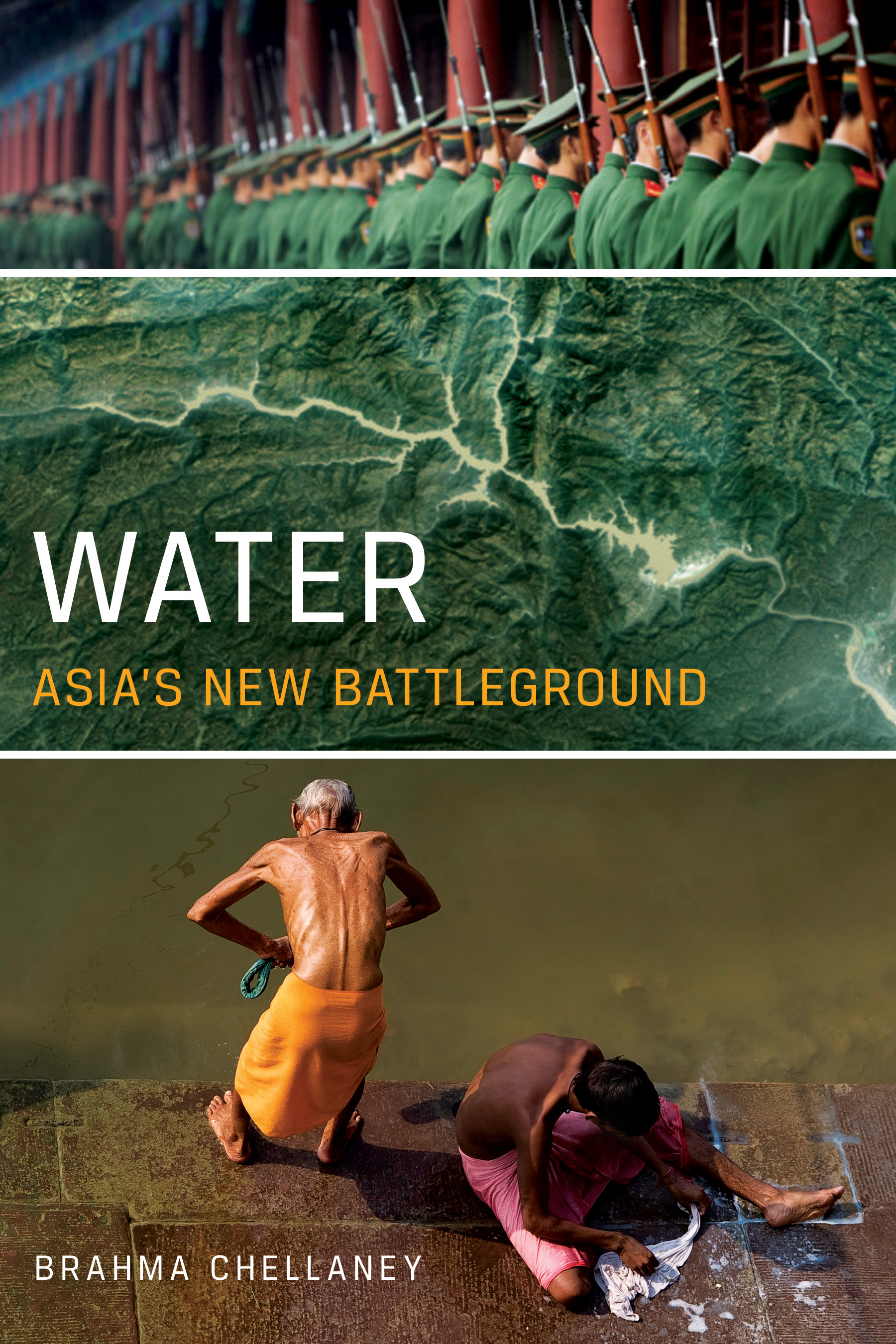
Brahma Chellaney, Professor of Strategic Studies at the New Delhi-based Center for Policy Research, is the author of Asian Juggernaut and the newly released Water: Asia’s New Battleground.

Copyright: Project Syndicate, 2011.
http://www.project-syndicate.org

Dragon’s Familiar Dance

With the 50th anniversary of the 1962 invasion approaching, history is in danger of repeating itself.

Brahma Chellaney
The writer is professor of strategic studies
at the Centre for Policy Research, New Delhi

GUEST COLUMN
India Today, November 7, 2011

https://i0.wp.com/i.telegraph.co.uk/multimedia/archive/00951/ChinaIndia_951129c.jpg
From a military invasion and a cartographic aggression, China is
moving to a hydrological aggression and a strategic squeeze of India
.

As the 50th anniversary of China’s invasion approaches, history is in danger of repeating itself, with Chinese military pressures and aggressive designs against India not only mirroring the pre-1962 war situation but also extending to Pakistan-occupied Kashmir (PoK) and the oceans around India. China’s expanding axis of evil with Pakistan, including a new troop presence in PoK, heightens India’s vulnerability in Jammu and Kashmir, even as India has beefed up its defences in Arunachal Pradesh.

By muscling up to India, what is China seeking to achieve? The present situation, ominously, is no different in several key aspects from the one that prevailed in the run-up to the 1962 war.

● The aim of “Mao’s India war” in 1962, as Harvard scholar Roderick MacFarquhar has called it, was largely political: to cut India to size by demolishing what it represented—a democratic alternative to China’s autocracy. The swiftness and force with which Mao Zedong defeated India helped discredit the Indian model, boost China’s international image, and consolidate Mao’s internal power. The return of the China-India pairing decades later riles Beijing.

● Just as the Dalai Lama’s flight to India in 1959 set the stage for the Chinese military attack, the exiled Tibetan leader today has become a bigger challenge for China than ever. The continuing security clampdown across the Tibetan plateau since the March 2008 Tibetan uprising parallels the harsh Chinese crackdown in Tibet during 1959-62.

● The prevailing pattern of cross-frontier incursions and other border incidents is no different than the situation that led up to the 1962 war. Yet, India is repeating the same mistake by playing down the Chinese intrusions. Gratuitously stretching the truth, Indian officials say the incursions are the result of differing perceptions about the line of control. But which side has refused to define the line of control? It speaks for itself that China hasn’t offered this excuse. The fact is that Chinese forces are intruding even into Utttarakhand—the only sector where the line of control has been clarified by an exchange of maps—and into Sikkim, whose 206-km border with Tibet is recognised by Beijing.

● The 1962 war occurred against the backdrop of China instigating and arming insurgents in India’s northeast. Although such Chinese activities ceased after Mao’s death, China has come full circle today, with Chinese-made arms increasingly flowing into guerrilla ranks in northeast India via Burmese front organisations. In fact, Pakistan-based terrorists targeting India also rely on Chinese arms.

● China’s pre-1962 psychological war is returning. In recent years, Beijing has employed its state-run media and nationalistic websites to warn of another armed conflict. It is a throwback to the coarse rhetoric China had used in its build-up to the 1962 war. Its People’s Daily, for example, has warned India to weigh “the consequences of a potential confrontation with China.” China merrily builds strategic projects in an internationally disputed area like PoK but responds with crude threats when others explore just for oil in the South China Sea.

● Just as India in the early 1960s retreated to a defensive position in the border negotiations after having undermined its leverage through a formal acceptance of the “Tibet region of China,” the spotlight now is on China’s revived Tibet-linked claim to Arunachal rather than on the core issue, Tibet itself. India, with its focus on process than results, has remained locked in continuous border negotiations with China since 1981—the longest and the most-fruitless process between any two nations post-Second World War. This process has only aided China’s containment-with-engagement strategy.

● In the same way that India under Nehru unwittingly created the context to embolden Beijing to wage aggression, New Delhi is again staring at the consequences of a mismanagement of relations. The more China’s trade surplus with India has swelled—jumping from $2 billion in 2002 to more than $30 billion now—the greater has been its condescension toward India. To make matters worse, the insidious, V.K. Krishna Menon-style shadow has returned to haunt Indian defence management and policy. India has never had more clueless defence and foreign ministers or a weaker Prime Minister with a credibility problem than it does today.

In fact, as it aims to mould a Sino-centric Asia, China is hinting that its real geopolitical contest is more with India than with the distant United States. The countries around India have become battlegrounds for China’s moves to encircle India. From a military invasion in 1962 and a subsequent cartographic aggression, China is moving towards a hydrological aggression and a multipronged strategic squeeze of India. China’s damming of rivers flowing from Tibet to India are highlighting Indian vulnerability on the water front even before India has plugged its disadvantage on the nuclear front by building a credible but minimal deterrent.

Whether Beijing actually sets out to teach India “the final lesson” by launching a 1962-style attack will depend on several factors. They include India’s domestic political situation, its defence preparedness, and the availability for China of a propitious international timing of the type the Cuban missile crisis provided in 1962. If India does not want to be caught napping again, it has to come out of the present political paralysis and inject greater realism into its China policy, which today bears a close resemblance to a studied imitation of an ostrich burying its head in the sand.

(c) India Today, 2011.

The Water Hegemon

https://i0.wp.com/www.asianoffbeat.com/CrazyPictures/China-Dam-Interactive-Map.jpg

Column internationally syndicated by Project Syndicate

International discussion about China’s rise has focused on its increasing trade muscle, growing maritime ambitions, and expanding capacity to project military power. One critical issue, however, usually escapes attention: China’s rise as a hydro-hegemon with no modern historical parallel.

No other country has ever managed to assume such unchallenged riparian preeminence on a continent by controlling the headwaters of multiple international rivers and manipulating their cross-border flows. China, the world’s biggest dam builder – with slightly more than half of the approximately 50,000 large dams on the planet — is rapidly accumulating leverage against its neighbors by undertaking massive hydro-engineering projects on transnational rivers.

Asia’s water map fundamentally changed after the 1949 Communist victory in China. Most of Asia’s important international rivers originate in territories that were forcibly annexed to the People’s Republic of China. The Tibetan Plateau, for example, is the world’s largest freshwater repository and the source of Asia’s greatest rivers, including those that are the lifeblood for mainland China and South and Southeast Asia. Other such Chinese territories contain the headwaters of rivers like the Irtysh, Illy, and Amur, which flow to Russia and Central Asia.

This makes China the source of cross-border water flows to the largest number of countries in the world. Yet China rejects the very notion of water sharing or institutionalized cooperation with downriver countries.

Whereas riparian neighbors in Southeast and South Asia are bound by water pacts that they have negotiated between themselves, China does not have a single water treaty with any co-riparian country. Indeed, having its cake and eating it, China is a dialogue partner but not a member of the Mekong River Commission, underscoring its intent not to abide by the Mekong basin community’s rules or take on any legal obligations.

Worse, while promoting multilateralism on the world stage, China has given the cold shoulder to multilateral cooperation among river-basin states. The lower-Mekong countries, for example, view China’s strategy as an attempt to “divide and conquer.”

Although China publicly favors bilateral initiatives over multilateral institutions in addressing water issues, it has not shown any real enthusiasm for meaningful bilateral action. As a result, water has increasingly become a new political divide in the country’s relations with neighbors like India, Russia, Kazakhstan, and Nepal.

China deflects attention from its refusal to share water, or to enter into institutionalized cooperation to manage common rivers sustainably, by flaunting the accords that it has signed on sharing flow statistics with riparian neighbors. These are not agreements to cooperate on shared resources, but rather commercial accords to sell hydrological data that other upstream countries provide free to downriver states.

In fact, by shifting its frenzied dam building from internal rivers to international rivers, China is now locked in water disputes with almost all co-riparian states. Those disputes are bound to worsen, given China’s new focus on erecting mega-dams, best symbolized by its latest addition on the Mekong — the 4,200-megawatt Xiaowan Dam, which dwarfs Paris’s Eiffel Tower in height — and a 38,000-megawatt dam planned on the Brahmaputra at Metog, close to the disputed border with India. The Metog Dam will be twice as large as the 18,300-megawatt Three Gorges Dam, currently the world’s largest, construction of which uprooted at least 1.7 million Chinese.

In addition, China has identified another mega-dam site on the Brahmaputra at Daduqia, which, like Metog, is to harness the force of a nearly 3,000-meter drop in the river’s height as it takes a sharp southerly turn from the Himalayan range into India, forming the world’s longest and steepest canyon. The Brahmaputra Canyon — twice as deep as the Grand Canyon in the United States – holds Asia’s greatest untapped water reserves.

The countries likely to bear the brunt of such massive diversion of waters are those located farthest downstream on rivers like the Brahmaputra and Mekong — Bangladesh, whose very future is threatened by climate and environmental change, and Vietnam, a rice bowl of Asia. China’s water appropriations from the Illy River threaten to turn Kazakhstan’s Lake Balkhash into another Aral Sea, which has shrunk to less than half its original size.

In addition, China has planned the “Great Western Route,” the proposed third leg of the Great South-North Water Diversion Project — the most ambitious inter-river and inter-basin transfer program ever conceived — whose first two legs, involving internal rivers in China’s ethnic Han heartland, are scheduled to be completed within three years. The Great Western Route, centered on the Tibetan Plateau, is designed to divert waters, including from international rivers, to the Yellow River, the main river of water-stressed northern China, which also originates in Tibet.

With its industry now dominating the global hydropower-equipment market, China has also emerged as the largest dam builder overseas. From Pakistani-held Kashmir to Burma’s troubled Kachin and Shan states, China has widened its dam building to disputed or insurgency-torn areas, despite local backlashes.

For example, units of the People’s Liberation Army are engaged in dam and other strategic projects in the restive, Shia-majority region of Gilgit-Baltistan in Pakistan-held Kashmir. And China’s dam building inside Burma to generate power for export to Chinese provinces has contributed to renewed bloody fighting recently, ending a 17-year ceasefire between the Kachin Independence Army and the government.

As with its territorial and maritime disputes with India, Vietnam, Japan, and others, China is seeking to disrupt the status quo on international-river flows. Persuading it to halt further unilateral appropriation of shared waters has thus become pivotal to Asian peace and stability. Otherwise, China is likely to emerge as the master of Asia’s water taps, thereby acquiring tremendous leverage over its neighbors’ behavior.

Brahma Chellaney, Professor of Strategic Studies at the Center for Policy Research, is the author of Water: Asia’s New Battleground.

Copyright: Project Syndicate, 2011.
http://www.project-syndicate.org

A rising hydro-hegemon raises worries downstream

By BRAHMA CHELLANEY
The Japan Times, September 21, 2011

Just as China has aroused international alarm by wielding its virtual rare-earths monopoly as a trade instrument and by thwarting efforts to resolve territorial disputes with its neighbors, it is raising deep concern over the manner it is seeking to fashion water into a political weapon against its co-riparian states.

China, the geographical hub of Asia, is the source of transboundary river flows to the largest number of countries in the world — from Russia to India, and from Kazakhstan to the Indochina Peninsula. This unique status is rooted in its forcible absorption of sprawling ethnic-minority homelands, which make up 60 percent of its landmass and are the origin of all the important international rivers flowing out of Chinese-held territory.

Getting this riparian power to accept water-sharing arrangements or other cooperative institutional mechanisms has proven unsuccessful so far in any basin. As epitomized by its construction of upstream dams on several major international rivers, including the Irtysh-Illy, Amur, Mekong, Salween, Brahmaputra, Arun, Indus, and Sutlej, China is increasingly headed in the opposite direction — toward unilateralist actions impervious to the concerns of downstream nations.

No country in history has been a greater dam builder than China, which boasts not only the world’s biggest dam (Three Gorges) but also a greater number of dams than the rest of the world combined. China thus is the most “dammed” country in the world, boasting slightly more than half of the nearly 50,000 large dams in the world.

Yet far from slowing its dam-building spree, China has stepped up its re-engineering of river flows by portentously shifting its focus from internal rivers to international rivers. It also has graduated from building large dams to building mega-dams.

Its newest dams on the Mekong are the 4,200-megawatt Xiaowan — taller than Paris’s Eiffel Tower and producing more electricity than the installed hydropower-generating capacity of all the lower Mekong countries combined — and the under-construction 5,850-megawatt Nuozhadu, which will be even bigger in storage volume but not in height.

Last summer, China’s state-run hydropower industry published a map of major new dams approved for construction, including one on the Brahmaputra at Metog (or “Motuo” in Chinese) that is to be twice the size of the 18,300-megawatt Three Gorges. The Metog site is almost on the disputed border with India.

In the next decade, according to international projections, the number of dams in the developed countries is likely to remain about the same, while much of the dam building in the developing world, in terms of aggregate storage-capacity buildup, will be concentrated in just one country — China. The consequences of such frenetic construction are already visible.

First, China is now involved in water disputes with almost all its riparian neighbors, ranging from big countries such as Russia and India to weak client-states like North Korea and Myanmar.

Second, its new focus on water megaprojects in the traditional homelands of ethnic minorities has triggered fresh tensions over displacement and submergence at a time when the Tibetan plateau, Xinjiang and Inner Mongolia have all been wracked by revolts or protests against Chinese rule.

Third, the projects threaten to replicate in international rivers the serious degradation haunting China’s internal rivers.

Yet, as if to declare itself the world’s unrivaled hydro-hegemon, China is also the largest dam builder overseas. From Pakistan-occupied Kashmir to Burma’s troubled Kachin and Shan states, China has widened its dam building to disputed or insurgency-torn areas, despite local backlash.

While units of the People’s Liberation Army are now engaged in dam and other strategic projects in the restive, Shiite region of Gilgit-Baltistan in Pakistan-held Kashmir, China’s dam building inside Burma has contributed to renewed bloody fighting recently, ending a 17-year ceasefire between the Kachin Independence Army and the government.

For downriver countries, a key concern is China’s opacity on its hydroengineering projects. It usually begins work quietly, almost furtively, and then presents a project as a fait accompli and as holding transboundary flood-control benefits.

Worse still, China rejects the very notion of a water-sharing arrangement or treaty with any riparian neighbor. The terms “water sharing,” “shared water resources,” “treaty” and “common norms and rules” are anathema to it. It is one of only three countries that voted against the 1997 United Nations Convention that lays down rules on the shared resources of international watercourses.

It is thus no accident that there are water treaties among co-riparian states in South and Southeast Asia, but not between China and any of its neighbors. That the country with a throttlehold over the headwaters of major Asian rivers is also a rising superpower, with a muscular confidence increasingly on open display, only compounds the regional security challenges.

In this light, China poses the single biggest obstacle to the building of institutionalized cooperation in Asia to harness internationally shared rivers for mutual and sustainable benefit.

Water indeed has emerged as a source of increasing intercountry competition and discord in Asia, the most-populous and fastest-developing continent whose per capita freshwater availability is less than half the global average.

The growing water stress threatens Asia’s continued rapid economic growth. And for investors, it carries risks that potentially are as damaging as nonperforming loans, real estate bubbles, infrastructure overbuilding, and political corruption.

Because of China’s centrality in the Asian water map, international pressure must be exerted on Beijing to respect the rights of subjacent states and halt further unilateralist appropriation of shared waters.

It should accept institutionalized basin cooperation, which demands a coextensive restraint among all parties so that no country utilizes shared waters in a way to injuriously affect a co-riparian.

Brahma Chellaney is the author of the just-released “Water: Asia’s New Battleground” (Georgetown University Press).

(C) Japan Times: All rights reserved

The Ominous Rise of a Thirsty Dragon

https://i0.wp.com/cmp.hku.hk/wp-content/uploads/2010/02/three-gorges-dam.jpg
A Chinese dam under construction.

Brahma Chellaney
Times of India, August 7, 2011

China, the geographical hub of Asia, is the source of transboundary-river flows to the largest number of countries in the world — from Russia to India, and from Kazakhstan to the Indochina Peninsula. This unique status is because of its forcible absorption of sprawling ethnic-minority homelands, which make up 60% of its landmass and are the origin of all the important international rivers flowing out of Chinese-held territory.

Getting this pre-eminent riparian power to accept water-sharing arrangements or other cooperative institutional mechanisms has proven unsuccessful in any basin. In fact, as epitomized by its planned or actual construction of a separate cascade of upstream dams on several major international rivers, including the Mekong, Salween, Brahmaputra, Arun, Irtysh-Illy, and Amur, China is increasingly headed in the opposite direction — toward unilateralist actions impervious to the concerns of downstream nations.

No country in history has been a greater dam builder than China, which boasts not only the world’s biggest dam (Three Gorges) but also more total number of dams than the rest of the world combined. Yet far from slowing its dam-building spree, China has stepped up its re-engineering of river flows in two ways: by portentously shifting its focus from internal rivers to international rivers, and by concentrating on mega-dams.

For example, its newest dams on the Mekong are the 4,200-megawatt Xiaowan — taller than Paris’s Eiffel Tower and producing more electricity than the installed hydropower-generating capacity of all of the lower Mekong countries together — and the 5,850-megawatt Nuozhadu, which when complete will be even bigger in storage volume but not in height.

Last summer, China’s state-run hydropower industry published a map of major new dams approved for construction, including one on the Brahmaputra at Metog (or “Motuo” in Chinese) that will be larger than even the 18,300-megawatt Three Gorges. India’s largest dam — the 2,000-megawatt Tehri — pales in comparison with China’s dams.

In the next one decade, according to international projections, the number of dams in the developed countries is likely to remain about the same, while much of the dam building in the developing world, in terms of aggregate storage-capacity buildup, will be concentrated in just one country — China.

The consequences of such frenetic construction are already visible. First, China is now involved in water disputes with almost all its riparian neighbours, ranging from big Russia and India to weak clients like North Korea and Myanmar.

Second, its new focus on water mega-projects in the traditional homelands of ethnic minorities has triggered fresh tensions along ethnic fault lines over displacement and submergence issues at a time when the Tibetan plateau, Xinjiang and Inner Mongolia have all been racked by revolts or protests against Chinese rule. And third, Chinese projects threaten to extend the serious degradation of internal rivers to international rivers.

Yet, as if to underpin its rise as the world’s unrivalled hydro-hegemon, China is also the largest dam builder overseas. From Pakistan-occupied Kashmir to Myanmar’s troubled Kachin and Shan states, China has widened its dam building to disputed or insurgency-torn areas, even in the face of local backlash. While PLA units are engaged in dam and other strategic projects in restive Gilgit-Baltistan, China’s dam building inside Myanmar has contributed to renewed bloody fighting recently, ending a 17-year ceasefire between the Kachin Independence Army and the government.

For downriver countries, a key concern is China’s opacity on its hydro-engineering projects. It usually begins work quietly, almost furtively, and then presents a project as holding transboundary flood-control benefits and as an unalterable fait accompli.

Worse still, China rejects the very notion of a water-sharing arrangement or treaty with any riparian neighbour. The terms “water sharing,” “shared water resources,” “treaty” and “common norms and rules” are an anathema to it. It is one of only three countries that voted against the 1997 UN Convention, which lays down rules on shared basin resources.

It is thus no accident that there are treaties among co-riparian states in South and Southeast Asia, but not between China and any of its neighbours. That the country with a throttlehold over the headwaters of major Asian rivers is also a rising superpower, whose muscular confidence is increasingly on open display, only compounds the regional security challenges.

In this light, China poses the single biggest obstacle to the building of institutionalized cooperation in Asia to harness internationally shared rivers for mutual and sustainable benefit.

Brahma Chellaney is professor of strategic studies at Centre for Policy Research, New Delhi.

(c) Times of India, 2011.

Lamaistic Drama and Intrigue on the Himalayas

Is the Karmapa Lama an agent of Beijing or a political scapegoat?

Chinese cash seized from the monastery of one of the most important figures in Tibetan Buddhism has stirred fresh intrigue
The Karmapa Lama at his monastery in Dharamsala, India, where large sums of Chinese cash were seized in a police raid
Brahma Chellaney
The Guardian
guardian.co.uk, 10 February 2011

The seizure by police of large sums of Chinese currency from the Indian monastery of the Karmapa Lama – one of the most important figures in Tibetan Buddhism – has revived old suspicions about his continuing links with China and forced him to deny that he is an “agent of Beijing”.

The Dalai Lama, the Panchen Lama, and the Karmapa Lama are the three highest figures in Tibetan Buddhism, representing parallel institutions that have intermittently been at odds with each other throughout their history. And China, seeking to tighten its grip on Tibet, has worked to control the traditional process of finding the reincarnation of any senior lama that passes away.

Thus, in 1992, China helped select the seven-year-old Ogyen Trinley Dorje as the 17th Karmapa Lama, installing him at Tibet’s Tsurphu monastery – the Karmapas’ ancestral abode, which was almost destroyed during the cultural revolution. He became the first reincarnated “living Buddha” to be recognised and ratified by Communist China.

But then, in 1999, Dorje staged a stunning escape to India via Nepal, attracting the world’s attention, but also deep suspicion, because of the apparent ease with which he and his entourage managed to flee. The Dalai Lama has hosted him at the Gyuto monastery in Dharamsala, India, ever since.

Earlier, in 1995, China installed its own Panchen Lama after its security services abducted the Tibetans’ six-year-old appointee, who has simply disappeared, along with his family.

Now, China is waiting for the current Dalai Lama – who is over 75 and has had bouts of ill health in recent years – to pass away, so that it can anoint his successor, too. But the Dalai Lama, the charismatic face of the Tibetan movement, has made it clear that his successor will come from the “free world”, thereby excluding Chinese-ruled Tibet. This has set the stage for the emergence of two rival Dalai Lamas, one chosen by China and the other by the Tibetan exile movement.

In fact, the Chinese-appointed Karmapa Lama has a doppelganger Karmapa, who has set up shop in New Delhi. With both the Karmapas in India, the Indian government has sought to maintain peace by barring the contenders from the sacred Rumtek monastery in the Indian Himalayan state of Sikkim.

Against this background, the discovery of large sums of Chinese and other foreign currency has ignited a fresh controversy over Dorje. While his supporters have staged protests against the police raid and interrogation of their leader, Indian officials have expressed apprehension that China may be funding Dorje as part of a plan to influence the Karmapa’s Kagyu sect, which controls important monasteries along the militarised Indo-Tibetan border.

According to Xu Zhitao, an official at the Chinese Communist party central committee’s united front work department, the allegation that “the Karmapa [may be] a Chinese agent or spy shows that India is keeping its mistrustful attitude toward China”. But such an attitude seems warranted: Xu’s Tibet division is tasked with overseeing monastic institutions, inculcating “patriotic” norms among monks and nuns – through re-education when necessary – and infiltrating the Tibetan resistance movement and Tibetan Buddhist monasteries on both sides of the Indo-Tibetan frontier.

Communities in the Himalayan region have historically been closely integrated. But, with Tibet locked behind an iron curtain since the 1951 Chinese annexation, the economies and cultures of the entire Himalayan region have weakened. Tibetan Buddhism, however, still serves as the common link, with the Karmapa’s Kagyu sect a powerful force on the Indian side.

The cash haul has reopened the question that arose in 1999: Was China behind Dorje’s flight to India, or is he a genuine defector who simply got fed up with living in a gilded Chinese cage?

China had several possible motives for staging his “escape”, including a desire to strengthen his claim to the title at a time when the rival contender (backed by important interests in India, Bhutan and Taiwan) appeared to be gaining ground. Had Dorje remained in Tibet, he could have lost out to his rival, because the 280-year-old Rumtek monastery, the Kagyu school’s holiest institution, is where the sect’s all-powerful “black hat”, the symbolic crown of the Karmapa – believed to be woven from the hair of female deities – is located.

China would also have drawn comfort from the fact that, within the murky world of intra-Tibetan politics, its anointed Karmapa, oddly, had the Dalai Lama’s backing. Historically, the Dalai Lamas and Karmapa Lamas vied with each other for influence until the Dalai Lama’s Gelug school gained ascendancy over the Kagyu order. According to Tibetan tradition, however, the Dalai Lama has no role in selecting or endorsing a Karmapa. The Dalai Lama in this case gave his approval for purely political reasons.

The previous Karmapa Lama died in 1981, and the controversy over his successor that has raged ever since also epitomises a struggle for control of the $1.5bn in assets held by the Kagyu order, the richest in Tibetan Buddhism. With control of the Rumtek monastery embroiled in rival lawsuits, the New Delhi-based Karmapa has, not surprisingly, greeted the recent cash seizure as “exposing” his Chinese-appointed rival.

Significantly, in contrast to its increasingly vituperative attacks on the Dalai Lama, China has not denounced (or de-recognised) its Karmapa, despite his flight to India signalling its failure to retain the loyalty of a supposed puppet. The Mandarin-speaking Ogyen Trinley Dorje, now 25, occasionally criticises the Chinese government, including its efforts “to create this ethnic conflict” in Tibet. Nevertheless, China has refrained from attacking him, making clear that it wants him to return eventually.

And the ongoing Karmapa saga, with its shadowy politics and intrigue, could turn out to be only the opening act – a foretaste of what may come when two duelling Dalai Lamas emerge after the incumbent passes from the scene.

China’s challenges in the Year of the Rabbit

Brahma Chellaney
The Economic Times, February 4, 2011

The Lunar New Year couldn’t have begun on a more edgy note for China’s rulers, who have been quick to add words like “Cairo” and “Egypt” to their list of words banned on the Internet. Haunted by the 1989 Tiananmen Square massacre, China’s leaders are nervously watching the rise of people’s power against some Arab dictatorships. If Egyptians could rise up, despite enjoying a per-capita income three times higher than the Chinese, China certainly risks the same contagion.

China actually lived up to the Year of the Tiger that 2010 represented in its astrology by roaring at its neighbours and picking territorial fights with them. Now in the Year of the Rabbit which started on Thursday, will China emulate that burrowing animal? Will it mean more tunnels being burrowed in the Himalayas for river diversion and other strategic projects? And “carrots” (rabbit’s favourite) being demanded from neighbours and the rest of the world for eschewing irascible behaviour?

If the Chinese leadership were forward-looking, it would utilize the Year of the Rabbit to loosen its political reign and make up for the diplomatic imprudence of 2010 that left an isolated China counting only the problems states of North Korea, Pakistan and Myanmar as its allies. But the military’s growing political clout and the sharpening power struggle in the run-up to the major leadership changes scheduled to take place from next year raise concerns that the world will likely see more of what made 2010 a particularly tiger-like year when China frontally discarded Deng Xiaoping’s dictum, tao guang yang hui (conceal ambitions and hide claws).

A tiger’s claws are retractable, but China has taken pride more in baring them than in drawing them in. While manipulating patriotic sentiment, it has pursued hardline policies at home, tightening its controls on the Internet and media and stepping up repression in Tibet and Xinjiang. On a host of issues — from diplomacy and territorial claims to trade and currency — China spent 2010 staking out a more-muscular role that only helped heighten international concerns about its rapidly accumulating power and unbridled ambition.

But nothing fanned international unease and alarm more than Beijing’s disproportionate response to the Japanese detention of a fishing-trawler captain last September. While Japanese Prime Minister Naoto Kan’s standing at home took a beating for his meek capitulation to Chinese coercive pressure, the real loser was China, in spite of having speedily secured the captain’s release.

Japan’s passivity in the face of belligerence helped magnify Beijing’s hysterical and menacing reaction. In the process, China not only undercut its international interests by presenting itself as a bully, but it also precipitately exposed the cards it is likely to bring into play when faced with a diplomatic or military crisis next — from employing its trade muscle to help inflict commercial pain to exploiting its monopoly on the global production of a vital resource, rare-earth minerals.

Its resort to economic warfare, even in the face of an insignificant provocation, has given other major states advance notice to find ways to offset its leverage, including by avoiding any commercial dependency and reducing their reliance on imports of Chinese rare earths.

At issue is not China’s rise but its selective acceptance of norms and rules, as well as its efforts to protect or enlarge unfair advantage in trade, resource, security, currency and other issues.

The gap between its words and actualities is also widening. For example, China persisted with its unannounced rare-earth embargo against Japan for weeks while continuing to blithely claim the opposite in public — that no export restriction had been imposed. Like its denials last year on two other subjects — the deployment of Chinese troops in Pakistan-held Kashmir to build strategic projects and its use of Chinese convicts as labourers on projects in some countries too poor and weak to protest — China has demonstrated a troubling propensity to obscure the truth.

Despite the battering to its international image — which has sunk to its lowest point since after the 1989 Tiananmen Square massacre of pro-democracy protestors — there is little prospect of 2011becoming a course-correction year for Beijing. The high turnover of leaders scheduled to occur at different levels in China during 2012-13 has set in motion within the Communist Party an intense jockeying for promotion, with senior functionaries engaged in competitive pandering to nationalistic sentiment.

But with the party increasingly dependent on the military to maintain its monopoly on power and ensure domestic order, senior military officers are overtly influencing foreign policy. Is China becoming a militaristic state where the government’s oversight over the armed forces exists only in name?

In truth, the more overtly China has embraced capitalism, the more indigenized it has become ideologically. By gradually turning its back on Marxist dogma — imported from the West — the country’s oligarchy has made Chinese nationalism the legitimating credo of its hold on power. The new crop of leaders, including President Hu Jintao’s putative successor, Xi Jinping, will bear a distinct nationalistic imprint.

As the present leadership prepares for the 18th party congress next year, it may find it difficult to resist flaunting the country’s newfound power, in a bid to play to the public gallery at home. A reminder of the domestic challenges was a recent viral video produced by a Beijing animation firm that showed the masses, portrayed as rabbits, rising up in anger against corruption and repression and killing party cadres.

The challenges could prompt China to go for the home run in 2012, the Year of the Dragon — the monster that has been universal since before biblical times. As the 50th year of China’s military attack on India, 2012 will be especially important in Asia, because the declared intent of that war — “to teach a lesson” — was repeated in the 1979 Chinese aggression against Vietnam and appeared to guide Beijing’s top-heavy response in the more-recent boat incident with Japan.

(c) The Economic Times, 2011