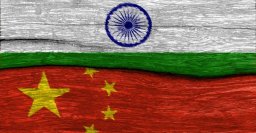
Asia’s colossus threatens a tiny state

In the latest chapter in China’s stealth wars, Bhutan is the target.

BY , The Japan Times, July 5, 2017

chickens-neck-India.jpg

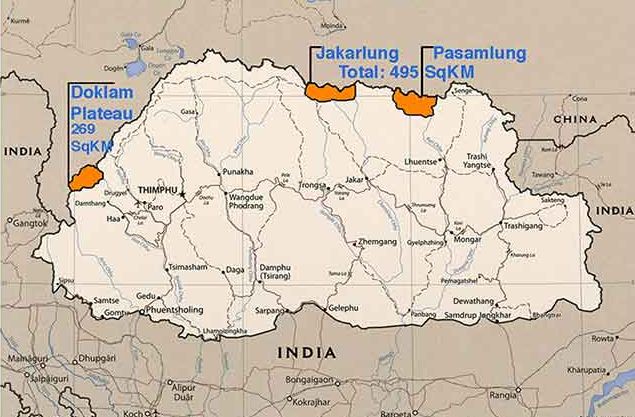
Bhutan, one of the world’s smallest nations, has protested that the Asian colossus, China, is chipping away at its territory by building a strategic highway near the Tibet-India-Bhutan trijunction in the Himalayas. Bhutan has security arrangements with India, and the construction has triggered a tense standoff between Chinese and Indian troops at the trijunction, with the Chinese state media warning of the possibility of war.

Bhutan says “China’s construction of the road inside Bhutanese territory is a direct violation” of its agreements with Beijing. China, however, has sought to obscure its aggression by blaming India for not respecting either the trijunction points or the boundary between Tibet and the Indian state of Sikkim, which is also contiguous to Bhutan.

In the way an increasingly muscular China — without firing a single shot — has waged stealth wars to change the status quo in the South and East China seas, it has been making furtive encroachments across its Himalayan frontiers with the intent to expand its control meter by meter, kilometer by kilometer. It has targeted strategic areas in particular.

If its land grab is challenged, China tends to play the victim, including accusing the other side of making a dangerous provocation. And to mask the real issue involved, it chooses to wage a furious propaganda war. Both these elements have vividly been on display in the current troop standoff at the edge of the Chumbi Valley, a Chinese-controlled zone that forms a wedge between Bhutan and Sikkim, and juts out as a dagger against a thin strip of Indian territory known as the Chicken Neck, which connects India’s northeast to the rest of the country.

In recent years, China has been upgrading its military infrastructure and deployments in this highly strategic region so that, in the event of a war, its military blitzkrieg can cut off India from its northeast. Such an invasion would also leave Bhutan completely surrounded and at China’s mercy.

India-Bhutan defense ties

Bhutan, with a population of only 750,000, shares some of its national defense responsibilities with India under a friendship treaty. Indian troops, for example, assist the undersized Royal Bhutan Army in guarding the vulnerable portions of Bhutan’s border with China.

The 2007 Bhutan-India friendship treaty states that the two neighbors “shall cooperate closely with each other on issues relating to their national interests.” The 2007 pact — signed after the Himalayan kingdom introduced major political reforms to emerge as the world’s newest democracy — replaced their 1949 treaty under which Bhutan effectively was an Indian protectorate, with one of the clauses stipulating that it would be “guided by” India in its foreign policy.

Recently, after days of rising Sino-Indian tensions at the trijunction, the People’s Liberation Army on June 16 brought in heavy earth-moving equipment and began building a road through Bhutan’s Doklam Plateau, which China claims, including Sinicizing its name as Donglong. Indian troops intervened, leading to scuffles with PLA soldiers, with the ongoing standoff halting work at the 3,000-meter-high construction site.

Significantly, the standoff did not become public until June 26 when China released a complaint against India, just as Indian Prime Minister Narendra Modi was about to begin discussions with U.S. President Donald Trump at the White House. The statement — timed to cast a shadow over the Modi-Trump discussions and to remind Modi of the costs Beijing could impose on India for his pro-U.S. tilt — presented China as the victim by alleging that Indian troops had “intruded” into “China’s Donglong region” and halted a legitimate construction activity. It demanded India withdraw its troops or face retaliation.

This was followed by a frenzied Chinese public-relations blitzkrieg against India designed to obfuscate the real issue — the PLA’s encroachment on Bhutanese territory. Chinese officials and state media fulminated against India over the troop standoff but shied away from even mentioning Bhutan.

It was only after Bhutan’s ambassador to India publicly revealed on June 28 that his country had protested the PLA’s violation of its territorial sovereignty and demanded a return to status quo ante that Beijing finally acknowledged the involvement of a third party in the dispute. The fact that an insecure and apprehensive Bhutan (which has no diplomatic relations with China) took eight days to make public its protest to Beijing played into China’s hands.

China piles on the pressure

The Chinese attacks on India for halting the road construction, meanwhile, are continuing. For example, the Chinese defense ministry spokesperson, alluding to India’s defeat in the 1962 war with China, asked the Indian army on June 29 to “learn from historical lessons” and to stop “clamoring for war.” The Indian defense minister, in response, said the India of today was different from the one in 1962.

The same trijunction was the scene of heavy Sino-Indian military clashes in 1967, barely five years after China’s 1962 trans-Himalayan invasion led to major Indian reverses. But unlike in 1962, the Chinese side suffered far heavier casualties in the 1967 clashes, concentrated at Nathu-la and Cho-la.

Today, to mount pressure on India, China has cut off Indian pilgrims’ historical access to a mountain-and-lake site in Tibet that is sacred to four faiths: Hinduism, Buddhism, Jainism and the indigenous religion of Tibet, Bon. While Manasarovar is the world’s highest freshwater lake at 4,557 meters above sea level, Mount Kailash — the world’s legendary center — is worshipped by believers as the abode of the planet’s father and mother, the gods Shiva and Uma, and as the place where Lord Buddha manifested himself in his super-bliss form. Four important rivers of Asia, including the Indus and the Brahmaputra, originate from around this duo.

By arbitrarily halting the pilgrimages, Beijing is reminding New Delhi to review its Tibet policy. India needs to subtly reopen Tibet as an outstanding issue in order to fend off Chinese pressure. After all, China lays claim to Indian and Bhutanese territories on the basis of alleged Tibetan (not Han Chinese) links to them historically. India must start to question China’s purportedly historical claim to Tibet itself.

More broadly, by waging stealth wars to accomplish political and military objectives, China is turning into a principle source of strategic instability in Asia. The stealth wars include constructing a dispute and then setting in motion a jurisdictional creep through a steady increase in the frequency and duration of Chinese incursions — all with the intent of either establishing military control over a coveted area or pressuring the opponent to cut a deal on its terms.

This strategy of territorial creep is based not on chess, which is centered on securing a decisive victory, but on the ancient Chinese game of Go, aimed at steadily making incremental gains by outwitting the opponent through unrelenting attacks on its weak points.

China has long camouflaged offense as defense, in keeping with the ancient theorist Sun Tzu’s advice that all warfare is “based on deception.” Still, the fact that the world’s fourth largest country in area, after Russia, Canada and the United States, is seeking to nibble away at the territory of a tiny nation speaks volumes about China’s aggressive strategy of expansion.

Longtime Japan Times contributor Brahma Chellaney is a geostrategist and the author of nine books.
© The Japan Times, 2017.

The Bull in the China Shop

Beijing’s annual trade surplus with India is large enough for it to finance one China-Pakistan Economic Corridor (CPEC) every calendar year and still have a few billion dollars to spare.

Brahma Chellaney, The Hindustan Times, June 29, 2017

Doklam plateau

Just as Indian Prime Minister Narendra Modi was meeting US President Donald Trump at the White House, Beijing ratcheted up pressure on India by officially publicizing a military standoff at the Sikkim-Bhutan-Tibet tri-junction. The shadow of China’s muscle flexing over the Modi-Trump discussions paralleled what happened when Chinese President Xi Jinping paid an official visit to India in 2014. Xi arrived on Modi’s birthday bearing an unusual gift for his host — a major Chinese military encroachment into Ladakh’s Chumar region. And Chinese Premier Li Keqiang’s 2013 visit was preceded by a 19-kilometre incursion into Ladakh’s Depsang Plateau.

In China’s Sun Tsu-style strategy, diplomacy and military pressure, as well as soft and hard tactics, go hand-in-hand. In the same way, China’s xenophobic nationalism goes hand-in-hand with its economic globalization project. Similarly, Beijing poses as a champion of free trade even as it abuses free-trade rules to maintain high trade barriers and to subsidize its exports. In effect, China has grown strong by quietly waging a trade war.  China has held border talks with India while its forces perched on the upper heights of the Tibetan massif have staged fresh incursions.

In Beijing’s view, India is a critical “swing state” that increasingly is moving to the US camp, undercutting Xi’s ambition to establish a Sino-centric Asia through an expanded tianxia system of the 15th century. Given India’s vantage geographical location, China needs its participation to plug key gaps in Xi’s “One Belt, One Road” (OBOR) project. But India not only boycotted Xi’s OBOR summit but has also portrayed OBOR as an opaque, neo-colonial enterprise seeking to ensnare smaller, cash-strapped states in a debt trap.

China, by encroaching on Bhutan’s Doklam enclave, may have orchestrated the tri-junction standoff not so much to cast a shadow over the Modi-Trump discussions as to warn Modi that his increasing tilt toward America will carry long-term costs. China is already stepping up its direct and surrogate threats against India. One example is the proliferation of incursions and other border incidents since the 2005 Indo-US nuclear deal, which laid out a strategic framework for the US to co-opt India. China is also waging psy-war through media.

With Chinese forces aggressively seeking to nibble away at Indian territory, India’s Himalayan challenge has been compounded by a lack of an integrated approach that blends military, economic and diplomatic elements into a coherent strategy. Modi, for example, has allowed China’s trade surplus with India to double on his watch to almost $60 billion. By comparison, India’s trade surplus with the US is about half of that, yet Trump wants urgent Indian action to balance the two-way trade.

By importing $5 worth of goods from China for every $1 worth of exports to it, India not only rewards Chinese belligerence but also foots the bill for Beijing’s encirclement strategy. Beijing’s annual trade surplus with India is large enough for it to finance one China-Pakistan Economic Corridor (CPEC) every calendar year and still have a few billion dollars to spare. India’s most powerful weapon against China is trade. Given China’s proclivity to deploy trade as a political weapon, as against South Korea in the latest case, why doesn’t India take a page out of the Chinese playbook?

India also needs to eschew accommodating rhetoric that plays into China’s hands. Modi’s recent statement that — despite the boundary dispute — “not a single bullet has been fired” was music to Chinese ears, with Beijing going out of its way to welcome it. In truth, China’s bullet-less Himalayan aggression, as the Sikkim episode demonstrates, is similar to the way it has expanded its control in the South China Sea. Indian statements should not give comfort to an adversary that employs furtive, creeping actions to alter the frontier bit by bit.

Meanwhile, China, by arbitrarily suspending Indians’ pilgrimage to the sacred duo of Mount Kailash and Lake Mansarover, is reminding New Delhi to review its Tibet policy. To blunt China’s Tibet-linked claims to Indian territories and to defend against the growing Chinese pressure, India must subtly reopen Tibet as an outstanding issue. Theoretically, India has a better historical claim to Kailash-Mansarover than China has to Arunachal, where no Han Chinese set foot until the 1962 invasion.

Make no mistake: Despite the cosy ties with Washington, India, essentially, is on its own against China. It needs to bolster its border defences and boost its nuclear and missile deterrent capabilities. The U.S., with a price tag of up to $3 billion, is offering 22 unarmed MQ-9B unmanned aerial vehicles (UAVs) for surveillance, not the “hunter-killer” UAVs India needs to counter the emerging Indian Ocean threat from China. By investing that kind of money, India could develop potent new deterrent instruments against China — intercontinental ballistic missiles (ICBMs) and long-range cruise missiles, the symbols of power in today’s world.

Brahma Chellaney is a geostrategist and author.

© The Hindustan Times, 2017.

Countering China’s High-Altitude Land Grab

A column internationally syndicated by Project Syndicate.

Bite by kilometer-size bite, China is eating away at India’s Himalayan borderlands. For decades, Asia’s two giants have fought a bulletless war for territory along their high-altitude border. Recently, though, China has become more assertive, underscoring the need for a new Indian containment strategy.

On average, China launches one stealth incursion into India every 24 hours. Kiren Rijiju, India’s Minister of State for Home Affairs, says the People’s Liberation Army is actively intruding into vacant border space with the objective of occupying it. And according to a former top official with India’s Intelligence Bureau, India has lost nearly 2,000 square kilometers to PLA encroachments over the last decade.

The strategy underlying China’s actions is more remarkable than their scope. On land, like at sea, China uses civilian resources – herders, farmers, and grazers – as the tip of the spear. Once civilians settle on contested land, army troops gain control of the disputed area, paving the way for the establishment of more permanent encampments or observation posts. Similarly, in the South China Sea, China’s naval forces follow fishermen to carve out space for the reclamation of rocks or reefs. In both theaters, China has deployed no missiles, drones, or bullets to advance its objectives.

China’s non-violent terrestrial aggression has garnered less opposition than its blue-water ambition, which has been challenged by the United States and under international law (albeit with little effect). Indian leaders have at times even seemed to condone China’s actions. During a recent panel discussion in Russia, for example, Indian Prime Minister Narendra Modi said that although China and India are at odds over borders, it was remarkable that “in the last 40 years, not a single bullet has been fired because of [it].” The Chinese foreign ministry responded by praising Modi’s “positive remarks.”

Moreover, Modi’s predecessor, Manmohan Singh, used to claim that, in their 5,000-year history, India and China fought only one war, in 1962. What this rose-tinted history failed to acknowledge was that China and India became neighbors only after China annexed the buffer Tibet in 1951.

Given India’s accommodating rhetoric, it is easy to view the country as a paper tiger. While Modi has used the phrase “inch toward miles” as the motto of India-China cooperation, the PLA has continued its cynical territorial aggrandizement by translating that slogan into incremental advance. After spending so many years on the defensive, India must retake the narrative.

The first order of business is to abandon the platitudes. Modi’s calls for border peace and tranquility might be sincere, but his tone has made India look like a meek enabler.

yh9Tk17LChina’s fast-growing trade surplus with India, which has doubled to almost $60 billion on Modi’s watch, has increased Chinese President Xi Jinping’s territorial assertiveness. The absence of clarity about the frontier – China reneged on a 2001 promise to exchange maps with India – serves as cover for the PLA’s aggression, with China denying all incursions and claiming that its troops are operating on “Chinese land.” But, by acquiescing on bilateral trade – the dumping of Chinese-made steel on the Indian market is just one of many examples – India has inadvertently helped foot the bill for the PLA’s encirclement strategy.
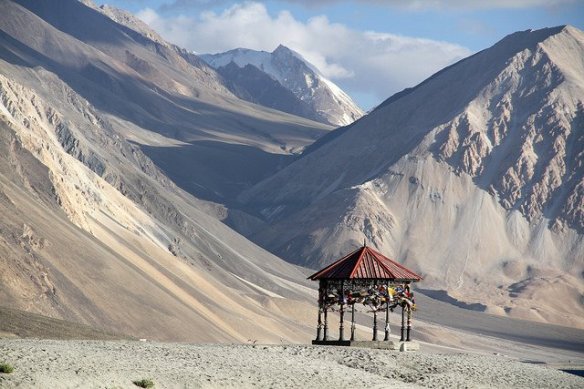
China’s financial regional leverage has grown dramatically in the past decade, as it has become almost all Asian economies’ largest trade and investment partner. In turn, many of the region’s developing countries have moved toward China on matters of regional security and transport connectivity. But, as Modi himself has stressed, there remains plenty of room for India to engage in Asia’s economic development. A more regionally integrated Indian economy would, by default, serve as a counterweight to China’s territorial expansion.

India should also beef up its border security forces to become a more formidable barrier to the PLA. India’s under-resourced Indo-Tibetan Border Police, under the command of the home ministry, is little more than a doorman. Training and equipping these units properly, and placing them under the command of the army, would signal to China that the days of an open door are over.

If the tables were turned, and Indian forces were attempting to chip away at Chinese territory, the PLA would surely respond with more than words. But in many cases, Indian border police patrolling the area don’t even carry weapons. With such a docile response, China has been able to do as it pleases along India’s northern frontier. China’s support of the Pakistani military, whose forces often fire at Indian troops along the disputed Kashmir frontier, should be viewed in this light.

The PLA began honing its “salami tactics” in the Himalayas in the 1950s, when it sliced off the Switzerland-size Aksai Chin plateau. Later, China inflicted a humiliating defeat on India in the 1962 border war, securing peace, as a state mouthpiece crowed in 2012, on its own terms. Today, China pursues a “cabbage” approach to borders, cutting off access to an adversary’s previously controlled territory and gradually surrounding it with multiple civilian and security layers.

Against this backdrop, the true sign of Himalayan peace will not be the holstering of guns, but rather the end of border incursions. India’s accommodating approach has failed to deter China. To halt further encroachments, India will need to bare its own teeth.

© 1995-2017 Project Syndicate.

DC5I29nUwAAy5S4

Water pincer against India

China steps up its challenge to India by signing an accord with Pakistan to fund and build two mega-dams in Gilgit-Baltistan, which the United Nations recognizes as a disputed region and part of Jammu and Kashmir.

Brahma Chellaney, The Times of India, May 16, 2017

Picture1

China, which is working to re-engineer the trans-boundary flows of rivers originating in Tibet, has taken its dam-building frenzy to Pakistan-occupied Gilgit-Baltistan, which is part of Jammu and Kashmir. In a new challenge to India, which claims Gilgit-Baltistan as its own territory, China will fund and build two Indus mega-dams at a total cost of $27 billion, according to a memorandum of understanding (MoU) signed in Beijing during Prime Minister Nawaz Sharif’s visit. The MoU came the same day India announced its boycott of China’s “one belt, one road” (OBOR) summit, saying no country “can accept a project that ignores its core concerns on sovereignty and territorial integrity”.

Such is the mammoth size of the planned 7,100-megawatt Bunji Dam and the 4,500-megawatt Bhasha Dam that India does not have a single dam measuring even one-third of Bunji in power-generating-capacity terms. In fact, the total installed hydropower generating capacity in India’s part of J&K currently does not equal the size of even the smaller of the two planned dams in Gilgit. Still, Pakistan disingenuously rails against India’s modest hydropower projects in J&K and has sought fresh international arbitral tribunal proceedings against India over two projects, including the tiny 330-megawatt Kishenganga.

Even more striking is China’s hypocrisy: It bellicosely protested, almost on a daily basis, the Dalai Lama’s recent visit to Arunachal Pradesh, claiming it to be a “disputed territory”, although only Beijing disputes India’s control over Arunachal. It also held out threats against India jointly exploring with Vietnam for offshore hydrocarbons in Vietnam’s exclusive economic zone. Yet it has no compunctions about unveiling projects — under the “China-Pakistan Economic Corridor” (CPEC) banner — in Pakistan-occupied Jammu and Kashmir, a UN-recognized disputed region.

C_6ju34UQAAiEYXCPEC — OBOR’s flagship programme, which will cement Pakistan’s status as China’s economic and security client — has become a convenient cover for Beijing to include major strategic projects, stretching from Gilgit-Baltistan to Pakistan’s Chinese-built Gwadar port. The Bunji and Bhasha dams are also claimed to be part of CPEC, which, by linking the maritime and overland “Silk Roads” that China is creating, will gravely impinge on India’s security. A grateful Pakistan has given China exclusive rights to run Gwadar port for the next 40 years.

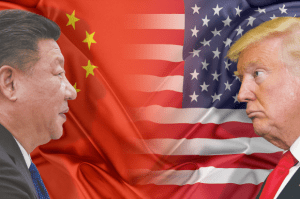
The Bunji and Bhasha dams, which will largely benefit the dominant Punjab province, located downstream, are set to enlarge China’s strategic footprint in the restive, Shia-majority Gilgit-Baltistan. For years, China has stationed several thousand of its own troops in Gilgit-Baltistan, ostensibly to protect its strategic projects there, including upgrading the Karakoram Highway and building a new railway and secret tunnels. CPEC has spurred increased concern that Gilgit-Baltistan, like Tibet, could get overwhelmed by the Chinese behemoth.

Pakistani authorities are responding harshly to anti-CPEC protests in Gilgit-Baltistan, where the corridor is widely seen as opening the path to the region’s enslavement by China. The fact that China rules Gilgit-Baltistan’s Shaksgam, Raskam, Shimshal, and Aghil valleys — ceded by Pakistan in 1963 to cement its strategic alliance with Beijing — has only added to the grassroots resistance against Chinese projects, which extend to mineral-resource extraction.

Indeed, the Bunji and Bhasha dam projects are already facing grassroots resistance because they are viewed locally as instruments to expropriate Gilgit-Baltistan’s water resources for Punjab province. The Bhasha Dam alone will flood 200 square kilometers of Gilgit-Baltistan, displacing at least 28,000 residents and submerging some significant archaeological sites.

As China uses CPEC to turn Pakistan into a colonial outpost, its new dam projects in Gilgit promise to bring the Indus Waters Treaty (IWT) under greater pressure. The paradox here is that China does not accept even the concept of water sharing but its activities in Gilgit are likely to impinge on the world’s most generous water-sharing treaty that remains a colossus among water pacts in the world.

The 57-year-old IWT has survived mainly because of India’s goodwill and full adherence, even as Pakistan violates the Simla peace treaty and canons of civilized conduct. China’s construction of dams in a disputed region is set to make Pakistan’s water relationship with India murkier. The IWT is binational but China has emerged as the third party through its Gilgit dam activities and upstream control of two of the six Indus-system rivers. The Chinese role will not only cast a pall on the IWT’s future but it could also deal a mortal blow to the treaty.

Brahma Chellaney is a geostrategist.

© The Times of India, 2017.

Asia’s American Menace

A column internationally syndicated by Project Syndicate.

p8-Chellaney-a-20170501-870x580

US President Donald Trump’s approach to foreign policy – based on tactics and transactions, rather than strategic vision – has produced a series of dazzling flip-flops. Lacking any guiding convictions, much less clear priorities, Trump has confounded America’s allies and strategic partners, particularly in Asia – jeopardizing regional security in the process.

To be sure, some of Trump’s reversals have brought him closer to traditional US positions. In particular, he has declared that NATO is “no longer obsolete,” as it supposedly was during his campaign. That change has eased some of the strain on the US relationship with Europe.

But in Asia – which faces serious security, political, and economic challenges – Trump’s reversals have only exacerbated regional volatility. With so many political flashpoints threatening to trigger violent conflict, the last thing Asia’s leaders need is another strategic wild card.

Yet, in Trump, that is precisely what they have. The US president has shown himself to be more mercurial than the foul-mouthed Philippine President Rodrigo Duterte or the autocratic Chinese President Xi Jinping. Even the famously impulsive North Korean dictator Kim Jong-un seems almost predictable, by comparison.

Perhaps the most consistent feature of Trump’s foreign policy is his obsession with gaining short-term advantage. In one recent tweet, he asked why he should label China a currency manipulator, when the Chinese are working with the US to rein in North Korea. Just days earlier, Trump had called the Chinese the “world champions” of currency manipulation.

That tweet may offer additional insight into Trump’s Asia policy. For starters, it highlights North Korea’s sudden emergence as Trump’s main foreign-policy challenge, suggesting that the strategic patience pursued by former President Barack Obama could well be replaced by a more accident-prone policy of strategic tetchiness.

This reading is reinforced by Vice President Mike Pence’s claims that the recent low-risk, low-reward US military strikes in Syria and Afghanistan demonstrate American “strength” and “resolve” against North Korea. Such claims reflect a lack of understanding that, when it comes to North Korea, the US has no credible military option, because any US attack would result in the immediate devastation of South Korea’s main population centers.

The Trump administration’s current strategy – counting on China to address the North Korea challenge – won’t work, either. After all, North Korea has lately been seeking to escape China’s clutches and pursue direct engagement with the US.

Given the bad blood between Xi and Kim, it seems that Trump’s best bet might be some version of what he proposed during the campaign: meeting with Kim over a hamburger. With the North Korean nuclear genie already out of the bottle, denuclearization may no longer be a plausible option. But a nuclear freeze could still be negotiated.

Trump’s reliance on China to manage North Korea won’t just be ineffective; it could actually prove even more destabilizing for Asia. Trump, who initially seemed eager to challenge China’s hegemonic ambitions, now seems poised to cede more ground to the country, compounding a major foreign-policy mistake on the part of the Obama administration.

Of all of Trump’s reversals, this one has the greatest geostrategic significance, because China will undoubtedly take full advantage of it to advance its own objectives. From its growing repression of political dissidents and ethnic minorities to its efforts to upend the territorial status quo in Asia, China constantly tests how far it can go. Under Obama, it got away with a lot. Under Trump, it could get away with even more.

Trump now calls China a friend and partner of his administration – and seems to have developed a fondness for Xi himself. “We have a great chemistry together,” he says. “We like each other. I like him a lot.”

That fondness extends beyond words: Trump’s actions have already strengthened Xi’s position – and undercut his own – though Trump probably didn’t realize it. First, Trump backed down from his threat not to honor the “one China” policy. More recently, Trump hosted Xi at his Florida resort, without requiring that China dismantle any of the unfair trade and investment practices that he railed against during the campaign.

The summit with Trump boosted Xi’s image at home ahead of the Chinese Communist Party’s 19th National Congress later this year, where Xi may manage to break free from institutionalized collective rule to wield power more autocratically than any Chinese leader since Mao Zedong. It also indicated the Trump administration’s tacit acceptance of China’s territorial grabs in the South China Sea. This will embolden China not just to militarize fully its seven manmade islands there, but also to pursue territorial revisionism in other regions, from the East China Sea to the western Himalayas.

Trump believes that “lots of very potentially bad problems will be going away,” owing to his relationship with the “terrific” Xi. In fact, his promise to “Make America Great Again” is antithetical to Xi’s “Chinese dream” of “rejuvenating the Chinese nation.”

Xi’s idea, which Trump is unwittingly endorsing, is that their countries should band together in a “new model of great power relations.” But it is hard to imagine how two countries with such opposing worldviews – not to mention what Harvard University’s Graham Allison has called “extreme superiority complexes” – can oversee world affairs effectively.

It is conceivable that Trump could flip again on China (or North Korea). Indeed, Trump’s policy reversals may well turn out to be more dangerous than his actual policies. The need for constant adjustment will only stoke greater anxiety among America’s allies and partners, who now run the risk that their core interests will be used as bargaining chips. If those anxieties prompt some countries to build up their militaries, Asia’s strategic landscape will be fundamentally altered.

© 1995-2017 Project Syndicate.

Trump’s foreign policy muddle

p7-Chellaney-a-20170401-870x346

Brahma Chellaney, The Japan Times, April 1, 2017

U.S. President Donald Trump came to office vowing to end what he saw as China’s free ride on trade and security issues that has allowed it to flex its muscles more strongly than ever. But as he prepares to host Chinese President Xi Jinping at Mar-a-Lago, there is little sign that Trump’s China approach thus far is different to that of his predecessor, Barack Obama, on whose watch Beijing initiated coercive actions with impunity in the South and East China seas.

Besieged by allegations of collusion between his campaign associates and Russia, Trump — to Beijing’s relief — has found little space to revamp his predecessor’s policy and take on China.

In contrast to his tough talk during his presidential campaign, when he famously said he would not “allow China to rape our country, and that’s what they’re doing,” Trump is seeking a cooperative relationship with China but grounded in flinty reciprocity. He has abandoned campaign promises to impose a punitive 45% tariff on Chinese goods and brand China a currency manipulator.

EQUAL OPPORTUNITY IN ASIA

In fact, underscoring how the U.S. still seeks to balance its bilateral relationships with important powers in Asia, Trump invited Xi to Mar-a-Lago — his private estate in Palm Beach, Florida, that he calls the “Southern White House” — because he wants to offer the leader of the world’s largest autocracy the same hospitality that he extended to the prime minister of China’s archrival, Japan, Asia’s oldest democracy. In February, Trump brought Prime Minister Shinzo Abe to Mar-a-Lago on Air Force One for a weekend of working lunches and golf.

Balancing U.S. ties with Japan and China was integral to the Obama foreign policy. Even while extending U.S. security assurances to Japan over the disputed Senkaku Islands in 2014, Obama emphasized that his administration was committed to encouraging China’s “peaceful rise” and urged Japan to shun “provocative actions.” Trump, in keeping with the softer line he has taken toward China after his February 9 discussion with Xi by telephone, has sought to forge a personal connection with Abe while also extending a hand of friendship to China’s “core” leader.

Xi-Trump photoThe wily Xi, during his impending two-day visit to Mar-a-Lago, will seek to capitalize on Trump’s penchant to cut deals. Indeed, Trump, the author of The Art of the Deal, appears eager to strike deals with Xi on trade and security issues — back-door deals that could potentially leave America’s allies in Asia out in the cold.
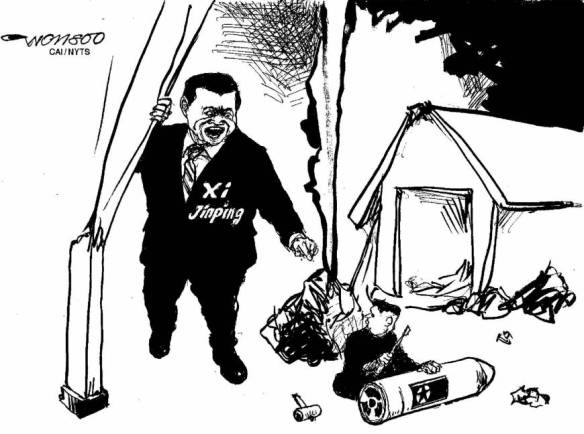
For example, to tackle the little bully, North Korea, Trump (like Obama) is seeking the help of the big bully, China, which has sought to please Washington by banning further imports this year of North Korean coal.

As the White House stated on March 20, it wants China to “step in and play a larger role” in relation to North Korea, which a Trump administration official has exaggeratingly portrayed as the “greatest immediate threat.” But the previous two U.S. administrations also relied on sanctions and Beijing to tame North Korea, only to see that reclusive nation significantly advance its nuclear and missile capabilities.

A greater U.S. reliance on China is unlikely to salvage Washington’s failed North Korea policy, but it will almost certainly result in Beijing exacting a stiff price from the Trump administration, including with respect to the South China Sea.

Beijing, in the initial test of wills, has already savored success in scuttling Trump’s effort to modify America’s longstanding “one China” policy.

Music to Beijing’s ears

Secretary of State Rex Tillerson’s recent visit to Beijing, in fact, suggested that the U.S. is willing to bend over backward to curry favor with China. Instead of delivering a clear message in Beijing, Tillerson transformed into a Chinese parrot, mouthing China’s favorite catchphrases like “mutual respect,” “non-confrontation” and “win-win” cooperation that are code for the U.S. accommodating China’s core interests and accepting a new model of bilateral ties that places the two powers essentially on an equal footing to decide Asia’s future, thus relegating U.S. allies and partners such as Japan and India to a secondary status.

It was music to Chinese ears as Tillerson echoed several Chinese bromides about the U.S.-China relationship, including “win-win” cooperation — a phrase Chinese analysts impishly refer to as entailing a double win for China.

For Beijing, the tag “mutual respect” holds great strategic importance: It is taken to mean that the U.S. and China would band together (in a sort of Group of Two) to manage international problems by respecting each other’s “core interests.” This, in turn, implies that the U.S. would avoid challenging China on the Taiwan and Tibet issues and in Beijing’s new “core-interest” area — the South China Sea.

Tillerson, in effect, compounded the Obama administration’s mistake in embracing Xi’s idea of a “new model of great power relations” between Washington and Beijing in 2013, over four years after Secretary of State Hillary Clinton helped foster the narrative of the U.S. propitiating China by famously declaring that Washington would not let human rights interfere with other issues it had with Beijing.

Worse still, Tillerson articulated the catchphrases by parroting Chinese President Xi Jinping’s words. For example, Xi said in November 2014 during a joint news conference with Obama in Beijing that, “China is ready to work with the United States to make efforts in a number of priority areas and putting into effect such principles as non-confrontation, non-conflict, mutual respect, and win-win cooperation.” Tillerson repeated the exact four principles twice in Beijing.

In his opening remarks at a March 18 news conference with Chinese Foreign Minister Wang Yi, Tillerson said: “Since the historic opening of relations between our two countries more than 40 years ago, the U.S.-China relationship has been guided by an understanding of non-conflict, non-confrontation, mutual respect, and win-win cooperation.” Later that day, at the start of talks with Wang, Tillerson again parroted the same catchphrases: “U.S.-China relationship … has been a very positive relationship built on non-confrontation, no conflict, mutual respect, and always searching for win-win solutions.”

Tillerson’s words were gleefully splashed all over the official Chinese media. For example, the Global Times gloated: “Xi highlighted the significance of the Sino-U.S. relationship and Tillerson expressed the U.S.’s commitment to the principle of non-conflict, non-confrontation, mutual respect and win-win cooperation in terms of developing its ties with China, which is exactly the core content of the China-raised major power relationship between Beijing and Washington.” It pointed out the Obama administration did not use those phrases.

To be sure, U.S. Defense Secretary Jim Mattis struck a different tone subsequently, telling a Senate Appropriations Committee hearing that China pursues a “tribute nation” approach to other states and aspires for “veto power” over their sovereign decisions. Still, the direction of Trump’s China policy appears more uncertain than ever.

Soft South China Sea Stance

This could make a clearer American stance against China’s territorial revisionism in Asia doubtful. Washington elites believe that friendly relations with China are indispensable to American interests. Indeed, there is talk in Washington that the Trump administration has little choice but to accept China’s territorial gains in the South China Sea.

Such acceptance, however tacit, is likely to hold security implications for America’s allies and security partners in Asia, because it will embolden Chinese revisionism in other regions — from the East China Sea to the Himalayas — while allowing China to consolidate its penetration and influence in the South China Sea. After deploying antiaircraft and other short-range weapon systems on all seven of its manmade islands in the South China Sea, Beijing is now building structures on three of them to place longer range surface-to-air missiles.

Under Obama, the U.S. made the most of Asian concerns over China’s increasingly muscular approach by strengthening military ties with U.S. allies in Asia and forging security relationships with new friends like India. However, there was little credible American pushback against China’s violation of international law in changing the status quo or against its strategy to create a Sinosphere of client nations through the geopolitically far-reaching “one belt, one road” initiative.

Tillerson, during his confirmation process, implicitly criticized Obama’s pussyfooting on China by describing Chinese expansion in the South China Sea as “akin to Russia’s taking Crimea” from Ukraine. He said the U.S. should “send China a clear signal” by blocking its access to the artificial islands it has built. But later he retreated, saying the U.S. ought to be “capable” of restricting such access in the event of a contingency.

Trump’s ascension to power was bad news for Beijing, especially because his “Make America Great Again” vision collides with Xi’s “Chinese dream” to make this the “Chinese century.” Yet China thus far has not only escaped any punitive American counteraction on trade and security matters, but also the expected Trump-Xi bonhomie at Mar-a-Lago could advertise that the more things change, the more they stay the same in U.S. foreign policy.

Brahma Chellaney, a longtime contributor to The Japan Times, is a geostrategist and the author of nine books, including “Water, Peace, and War.”

© The Japan Times, 2017.

A rising power without allies

p8-chellaney-a-20170307-870x648

BY BRAHMA CHELLANEYThe Japan Times

The more power China has accumulated, the greater has been its difficulty in gaining genuine allies, underscoring that leadership demands more than brute might. Contrast this with the strong network of allies and partners that the United States maintains in the Asia-Pacific region and elsewhere. The withering of China’s special relationship with North Korea, once its vassal, illustrates Beijing’s dilemma.

Last year, Admiral Harry Harris, commander of the U.S. Pacific Command, said “we have allies, friends and partners where China does not,” while U.S. Secretary for Defense Ash Carter asserted that Beijing is “erecting a great wall of self-isolation.”

The rapid deterioration in Beijing’s ties with North Korea — which boasts good reserves of iron ore, coal, magnesite, graphite, copper, zinc and other minerals — is sure to increase China’s sense of being alone.

Indeed, when Pyongyang recently accused China of “mean behavior” and “dancing to America’s tune,” it underscored not only its ruptured relationship with its powerful neighbor but also the fact that Beijing is now left with just one real ally, Pakistan. Quasi-failed Pakistan, although a useful tool for Beijing to contain India, is a dubious ally for China in the larger context.

China’s rift with Pyongyang has followed the considerable weakening of Beijing’s once-tight hold on Myanmar, another country rich in natural resources — from oil and gas to jade and timber. Today, the Beijing-Pyongyang relationship is at its lowest point since the founding of North Korea in 1948.

The reported fatal poisoning of North Korean ruler Kim Jong Un’s estranged half brother, Kim Jong Nam, at Kuala Lumpur International Airport, represents a major setback for China. Beijing valued him — a faded playboy with residences in Macau and Beijing — as a key asset against the North Korean dictator.

To be clear, China’s vaunted “blood relations” with North Korea have been souring since Kim Jong Un came to power after the death of his father, Kim Jong Il, in December 2011.

Since then, Kim Jong Un has been trying to show that North Korea is no client-state of China, including by rekindling the “juche” ideology of self-reliance. He has defied Beijing by repeatedly conducting nuclear and missile tests and signaled that he wants North Korea to escape from China’s clutches through better relations with the United States — an appeal that has gone unheeded in Washington.

Kim Jong Nam’s death, of course, is a blow not just for China but also for South Korea and the U.S., which had milked him for any intelligence he could provide on the inner workings of the Stalinist regime in Pyongyang. These three countries, recognizing the importance of the Kim family bloodline in dynastic North Korea, had indeed cultivated him as a potential replacement for his half brother. The North Korean ruler thus had ample reason to get rid of Kim Jong Nam.

Earlier in 2013, Pyongyang executed China’s most valued friend in the North Korean power hierarchy — Jang Song Thaek, a four-star general who was Kim Jong Un’s uncle by marriage. Jang, a mentor to Kim Jong Nam and Beijing’s main link to Pyongyang, was accused by the regime of abusing his power to favor China, including by underselling resources like coal, land and precious metals.

At the center of the growing China-North Korea tensions, however, is the bad blood between Kim Jong Un, who at 33 remains the world’s youngest head of state, and Chinese President Xi Jinping, nearly twice as old as him.

When Xi paid a state visit to South Korea in mid-2014, he overturned decades of tradition in which Chinese leaders always visited North Korea first. Xi has yet to travel to Pyongyang, just as Kim Jong Un has refused to visit Beijing. Paying obeisance in Beijing, however, was customary for Kim’s grandfather and father: Kim Il Sung, the founder of the state, paid 37 official visits to China, while his son and successor, Kim Jong Il, went nine times.

The young ruler’s effort to chart an independent course has sparked a sustained propaganda campaign against him in recent years by China’s state media, which has accused him of pursuing “de-Sinification” of his country and seeking to unlock ties with the U.S. and Japan.

Despite its exasperation, China’s options against the Kim regime are limited, given the fact that it does not want the North Korean state to unravel — a scenario that will result in a reunified and resurgent Korea allied with the U.S. The prospect of American troops on its border is a nightmare for China, which explains why it intervened in the Korean War when the U.S. Army crossed the 38th parallel and threatened to advance toward the Chinese border.

For centuries, China has seen the Korean Peninsula as its strategic Achilles’ heel — a region that offers foreign powers an attractive invasion route or a beachhead for attacking China.

Today, China has territorial and resource disputes with North Korea that a reunified Korea would inherit and rail against. The territorial disputes center on Chonji, the crater lake on Mount Paektu (where a 33-km stretch of the Sino-Korean boundary has not been settled) and certain islands in the Yalu and Tumen rivers, whose courses broadly define the frontier between the two countries.

Indeed, as if to signal that its present border with North Korea is not final, China has posted a revisionist historical claim that the ancient kingdom of Koguryo — founded in the Tongge River basin of northern Korea — was Chinese, not Korean, as believed by international historians. A 2012 U.S. Senate report warned that China “may be seeking to lay the groundwork for possible future territorial claims on the Korean Peninsula.”

Against this background, China sees status quo on the Korean Peninsula as serving its interest best. It will likely accept Korean reunification only if it leads to a “Finlandized” Korea making permanent strategic concessions to it.

China’s strongest action against North Korea to date — the recently imposed suspension of coal imports — can be ascribed to the “Trump effect.” U.S. President Donald Trump’s less predictable line, reflected in his wavering on the “one-China” policy and his tougher stance on Chinese expansion in the South China Sea, has prompted Beijing to take this action to blunt U.S. criticism that it is not doing enough to implement United Nations sanctions.

But China’s growing tensions with Pyongyang mean that the value of the North Korea card in Beijing’s dealings with the U.S. is likely to erode. For years, the U.S. has outsourced the North Korea issue to Beijing by offering it concessions. Today, far from credibly serving as Washington’s intermediary with North Korea, China is smarting from Pyongyang’s open disdain for it.

Still, China must grapple with the larger question of whether it can be a peer rival to the U.S. without any allies.

Brahma Chellaney, a longtime contributor to The Japan Times, is a geostrategist and the author of nine books, including “Water, Peace, and War.”

© The Japan Times, 2017.

Japan’s Senkaku challenge

lee_photo_a2Japan Times


At a time of shifting power dynamics in Asia, Japan faces pressing security challenges. Of the 400 remote islands that serve as markers for determining Japan’s territorial waters, only about 50 are inhabited. But no group of islands poses a bigger challenge for its security than the Senkakus, a clutch of five uninhabited islets and three rocks.

This challenge is compounded by demographic and military trends. Japan has barely one-tenth the population of China’s. Moreover, its population is not just aging but also shrinking significantly; it declined by nearly a million just between 2010 and 2015.

About a decade ago, Japan’s defense budget was larger than China’s. But now China’s military spending surpasses the combined defense expenditure of Japan, Britain and France.

To make matters worse, China’s increasing territorial assertiveness and muscular foreign policy are contributing to a sense of insecurity in Japan.

President Xi Jinping declared much of the East China Sea, including the Senkakus, to be a Chinese air defense zone in 2013, and since then China has stepped up its challenge to Japan’s control over those islands, including through repeated intrusions by its military aircraft and warships. Beijing has hardened its stance by elevating its claim to the Senkakus to a “core interest,” while some in China have gone to the extent of questioning Japan’s sovereignty over even Okinawa.

Against this background, many Japanese have wondered whether the United States would come to Japan’s defense in the event of a Chinese attack on the Senkakus. The 1960 U.S.-Japan Security Treaty states that an armed attack on either country in the territories under Japan’s administration would prompt joint action “to meet the common danger.”

Then U.S. President Barack Obama’s contradictory rhetoric instilled a sense of skepticism in Japan. Obama publicly affirmed that the U.S.-Japan security treaty covered the Senkakus. But in the same breath he refused to take a position on the islands’ sovereignty and advised Tokyo and Beijing to sort out their dispute peacefully.

Obama said the U.S. security treaty with Japan covered the Senkaku Islands because they “are under Japanese jurisdiction,” yet “we also stress that we don’t take a position on the sovereignty of the Senkaku Islands.”

At his April 2014 joint news conference with Prime Minister Shinzo Abe in Tokyo, Obama, while unveiling his position on the Senkakus, urged Japan to refrain from “provocative actions” and emphasized that his administration was committed to encouraging China’s “peaceful rise.”

He stated: “We don’t take a position on final sovereignty determinations with respect to Senkakus, but historically they have been administered by Japan and we do not believe that they should be subject to change unilaterally … In our discussions, I emphasized with Prime Minister Abe the importance of resolving this issue peacefully — not escalating the situation, keeping the rhetoric low, not taking provocative actions, and trying to determine how both Japan and China can work cooperatively together. And I want to make that larger point. We have strong relations with China. They are a critical country not just to the region but to the world. Obviously, with a huge population, a growing economy, we want to continue to encourage the peaceful rise of China.”

How could such doublespeak reassure Japan? In fact, such statements sowed doubt over America’s willingness to go to war with China to back Japan’s territorial rights, in the event of a surprise Chinese invasion of the Senkakus. The Obama administration responded by simply saying that “we do not envision that this current tension will rise to that level in any foreseeable scenario.”

Add to the picture Obama’s conspicuous inaction and silence on China’s 2012 seizure of the disputed Scarborough Shoal from the Philippines, despite America’s longstanding mutual defense treaty with Manila. That development served as a wakeup call for Japan and other U.S. allies in Asia.

By contrast, the new U.S. administration led by President Donald Trump has taken a more clear-cut stance in reassuring Japan that the U.S. would defend it in any confrontation with China over the Senkakus. It has done so without the Obama-style caveat — that Washington does not take sides in the sovereignty dispute and calls on China and Japan to resolve their dispute peacefully through dialogue.

In fact, the recent Trump-Abe summit marked the first time that the U.S. commitment to defend Japan’s control over the Senkakus was recorded in a joint statement.

The Feb. 12 Trump-Abe joint statement came out strongly for Senkakus’ defense: “The two leaders affirmed that Article V of the U.S.-Japan Treaty of Mutual Cooperation and Security covers the Senkaku Islands. They oppose any unilateral action that seeks to undermine Japan’s administration of these islands … The United States and Japan oppose any attempt to assert maritime claims through the use of intimidation, coercion or force.”

This unambiguous commitment should be seen as an important success of Abe’s proactive diplomacy in seeking to build a personal connection with the new U.S. president. Abe was the first foreign leader Trump hosted at Mar-a-Lago, which he calls “The Southern White House.” Earlier, just after Trump’s unexpected election victory, Abe met face-to-face with him by making a special stop in New York en route to the Asia-Pacific Economic Cooperation summit in Peru.

Let’s be clear: The Senkaku issue is not just about a seven-square-kilometer real estate or the potential oil and gas reserves that lie around it. The strategically located Senkakus, despite their small size, are critical to maritime security and the larger contest for influence in the East China Sea and beyond.

China is seeking to wage a campaign of attrition against Japan over the Senkakus by gradually increasing the frequency and duration of its intrusions into Japan’s airspace and territorial waters. In doing so, it has made the rest of the world recognize the existence of a dispute and the risks of armed conflict.

To be sure, changing the territorial status quo is nothing new for Beijing. The People’s Republic of China has been doing that ever since it was founded in 1949. The early forcible absorption of the sprawling Xinjiang and Tibetan Plateau more than doubled China’s landmass.

In the 21st century, Chinese expansionism has increasingly relied upon “salami tactics” — a steady progression of small, furtive actions, none of which serves as a casus belli by itself, yet which help to incrementally change facts on the ground in China’s favor.

Unlike China’s success in expanding its frontiers in the South China Sea, it has found the going tough in the East China Sea. Indeed, Beijing’s actions have shaken Tokyo out of its complacency and diffidence and set in motion the strengthening of Japan’s defense capabilities, including arming its far-flung island chain in the East China Sea with a string of anti-ship, anti-aircraft missile batteries.

At his joint news conference with Trump at the White House, Abe pledged that Japan will play a “greater role” in East Asian security. It was as if he was responding to Trump’s campaign rhetoric that Japan, which hosts about 50,000 American troops, should do more to defend itself.

One effective way the Trump administration can encourage Japan to do more for its own defense is by lending full support to the Abe-initiated national security and constitutional reform process. Such reforms could help forestall the emergence of a destabilizing power imbalance in East Asia. Japan is already working to constrain China with its own version of Beijing’s “anti-access, area denial” doctrine against the U.S.

Brahma Chellaney is a geostrategist and the author of nine books, including “Water, Peace, and War.”

© The Japan Times, 2017.

Engagement over Antagonism

Sanctions alone will not curb North Korea’s nuclear ambitions. A healthy dose of diplomacy is needed too.

Brahma Chellaney, Nikkei Asian Review, February 27-March 5, 2017

missile-test

For North Korea, reeling under severe United Nations sanctions, conducting missile tests has become a regular expression of political defiance and technological progress. Just last year, showing its continuing contempt for UN resolutions, it tested almost two dozen missiles, including a submarine-launched ballistic missiles. Yet its first missile test since Donald Trump won the U.S. presidential election in November has been speciously portrayed as a major challenge to the new administration in Washington, with some analysts like ex-CIA chief James Woolsey even calling North Korea the top national security problem at present.

The fact is that the Feb. 12 test did not involve a long-range ballistic missile, which North Korean dictator Kim Jong Un had said in his New Year’s Day speech was almost ready for launch. The fired missile, which traveled 500km, was just a medium-range type that Pyongyang has tested multiple times in different variants. And although North Korea said the test involved a new missile model with a solid fuel-powered engine — a technological advance that facilitates mobility and rapid launch — this is not the country’s first solid-fueled missile. As Pyongyang admits, the new surface-to-surface missile is based on its solid-fueled submarine-launched ballistic missile.

Lost in the alarmism over the new missile is the fact that the test occurred just after Trump called North Korea a threat. Kim had been on good behavior ever since Trump’s unexpected election triumph, hoping that the new American president would adopt a fresh tack, in keeping with what Trump had said during the campaign — that he would be willing to meet with the North Korean leader over a hamburger.

Kim — the world’s youngest head of state — tested a nuclear device, purportedly a hydrogen bomb, two days before his Jan. 8 birthday in 2016. International media speculated that this year Kim would celebrate his birthday by testing an intercontinental ballistic missile, although he had referred to a long-range missile, not an ICBM, in his New Year’s Day speech. Kim, however, delayed his first missile test since Trump’s victory until much later — conducting it less than 36 hours after Trump, in a joint news conference with Japanese Prime Minister Shinzo Abe at the White House, said that “defending against the North Korean missile and nuclear threat” was “a very, very high priority” for him.

Trump’s tempered response to the missile test drew cynical comments from critics citing his bombastic Jan. 3 tweet. Relying on misleading media reports that Kim had threatened to test an ICBM, Trump posted on Twitter: “North Korea just stated that it is in the final stages of developing a nuclear weapon capable of reaching parts of the U.S. It won’t happen!” Truth be told, North Korea is far from developing an ICBM, as the latest missile test underscores.

Still, Trump is being publicly advised to ratchet up military pressure on Pyongyang, prompting him to declare: “Obviously, North Korea is a big, big problem, and we will deal with that very strongly.”

BIG-PICTURE ISSUES  

The debate on how to tame North Korea’s nuclear and missile ambitions should not obscure the larger issues involved. Three key matters stand out.

Firstly, the sanctions-only approach toward North Korea spearheaded by the United States has been a conspicuous failure, encouraging Pyongyang to rapidly advance its nuclear and missile programs. With little to lose, North Korea has responded to heavy sanctions by testing nuclear devices in 2006, 2009, 2013 and twice in 2016. It has the dubious distinction of being the only country in the world to conduct nuclear tests in the 21st century. North Korea has also considerably enhanced its missile capabilities, though they remain subregionally confined in range.

Sanctions without engagement have never worked. In the North Korean case, the sanctions-only approach has done exactly the opposite of its intended goal — instead of halting or retarding nuclearization, slapping on additional sanctions after every major test has only egged Pyongyang on.

Secondly, Kim has repeatedly signaled that he wants his internationally isolated nation to escape from the clutches of its millennial rival, China. Significantly, he has not visited China since assuming power in 2011, although paying obeisance in Beijing was customary for his father and grandfather, who ruled before him.

Mao Zedong famously said China and North Korea were as close as lips are to teeth. But when China last March joined hands with the U.S. to approve the toughest new U.N. sanctions in two decades against North Korea, it highlighted its virtually ruptured relationship with Pyongyang.

At a time when China’s state media has accused Kim of pursuing “de-Sinification” and seeking improved ties with the U.S. and Japan, the fatal poisoning of Kim’s half brother, Kim Jong Nam, at Kuala Lumpur International Airport has increased the sense of alarm and frustration in Beijing. Kim Jong Nam, a reputed playboy with residences in Beijing and Macau, was a virtual Chinese pawn against Kim.

Yet, oddly, Washington has attempted to push Kim further into the Chinese dragnet, instead of seizing on the opportunity created by his desire to unlock frozen ties with America. Some U.S. scholars have even suggested a grand bargain with Beijing on North Korea. Given that North Korea has sought direct engagement with Washington to offset Chinese leverage over it, nothing is more galling to Pyongyang than U.S. efforts to use Beijing as a diplomatic instrument against it. In effect, American policy has handed Beijing the North Korea card to play against South Korea, Japan and the U.S. itself.

In truth, China is already putting the squeeze on North Korea, especially since that country carried out its most powerful nuclear test last September. But its enforcement of U.N. sanctions in a controlled way has failed to change Kim’s calculus. Beijing, of course, values North Korea as a buffer state and does not want a reunified and resurgent Korea allied with Washington, because that will open a new threat, including bringing American troops to China’s border. Make no mistake: Chinese and American interests diverge fundamentally.

And thirdly, the U.S. has no credible military option against North Korea. Any military strikes to degrade the North’s nuclear and missile capabilities will provoke Pyongyang to unleash its artillery-barrage power against the South, triggering widespread destruction and a full-fledged war involving America. The planned U.S. deployment in South Korea of the anti-missile Terminal High Altitude Area Defense, or THAAD — which has never been battle-tested — is no real answer to North Korea’s nuclearization or to the North’s artillery choke-hold on Seoul. China, with some justification, sees the THAAD plan as essentially directed against it.

If there is any credible U.S. option to deal with Pyongyang, it is to give diplomacy a chance, with the goal of forging a peace treaty with the North to formally end the Korean War — which has officially been in a state of cease-fire since 1953. Denuclearization should be integral to the terms of such a peace treaty. But if denuclearization is made the sole purpose of engagement with the North, diplomacy will not succeed. President Barack Obama’s administration simply refused to talk unless Pyongyang first pledged to denuclearize. The North’s only leverage is the nuclear card, which it will not surrender without securing a comprehensive peace deal.

When repeated rounds of tight sanctions not only fail to achieve their objectives but counterproductively trigger opposite effects, the need for a new approach becomes inescapable.

Through a carrot-and-stick approach of easing some sanctions and keeping more biting ones in place, diplomacy can, by persisting with what will be difficult and tough negotiations, clinch a deal to end one of the world’s longest-lingering conflicts and eliminate weapons of mass destruction.

Brahma Chellaney is a geostrategist and the author of nine books, including “Water: Asia’s New Battleground,” the winner of the Bernard Schwartz Award.

© Nikkei Asian Review, 2017.

MOUNTAINS OF TROUBLE

A bolder India could rein in China’s dangerous antics in Tibet

Brahma Chellaney, Nikkei Asian Review, January 23-29, 2017, pages 56-57

download-1While it has become fashionable to pair China and India as if they were joined at the hip, it is often forgotten that the two have little in common politically, economically or culturally.

Comparatively speaking, the countries are new neighbors. The vast Tibetan plateau, encompassing an area greater than Western Europe, separated the two civilizations throughout history, limiting interaction to sporadic cultural and religious contacts.

It was only after China’s annexation of Tibet in 1951 that Chinese army units appeared for the first time on India’s Himalayan frontiers. This was followed 11 years later by a war in which China’s battlefield triumph sowed the seeds of greater rivalry.

Today, Tibet remains at the center of the China-India divide, fueling territorial disputes, diplomatic tensions and feuds over river-water flows. For example, Beijing was harshly critical of New Delhi in December for allowing the exiled Dalai Lama — who has lived in India since fleeing Tibet in 1959 — to visit the presidential palace for a public event and meet President Pranab Mukherjee, India’s head of state.

Further diplomatic protests from Beijing are expected in coming weeks when the Dalai Lama begins a religious tour of Arunachal Pradesh, a sprawling Indian state famous for its virgin forests and soaring mountain ranges. China claims the territory, which it has called “South Tibet” since 2006.

Tibet is an issue of relevance far beyond China and India. With its lofty terrain, featuring the world’s tallest mountain peaks and largest concentration of glaciers and riverheads, the Tibetan plateau influences atmospheric circulation — and therefore climate and weather patterns — across the northern hemisphere.

China has turned this resource-rich but ecologically fragile plateau into the center of its mining and dam-building activities. With the plateau warming at a rate nearly twice as fast as the rest of the world, glacial recession in the eastern Himalayas and the thawing of permafrost (permanently frozen ground) in Tibet are increasingly apparent.

Wedge issue

The environmental crisis haunting the plateau threatens the ecological well-being of multiple nations, including those dependent on the 10 major Asian river systems that originate on the Tibetan massif. But the environmental problems are dwarfed by political strains in the region.

China lays claim to vast tracts of Indian Himalayan land on the basis of purported Tibetan ecclesial or tutelary links. Tibet’s long shadow over China-India relations is also apparent from the Dalai Lama’s lengthy abode in the Indian hill resort of Dharamsala, the seat of the Tibetan government-in-exile.

The fall of Tibet represented the most far-reaching geopolitical development in modern India’s history. It gave China borders with India, Bhutan and Nepal for the first time, and facilitated a Sino-Pakistan strategic axis by opening a common land corridor.

The impact has been exacerbated by Indian blunders that have compounded the country’s “China problem” and undercut its leverage. New Delhi was one of the first capitals to embrace the Mao Zedong-led regime in Beijing after the Chinese Communist Party seized power in 1949. But just months later, Mao began annexing the historical buffer of Tibet, eliminating India’s outer line of defense by 1951.

Led by Jawaharlal Nehru, a romantic who viewed China sympathetically as a fellow postcolonial state, India went on to surrender extraterritorial rights in Tibet inherited from the U.K., its former colonial master. It also acknowledged the “Tibet region of China,” without getting Beijing to recognize the existing Indo-Tibetan border. Ironically, the pact that recognized China’s rights in Tibet was named after the Tibetan Buddhist doctrine of Panchsheela, the five principles of peaceful coexistence.

Almost half a century later, India went further still, using the legal term “recognize” in a document signed by the heads of government of the two countries in 2003 that formally accepted Tibet as “part of the territory of the People’s Republic of China.”

Dictating terms

20170106_dalai_lama_article_main_image

Tibetan spiritual leader, the Dalai Lama, is helped by attending monks as he arrives at the inauguration of a four-day seminar in New Delhi, India on Dec. 9, 2016. © AP

Meanwhile, China has sought to crimp the Dalai Lama’s freedom within a democratic India. Initially, Beijing objected to official discussions between the Dalai Lama and foreign heads of state or government. But China has progressed over the years to protesting his presence at any state-linked event, and even his visits to other countries, such as a purely religious trip to Mongolia in November.

The New Delhi event that riled Beijing in December was organized for children’s welfare by Nobel laureates, a group that includes the Dalai Lama. Demanding that India respect China’s “core interests” and refrain from causing “any disturbance” to bilateral ties, China couched its protest in imperious terms. Instead of censuring Beijing for seeking to dictate terms to India, New Delhi responded almost apologetically that the meeting was a “non-political event.”

The more accommodative that India has become of China’s claims and concerns over Tibet, the more assertive Beijing has been in upping the ante. For example, in ratcheting up the Arunachal Pradesh issue in recent years, Beijing has contended that the region — almost three times larger than Taiwan — must be “reunified” with the Chinese state to respect Tibetan sentiment. The flimsy basis of its historical claim has been exposed by the Dalai Lama, who has publicly declared that Arunachal was never part of Tibet.

By bringing its Tibet position into alignment with China’s claim, India has not won Chinese gratitude; rather it has boosted Beijing’s clout and encouraged Chinese re-engineering of transboundary river flows, on which India is critically dependent.

According to Aquastat, a database maintained by the Food and Agriculture Organization of the United Nations, 718 billion cubic meters of surface water a year flows out of the Tibetan plateau and the Chinese regions of Xinjiang and Inner Mongolia to neighboring countries. Of that amount, 48.33% runs directly into India. In addition, Nepal’s Tibet-originating rivers drain into India’s Gangetic basin. So no country is more vulnerable than India to China’s current focus on building cascades of large dams on international rivers.

India can reclaim its Tibet leverage by emphasizing that its acceptance of China’s claim over Tibet hinged on a grant of genuine autonomy to the region. Instead of autonomy, Tibet has experienced tightening political control and increasing repression, triggering grassroots desperation and a wave of self-immolations.

A braver Indian approach would include showing Tibet in its official maps in a different color from the rest of China and using expressions such as “the Indo-Tibet border,” instead of “the India-China border.” Using measures such as this, India can subtly reopen Tibet as an outstanding issue without having to renounce formally any of its previously stated positions.

Whatever it does, India must not shy away from urging China to begin a process of reconciliation and healing in Tibet. Having ceased to be a political buffer between China and India, Tibet can still become a political bridge between the world’s demographic titans if Beijing initiates a process of genuine reconciliation there to ease Tibetans’ feelings of estrangement. Otherwise, Tibet will remain at the core of the China-India divide.

India has played an important role in aiding the survival of Tibetan culture by funding Tibetan schools for the large number of Tibetan exiles it hosts. By recalibrating its Tibet policy, India could elevate Tibet as a strategic and environmental issue that impinges on international security and climatic and hydrological stability.

Brahma Chellaney is a geostrategist and the author of nine books, including “Water: Asia’s New Battleground,” the winner of the Bernard Schwartz Award.

© Nikkei Asian Review, 2017.