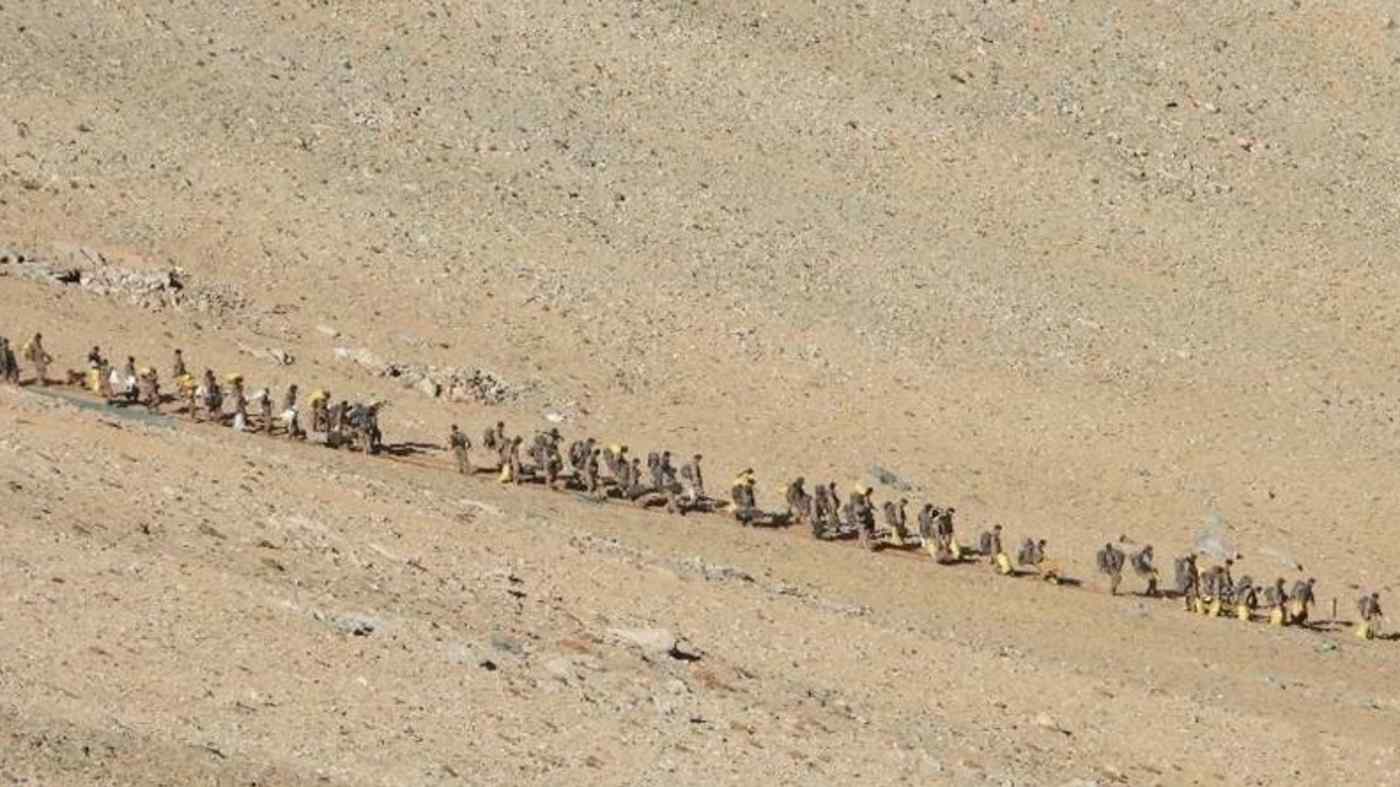
The spotlight on the growing Chinese military threat against Taiwan has helped obscure China’s more serious military confrontation with India along an extended, mountainous frontier.
Although the intensifying multiple military standoffs between nuclear-armed titans China and India have grabbed few headlines, the risk of renewed border skirmishing, if not outright war, is increasing. Indeed, the Pentagon’s newly released annual report on China says the Chinese military is bracing for a two-front war scenario — “any escalation of border tensions with India, as well as preparing to support a Taiwan contingency.”
A reminder of the looming risks is China’s latest provocation — the enactment of a Land Borders Law — which appears primarily aimed at advancing its territorial revisionism in the Himalayas.
The law effectively negates the possibility of peacefully resolving its territorial disputes with India. Instead of mutually settled borders, the law enables unilaterally imposed borders.
The ongoing military standoffs began more than 18 months ago when a shocked India discovered that China had stealthily encroached on several key border areas in the northernmost Indian territory of Ladakh. The discovery led to the first deadly Chinese-Indian military clashes since 1975, including China’s first combat deaths in decades.
Unlike China’s expansionism elsewhere, including swallowing Hong Kong and redrawing maritime frontiers in the South China Sea without firing a shot, its Himalayan aggression has run into armed resistance. India has not only more than matched Chinese military deployments, but in recent days, it test-fired a nuclear-capable intercontinental ballistic missile as a warning shot to China and conducted daring border paratrooper exercises simulating territory capture behind enemy lines.
The deepening military stalemate at the Himalayan border led Beijing to enact its new Land Borders Law, which gives its imprimatur to assertive actions along land frontiers. Those actions emulate China’s aggressive moves in the East and South China Seas, including an intensifying campaign against the Japan-controlled Senkaku Islands, claimed by Beijing as the Diaoyu, through aerial and maritime incursions.
The Land Borders Law, which India’s foreign ministry slammed as a “unilateral move,” extends to transboundary river waters. According to Chinese state media, the law upholds China’s “legitimate rights and interests” over the Tibet-originating transboundary rivers like the Brahmaputra and Mekong.
The law’s assertion of full sovereignty over cross-border waters means that China has a declared right to divert as much of the shared waters as it wishes, regardless of downstream impacts. Nikkei Asia has reported in an online article, “China law tightens land borders amid regional tensions,” that Beijing is toying with the idea of limiting the volume of cross-border water flows to India during conflicts, by citing the “protection and reasonable use” stipulation of its Land Borders Law.
In fact, underscoring its readiness to weaponize even the sharing of water data on upstream river flows, China in 2017 inexplicably refused to supply hydrological data to India in violation of the terms of two bilateral agreements. The one-year data denial resulted in preventable deaths as the monsoon-swollen Brahmaputra overran its banks, leaving a major trail of destruction, especially in India’s Assam state.
The Land Borders Law is just the latest example of how an increasingly aggressive China is using domestic law to underpin its expansionism. Beijing, for example, used a new national security law to crush Hong Kong’s pro-democracy movement and bring the city into political lockstep with the Chinese Communist Party in breach of China’s United Nations-registered treaty with Britain.
The Land Borders Law came just months after China’s new Coast Guard Law took effect. Several countries, including Japan, the United States, the Philippines and Vietnam, have raised concerns about the Coast Guard Law, which clearly violates the United Nations Convention on the Law of the Sea.
But just as the Coast Guard Law is aimed at accelerating China’s maritime militarization, the Land Borders Law will speed up its militarization of the Himalayas. And just as the Coast Guard Law authorizes the use of lethal force in disputed waters claimed by China, the land law permits the use of force in defending and furthering Chinese claims to contested lands.
Simply put, Beijing enacts domestic law to violate international law. China’s success in unraveling Hong Kong’s autonomy through a national security law could inspire it to enact a Taiwan-specific legislation or activate its 2005 Anti-Secession Law against that island democracy.
By employing domestic law as a cover for unlawful actions, China illustrates that international law is powerless against the powerful, especially scofflaw states. But China’s expansionism often breaches international law with the aim, ironically, of asserting its own claims and rights under international law.
Examples include China’s human-made militarized islands in the South China Sea and its current militarized village-building spree in disputed Himalayan borderlands in order to extend or consolidate its control over strategically important areas that India, Bhutan and Nepal maintain fall within their national boundaries.
Effective control is the sine qua non of a strong territorial claim in international law. Armed patrols do not prove effective control, but civilian settlements do. So, the Chinese Communist Party is callously uprooting Tibetan nomads and forcing them to settle in its artificial new Himalayan border villages, where ethnic Han Chinese party members serve as resident overseers.
Whether China can legitimize unlawful actions retroactively in this manner is a moot point. But lawfare, or the misuse and abuse of law for political and military ends, is a key component of China’s asymmetrical or hybrid warfare.
This blends conventional and irregular tactics with incremental territorial encroachment — salami-slicing — psychological manipulation, disinformation and coercive diplomacy to help advance its expansionism.
Brahma Chellaney is a geostrategist and author of nine books, including “Asian Juggernaut: The Rise of China, India and Japan.”
The incredible story of A.Q. Khan, the Netherlands-trained Pakistani metallurgist who — with impunity — ran an illicit global nuclear-smuggling network for a quarter-century would make for a captivating thriller.
A key plotline would surely be the mystery of why Khan, who died on October 10 from complications caused by COVID-19, was never indicted by the U.S. for stealing nuclear secrets from the West. Khan played a pivotal role in helping Pakistan develop nuclear weapons and then selling crucial know-how to three U.S.-labeled “rogue states” — Iran, North Korea and Libya.
Former Netherlands Prime Minister Ruud Lubbers revealed in 2005 that Dutch authorities wanted to arrest Khan in 1975 and again in 1986 but that on each occasion the Central Intelligence Agency advised against taking such action. According to Lubbers, the CIA conveyed the message: “Give us all the information, but don’t arrest him.”
After Khan was tried in absentia and sentenced to four years in prison in 1983 for stealing uranium enrichment secrets from the Netherlands, files held by an Amsterdam court were mysteriously lost, with the main judge suspecting the CIA’s hand in their disappearance.
When an appeals court overturned Khan’s conviction on a technicality, the Netherlands — a key U.S. ally during the Cold War — declined to seek a retrial, effectively letting Khan off the hook. As the Financial Times put it, the Dutch “abandoned prosecution of the most consequential crime committed on their territory since the second world war.”
Geopolitics partly explains why the CIA wanted to protect Khan.
While the U.S. and India are close partners today, at the time Dutch authorities were seeking to arrest Khan, the U.S. was not averse to the idea of Pakistan developing a nuclear-weapons capability to balance India, which had conducted its first nuclear test in 1974. For years, the U.S. simply turned a blind eye to Pakistan’s covert nuclear-weapons development.
American concerns, however, were stirred when Khan began selling nuclear items to other renegade states. U.S. pressure compelled Pakistan to open investigations into Khan’s activities in 2003 after Iran and Libya admitted to the International Atomic Energy Agency (IAEA) that Pakistan-linked black marketeers supplied them with the components they needed to advance their nuclear research.
In 2004, Khan appeared on national television asking for forgiveness, saying he had acted entirely on his own in passing on nuclear secrets to other countries. “I take full responsibility for my actions,” Khan said, “and seek your pardon.”
After this orchestrated confession, Pakistani dictator General Pervez Musharraf, citing Khan’s status as a national hero, pardoned him. Musharraf also barred U.S. or IAEA investigators from questioning Khan. Oddly, Washington went along with this charade, which extended to Khan’s ostensible house detention.
Investigative journalists Adrian Levy and Catherine Scott-Clark, in their acclaimed 2007 book “Deception: Pakistan, the United States, and the Secret Trade in Nuclear Weapons,” concluded that Khan was the fall guy. “The covert trade in doomsday technology was not the work of one man, but the foreign policy of a nation and supervised by Pakistan’s ruling military clique,” Levy and Scott-Clark wrote, adding that Pakistan’s generals have long maintained a nexus with terrorist groups.
The military’s collusion with Khan was underscored by the use of an army plane in 2000 to transport centrifuges to Pyongyang. In return, Pakistan received North Korean ballistic missile technology, helping it to build its first intermediate-range, nuclear-capable missile, Ghauri.
While most technology transfers appeared to be state-sanctioned, Khan likely sold some nuclear items for personal profit.
Still, despite exaggerated Western media reports then, no evidence has surfaced to indicate that the Pakistani transfers significantly contributed to advancing the Iranian, North Korean and Libyan nuclear programs. North Korea, the only recipient to cross the nuclear threshold, has long relied on plutonium, which the Khan network did not traffic.
Pakistan’s own nuclear weaponization benefited decisively from clandestine transfers from China, another archrival of India. Such transfers began in 1982, when, as Khan admitted, China supplied the blueprint for one of the nuclear bombs it had tested, as well as enough weapons-grade uranium for two atomic weapons.
Yet the U.S., just as it has not penalized China for its continuing nuclear and missile transfers to Pakistan, chose not to indict the rogue Pakistani scientist that spearheaded an international smuggling enterprise. Washington, however, has indicted a number of other individuals — including as recently as last year — for conspiring to smuggle nuclear goods to Pakistan.
America’s shielding of Khan, a nuclear jihadist committed to payback for real and imagined injustices against Muslims, was doubly ironic, because it set the stage for Pakistan’s emergence as an epicenter for terrorism, with its own nuclear weapons acting as enough of a deterrent to retaliation by another state.
Indeed, through its humiliating Afghanistan defeat at the hands of the Taliban, America has tasted the bitter fruits of the Pakistani generals’ cross-border use of jihadist proxies from behind their protective nuclear shield.
The U.S. maintains contingency plans to seize Pakistan’s nuclear weapons if they risk falling into terrorist hands. But if a 9/11 style terrorist attack with a crude nuclear device were to occur anywhere in the world, the trail of devastation would likely lead back to Pakistan.
Brahma Chellaney is a geostrategist and author of nine books, including “Asian Juggernaut: The Rise of China, India and Japan.”
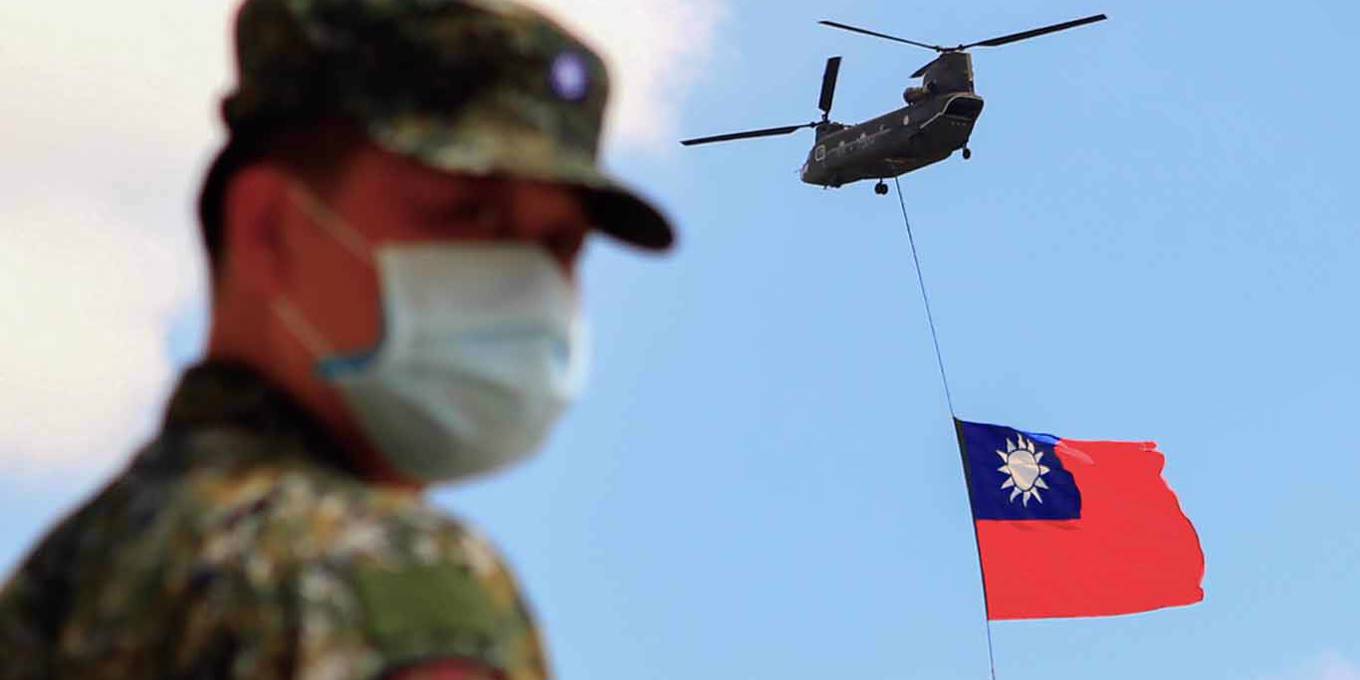
Chinese President Xi Jinping seems eager for Taiwan to go the way of once-autonomous Tibet, which was gobbled up by Mao Zedong’s regime in the early 1950s. This would constitute the biggest threat to world peace in a generation, and the United States cannot afford to allow it.
China’s coercive expansionism may be taking its most dangerous turn yet. Recently, record-breaking numbers of Chinese military planes have entered Taiwan’s “air defense identification zone,” where the island’s authorities assert the right to demand that aircraft identify themselves. China’s muscle-flexing sends a clear message: it is serious about incorporating the island – and “reunifying” China – potentially by force.
Though the international community has been reluctant to challenge the Chinese claim that Taiwan has “always been” part of China, the claim is dubious, at best, and based on revisionist history. For most of its history, Taiwan was inhabited by non-Chinese peoples – Malayo-Polynesian tribes – and had no relationship with China. Geographically, Taiwan is closer to the Philippines than to the Chinese mainland.
It was not until the seventeenth century that significant numbers of Chinese began to migrate to Taiwan, encouraged by the island’s Dutch colonial rulers, who needed workers. Over the next 100 years, the ethnic Chinese population grew to outnumber Taiwanese natives, who were increasingly dispossessed, often violently. During this period, Taiwan came under the Qing Dynasty’s control. But it was not until 1887 that Taiwan was declared a province of China.
Barely eight years later, China ceded Taiwan to Japan in perpetuity, following its defeat in the Sino-Japanese War. Taiwan remained under Japanese colonial rule until 1945 – Japan officially renounced its sovereignty over it in the 1951 San Francisco Peace Treaty – and has been self-governing ever since. In other words, for the last 126 years, Taiwan has been outside China’s lawful control.
Today, Taiwan has all the attributes of a robust independent state, and most Taiwanese want it to stay that way. But Chinese President Xi Jinping appears eager to annex the island, as Mao Zedong’s regime did to Tibet in the early 1950s, in the name of “reunification.” A Chinese invasion of Taiwan would constitute the biggest threat to world peace in a generation.
Beyond compromising freedom of navigation in a crucial region, a Chinese takeover of Taiwan would upend the balance of power in the Indo-Pacific, not least by enabling China to break out of the “first island chain” that runs from the Japanese archipelago, through Taiwan, the Philippines, and on to Borneo, enclosing China’s coastal seas. It would also irreparably damage America’s reputation as a reliable ally. If the United States cannot (or will not) prevent Taiwan’s subjugation, why should anyone else count on US protection?
The risks are particularly acute for Japan, whose southernmost islands are adjacent to Taiwan. As then-Deputy Prime Minister Taro Aso observed in July, “Okinawa could be next.” Unable to rely on the Americans, Japan would likely remilitarize and even acquire nuclear weapons. Other US allies – such as South Korea, the Philippines, and Thailand – would likely be brought into China’s sphere of influence.
Yet the US does not seem particularly committed to preventing a Chinese takeover of Taiwan and the subsequent collapse of the half-century-old Asian security order. This is exactly what Xi is counting on. Successive US administrations have let him get away with countless expansionist maneuvers – from militarizing the South China Sea to demolishing Hong Kong’s autonomy – as well as cultural genocide in Xinjiang. Why should Taiwan be any different?
US President Joe Biden’s recent shift to a more conciliatory approach toward China has probably bolstered Xi’s confidence further. Xi currently may be focused on China’s 17-month-long military confrontation with India in the Himalayas, where Chinese territorial encroachments have triggered a massive buildup of forces along the inhospitable frontier. But, if some resolution can be found that reduces tensions in the Himalayas, it would free up Chinese capabilities to deal with the fallout of any Taiwan-related operation.
At that point, the only thing that would deter China from attempting to recolonize Taiwan would be the knowledge that it would incur high concrete – not just reputational – costs. Biden must therefore make it crystal clear to Xi that the US would mobilize its own military resources to defend Taiwan.
But will he? The US Strategic Framework for the Indo-Pacific – a policy document declassified by President Donald Trump’s administration before leaving office – recommends that America help Taiwan develop “asymmetric” capabilities against China. Such a strategy has recently been backed by some former American government and military officials. As retired Admiral James Stavridis puts it, just as a porcupine’s quills protect it from larger predators by making it difficult to digest, weapons like anti-ship and anti-aircraft missiles would turn any invasion of Taiwan into a bloody, protracted, and costly guerrilla campaign.
It is true that bolstering Taiwan’s defenses is crucial to avert Chinese amphibious and airborne operations. But even if the US and Taiwanese governments reached an agreement on an asymmetric strategy, it would take several years to build a “porcupine Taiwan” capable of choking the Chinese dragon. This process would include training a large civilian corps to mount sustained guerrilla attacks on invaders.
Until then, in keeping with the central paradox of deterrence, the only way to discourage aggression by a revisionist power is for the status quo power to threaten to go to war. That is how the US kept West Berlin – which had a political status even more precarious than Taiwan’s – free throughout the Cold War.
The worst stance the US could take would be to oppose a Chinese takeover of Taiwan without credibly signaling a genuine willingness to defend the island militarily. Such an approach could encourage Xi, who has grown accustomed to acting with impunity, to order a surprise invasion. With that, the Indo-Pacific order would be overturned, dealing a mortal blow to America’s global preeminence.
In a defiant speech on Aug. 31, President Biden claimed that his precipitous exit from Afghanistan, which facilitated the terrorist takeover of that country, would allow the United States to focus on its “serious competition with China.” But there are now growing signs that Biden’s Afghan blunder has weakened his hand against China and opened greater strategic space for America’s main rival.
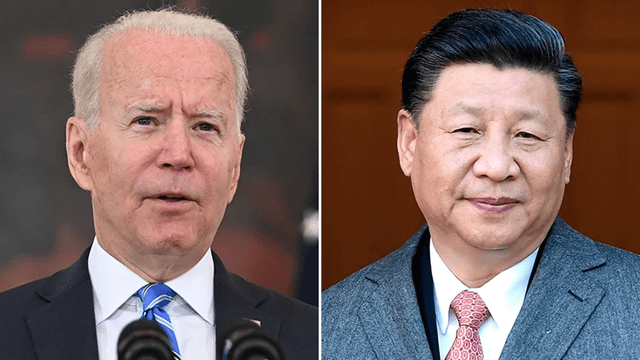
Illustrating his weakened position, the president has just capitulated to China’s hostage-taking tactics. In a deal Biden finalized with Chinese President Xi Jinping, the U.S. dropped its extradition case against Huawei executive Meng Wanzhou, allowing her to return home from Canada, in exchange for China’s release of Canadian hostages Michael Spavor and Michael Kovrig, who spent 1,019 days in Chinese prisons on trumped-up charges.
The hostages-for-Meng swap is the latest example of Biden’s efforts to ease tensions with China by propitiating Xi. By rewarding Xi’s use of rogue tactics, the deal sends a chilling message to foreigners working in China.
Earlier, Biden bowed to another Chinese demand — that the U.S. stop tracing the origins of the COVID-19 virus, even though the world has a right to know if China caused the worst disaster of our time, which has already killed more than 4.7 million people. Twelve days after Kabul’s fall, Biden announced on Aug. 27 that the intelligence inquiry he initiated had ended, even though it failed to uncover the genesis of the pandemic.
Xi’s regime, involved in one of the greatest cover-ups ever seen, doesn’t want the truth to come out. After all, if China’s negligence or complicity spawned the world’s worst public-health catastrophe in more than a century, it would constitute a crime against humanity.
Biden should have ordered the U.S. intelligence community to keep searching for the true origins of the virus until it reached a definitive conclusion. By not extending the inquiry’s 90-day deadline, Biden met an important Chinese demand.
Since the Afghan debacle, Biden has gone to extraordinary lengths to alleviate tensions with China. Last week began with the president’s China-conciliatory address at the United Nations and ended with Meng’s return home to a hero’s welcome.
During a recent 90-minute phone conversation with Xi, Biden sought to explain U.S. actions toward China “in a way that [is] not misinterpreted as…somehow trying to sort of undermine Beijing in particular ways,” according to the readout from a senior U.S. official. In fact, during the call, Xi spurned Biden’s face-to-face summit offer, demanding that the U.S. first soften its China policy and tamp down rhetoric.
As if heeding Xi’s demand, Biden in his UN address never uttered the word “China,” even as he called out Iran and North Korea. The address stood in stark contrast with then-President Trump’s 2020 UN speech, which demanded the world “hold China accountable” for unleashing the “China virus.” Biden’s speech defensively stated, “We’re not seeking – say it again, we are not seeking – a new Cold War or a world divided into rigid blocs.”
Such fecklessness appears out of step with reality, given that an ambitious and expansionist China is actively working to supplant the U.S. as the world’s preeminent power while waging a cold war against it. Since Biden assumed the presidency, the U.S. has initiated most moves for high-level talks with China, including the latest phone call.
The White House’s dropping of fraud charges against Meng, the daughter of the man who founded the military-linked Huawei, is a real shot in the arm for Xi, whose increasing appetite for taking major risks poses an international challenge. In a striking paradox, Meng departed for home from Canada on the day Biden hosted the first face-to-face leaders’ meeting of the Quad, a U.S.-India-Japan-Australia grouping catalyzed by China’s muscular foreign policy and rogue behavior.
Deals with hostage-takers usually boomerang. For example, to secure the release of Bowe Bergdahl, a captured U.S. Army sergeant who had deserted his unit in Afghanistan, President Obama in 2014 freed five Taliban leaders from Guantánamo Bay. The release of the five – “the hardest of the hardcore,” as the late Sen. John McCain (R-Ariz.) said then – proved costly.
An emboldened Taliban sharply escalated its attacks in Afghanistan, bringing Afghan and U.S.-NATO forces under increasing pressure. This eventually led to Trump’s one-sided withdrawal deal with the Taliban in February 2020 and then to Biden’s recent handover of Afghanistan to that Pakistan-backed terrorist militia. Today, the five former Guantánamo inmates are senior officials of the new Afghan regime, made up of a who’s who of international terrorism.
The Biden-arranged swap is likely to prove detrimental to the free world. The deal may have unwittingly vindicated Chinese propaganda that the 2018 Canadian arrest of Meng on a U.S. warrant was politically driven and that the U.S. and Canadian judicial systems do not operate independent of political interests.
Indeed, the White House has shamed the rule of law by terminating a legal case through a political deal with a hostage-holding regime, thereby setting a terrible precedent in international relations.
The deal will inspire other hostage-takers, including the Taliban. To press for sanctions relief and other demands, the Taliban is already obstructing the evacuation of the remaining stranded foreigners from Afghanistan, including Afghans with Western passports.
More ominously, America’s yielding to China’s thuggish diplomacy of hostage-taking will encourage greater Chinese defiance of international rules and norms. Xi’s regime doesn’t care about the costs to the country’s image, which explains why, despite unfavorable views of China rising to near historic highs, it is busy corrupting, coercing or co-opting other states.
In pursuing a more conciliatory approach toward China, Biden has given respectability to the rogue-state tactic of taking hostages, making it virtually certain that the two freed Canadians will not be the last foreigners seized by Beijing as bargaining chips.
Brahma Chellaney is a geostrategist and the author of nine books, including the award-winning “Water: Asia’s New Battleground” (Georgetown University Press).
No sooner had the Taliban completed their lightning-quick conquest of Afghanistan than U.S. Secretary of State Antony Blinken announced that Washington was ready to work on “counterterrorism” with the same marauding Islamist force that has so much American blood on its hands.
No less shocking was the statement from the chairman of the U.S. Joint Chiefs of Staff, Gen. Mark Milley, that it is “possible” the U.S. will coordinate with the Taliban to conduct counterterrorism strikes on other Islamist terrorists.
British Chief of Defense Staff Gen. Nick Carter called the Taliban — responsible for the killing of more than 2,000 American soldiers and hundreds of allied troops — “country boys” that “live by a code of honor and a standard.” Carter’s claim that the Taliban have “changed” and “want an Afghanistan that is inclusive for all” has already been contradicted.
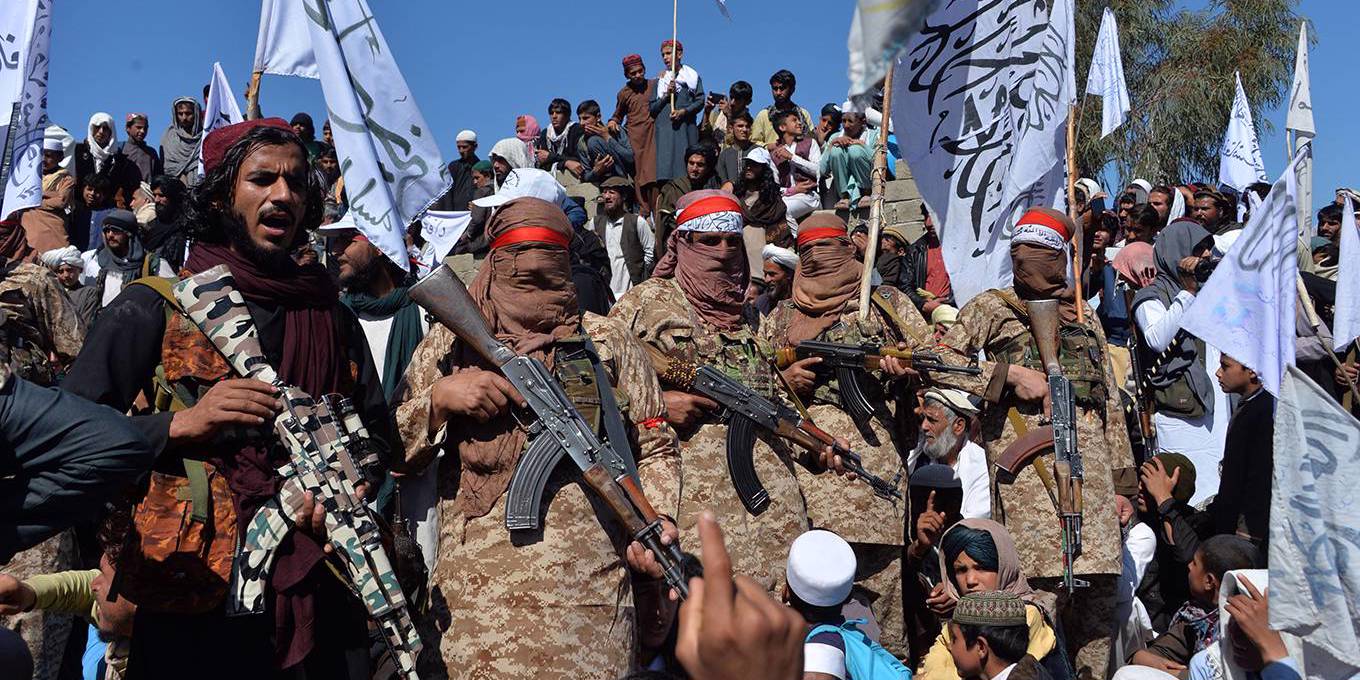
The Taliban’s all-male regime of hard-core extremists is a who’s who of international terrorism, with 17 of the 33 cabinet ministers on the United Nations’ terrorism-related sanctions list, and four former Guantanamo Bay inmates and several others who remain U.S.-designated global terrorists. The regime is headed by Mohammad Hassan Akhund, a U.N.-listed terrorist and architect of the 2001 destruction of the monumental Buddhas of Bamiyan.
The Anglo-American outreach to the Taliban stands in eerie contrast with U.S. and British efforts to isolate and squeeze another of India’s neighbors — military-ruled Myanmar. It is as if Myanmar’s military government is a bigger threat to international security than a Kabul regime run by some of the world’s deadliest terrorists.
Yet, after the latest military takeover on Feb. 1, the U.S. and Britain took the lead in slapping a series of sanctions on Myanmar, with America even suspending bilateral trade ties. Washington says its 2013 Trade and Investment Framework Agreement with Myanmar will remain suspended until the return of a democratically elected government, of which there is currently little hope.
The U.S.-led efforts to use economic and political levers to unseat the military regime have only emboldened insurgent groups to step up their violent campaigns. A shadow government formed by opponents of military rule recently called for taking up arms against the regime. More than 220,000 people have already been displaced by internal conflict since the military takeover.
Yet, the U.S. and Britain appear reconciled to a terrorist regime ruling Afghanistan. In an echo of Gen. Carter’s call to be “very careful about using the term ‘enemy'” for the Taliban, U.S. national security adviser Jake Sullivan has declined to call the militia an enemy of the U.S., saying, “It’s hard to put a label on it.”
In fact, Britain responded to the Taliban’s conquest by immediately announcing a doubling of its aid to Afghanistan. And U.S. President Joe Biden — not content with his Afghan surrender gifting troves of American-made weapons to the Taliban, making them the first terrorist group to acquire advanced air and land-based capabilities — is sending $64 million in aid to Afghanistan. As The Wall Street Journal put it, the Taliban “have overnight turned into a courted U.S. partner.”
The White House has praised the Taliban for being “businesslike and professional” on evacuations. They have certainly been businesslike and professional in detaining and executing perceived opponents, in ongoing ethnic cleansing and in their Pakistan-aided brutal assaults on the Panjshir Valley, the last resistance stronghold, where tens of thousands of residents have been uprooted amid widespread killings.
Meanwhile, Taliban death squads, going door to door, have been hunting down and killing those who assisted the previous government, including, in one documented case, first pulling out all the victim’s fingernails. The Taliban have been businesslike and professional too in their imposition of seventh-century Islamic practices from the Arab world that are alien to Afghan culture.
The Taliban have “changed” in one respect: In place of the blue burqa that women were made to wear during their 1996-2001 rule, they have now prescribed a full-body covering of a different color, black.
The U.S. outreach to the Taliban, including drawing specious distinctions between “good” and “bad” terrorists, is designed to soften the blow from Biden’s handover of a mineral-rich country to a militia that is a wing of the Pakistani deep state. But such an effort cannot camouflage the damage to America’s international credibility and standing.
More fundamentally, the Anglo-American courting of the Taliban highlights the selective, geopolitics-driven approach to combating terrorism, which is why the U.S.-launched global war on terrorism has yielded little even two decades after its launch. The scourge of transnational terrorism has only spread deeper and wider.
The Taliban’s rollback of civil, human and women’s rights, brutal executions, replacement of education and music with religious dogma, and enslavement of prepubescent girls through forced “marriage” to their fighters ought to spur a concerted global response.
The last thing the world can afford is condoning the Taliban’s medieval practices, misogyny and barbarity. Yet the West remains a mute spectator to the Taliban’s ongoing atrocities.
Brahma Chellaney is a geostrategist and author of nine books, including “Asian Juggernaut: The Rise of China, India and Japan.”
There is an old Chinese idiom: “Kill the chicken to scare the monkey.” And in the political crossfire between Washington and Beijing over the 2018 Canadian arrest of Huawei executive Meng Wanzhou on a U.S. warrant, it is clear that for China, Canada has been the chicken to the U.S.’s monkey.
The relief in Canada over the return of Michael Spavor and Michael Kovrig from almost three years of arbitrary detention in China should not obscure the larger implications of the U.S.-arranged deal. It represents a triumph of China’s scofflaw tactics, and a real shot in the arm for President Xi Jinping, whose expansionist policies already pose a growing international challenge.
In recent weeks, U.S. President Joe Biden has gone to extraordinary lengths to ease tensions with China, as if to underscore that the humiliating U.S. defeat in Afghanistan has weakened his hand against his country’s principal rival. During a recent 90-minute phone conversation, Mr. Xi spurned Mr. Biden’s offer of a face-to-face summit, demanding that the U.S. first soften its China policy and tamp down its rhetoric.
As if heeding Mr. Xi’s demand, Mr. Biden did not utter the word “China” in his address at the United Nations last week, even as he called out Iran and North Korea. “We’re not seeking – I’ll say it again, we are not seeking – a new Cold War or a world divided into rigid blocs,” he said defensively. Contrast that with then-president Donald Trump’s 2020 UN speech, in which he declared that the world must “hold China accountable” for the COVID-19 pandemic. And indeed, during his phone call with Mr. Xi, Mr. Biden sought to explain U.S. actions toward China “in a way that [is] not misinterpreted as … somehow trying to sort of undermine Beijing in particular ways,” according to the readout from a senior U.S. official.
Such fecklessness appears out of step with reality, given that China has been actively working to displace the U.S. as the world’s pre-eminent power. Yet, since Mr. Biden assumed office, it is the U.S. that has initiated most of the moves for high-level talks with China, including the latest phone call.
The Biden administration’s dropping of fraud charges against Ms. Meng came just after Canada completed its federal election. But, in a striking paradox, Ms. Meng departed for home from Canada on the day Mr. Biden hosted the first face-to-face leaders’ meeting of the Quad, a U.S.-India-Japan-Australia coalition catalyzed by China’s aggressive foreign policy and rogue behaviour.
By terminating a legal case through a political deal, Washington may have unwittingly vindicated Chinese propaganda – that Ms. Meng’s arrest was politically driven and that the U.S. and Canadian judicial systems were not free from political influence. The deal will encourage China to further defy international rules and norms and coerce other states, as it seeks to establish a 21st-century version of the imperial tributary system.
The White House, unfortunately, has ignored the lesson that deals with hostage takers usually boomerang. For example, to secure the release of Bowe Bergdahl, a captured U.S. Army sergeant who had deserted his unit in Afghanistan, U.S. President Barack Obama freed five Taliban leaders – “the hardest of the hardcore,” as the late senator John McCain called them at the time – from Guantánamo Bay in 2014. An emboldened Taliban then sharply escalated its attacks in Afghanistan, bringing Afghan and U.S.-NATO forces under increasing pressure. This led eventually to Mr. Trump’s one-sided withdrawal deal in February, 2020, whose precipitous implementation by Mr. Biden facilitated the Taliban’s sweep into power in August. Today, the five former Guantanamo inmates are senior officials of the Taliban regime, which is stacked with cabinet ministers who are on UN and U.S. terrorism-related sanctions lists.
Mr. Biden’s deal is also likely to prove broadly detrimental to Western interests. By striking a deal with a hostage-holding government, the White House has advertised weakness. The fact that China has gotten its way will inspire other hostage-takers, including the Taliban. In fact, to press for sanctions relief and other demands, the Taliban are already obstructing the evacuation of the remaining Western citizens from Afghanistan, including Afghans who hold U.S. passports or green cards.
Thanks to the U.S.’s deal, Mr. Kovrig and Mr. Spavor will surely not be the last foreigners seized by Beijing as bargaining chips. By rewarding China’s hostage diplomacy, the White House has given respectability to a rogue-state tactic that Mr. Xi is sure to now employ again.
Brahma Chellaney is a geostrategist and the author of nine books, including the award-winning Water: Asia’s New Battleground.
The Taliban’s takeover of Afghanistan, the greatest jihadist victory in modern times, will give rise to a terrorist super-state that serves as a magnet for violent Islamists from around the world. The US-led global war on terror, which was already faltering before President Joe Biden took office, may not recover.
The American-led global war on terror, launched 20 years ago after the September 11, 2001, attacks against the United States, was already faltering before President Joe Biden took office. Now it may not recover from the blow delivered by Biden’s historic blunder in facilitating the Taliban’s return to power in Afghanistan. The flag of the world’s deadliest terrorists – responsible for killing over 2,000 US soldiers since 2001 – will fly above Kabul on the 20th anniversary of the 9/11 attacks.
By empowering the Taliban, Biden has empowered all violent Islamist groups, thus making the rebirth of global terror highly likely. And by betraying one ally – the Afghan government – he has made other American allies feel that the US could abandon them, too, when the chips are down.
The greatest jihadist victory in modern times will soon give rise to a terrorist super-state – a haven for transnational fanatics and a magnet for violent Islamists from around the world seeking training to carry out attacks back home. The Taliban’s “Islamic emirate” will lay the foundation for an international caliphate of the type sought by the late al-Qaeda leader Osama bin Laden and the hijackers who carried out the 9/11 attacks.
Whereas the short-lived “caliphate” of the Islamic State (ISIS) filled a political vacuum in northern Syria before expanding into Iraq, the Taliban’s emirate has resulted from the defeat of the world’s mightiest power. The Taliban’s triumph will thus give the international jihadist movement an unprecedented boost, including for enlisting new recruits, with consequences that will play out for many years. The war on terror, which extends from the Middle East and southern Europe to Africa and Asia, will become increasingly difficult as its fronts multiply.
This comes at a time when America’s accelerating imperial decline is already weakening its capacity to impose its will on other countries, thereby encouraging China’s global expansion. Biden, continuing his predecessor Donald Trump’s policy of military retrenchment, recently committed to ending the US combat mission in Iraq this year.
The US has expended huge resources in its war on terror, waging counterterrorism operations in scores of countries. According to a recent report from Brown University’s Costs of War project, America’s post-9/11 wars, including efforts to secure its homeland, have cost about $8 trillion and caused an estimated 900,000 deaths, including of civilians and humanitarian aid workers. But they have yielded no enduring results.
The main reason is that America has long forgotten the lessons of 9/11, including the need to shun the path of expediency. As a result, the politicization of the war on terror has prevented a concerted ideological onslaught on violent jihadism.
Biden, for his part, is drawing specious distinctions between “good” and “bad” terrorists, in a bid to obscure both the significance of the Taliban’s takeover of Afghanistan and his administration’s outreach to it. For example, he claims that “ISIS-K terrorists” are “sworn enemies of the Taliban” without acknowledging that the Taliban – like al-Qaeda and ISIS-K – are sworn enemies of the free world. Likewise, Biden was quick to absolve the Taliban of responsibility for the recent terrorist bombing at Kabul airport by pinning the blame on ISIS-K, while Secretary of State Antony Blinken said the US is ready to work on “counterterrorism” with the new regime in Kabul.
But the Taliban, al-Qaeda, and ISIS-K share a common ideology and commitment to violent jihad, with their members commingling and even moving from one group to another. As the Pentagon has acknowledged, the victorious Taliban have released thousands of ISIS-K prisoners. And according to a recent United Nations Security Council report, “the Taliban and Al-Qaida remain closely aligned.”
Meanwhile, the State Department has sought to spin a myth by claiming that the Taliban and their special forces, the Haqqani Network, “are separate entities.” In fact, the Taliban and the Haqqani Network are a wing of Pakistan’s “deep state.” The network’s chief, Sirajuddin Haqqani, is a deputy leader of the Taliban. And the arrival in Kabul of the head of Pakistan’s rogue Inter-Services Intelligence agency even before the Taliban formed their government highlighted that the real victor in Afghanistan is Pakistan, which has virtually gained proxy control of its neighbor.
Yet, underscoring the geopolitics behind the war on terror, the Biden administration is unlikely to punish Pakistan, a “major non-NATO ally,” for engineering America’s humiliating rout in Afghanistan. Instead, it is relying on Pakistan and another long-time sponsor of jihadists, Qatar, to establish a relationship with the theocratic dictatorship in Kabul.
The US has come full circle by ceding control of Afghanistan to the same organization that gave bin Laden the base from which to plot the 9/11 attacks. Those attacks resulted from America’s troubling ties with Islamist groups since the 1980s, when President Ronald Reagan used Islam as an ideological tool to encourage armed resistance to the Soviet occupation of Afghanistan. Bin Laden and other al-Qaeda leaders, including the Haqqani Network’s founder, cut their teeth in that CIA-run covert war. Another veteran of that war now heads the Taliban regime – Muhammad Hassan Akhund, a UN-listed terrorist and architect of the 2001 demolition of the monumental Buddhas of Bamiyan.
But within a decade of 9/11, the US returned to training jihadists and funneling lethal arms to them in regime-change wars, such as in Syria and Libya, with the CIA’s $1 billion secret war to topple Syrian President Bashar al-Assad resulting in the rise of ISIS. And it bankrolled a renegade Pakistan as it sheltered the Taliban’s command-and-control network.
Forgetting the lessons of 9/11 has effectively derailed the global war on terror. Putting it back on track, though a daunting challenge, is essential if the scourge of violent jihadism is not to become the defining crisis of this century.
The U.S.-led war on terror, in the global imagination, has become associated with U.S. surveillance excesses, torture, renditions, and regime-change military interventions. America’s Afghan defeat, drenched in the blood of betrayal, is the final nail in the coffin.
On the day the United States marked two decades since the 9/11 terrorist attacks, the Taliban triumphantly hoisted their flag over the Afghan presidential palace and launched their new regime in a brief ceremony. The unprecedented 9/11 attacks prompted the U.S. not only to invade landlocked, strategically located Afghanistan but also to launch a global war on terror. But now, the U.S. has come full circle by handing Afghanistan to the same terrorists responsible for 9/11.
President Joe Biden’s historic blunder in facilitating the terrorist takeover of Afghanistan has highlighted how the U.S.-led war on terror has gone astray. Over the past 20 years, the scourge of international terrorism has spread deeper and wider in the world.
Biden has earned his place in history by making the world’s deadliest terrorists — the Pakistan-reared Taliban, who killed more than 2,000 American soldiers since 2001 — great again. Historians will be flummoxed that the U.S. expended considerable blood and treasure in a protracted war to ultimately help its enemy ride triumphantly back to power.
The humiliating rout of the world’s mightiest power represents the greatest victory of violent Islamists in the modern history of jihadism, with the Taliban calling it “the most joyful day of our existence.” The triumph over the “Great Satan” is certain to inspire other Islamist and terrorist groups worldwide.
Undeterred by his Afghan disaster, Biden plans to withdraw from Iraq this year, in keeping with what he declared in his August 31 address to the nation: “This decision about Afghanistan is not just about Afghanistan. It’s about ending an era of major military operations to remake other countries.” This readjustment of strategic objectives is already rattling allies — from Taiwan to Ukraine — who fear being abandoned the way the U.S. threw the Afghan government under the bus.
Afghanistan indeed may not be the last blunder of the Biden presidency. Robert Gates, who served as defense secretary under presidents George W. Bush and Barack Obama, wrote in 2014 that Biden “has been wrong on nearly every major foreign policy and national security issue over the past four decades.” Gates has proved right.
In fact, al-Qaeda leader Osama bin Laden, in a May 2010 letter found in his Pakistan compound after he was killed by U.S. forces, advised al-Qaeda not to target then-Vice President Biden, in the hope that he would one day become president. “Biden is totally unprepared for that post, which will lead the U.S. into a crisis,” bin Laden wrote. He too has proved correct.
Biden has ignored the lessons of 9/11. This is apparent from the administration’s outreach to the Taliban. Biden has attempted to paint the Taliban as “good” terrorists and ISIS-K, al-Qaeda and the Haqqani Network as “bad” terrorists. He even claimed that “ISIS-K terrorists” are “sworn enemies of the Taliban,” ignoring the Pentagon’s acknowledgment that it was the victorious Taliban that freed thousands of ISIS-K prisoners.
Like the administration’s attempt to portray the new Taliban as more enlightened than the old Taliban, Biden’s specious distinctions between “good” and “bad” terrorists have been part of his public-relations campaign to soften the blow from his handover of mineral-rich Afghanistan to an Islamist militia that is a wing of the Pakistani “deep state.” Indeed, extending its good-terrorists-versus-bad-terrorists hypothesis, Team Biden has sought to court the Taliban as America’s new partner to help contain the “bad” militants, with Secretary of State Antony Blinken saying publicly that the U.S. is ready to work on “counterterrorism” with the Taliban.
A key 9/11 lesson was that the viper reared against one state is a viper against others. Drawing distinctions between those who threaten U.S. security and those who threaten others is a sure recipe for counterterrorism failure, as terrorist cells and networks must be targeted wherever they exist on a sustained basis in order to achieve enduring results against the forces of global jihad.
Team Biden is intentionally ignoring the fact that the Taliban are closely entwined with other terror groups. A recent United Nations Security Council report said, “the Taliban and al-Qaida remain closely aligned” and cooperate through the Haqqani Network. The triumphant Taliban have not only refused to utter a critical word about al-Qaeda but also now claim there is “no proof” that bin Laden was responsible for 9/11.
The Taliban and the Haqqani Network are not “two separate entities,” as the State Department claimed, but closely integrated, as the lineup of the new Cabinet ministers in Kabul shows. And, although Biden sought to insulate the Taliban from the Aug. 26 Kabul Airport bombing by quickly pinning the blame on ISIS-K, the fact is that ISIS-K has little relationship with the ISIS founded by Abu Bakr al-Baghdadi. Rather, as part of Pakistani intelligence’s deception operations to build plausible deniability in terror attacks, ISIS-K draws its cadres largely from the Taliban’s special forces — the Haqqani Network.
The world today is reaping the bitter fruits of a geopolitics-driven war on terror, which, in the global imagination, has become associated with U.S. surveillance excesses, torture, renditions and regime-change military interventions. Afghanistan is set to become a haven for international terrorists under a regime stacked with U.N.-listed or U.S.-designated terrorists, including the prime minister, who was instrumental in the 2001 destruction of two giant, sixth-century Buddhas in Bamiyan.
America’s Afghan defeat, drenched in the blood of betrayal, resulted from ignoring the lessons of 9/11, including the importance of not coddling states that bankroll or sponsor transnational terrorism. And the U.S.-led war on terror, instead of containing terrorism, has generated greater international insecurity. It is not too late for the U.S. to absorb the lessons from national policies that gave rise to Frankenstein’s monsters.
Brahma Chellaney is a geostrategist and the author of nine books, including the award-winning “Water: Asia’s New Battleground” (Georgetown University Press).
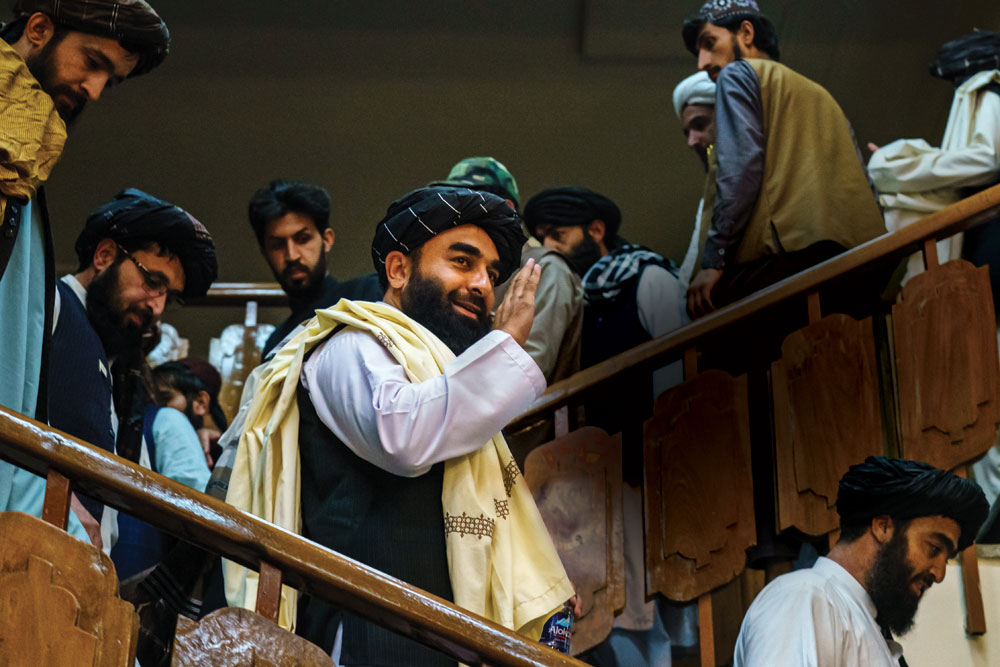
Taliban Spokesman Zabihullah Mujahid makes his first-ever public appearance at a press conference in Kabul, August 17 (Photo: Getty Images)
THE UNPARALLELED TERRORIST attacks of September 11th, 2001 in the US gave birth to the American-led global war on terror. Nearly 3,000 Americans died in the unprecedented 9/11 attacks. Yet, two decades later, it is apparent that the war on terror has been remarkably ineffective, as the recent terrorist takeover of Afghanistan highlights.
Much before US President Joe Biden’s blunder in enabling the Taliban’s conquest of Afghanistan, the war on terror had already gone astray. Over the past 20 years, the number of terrorism-related casualties has increased globally. Terror has spread geographically, with new regions being battered by the scourge of violent extremism. And national expenditures on combating terrorism, from North America and Europe to Asia, have risen sharply.
In fact, it has been in the period since 9/11 that India has suffered a series of major terrorist strikes. The terrorist assaults on the state legislature of Jammu and Kashmir and the Indian Parliament occurred within weeks of 9/11. The 2008 Mumbai massacre was India’s equivalent of 9/11, affecting the Indian psyche more deeply than any other attack.
Globally, the past two decades have largely been a wasted period in combating the menace of terrorism: Instead of containing terrorism, the war on terror has generated greater insecurity in several parts of the world, including Europe, Africa and Asia. “The war has been long and complex and horrific and unsuccessful,” in the words of Brown University’s Catherine Lutz, who has been tracking the costs of America’s counterterrorism operations across the world.
What explains the failure of the US-led war on terror to achieve tangible results? Simply put, the war’s increasing politicisation has effectively stymied any possibility of achieving lasting success.
GEOPOLITICS DRIVES COUNTERTERRORISM
The US under successive presidents has turned the war on terror into a geopolitical instrument to advance narrow interests, instead of focusing on rooting out all terrorist groups wherever they exist. It is this approach that has led to the US defeat and humiliation in Afghanistan. This defeat was drenched in the blood of betrayal: America ditched its ally—the elected Afghan government—and got into bed with the world’s deadliest terrorists (the Taliban), culminating in its humiliating rout.
The only way to combat terrorism is through vigorous, proactive and pre-emptive actions, without seeking to differentiate between good terrorists and bad terrorists. Also, talking tough but doing little in action only emboldens terrorists and their sponsors.
The US, unfortunately, has never adopted a forward-looking approach to containing international terrorism. It has been more concerned about protecting its own interests, including its homeland, than about winning the larger war against terrorism. It has entered into deals with terrorist groups operating against its own regional allies and partners.
Yet it has long maintained the pretence that it does not negotiate with terrorists. In 2008, then US Vice President Dick Cheney even declared, “We don’t negotiate with evil; we defeat it.” But while regurgitating the line that “we don’t negotiate with terrorists,” the US has quietly done the opposite in practice, as President Donald Trump’s deal with the Taliban and the Biden administration’s current outreach to that militia underscore.
The February 2020 Doha deal between the US and the Taliban showed that Washington not only negotiates with terrorists, but also clinches an agreement with much fanfare.
Even before the Doha deal, the US traded three leading Taliban terrorists, including Anas Haqqani (son of the Haqqani network’s founder), for two captured Westerners in November 2019. Likewise, in 2014, it freed five Taliban leaders from Guantánamo Bay in exchange for the release of a captured US Army sergeant. The late American Senator, John McCain, had called the five released detainees “the hardest of the hardcore.”
Despite America’s obsession with counterterrorism, it has always waged its war on terror selectively. It has shielded client nations even if they have bankrolled or sponsored transnational terrorism, and gone after countries that have defiantly stood their ground against Washington.
This is apparent from America’s list of state sponsors of terrorism, which today includes only four countries—Cuba, Iran, North Korea and Syria. These four have been targeted for geopolitical reasons. Such has been the arbitrariness that the US identified Cuba out of the blue as a state sponsor of terrorism in January this year, after earlier dropping Sudan from its list.
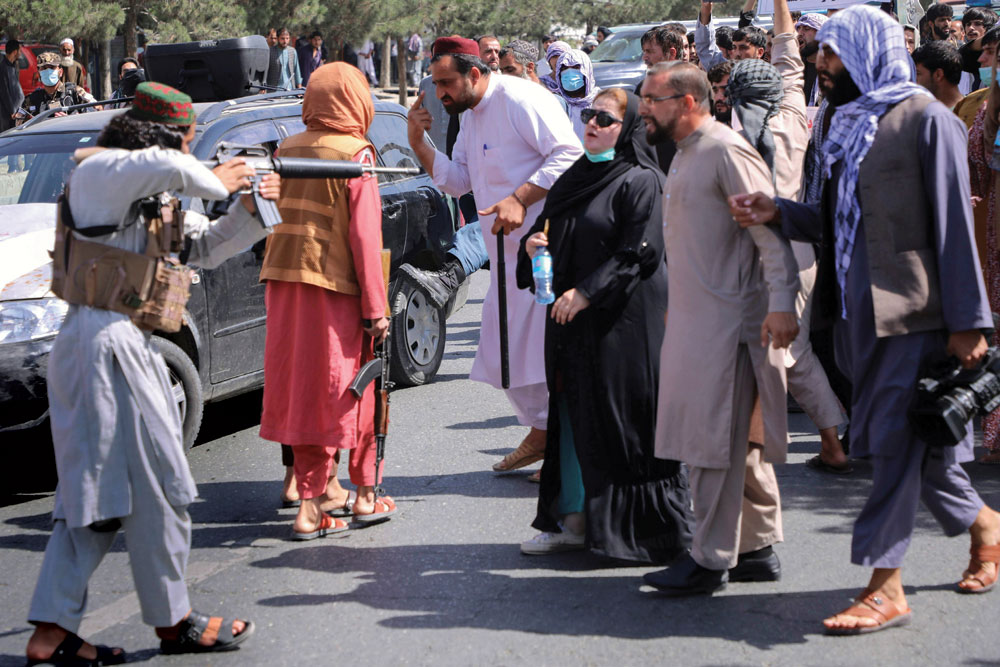
A Taliban member points his gun at protestors outside the Pakistan Embassy in Kabul, September 7 (Photo: Reuters)
The main financiers of violent Islamists, by Washington’s own admission, are US allies (Saudi Arabia and the other oil sheikhdoms). In fact, President Trump once called Saudi Arabia “the world’s biggest funder of terrorism.” And another US ally, Pakistan, has long served as the main international sanctuary of Al Qaeda and other transnational terrorists like the Haqqani network and Lashkar-e-Toiba.
Thanks to WikiLeaks disclosures, we know that US officials have privately acknowledged that the terrorism problem is largely tied to American allies. Yet successive US governments have employed the war on terror as a geopolitical tool, instead of focusing on reining in America’s renegade allies.
Given the number of U.N.-listed terrorists that the Taliban have appointed as ministers, can there be any doubt that helping this terrorist regime to gain international acceptability will be disastrous for counterterrorism?
Pakistan’s shadowy Inter-Services Intelligence (ISI) agency, as a tacit or overt sponsor of violent extremists and terrorist groups, has long acted as the enabler of transnational terrorism. No other intelligence agency in the world has promoted international terrorism to the extent ISI has done over more than four decades.
Yet the US has added Iran’s Islamic Revolutionary Guard Corps to its list of foreign terrorist organizations but not ISI, with which the Central Intelligence Agency (CIA) has sustained a longstanding relationship. ISI itself is part of a major terrorism-exporting force—Pakistan’s military—which maintains cosy ties with transnational terrorist groups, including providing, as President Trump acknowledged, “safe haven to the terrorists we hunt in Afghanistan.”
Nothing better illustrates the politicisation of the global war on terror than the fact that the US government never added the Pakistan-reared Afghan Taliban to the State Department’s annual list of Foreign Terrorist Organizations. This outfit killed more than 2,000 American soldiers between 2001 and 2021. The Taliban’s rapid conquest of Afghanistan may have brought shame and humiliation to the US, yet today the Biden administration, paradoxically, is courting this militia that is responsible for so many American deaths.
Take another example: Pakistan engineered the US rout in Afghanistan through its proxy, yet Biden is unlikely to revoke the “major non-NATO ally” (MNNA) status enjoyed by that country. Sixteen other countries, including Japan, Australia and Israel but not India, have the MNNA status, which carries security benefits under American law. Nor is Biden likely to impose any financial or diplomatic sanctions on Pakistan.
It is thus no wonder that terrorism has virtually become our new normal. After the terrorist capture of Afghanistan, the international counterterrorism challenges are bound to escalate.
SURRENDER IN AFGHANISTAN
Biden’s surrender of Afghanistan to the Taliban and his administration’s ongoing efforts to legitimise the new terrorist regime in Kabul have unravelled whatever was left of the American-led global war on terror. Given the number of United Nations-listed terrorists that the Taliban have appointed as ministers, can there be any doubt that helping this terrorist regime to gain international acceptability will be disastrous for counterterrorism?
Even the head of the Taliban regime, Mohammad Hassan Akhund, is on the UN blacklist. In fact, Hassan Akhund oversaw the demolition of the Buddhas of Bamiyan in March 2001. And with the FBI-wanted Sirajuddin Haqqani as interior minister, the notorious Haqqani network—and by extension Pakistan’s ISI agency—will be in charge of Afghanistan’s internal security. So much for the talk that the Taliban have changed!
Biden, however, has defiantly refused to offer any sort of mea culpa for his Afghan surrender and instead repeatedly attempted to rationalise his precipitous and ill-planned military withdrawal, which set in motion developments beyond the control of the US or the elected Afghan government. Lost in such defiance is Biden’s admission that Afghanistan is not a one-off decision. Rather, according to him, it represents a fundamental readjustment of America’s strategic objectives under his leadership.
“This decision about Afghanistan is not just about Afghanistan. It’s about ending an era of major military operations to remake other countries,” Biden declared in his August 31st address to the nation. The statement, reinforced by his recent pledge to withdraw from Iraq this year, raises nagging questions whether the US is faltering and retreating from its global commitments.
Biden’s Afghan disaster and new foreign-policy vision, while emboldening America’s adversaries, are likely to spur US allies to hedge, given that US objectives and resolve now seem suspect. Ukraine is worried Biden will abandon it the way he ditched the Afghan government. And Taiwan is concerned that Biden’s blunder could embolden Chinese dictator Xi Jinping to launch a lightning attack to forcibly absorb the island democracy of 24 million people. Those worries prompted Taiwanese President Tsai Ing-wen to declare, “It is not our option to do nothing and only rely on others for protection.”
What stands out, however, is the huge victory for global jihad that Biden has helped deliver. There was no strategic or domestic imperative for Biden to order a hasty and total pullout of the US force that had been drastically cut, as he admitted, to the “bare minimum of 2,500” before his predecessor left office.
That small US force could have been easily sustained with relatively modest cost and little risk to American lives. Since the US combat role in Afghanistan ended on December 31st, 2014, Afghan soldiers, not American troops, had been on the frontlines, with the residual US force playing only a supporting role.
Yet Biden rebuffed his top military commanders’ advice and ordered all American troops to rapidly return home. Biden also ignored the report of the bipartisan Afghanistan Study Group that recommended a conditions-based withdrawal while warning that a hurried, unconditional military exit would “leave America more vulnerable to terrorist threats” and have “catastrophic effects in Afghanistan and the region.”
An unclassified version of the US intelligence community’s global threat assessment had warned in April: “The Taliban is likely to make gains on the battlefield, and the Afghan Government will struggle to hold the Taliban at bay if the coalition withdraws support.”
Biden, however, refused to listen to any advice suggesting caution or developing a transition plan for the Afghan forces, which for combat operations were highly reliant on US and NATO capabilities—from intelligence and close air support to emergency logistics and medical evacuation.
Biden’s Afghan surrender occurred just months after he took office, suggesting that this is unlikely to be the last blunder of his presidency. But the US and its Western allies are located far from Afghanistan. It is next-door India that will likely bear the brunt of the strategic fallout from Pakistan’s success in Afghanistan.
An emboldened Pakistani military establishment is bound to use its ISI agency to keep India off balance in the Union territory of Jammu and Kashmir. Cadres of Lashkar-e-Toiba, Jaish-e-Mohammed and Al-Badr, which are all fronts for ISI, are likely to create greater trouble for India in Jammu and Kashmir and possibly elsewhere.
To make matters worse, the Biden administration has been drawing false distinctions between the Taliban, Haqqani network, Al Qaeda and ISIS-K. In reality, these groups are interlinked. For example, the Taliban and Al Qaeda members are tied by close personal relationships and intermarriage, and Al Qaeda has pledged loyalty to every Taliban leader since the time ISI created the Taliban in the mid-1990s, according to terrorism expert Seth G Jones.
ISI has used the Haqqani network to provide cadres to ISIS-K so as to help establish plausible deniability in terror attacks. As for the Taliban, their longstanding ties with Al Qaeda are reflected in the fact that, since Kabul’s fall, Taliban spokesmen have not only refused to utter a critical word about Al Qaeda, but also have claimed that there is “no proof” that Osama bin Laden was responsible for the 9/11 attacks.
In October 2015, US forces under General John F Campbell uncovered in Kandahar province the largest Al Qaeda base discovered anywhere in the world (75 square kilometres in size), where Al Qaeda and the Taliban were found training and operating together. According to a recent UN Security Council report, “the Taliban and Al Qaida remain closely aligned” and cooperate through the Haqqani network.
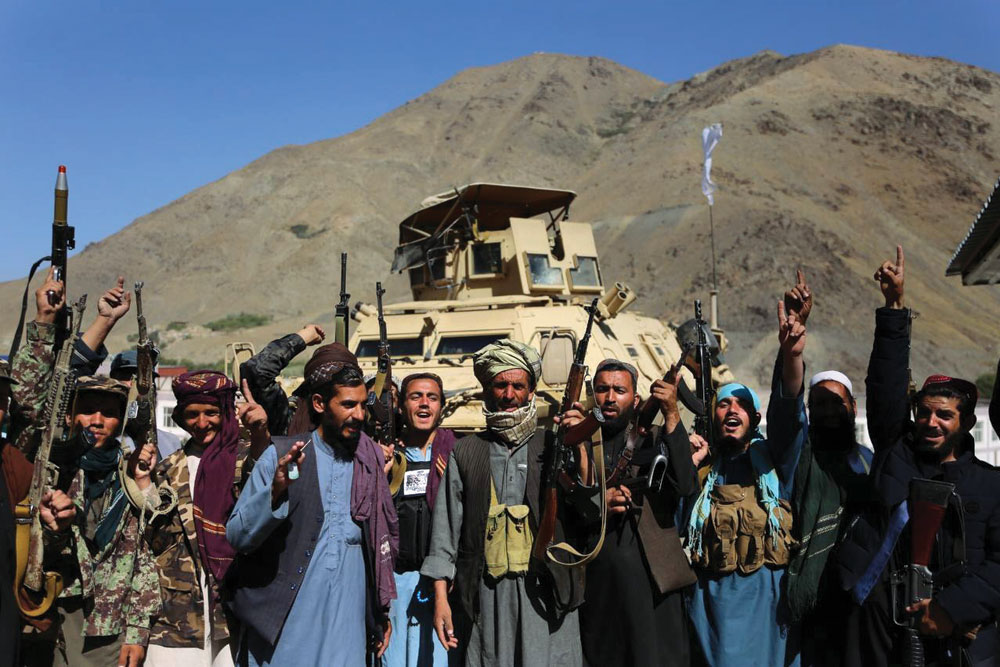
Taliban fighters after taking over the mouth of the Panjshir Valley, September 6 (Photo: Getty Images)
Against this background, the Taliban must be deterred, not emboldened. But the Biden administration, not content with having indirectly armed the Taliban with billions of dollars worth of US-made weapons, is seeking to build a partnership with this terrorist militia.
In the first ever case of a terrorist organisation acquiring an air force and sophisticated land-based capabilities, troves of US-made weapons, helicopters, planes and armoured vehicles have fallen into the Taliban’s hands. The most sophisticated weapons probably have already been transported to Pakistan for likely deployment against India. Taliban patrols are now using some of the other US-made weapons. The Taliban could transfer some weapons to Pakistani jihadists operating from Afghanistan.
Biden, seeking to blunt the torrent of bipartisan criticism at home, has bragged that he ended “the longest war in American history”. With Afghanistan now set to become a haven for transnational terrorists, the US role has merely paused. But the damage to America’s credibility and the global war on terror cannot be undone.
NEGLECTED LESSONS OF 9/11
The Afghanistan war did not start in 2001 after the 9/11 attacks. As Columbia University’s Jeffery Sachs has explained, “The Afghanistan war started 42 years ago, in 1979, when President Jimmy Carter’s administration covertly supported Islamic jihadists to fight a Soviet-backed regime. Soon, the CIA-backed mujahideen helped to provoke a Soviet invasion, trapping the Soviet Union in a debilitating conflict, while pushing Afghanistan into what became a forty-year-long downward spiral of violence and bloodshed.”
With the 9/11 attacks, however, the chickens came home to roost. The attacks profoundly shook the US. But did the US draw the appropriate lessons from 9/11 and halt further training and arming of jihadists by CIA?
Then-US Secretary of State Hillary Clinton candidly said in an ABC News interview in November 2010 that the US was paying the price for creating Al Qaeda. “Part of what we are fighting against right now, the United States created. We created the mujahideen force against the Soviet Union. We trained them, we equipped them, we funded them, including somebody named Osama bin Laden. And then when we finally saw the end of the Soviet Army crossing back out of Afghanistan, we all breathed a sigh of relief and said, okay, fine, we’re out of there. And it didn’t work out so well for us,” she said.
Yet, less than a year after that interview, then-US President Barack Obama, with Hillary Clinton’s active encouragement, helped turn Libya into a failed state by toppling ruler Muammar Gaddafi. Obama also started an air war in Syria—his presidency’s seventh military campaign in a Muslim nation and one that consumed his remaining term in office.
Less known is that the Obama-ordered CIA covert war in Syria ended up creating ISIS, even if inadvertently. As Trump put it, “Obama and Hillary created ISIS.”
Against this background, is it any surprise that in the period since America launched the global war on terror in 2001 under Obama’s predecessor, George W Bush, the scourge of international terrorism has only spread deeper and wider in the world? Jihadist forces extolling terror as a sanctified tool of religion have gained ground in a number of countries. And once-stable nations such as Iraq, Syria and Libya have become anarchic, crumbling states and new hubs of transnational terrorism, even as Pakistan has remained “ground zero” for the international terrorist threat.
The first lesson is to keep the focus on longer-term goals. Terrorism can be stemmed only through a concerted and sustained international campaign that targets terrorist cells and networks wherever they exist and as long as they exist
The lessons of 9/11 were obvious, but successive US governments ignored them. The Biden administration is doing the same.
The first lesson is to keep the focus on longer-term goals and not be carried away by political convenience and narrow objectives. Terrorism can be stemmed only through a concerted and sustained international campaign that targets terrorist cells and networks wherever they exist and as long as they exist. The US cannot afford to draw distinctions between good and bad terrorists and between those who threaten its security and those who threaten others. The viper reared against one country is a viper against others.
A second lesson is not to turn the war against terrorism into a geopolitical battle to serve one’s strategic interests while ignoring the interests of others, including allies and strategic partners. After launching the global war on terror, President Bush used it to expand US military, diplomatic and energy interests in an unprecedented manner and position American forces in the largest array of nations since World War II—all in the name of fighting terror.
Another lesson is that the problem of and solution to terrorism are linked. Terrorism not only threatens the free, secular world but also springs from the rejection of democracy and secularism. The terrorism-breeding swamps can never be fully drained so long as the societies that rear or tolerate them are not de-radicalised and democratised.
President Biden’s Afghanistan blunder has spawned the greatest victory for terrorists in the modern history of global jihadism. Notwithstanding his claim in a defiant speech on Tuesday that the exit from Afghanistan will allow the United States to counter China and Russia, Biden knows that the Afghan security and humanitarian catastrophe he unleashed has weakened his hand against America’s adversaries.
In fact, the U.S. defeat and humiliation in Afghanistan, while highlighting the irreversible decline of American power, have created greater space for China’s assertive global expansion, for Russia’s geopolitical ambitions in the former Soviet republics of Central Asia and for Iran’s continued defiance. The calamitous U.S. withdrawal also threatens to destabilize the wider region extending across the Indian subcontinent.
The Taliban’s victory over the “Great Satan,” meanwhile, is inspiring other Islamist and terrorist groups across the world. By serving as an unparalleled recruiting boost, it is promising to deliver the rebirth of global terror.
Biden not only facilitated the Taliban’s sweep of Afghanistan but also is now seeking to strike a Faustian bargain with this Pakistan-reared terrorist militia. Biden kept his promise to the Taliban, including a complete U.S. withdrawal by Aug. 31, but not his word to U.S. allies in Afghanistan or to partner countries.
Historians will be flummoxed that the world’s mightiest power expended considerable blood and treasure in a two-decade-long war to ultimately help its enemy ride triumphantly back to power.
This is a watershed moment that will go down in history books as marking the beginning of the end of American preeminence. After the way the U.S. betrayed the elected Afghan government, other allies can scarcely rely on Washington to support them when the chips are down. The erosion of American credibility will cause lasting damage to the interests of the U.S. and its friends.
America’s close partner India, with its location right next to the Afghanistan-Pakistan belt, is likely to be one big loser from Biden’s Afghan debacle. The rejuvenated epicenter for terrorism next door will leave India less space to counter an expansionist China. Nuclear-armed titans China and India have been locked in a Himalayan military confrontation for the past 16 months following Chinese border encroachments.
The void created by America’s retreat is a strategic boon for China, which will now shore up its interests in mineral-rich Afghanistan and deepen its penetration of Pakistan, Iran and Central Asia. The retreat will also embolden Chinese President Xi Jinping’s expansionism.
Indeed, Biden may have made Taiwan Xi’s next target by acknowledging, “This decision about Afghanistan is not just about Afghanistan. It’s about ending an era of major military operations to remake other countries.” The statement conveys a great deal about U.S. objectives and resolve. No wonder Taiwanese President Tsai Ing-wen, responding to Chinese warnings that the U.S. will abandon it like Afghanistan, declared, “Taiwan’s only option is to grow stronger … It is not our option to do nothing and only rely on others for protection.”
Illustrating his weakened position, Biden has just bowed to China’s demand to stop tracing the origins of the COVID-19 virus by announcing that the intelligence inquiry he ordered has ended, even though the probe failed to uncover the genesis of the world’s worst public-health catastrophe in more than a century. By not extending the inquiry’s 90-day deadline, Biden, in effect, is letting China get away scot-free over its cover-up of the virus’s origins.
The president could have ordered the U.S. intelligence community to keep searching for the true origins of the virus until a definitive conclusion was reached. Instead, as if to underline that he can ill-afford a crisis in relations with China at this stage, Biden has pleaded with a recalcitrant Beijing “to cooperate with the World Health Organization’s Phase II evidence-based, expert-led determination into the origins of COVID-19.” But China, as the intelligence inquiry’s declassified summary states, “continues to hinder the global investigation, resist sharing information and blame other countries, including the United States.”
Had Biden extended the term of the inquiry, it would have scuttled the ongoing effort to set up a meeting between him and Xi on the sidelines of the G20 Rome summit in October. To make matters worse, Biden’s Afghan disaster has undercut U.S. leverage to pressure China to share information relevant to determining the virus’s origins, including lab records, clinical samples and raw health data from the earliest COVID-19 cases.
The upcoming 20th anniversary of the 9/11 attacks should be an occasion to reflect on how the U.S., by facilitating the terrorist takeover of Afghanistan, has made its homeland and its friends less safe. The seeds of another 9/11 may have been sown.
One forgotten lesson of 9/11 is that the U.S. must not draw specious distinctions between “good” and “bad” terrorists. The Biden administration, while quick to blame a local ISIS affiliate for the Kabul airport massacre, has sought to build a partnership with the Taliban, including, strangely, on “counterterrorism,” as Secretary of State Antony Blinken acknowledges. It has also refrained from striking Black Hawk helicopters and other U.S.-made assets parked in the open at Afghan bases.
In the first ever case of a terrorist organization acquiring an air force and sophisticated land-based capabilities, troves of U.S.-made weapons, helicopters, planes and armored vehicles worth many billions of dollars have fallen into the Taliban’s hands. The terrorist capture of Afghanistan will come back to haunt U.S. security sooner or later.
Brahma Chellaney is a geostrategist and the author of nine books, including the award-winning “Water: Asia’s New Battleground” (Georgetown University Press).





 Soldiers set up barricades in Yangon on Feb. 15: military rule is nothing new to Myanmar, © NurPhoto/Getty Images

 Stagecraft and Statecraft
You must be logged in to post a comment.