Biden’s Dangerous Embrace of Pakistan

The Biden administration could have used Pakistan’s economic crisis to compel the country to sever its longstanding ties to terrorist groups. Instead, the US continues to protect and reward it, putting short-term geopolitical considerations ahead of long-term interests.
By Brahma ChellaneyProject Syndicate

The United States rarely learns from its mistakes, because it suffers from what the late political scientist Hans Morgenthau called “strategic narcissism.” Each US president seems to believe the world is waiting for American direction and devises policies based on this flawed assumption.

For example, President Joe Biden seems determined to repeat past blunders by resuming America’s coddling of Pakistan. Successive US presidents have failed to appreciate that America’s longstanding partnership with Pakistan’s rogue Inter-Services Intelligence agency has allowed Pakistan to institutionalize terrorism by employing armed jihadists in low-intensity asymmetric warfare against neighboring countries. For example, Pakistan has always sought to colonize Afghanistan by installing a regime that would do its bidding, so the ISI created the Taliban in the early 1990s. With the Taliban back in control after the ISI engineered America’s humiliating defeat in Afghanistan, Pakistan has gotten its wish.

Pakistan itself has become an extremist mecca that hosts multiple United Nations-designated terrorist entities. The US found al-Qaeda founder Osama bin Laden – the mastermind behind the worst terrorist attack in American history – living next to the Pakistan Military Academy. Other 9/11 plotters – including Khalid Sheikh Mohammed, al-Qaeda’s third in command, and Abu Zubeida, the network’s operations chief – were also captured in Pakistan. And yet, despite its terrorist ties, Pakistan’s politically powerful military, including its ISI, has managed to get off scot-free.

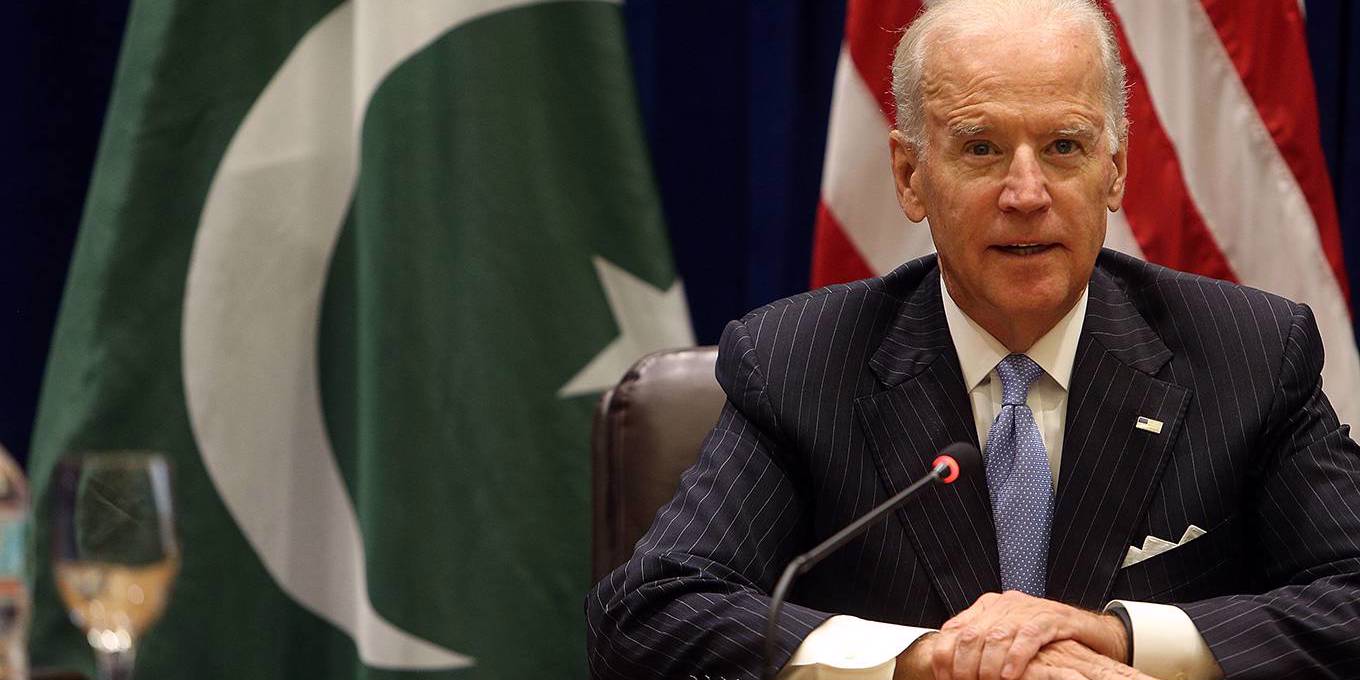
On the recent 21st anniversary of the 9/11 attacks, Biden pledged to continue monitoring and disrupting terrorist activities “wherever we find them, wherever they exist,” while noting that it took “ten years to hunt down and kill Osama bin Laden.” Yet, disturbingly, Biden has reversed the policy of his predecessor, Donald Trump, to keep Pakistan at arm’s length until it ended its unholy alliance with terrorist organizations.

Biden could have taken advantage of Pakistan’s desperate need for an International Monetary Fund bailout to compel it to sever its links with state-backed terrorist groups. Instead, his administration recently helped the country stave off an imminent debt default by securing the IMF board’s approval for the immediate disbursement of a $1.1 billion aid package.

This is not the only leverage over Pakistan that the Biden administration has been reluctant to use. With American and Chinese support, Pakistan is close to exiting the “gray list” of the Paris-based Financial Action Task Force (FATF), the Paris-based inter-governmental agency combating terrorist financing and money laundering. The fact that Pakistani authorities have not addressed the reason their country was placed on that list in 2018 – tolerating terrorist financing – appears to matter little. In fact, Pakistan should have been placed on the FATF’s most punitive “black” list, a status that usually invites Western sanctions. But American troops were fighting the Taliban at the time, and the US, seeking to moderate Pakistan’s approach to Afghanistan, successfully lobbied against it.

Nothing better illustrates Biden’s embrace of Pakistan than the $450-million deal unveiled this month to modernize the cash-strapped country’s US-supplied F-16 fleet, despite the risk that it might harm America’s close strategic relationship with India. For decades, the US had armed Pakistan to the teeth, a role subsequently taken over by China as a maneuver against India. The F-16s were given to Pakistan as a reward for its serving as the staging ground for the covert US war against the Soviet forces occupying Afghanistan in the 1980s, when Pakistan also launched its nuclear-weapons program clandestinely. Pakistan’s four active F-16 squadrons remain central to its air-warfare plans against India; in fact, some were involved in a February 2019 skirmish across the Line of Control in Kashmir.

The US justified the deal by disingenuously claiming that equipping Pakistan’s F-16s with cutting-edge avionics would advance counterterrorism. But the move – announced without warning India, which was hosting senior US officials at the time – will likely renew skepticism toward the US among Indian officials. Biden has said nothing about China’s 28-month-long frontier aggression against India, and his State Department chose to remain neutral by urging the two powers to find “a peaceful resolution.” By strengthening Pakistan – China’s client state – the F-16 deal further imperils US-India relations.

Biden’s enthusiastic re-engagement with Pakistan dismisses those who called on the US to punish Pakistan for its pivotal role in the Afghanistan debacle. Far from imposing sanctions or adding Pakistan to the State Department’s list of state sponsors of terrorism, his administration has championed the country as a “major non-NATO ally,” a status conferred on 17 other countries as well – but not India.

This approach should not come as a surprise. The US did not impose sanctions on Pakistan even after it aided and abetted the Taliban’s killing of American soldiers. Instead, the US treated Pakistan as a gatekeeper of its geopolitical interests in the region. America’s weakened position following its Afghan fiasco has only increased its dependence on the ISI, which continues to facilitate the Biden administration’s outreach to the Taliban.

The recent assassination of al-Qaeda leader Ayman al-Zawahiri in Kabul by an American drone strike would not have been possible without US access to Pakistani airspace, which explains Secretary of State Antony Blinken’s commitment to “expanding the US-Pakistan partnership.” But at the heart of this partnership is a Faustian bargain whereby the Biden administration condones Pakistan’s harboring of known terrorists and eases sanctions on the brutal Taliban regime, despite its close ties with al-Qaeda.

The Biden administration’s reluctance to learn from previous US failures ensures that short-term geopolitical considerations will continue to drive American foreign policy, despite the long-term strategic damage to America’s interests. Biden’s approach will nurture a major hub of international terrorism and jihadism, allowing Pakistan to set regional fires while pretending to be a firefighter.

Brahma Chellaney

Brahma Chellaney, Professor of Strategic Studies at the New Delhi-based Center for Policy Research and Fellow at the Robert Bosch Academy in Berlin, is the author of nine books, including Asian Juggernaut; Water: Asia’s New Battleground; and Water, Peace, and War: Confronting the Global Water Crisis.

© Project Syndicate, 2022.

The Quad is at risk of losing its strategic focus

Biden is saddling the group with a distracting global agenda

Brahma Chellaney, Nikkei Asia

Quad leaders chat in Tokyo on May 24: Joe Biden has coaxed the group into adopting an expansive agenda. © Reuters

Can the Indo-Pacific region be America’s top priority if U.S. President Joe Biden is deepening commitments and resources for Europe and the Middle East?

This question is central to the future of the Quad, the strategic coalition of leading Indo-Pacific democracies comprising India, Australia, Japan and the U.S.

High-level Quad meetings, like last week’s senior officials’ gathering in New Delhi, are becoming more frequent. The group’s four national leaders alone have held four summit meetings since Biden took office in January 2021.

The accelerating tempo of meetings, though, can obscure the fact that the Quad faces important challenges, including establishing a clear strategic mission in the Indo-Pacific region, a sprawling area shaping up as the world’s economic and geopolitical hub. The Quad may have been designed to serve as a bulwark against Chinese expansionism, but Biden has coaxed the group into adopting an expansive agenda.

To be sure, the Quad has steadily gained strength since it was resurrected in 2017 from a decadelong dormancy. Chinese Foreign Minister Wang Yi famously mocked the Quad in 2018 as a “headline-grabbing idea” that will dissipate “like the sea foam in the Pacific or Indian Oceans.” But China’s increasingly muscular policies have helped the Quad to build momentum.

The waters of the Indo-Pacific have become an arena of competition for resources and geopolitical influence, which explains the Quad’s emphasis on the maritime domain. Indeed, as underscored by current concerns over Taiwan and the East and South China Seas, future Indo-Pacific crises are likely to be triggered at sea.

The Quad has also been catalyzed by the threat of an illiberal hegemonic regional order, which would pose significant risks to international security and global markets. The free and open Indo-Pacific vision driving the Quad was originally set out by Shinzo Abe, the late Japanese prime minister, and has since become shorthand for a rules-based, liberal order.

The Quad’s future, however, is fundamentally tied to American policies. U.S. Defense Secretary Lloyd Austin in June called America’s commitment to the Indo-Pacific region “the core organizing principle of American national-security policy.”

It is “our priority theater of operations,” “the heart of American grand strategy” and “our center of strategic gravity,” Austin declared.

However, Russia’s invasion of Ukraine and the ensuing hybrid war effort led by the U.S. against Moscow are distracting America from growing Indo-Pacific challenges. America’s new strategic focus on Europe and force deployments there — along with the rise of a more robust NATO, which has named Russia as its primary adversary and China as just a “challenge” — make it harder for the U.S. to genuinely pivot to the Indo-Pacific.

In fact, as the U.S. gets more deeply involved in a proxy conflict with Russia, including supplying offensive weapons and battlefield intelligence to Ukraine, the Quad faces new uncertainties. Biden is the third straight president to commit to shifting America’s primary strategic focus to Asia and the wider Indo-Pacific. But Biden’s expressed belief that the Ukraine “war could continue for a long time” suggests that he too could fail, as Donald Trump and Barack Obama did.

The new cold war with Moscow, meanwhile, is constraining Biden from taking a tough line toward Beijing, lest it help cement the nascent China-Russia axis. China, with an economy 10 times larger than Russia’s, has the capacity to seriously undercut Western sanctions against Moscow and bail out the Russian economy. All this is reinforcing the more conciliatory approach toward Beijing that Biden has pursued since taking office.

Against this backdrop, it is scarcely a surprise that the Quad’s security agenda has begun to take a back seat.

In fact, Biden has saddled the Quad with an increasingly global agenda that dilutes its Indo-Pacific strategic focus. Biden’s Indo-Pacific strategy, as unveiled in February, confirmed the Quad’s shift toward universal challenges, from global health security and climate change to cybersecurity, resilient supply chains and green shipping.

As a small group, the Quad is in no position to deal with global challenges. Yet having launched six separate working groups on climate change, COVID-19 vaccines, critical and emerging technologies, cybersecurity, infrastructure and space, the Quad is getting weighed down by an overly ambitious agenda, crimping its ability to produce results.

The danger of overcommitting and underdelivering has been highlighted by the difficulties encountered by the Quad in supplying 1 billion Indian-manufactured COVID-19 vaccine doses to the developing world by year-end as promised. Even with the support of all four members, the Quad is set to fall far short of its vaccine pledge.

Meanwhile, as the U.S. pours military resources into Europe and the Middle East, the geostrategic dynamics are changing rapidly in the Indo-Pacific, where China is working quietly to eclipse America militarily and economically. The bulk of U.S. economic and military assistance still goes to the Middle East, even as the U.S. prioritizes NATO in order to dominate European security.

The paradox in this situation is that the Quad is becoming stronger through greater engagement among its leaders and senior officials, yet the group appears in danger of losing its strategic vision and purpose. Unless its member states imbue the Quad with a clear strategic direction and meaning, it could become a showpiece or a mere U.S. tool of leverage with Beijing.

Before critics pummel the Quad for being all bark and no bite, the group must refocus its attention on the strategic challenges in the Indo-Pacific region.

Brahma Chellaney is professor emeritus of strategic studies at the Centre for Policy Research in New Delhi and a former adviser to India’s National Security Council. He is the author of nine books, including “Water: Asia’s New Battleground.”

China’s cost-free gulag for Muslims

BY BRAHMA CHELLANEY, The Hill

Guard towers stand on the perimeter wall of the Urumqi No. 3 Detention Center in Dabancheng in western China’s Xinjiang Uyghur Autonomous Region on April 23, 2021. China’s discriminatory detention of Uyghurs and other Muslims in the western region of Xinjiang may constitute crimes against humanity, the U.N. human rights office said in a long-awaited report released on Aug. 31, 2022. (AP Photo/Mark Schiefelbein, File)

China’s prolonged detention of more than 1 million Muslims in Xinjiang represents the largest mass incarceration of people on religious grounds since the Nazi era. Yet, disturbingly, China has incurred no international costs.

Chinese President Xi Jinping, the brain behind the scheme, and his inner circle have faced no consequences for sustaining the Muslim gulag since at least March 2017. Despite two successive U.S. administrations describing the unparalleled repression in Xinjiang as “genocide” and “crimes against humanity,” Western actions against China have largely been symbolic.

The just-released report on Xinjiang by the United Nations’ human rights office cites serious human-rights violations there and recommends that Beijing take “prompt steps to release all individuals arbitrarily deprived of their liberty” in that sprawling ethnic-minority homeland.

Yet this report, paradoxically, is a fresh reminder that China has escaped scot-free, with little prospect that it will be held to account for its mass internment of Muslim minorities, including expanding detention sites in Xinjiang since 2019. The Xinjiang repression also includes forced sterilization and abortion, torture of detainees, slave labor and draconian curbs on freedom of religion and movement.

The report’s release came after nearly a yearlong delay and just minutes before the four-year term of Michelle Bachelet, the U.N. high commissioner for human rights, ended. U.N. investigators had compiled the Xinjiang report almost a year ago, but Bachelet kept stalling its release, despite growing pressure from Western countries.

In May, after lengthy discussions with Beijing on arrangements, Bachelet undertook a controversial official visit to China, the first by a U.N. high commissioner for human rights since 2005. During her tenure, Bachelet – a former Chilean president and political detainee under dictator Augusto Pinochet – stayed mum on the Chinese repression in Xinjiang (and Tibet). She said nothing on the crackdown in Xinjiang even when she briefly visited that region during her restrictive China tour, which glossed over abuses by Xi’s regime.

Bachelet had earlier acknowledged that she was under “tremendous pressure” over the report, with China asking her to bury it. The eventual release of the report, minutes before Bachelet’s retirement at midnight on Aug. 31, indicated that she did not want her successor or temporary replacement to take credit for publishing it. Failing to release the report would have left a glaring black mark on her tenure.

Days before her retirement, Bachelet sent a copy of the report to Beijing because, as she explained in a Sept. 1 statement, she “wanted to take the greatest care to deal with the responses and inputs received from the (Chinese) government last week.” In response to the 48-page U.N. assessment, China wrote a 131-page rebuttal, with its foreign ministry calling the report a “farce.”

China has been emboldened by the international community’s indifference and indulgence. It successfully hosted the 2022 Winter Olympics, probably the most divisive games since the 1936 Berlin Summer Olympics, which helped strengthen the hands of Germany’s Adolf Hitler.

Underscoring China’s growing economic power and geopolitical clout, even Muslim countries, by and large, have remained shockingly silent on the Xinjiang repression. As if that weren’t bad enough, the 57-nation Organization of Islamic Cooperation in March honored Chinese Foreign Minister Wang Yi as a speaker at its foreign ministers’ forum in Pakistan.

Xi’s Muslim gulag has made a mockery of the 1948 Genocide Convention, to which China acceded in 1983 (with the rider that it does not consider itself bound by Article IX, the clause allowing any party in a dispute to lodge a complaint with the International Court of Justice). The Genocide Convention requires its parties, which include the United States, to “prevent and punish” acts of genocide.

Chinese authorities have subjected Uyghur and other Muslim groups in Xinjiang, including ethnic Kazakhs and Kyrgyz, to Orwellian levels of surveillance and control over many details of life. As Secretary of Commerce Gina M. Raimondo warned, China is weaponizing biotechnology to “pursue control over its people and its repression of members of ethnic and religious minority groups.”

The Xinjiang repression is aimed at indoctrinating not just political dissidents and religious zealots but entire Muslim communities by imposing large-scale deprogramming of Islamic identities. A gulag archipelago of 380 internment camps (or “reeducation hospitals,” as Beijing calls them) has become integral to this larger assault on Islam.

It is against this background that the carefully worded U.N. report warns that, “The extent of arbitrary and discriminatory detention of members of Uyghur and other predominantly Muslim groups … and deprivation more generally of fundamental rights enjoyed individually and collectively, may constitute international crimes, in particular crimes against humanity.” The report cited “patterns of torture or other forms of cruel, inhuman or degrading treatment or punishment” in the detention centers, including “credible” allegations of sexual violence.

The U.N. report may carry the imprimatur of the world’s only truly universal organization and its member states, yet China was quick to pour scorn on it. Just as it rubbished a 2016 international arbitral tribunal ruling that invalidated its territorial claims in the South China Sea, China ridiculed the U.N. report, calling it a pack of “disinformation and lies.”Could long COVID finally make us take chronic pain seriously?It’s crucial to reintegrate Taiwan into the ICAO

The 1945-46 Nuremberg Military Tribunal, set up after Germany’s surrender in World War II, prosecuted those involved in crimes against humanity, the same crimes now being perpetrated in Xinjiang. Yet, with China a rising power, there seems little prospect that Chinese officials behind the Muslim gulag will face similar justice.

Indeed, just as China responded to the tribunal’s ruling by accelerating its expansionism in the South China Sea, including militarizing the region, it could step up its repression in Xinjiang until it manages to fully Sinicize and tame Muslim groups.

Brahma Chellaney is a geostrategist and the author of nine books, including the award-winning “Water: Asia’s New Battleground” (Georgetown University Press). Follow him on Twitter @Chellaney.