The nuclear arms race is back, and it’s testing US power

Featured

By Brahma Chellaney, The Hill

A Yars intercontinental ballistic being test-fired in 2022 as part of Russia’s nuclear drills. (AP)

One of the least-discussed but most consequential outcomes of the resurgence of major-power rivalries is the return of nuclear weapons to the center of international politics.

The global salience of nuclear weapons — once expected to diminish after the Cold War — is instead rising sharply. This revival is testing U.S. power at a moment when Washington faces a more complex and fragmented strategic landscape than at any time since the dawn of the nuclear age.

The problem is not just that nuclear arsenals are expanding. It is also that the geopolitical environment that once helped manage nuclear risks has eroded.

Advances in non-nuclear strategic technologies — including precision-guided conventional strike systems, cyberwarfare, anti-satellite weapons and layered missile defenses — are driving nuclear-armed states to harden, diversify and enlarge their arsenals to ensure survivable second-strike capabilities. At the same time, regional flashpoints — from Ukraine to the Taiwan Strait to the Korean Peninsula — heighten the risk of escalation through miscalculation or coercion.

No shift is more momentous than China’s sweeping peacetime military expansion — the most ambitious in modern history. Its naval output alone now surpasses the combined production of U.S. and Soviet shipyards at the height of the Cold War. Even more troubling is its frenzied nuclear buildup: China has more than doubled its nuclear-weapons stockpile in just five years and is on track to field as many deployed warheads as the U.S. by the mid-2030s.

Determined to supplant the U.S. as the world’s leading power, China is not only expanding but diversifying its nuclear arsenal. The aim is to give Beijing an expanded set of coercive tools and create new escalation pathways. In effect, China has already diluted its own longstanding “no first use” nuclear pledge. Few now view that declaratory policy as credible.

Although China’s nuclear surge is framed domestically as defensive, its purpose extends beyond deterrence. Beijing’s growing arsenal enables it to pursue coercive territorial and strategic objectives — from the South and East China Seas to the Himalayas. The implications for U.S. extended deterrence, especially in the Indo-Pacific, are profound.

Russia, meanwhile, has turned to nuclear weapons as the principal currency of its great-power status amid economic stagnation.

Its modernization program includes novel, destabilizing systems such as the nuclear-powered Burevestnik cruise missile and Poseidon underwater drone. These exotic weapons are explicitly designed to circumvent U.S. missile defenses. The Ukraine war has visibly increased the importance — and the coercive utility — of nuclear weapons in Russian strategy.

The combined nuclear expansions of China and Russia pose a challenge the U.S. has never confronted before: deterring two peer or near-peer nuclear adversaries simultaneously. During the Cold War, Washington could focus its strategic posture on a single rival, the Soviet Union. Today, the geometry is tripolar, and far more complex.

To make matters worse, the arms-control framework that provided essential guardrails for decades has nearly collapsed. Russia and the U.S. have withdrawn from key agreements, with Moscow recently suspending its participation in the New START Treaty and also withdrawing its ratification of the Comprehensive Test Ban Treaty. China, for its part, refuses to enter any arms-control negotiation that might cap its rapidly rising arsenal.

The result is a world sliding toward an unconstrained arms race, with fewer safety valves and greater risks of miscalculation.

This shifting balance reverberates through America’s alliance system. Allies who depend on the U.S. nuclear umbrella — particularly Japan, South Korea, Australia and NATO’s eastern members — are increasingly anxious about whether Washington would risk a nuclear exchange with China or Russia to defend them. Their concern is not theoretical: The simultaneous growth of Chinese and Russian nuclear prowess creates the very scenario U.S. strategists long feared — deterrence stress in multiple theaters.

As credibility questions grow, so does the risk of allied nuclear proliferation. If countries with advanced nuclear fuel cycles come to doubt long-term U.S. protection, they may seek independent deterrents. The Nuclear Non-Proliferation Treaty is already strained by the modernization programs of nuclear-weapon states. Moreover, the U.S. bombing of Iranian nuclear sites earlier this year — while successful tactically — may deepen incentives for clandestine nuclear development elsewhere.

The U.S. now faces a stark reality: It must modernize its nuclear forces, reassure anxious allies, deter two nuclear peers and revive some form of strategic dialogue — all while preventing a ruinous arms race.

America’s challenge is to maintain credible deterrence across two theaters without overextending U.S. conventional forces. That pressure may tempt Washington to rely more heavily on nuclear weapons to compensate for shrinking force-projection margins vis-à-vis China in the Indo-Pacific and Russia in Europe. Such a shift would mirror the very trends that have made nuclear weapons so prominent in Russian and Chinese strategies.

In this volatile environment, risk-reduction mechanisms are essential. The world needs updated norms for emerging technologies — particularly artificial intelligence, hypersonic delivery systems and dual-use cyber capabilities — that could compress decision time or introduce new uncertainties in nuclear command and control.

Ensuring that nuclear-use authority remains fully under human control is no longer simply a normative concern; it is becoming a strategic imperative in the age of AI.

Brahma Chellaney is a geostrategist and the author of nine books, including the award-winning “Water: Asia’s New Battleground.”

Posted in WMD

Trump’s nuclear test order projects toughness — and sows confusion

Featured

By Brahma Chellaney, The Hill

AP Photo/Evan Vucci

Was President Trump’s recent directive to resume U.S. nuclear testing — after a hiatus of 33 years — an actual policy decision? Or was it a political stunt to project toughness?

His surprise announcement stirred Cold War echoes and revived the old fears of Armageddon and “mutually assured destruction” that once defined nuclear deterrence.

The U.S. last conducted a full-scale nuclear explosion in 1992. Russia stopped doing them in 1990, China in 1996. Those moratoria paved the way for the 1996 Comprehensive Test Ban Treaty to prohibit all nuclear testing.

Although the treaty never formally entered into force, it has established a powerful international norm. Nations have gained confidence that any nuclear detonation would be quickly detected. Since the treaty opened for signature, no country other than North Korea has carried out a nuclear explosion — and even Pyongyang has maintained a self-declared moratorium since 2018.

Yet Trump told reporters aboard Air Force One, while returning from South Korea, that he had decided to restart testing.

“We’ve halted it many years ago,” he said. “But with others doing testing, I think it is appropriate that we do also.” On Truth Social, he posted: “Because of other countries’ testing programs, I have instructed the Department of War to start testing our nuclear weapons on an equal basis. That process will begin immediately.”

The announcement raised immediate alarms — and eyebrows. For one thing, nuclear testing is not the Pentagon’s responsibility, but that of the Department of Energy’s semi-autonomous National Nuclear Security Administration, which oversees the design, production and stewardship of America’s nuclear arsenal. Trump’s reference to the War Department thus hinted at his unfamiliarity with the institutional framework governing nuclear weapons.

His vaguely worded vow to test “on an equal basis” with geopolitical rivals baffled security officials. And his boast that the U.S. has “more nuclear weapons than any other country” was flatly wrong — Russia has several hundred more.

Then came more mixed messages. In a “60 Minutes” interview, Trump spoke of denuclearization while simultaneously accusing Russia, China, North Korea and even Pakistan — whose only tests were conducted in 1998 — of “testing nuclear weapons.” Having confirmed his intention to resume tests, he immediately contradicted himself: “I believe we need to do something about denuclearization, and I have indeed discussed it with both [Russian President Vladimir] Putin and President Xi [Jinping of China].”

The confusion rattled allies and arms control experts alike. Energy Secretary Chris Wright soon intervened to clarify that any U.S. testing would involve not nuclear explosions but “what we call non-critical explosions” — non-explosive subcritical tests that use nuclear materials but stop short of a self-sustaining nuclear fission chain reaction.

In reality, the U.S. has been conducting subcritical tests for decades to ensure the safety and reliability of its weapons stockpile. As Brandon Williams told the Senate during his confirmation hearing as head of the National Nuclear Security Administration, “I would not advise testing, and I think we should rely on the scientific information.”

Beyond politics, there are hard technical obstacles to restarting full-scale explosive tests. Facilities at the Nevada National Security Site have degraded, and the specialized know-how to conduct live detonations has largely vanished after decades of reliance on supercomputer modeling and subcritical tests. Launching a live test would take months, if not years — making Trump’s call for “immediate” testing technically impossible.

Trump’s announcement appeared to stem partly from anxiety over recent Russian and Chinese developments. Moscow recently claimed to have tested two exotic nuclear-powered and nuclear-capable delivery systems — the Burevestnik cruise missile and the Poseidon underwater drone — designed for nearly unlimited range and stealth. Beijing, meanwhile, is racing ahead with a massive nuclear buildup, more than doubling its warhead inventory since 2020 and expanding its missile silos, submarines and bomber fleets. This surge aligns with China’s goal to achieve global primacy by 2049, the centenary of Communist rule.

Against this backdrop, Trump’s abrupt testing directive sent tremors through arms control circles. Even hinting at a return to nuclear testing risks unraveling the global test moratorium. If the U.S. — the principal architect of the test ban treaty — were to abandon restraint, others would likely follow, triggering a destabilizing cascade of nuclear test resumption.

Fortunately, Wright’s clarification defused the immediate crisis, reducing Trump’s order to bluster rather than policy. Still, the episode underscored how impulsive presidential words can reverberate globally, unsettling allies and emboldening adversaries.

Trump’s brand of nuclear showmanship may play well to a domestic audience seeking toughness, but it highlights the perils of improvisation in nuclear policy. In the nuclear age, restraint is not a sign of weakness but a strategic necessity.

History shows that nuclear deterrence rests not only on weapons but on credibility and clarity. When those erode, the risks of miscalculation rise sharply. Trump’s confused directive serves as a reminder that, when it comes to nuclear weapons, even words can be destabilizing — and confusion itself can become a form of danger.

Brahma Chellaney is the author of nine books, including the award-winning “Water: Asia’s New Battleground.”

Posted in WMD

An Iranian Bomb Just Became More Likely

Featured

Military strikes might slow down a nuclear program, but they cannot impose long-term restraint – especially when they are carried out by powers that flout the very rules they claim to be enforcing. The US and Israel are likely to learn this the hard way, as Iran abandons all doubts about pursuing nuclear breakout.

Brahma ChellaneyProject Syndicate

Israel and the United States have dealt punishing blows to Iran’s nuclear infrastructure. “Operation Rising Lion” and “Operation Midnight Hammer” have been portrayed as precision strikes that will stop the Islamic Republic’s nuclear program in its tracks. But whatever the bombings might have achieved tactically, they risk forfeiting strategically, as Iran is now more convinced than ever that nuclear weapons are the only way to deter future aggression and ensure the regime’s survival.

Iran was once brought to the negotiating table through a carefully calibrated mix of pressure and incentives. Despite its imperfections, that approach worked. In 2015, the Joint Comprehensive Plan of Action was agreed, with Iran agreeing to limit its nuclear program in exchange for sanctions relief and other concessions. But – at Israel’s urging and despite Iran’s apparent compliance – Donald Trump abandoned the JCPOA during his first term as president, destroying whatever mutual trust had been built over the course of 20 months of painstaking diplomacy.

Now, despite pursuing new nuclear negotiations with Iran, the US has joined Israel in abandoning strategic patience in favor of spasmodic force. Some argue that Iran invited the attacks by deceiving the international community, stoking regional conflicts, and enriching uranium to levels well beyond those needed for any civilian application. These are legitimate complaints.

Even the International Atomic Energy Agency (IAEA), in a report released just before Israel’s campaign began, raised concerns about Iran’s compliance with its international obligations. Indeed, an analysis of this report by the Institute for Science and International Security argued that “Iran can convert its current stock of 60 percent enriched uranium into 233 kg of [weapon-grade uranium] in three weeks at the Fordow Fuel Enrichment Plant (FFEP), enough for 9 nuclear weapons.” That conclusion may well have lit a fire under the Trump administration.

But the IAEA also concluded that it had “no credible indications of an ongoing, undeclared structured nuclear program” in Iran, while underscoring the urgency of reaching a nuclear deal. “Iran,” the agency warned, “is the only non-nuclear-weapon state in the world that is producing and accumulating uranium enriched to 60%” – just a short technical step away from the 90% purity needed for weapons-grade material.

Even so, US and Israeli decision-makers green-lit attacks on Iranian nuclear sites at Fordow, Natanz, and Isfahan – facilities that are subject to IAEA safeguards and monitored under Iran’s Non-Proliferation Treaty (NPT) commitments. With that, they unraveled the legal and verification framework that exists precisely to prevent weaponization.

Beyond undermining the authority of the IAEA and its inspection regime, the attacks violated the NPT’s principle of peaceful nuclear use (Article IV) and breachedinternational law, including the United Nations Charter. The US, a nuclear superpower with a record of catastrophic wars aimed at regime change, and Israel, a clandestine nuclear-armed state that refuses to sign the NPT, have thus sent an unmistakable message: only the weak follow rules, and only the strong are safe. In fact, as long as you have nuclear weapons, you can violate international law at will. 

This is true not only for major powers, but also for smaller states. Pakistan, for example, nurtures cross-border terrorism and exports proxy war with impunity, threatening nuclear retaliation for anyone who crosses it. This poses a more acute threat to regional peace than Iran’s hypothetical bomb, but the US remains silent. 

This hypocrisy is deeply rooted. It was the US, after all, that aided and abettedPakistan’s covert pursuit of the bomb. Throughout the 1980s and 1990s, successive US administrations ignored mounting evidence that Pakistan was secretly enriching uranium and building nuclear weapons – and continued funneling billions of dollars in aid to the country. The result is a fragile state armed with an “Islamic bomb.” 

Today, with diplomacy derailed, inspections discredited, coercion normalized, and double standards embraced, what tools remain to convince Iran that remaining non-nuclear is wise and strategically viable? After years of debate over the value of a nuclear deterrent – with Supreme Leader Ayatollah Ali Khamenei even issuing religious edicts against nuclear weapons – Iranian decision-makers are almost certain to decide that there is no other way to keep the country safe from attack. 

Iran now has every incentive to exit – or at least limit – the IAEA framework and race toward nuclear breakout. Just as Saddam Hussein took his nuclear program underground following Israel’s 1981 bombing of Iraq’s IAEA-monitored Osirak reactor, Iran is likely to reject transparency and oversight in favor of secrecy and ambiguity. That would not be some dramatic act of defiance, but rather a rational response to a serious – even existential – threat. 

And it is not just Iran. If powerful states can bomb safeguarded nuclear facilities with impunity, why should any country put its faith in the global nonproliferation regime? Any government that wants to avoid the fateof Saddam’s Iraq or Muammar el-Qaddafi’s Libya (or, for that matter, democratic Ukraine), will seek to acquire the bomb – or at least come close enough to keep adversaries guessing. 

The only viable path to nonproliferation is and always will be diplomacy, not destruction. Military strikes might slow down a nuclear program, but they cannot impose long-term restraint – especially when they are carried out by powers that flout the very rules they claim to be enforcing. In the end, Operation Rising Lion and Operation Midnight Hammer may be remembered not as preemptive strikes against Iran’s nuclear breakout, but as catalysts for it.

Brahma Chellaney, Professor of Strategic Studies at the New Delhi-based Center for Policy Research and Fellow at the Robert Bosch Academy in Berlin, is the author of nine books, including Water: Asia’s New Battleground (Georgetown University Press, 2011), for which he won the 2012 Asia Society Bernard Schwartz Book Award.

© Project Syndicate, 2025.

Posted in WMD

Israel’s preemptive war could finally push Iran to go nuclear

Featured

By Brahma Chellaney, The Hill

(AP Photo/Abdolrahman Rafati/Tasnim News Agency): Mourners carry the flag-draped coffins of men who were reportedly killed in Israeli strikes in the city of Asadabad, Iran, on Monday, June 16, 2025.

Israel has long pursued a strategy to remain the Middle East’s sole nuclear-armed state, using military force to preempt or prevent other regional powers from acquiring nuclear-weapons capabilities. But Israel’s strikes on Iran risk backfiring, with a wounded foe more determined than ever to acquire the nuclear bomb. 

Israel’s strategic posture, institutionalized as the “Begin Doctrine” after former Prime Minister Menachem Begin, holds that it will not allow any neighboring state to even approach nuclear-weapons capability. In practice, Israel has expanded this doctrine to block even peaceful nuclear programs under international safeguards.

The Begin Doctrine was first operationalized in 1981 with the bombing of Iraq’s Osirak nuclear reactor, which was built by France for peaceful research and subject to International Atomic Energy Agency inspections. Though Iraq was a party to the Nuclear Non-Proliferation Treaty and had agreed to stringent safeguards extending beyond international inspections to prevent reactor misuse, Israel claimed Baghdad harbored military ambitions and struck preemptively.

The attack, which destroyed the $275 million reactor just before it was to become operational, was carried out with U.S.-supplied F-16 and F-15 aircraft. One French engineer and 10 Iraqi soldiers were killed. The operation triggered minimal diplomatic fallout for Israel, but pushed Saddam Hussein’s nuclear program underground — an outcome that would later lead to the 2003 U.S. invasion and occupation of Iraq under the false pretext of dismantling weapons of mass destruction.

In 2007, Israel again invoked the Begin Doctrine to destroy a suspected nuclear reactor under construction in Syria. The al-Kibar facility was flattened in an airstrike dubbed Operation Orchard. Israeli intelligence claimed the project, allegedly aided by North Korea, had covert military dimensions. The IAEA concluded three years later that the destroyed facility was “very likely” a nuclear reactor under development.

These precedents pale in comparison to Israel’s current military campaign against Iran, dubbed Operation Rising Lion, which aims to wipe out Iran’s nuclear program. The stakes are exponentially higher: Iran is a larger, more capable adversary located beyond Israel’s immediate neighborhood. And unlike Iraq or Syria in decades past, Iran has already accumulated significant nuclear know-how and material.

Prime Minister Benjamin Netanyahu, invoking the Begin Doctrine, claimed that Iran was on the verge of developing nuclear weapons and vowed that Israeli strikes would continue “as long as necessary” to neutralize the threat. But this assertion lacks backing from key intelligence assessments.

On March 25, U.S. Director of National Intelligence Tulsi Gabbard testified that the American intelligence community had assessed that “Iran is not building a nuclear weapon.” However, Gabbard — and the IAEA separately in a recent report — expressed concern over Iran’s stockpile of uranium enriched to 60 percent purity, which, if enriched further to 90 percent, would become weapons-grade material. The IAEA, like Gabbard, concluded there was no evidence of a structured nuclear-weapons program underway.

Yet Israel pressed ahead with its military strikes. Netanyahu’s government, in coordination with the Trump administration, seems to believe that such force will buy leverage at the diplomatic table.

In reality, the attacks are likely to achieve the opposite. Far from forcing concessions, the Israeli strikes have derailed nuclear diplomacy. Tehran has suspended talks indefinitely, accusing Washington of coordinating and authorizing the Israeli operation. This mirrors a pattern from Trump’s first term, when his “maximum pressure” campaign on Iran backfired, hardening Iranian resolve rather than moderating it.

Indeed, if Israel’s goal is to eliminate the Iranian nuclear threat, this strategy may prove deeply counterproductive.

Two key factors make this preemptive war particularly perilous. First, Israel cannot destroy Iran’s nuclear program by military means alone. Tzachi Hanegbi, Netanyahu’s own national security adviser, acknowledged on Israeli television on June 13 that Iran’s program “cannot be destroyed through kinetic means.” A negotiated settlement, he suggested, was the only sustainable option.

But with the collapse of diplomacy and deepening Iranian hostility, Israel may be forcing Iran toward the very nuclear path it wants to prevent. Tehran could emulate North Korea’s playbook: withdraw from the NPT, eject IAEA inspectors and weaponize its nuclear assets at speed. North Korea withdrew from the NPT in 2003 and tested a nuclear bomb just three years later, becoming a de facto nuclear-weapons state.

Iran, heavily sanctioned and increasingly isolated, may now conclude that it has little to lose from following suit. If Iran raises enrichment from 60 percent to 90 percent purity — a short technical leap — it could rapidly convert its uranium stockpile into bomb-grade material. That would mark a historic failure of U.S. and Israeli nonproliferation strategy and hand Tehran the strategic deterrent it long claimed not to seek.

Second, the underlying logic of the Israeli campaign may no longer be about nuclear rollback but rather regime change. Netanyahu has openly called for the fall of the Iranian regime, and Israeli strikes have expanded beyond nuclear and military sites to include economic infrastructure, energy facilities and civilian aviation hubs.

This broadening of war aims could lock Israel into a prolonged military confrontation with Iran — a campaign that could exact heavy human and economic costs. Even before the Iran operation, Israeli society was showing signs of war fatigue, with growing numbers of reservists declining to report for duty.

Meanwhile, U.S. forces are increasingly entangled in the conflict. In defending Israel from retaliatory missile and drone attacks, American troops are already operating in air, land and naval roles. A broader U.S. intervention remains a distinct risk.

Israel has long justified its aggressive posture on existential grounds. Its small size and hostile environment, it argues, require proactive and sometimes disproportionate defense measures. But the line between deterrence and provocation is perilously thin — and it may now have been crossed.

History shows that Israel’s pursuit of short-term tactical victories often undermines its long-term strategic interests. The Osirak attack contributed to decades of conflict in Iraq. The al-Kibar strike delayed but did not eliminate Syria’s nuclear ambitions. And now, Operation Rising Lion could go down as the moment when Israel’s policy of preemption made an Iranian bomb inevitable.

Israel remains the Middle East’s preeminent military power, possessing not only superior conventional forces but also undeclared nuclear weapons. That should afford it the confidence to pursue measured strategies.

Instead, by trying to preserve its nuclear monopoly through force, Israel risks fueling the very proliferation spiral it has long sought to prevent.

Brahma Chellaney is a geostrategist and the author of nine books, including the award-winning “Water: Asia’s New Battleground.”
Posted in WMD

The wartime legacies of Hiroshima and Nagasaki haunt humanity

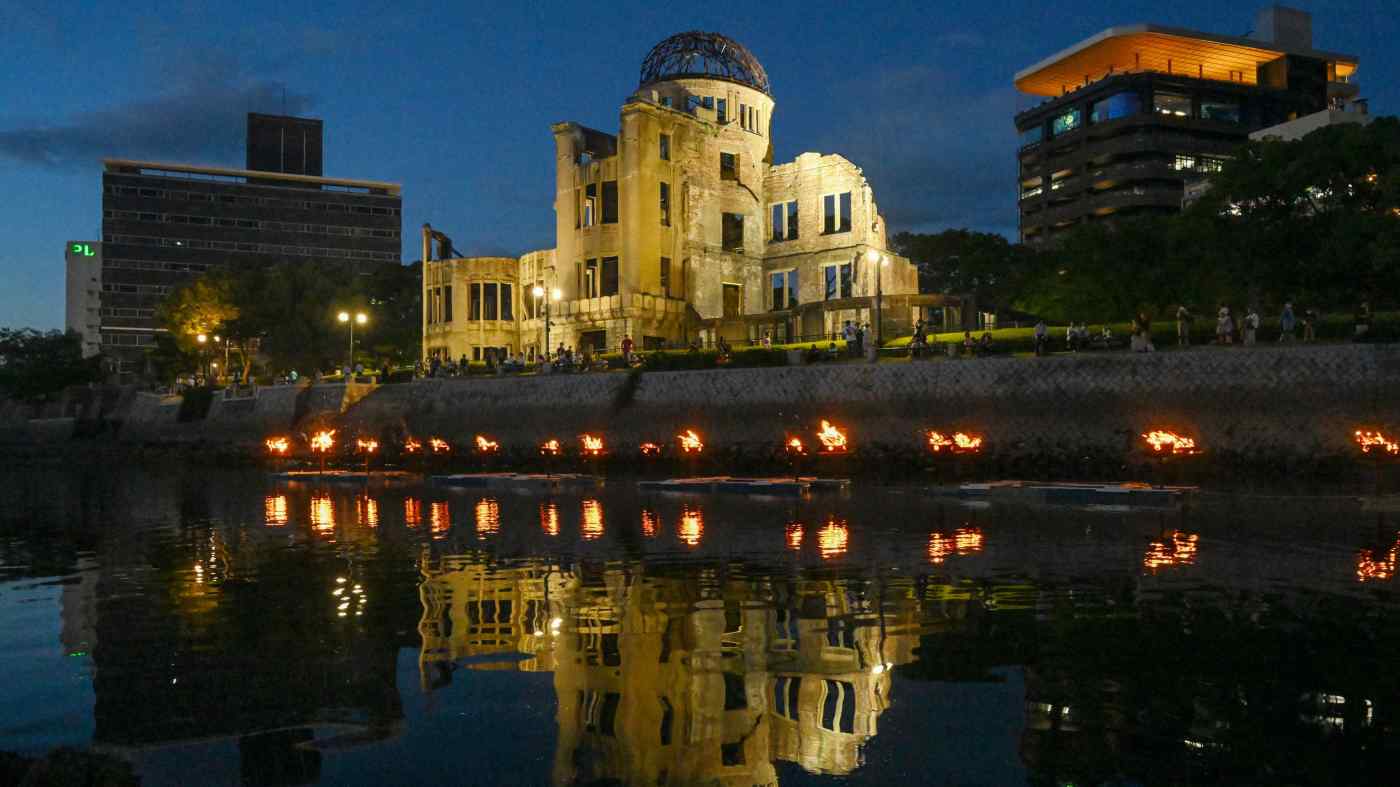
The Atomic Bomb Dome in Hiroshima on Aug.5, eve of the 78th anniversary of the U.S. nuclear attack: Japan was already essentially defeated before the city was destroyed. (Photo by Yo Inoue)

Atomic bombings were more about demonstrating power than securing surrender

Months before the twin atomic attacks, it had become clear that the issue was not whether Japan would surrender but when. America’s own Strategic Bombing Survey concluded in 1946 that “Japan would have surrendered even if the atomic bombs had not been dropped.”

Brahma Chellaney, Nikkei Asia

The Hollywood blockbuster “Oppenheimer” carries the somber message that the nuclear age may have doomed us all.

The biopic about American physicist J. Robert Oppenheimer, the “father of the atomic bomb,” has renewed international attention around the morality and military necessity of the nuclear attacks on the Japanese cities of Hiroshima and Nagasaki 78 years ago.

Why the first and only use of atomic weapons occurred is still something of a vexed question, especially because Japan was already essentially defeated before Hiroshima was destroyed. Japan was then under a crippling sea and air blockade and conventional U.S. firebombing air raids were devastating its major cities.

Years later, plagued by guilt, the real Oppenheimer acknowledged that the bomb on Hiroshima was used “against an essentially defeated enemy.”

The U.S. may have won the war before the Hiroshima bombing but it was not content with defeating Japan. It sought Japan’s unconditional surrender.

Decades later, there is still no definitive answer as to why the U.S. attacked Nagasaki with a nuclear weapon just three days after Hiroshima’s destruction and before Japan had time to fully grasp the strategic implications of the first atomic attack.

Even if the Hiroshima bombing was justifiable as a way to force Japan to surrender, what military purpose did the precipitous second attack serve?

Telford Taylor, who served as chief prosecutor at the Nazi war crime trials in Nuremberg, Germany, said, “The rights and wrongs of Hiroshima are debatable, but I have never heard a plausible justification of Nagasaki.”

The unstated justification, I would argue, had little to do with Nagasaki itself. Rather, the administration of U.S. President Harry S. Truman judged the bombing as necessary to fully demonstrate America’s new destructive powers.

Truman, who took office in April 1945 days before Nazi dictator Adolf Hitler committed suicide, gave Japan no firm deadline to surrender before rushing into the second atomic strike. No warning was given to the residents of either city bombed.

To be sure, all sides, including imperial Japan, engaged in mass killings during World War II, a conflict in which nearly 60 million people died. The then-prevailing political-military culture that regarded the targeting of civilian centers as a legitimate tool of warfare certainly facilitated the atomic bombings.

Did the bombings alone lead to Japan’s announcement of surrender six days after the Nagasaki attack? Disagreement among historians still persists over this issue.

The entry of the Soviet Union into the war against Japan, one day before the Nagasaki bombing, gutted a bilateral nonaggression pact and was an equally, if not more, critical factor in Tokyo’s surrender. By opening a new front in the conflict, the Soviet move was a mortal blow to Japanese morale, making capitulation more certain.

The official U.S. narrative in the war’s immediate aftermath asserted that the atomic bombings by themselves accomplished the goal of compelling Japan to surrender, saving the lives of thousands of Americans who would have been killed if a full-scale invasion of Japan’s main islands had become necessary.

This “noble action” narrative later came under attack from American scholars who argued that Japan had been ready to surrender before the atomic bombings.

A moment of silence is observed at 11:02 am on Aug. 9 at the Peace Statue in Nagasaki, marking the moment an atomic bomb was dropped on the city in 1945. © Kyodo

The revisionist thesis drew strength from the White House-initiated U.S. Strategic Bombing Survey, which in 1945-46 examined the U.S. bombing campaigns against Germany and Japan. The report concluded that “Japan would have surrendered even if the atomic bombs had not been dropped.”

In fact, months before the twin atomic attacks, it had become clear that the issue was not whether Japan would surrender but when. A key sticking point was the emperor’s role: The Japanese wanted the emperor to retain authority rather than be reduced to a figurehead as ultimately happened under U.S. military occupation.

In deciding how to bring the war to a close, the Truman administration overruled America’s military leadership. Indeed, a string of U.S. military leaders later publicly criticized the atomic bombings as unnecessary.

“The Japanese had, in fact, already sued for peace,” said Admiral Chester Nimitz, who served as commander in chief of the U.S. Pacific Fleet. “The atomic bomb played no decisive part from a purely military point of view in the defeat of Japan.”

Admiral William Halsey Jr., the U.S. Third Fleet commander, said: “It was a mistake. … [The scientists] had this toy and they wanted to try it out, so they dropped it.”

Hiroshima was selected as the first nuclear target because of its flat terrain and because it had essentially been untouched by U.S. aid raids, thus allowing the impact of the first atomic weapon, an untested uranium bomb, to be clearly assessed.

For the second attack, the U.S. chose to employ a more powerful plutonium bomb that had been secretly tested 24 days earlier in the New Mexico desert. The city of Kokura, now part of Kitakyushu, was chosen as the primary target, but because of heavy cloud cover there on the appointed day, the U.S. B-29 bomber carrying the weapon was diverted to Nagasaki.

The techno-political imperative to show off America’s unmatched destructive prowess to the world then set in motion a new U.S.-led global order. Indeed, while the bombings may have contributed to ending a hot war, they were the opening shots of a long Cold War.

The resulting proliferation of nuclear weapons created an edgy world that today bristles with more than 13,000 atomic weapons. The Ukraine conflict, meanwhile, has increased the risks of a cataclysmic nuclear war, with both Russia and NATO conducting preparatory drills.

The legacy of Hiroshima and Nagasaki has been to put humanity’s future in jeopardy. The world today has a nuclear test ban treaty but no treaty outlawing the use of nuclear weapons.

This ominously means that parties to the Comprehensive Test Ban Treaty, while prohibited from testing on their territories, face no legal constraint to following the U.S. example in Hiroshima of employing an untested nuclear weapon against an adversary. For the time being, fortunately, political constraints still apply, even if tenuously.

Brahma Chellaney is professor emeritus of strategic studies at the Center for Policy Research in New Delhi and a former adviser to India’s National Security Council. He is the author of nine books, including “Water: Asia’s New Battleground.”

Posted in WMD

Can punishing Russia become an end in itself?

Biden, going beyond the traditional tools of deterrence and diplomacy, is relying entirely on his unprecedented sanctions to shape the behavior of a rival nuclear power, which has a long record of enduring economic hardship.

BY BRAHMA CHELLANEY, THE HILL

Getty Images

President Biden’s gaffes during his recent European tour – from suggesting to American troops in Poland that they would be in war-torn Ukraine and saying NATO would respond “in kind” if Russia used chemical weapons to seemingly calling for regime change in Moscow – led to considerable clean-up efforts by his team. Biden, by his own admission, has a record of being a “gaffe machine.”

But the president’s misstatements on issues of war and peace in this perilous time carry significant risks, which explains why his top officials were quick to walk back his apparent regime-change call, lest it further erode U.S.-Russia relations. U.S.-Russia ties are already at an all-time low.

More fundamentally, Biden’s propensity for making misstatements that land his administration in difficult situations is detracting attention from the larger question of whether the president has a strategy to end the war in Ukraine.

Biden’s statements, in fact, are making it increasingly difficult to negotiate an end to the war. Washington’s overriding focus on punishing Russia for its brazen invasion suggests that top U.S. officials are not thinking of how to terminate the war, even as Moscow and Kyiv hold talks.

Punishing Russia for invading Ukraine, while essential, has ceased to be a means to an end and has apparently become an end in itself.

This may explain why Biden has discarded some key tenets of diplomacy, including avoiding insulting another country’s head of state or conveying an unintended policy message to preserve space for direct negotiations.

Biden has increasingly personalized the conflict by hurling a steady stream of insults at Russian President Vladimir Putin, while vowing to make him “a pariah on the international stage.” In the days before declaring, “For God’s sake, this man cannot remain in power,” Biden called Putin “a butcher,” “a murderous dictator,” “a pure thug” and “a war criminal” — a term whose past use against a foreign leader (for example, Saddam Hussein in Iraq or Syrian President Bashar al-Assad) was usually accompanied by a U.S.-led campaign to topple him from power.   

The use of aggressive language began long before the Ukraine war. Just weeks after entering the White House, Biden said Putin is “a killer,” vowing that the Russian leader will “pay a price” for allegedly meddling in the 2020 U.S. presidential election.

By contrast, Biden has treated Chinese President Xi Jinping with respect. Despite Xi’s coverup of the origins of the COVID-19 virus, his Asian expansionism and his Muslim gulag (which represents the largest mass incarceration of people on religious grounds since Adolf Hitler), the president has not hurled any personal insult at him. Nor has he imposed any sanctions on the Chinese leader or those in his inner circle.

The unintended consequence of Biden’s vilification of Putin is to seriously crimp space for the U.S. and Russia to reach a modus vivendi to rein in their conflict. Putin now has a greater reason to double down and continue his invasion until the Russian forces carve out a strategic buffer against NATO that effectively partitions Ukraine into two, with the Dnieper River possibly serving as the approximate dividing line.

Biden, going beyond the traditional tools of deterrence and diplomacy, is relying entirely on his unprecedented sanctions to shape the behavior of a rival nuclear power, which has a long record of enduring economic hardship. In the post-World War II period, the U.S. has generally relied on sanctions to help bring weak states to heel. Regime change likewise has been imposed only on weak, vulnerable nations.

Squeezing a major power with a raft of harsh sanctions is fraught with danger. The unforeseen consequences could trigger an escalating spiral leading to devastating armed conflict. It was U.S. sanctions against Imperial Japan that ultimately provoked the attack on Pearl Harbor, leading to the Pacific war and eventually the nuclear bombings of Hiroshima and Nagasaki.

Today’s Biden-initiated Western sanctions on Russia are the largest, coordinated punitive measures ever rolled out against any country in history. But just as Biden’s threat to impose such sanctions failed to deter Russia from invading Ukraine, their actual imposition, far from chastening Moscow, is likely to resurrect the Iron Curtain and spur the emergence of a remilitarized, neo-imperial Russia.

The U.S.-led sanctions that followed Russia’s 2014 Crimea annexation, while fueling Russian nationalism, compelled Moscow to pivot to China, turning two natural competitors into close strategic partners. Those sanctions also led Russia to build a parallel payments system that has now helped take the sting out of the recent exit of Visa and Mastercard, thereby setting an example for other nations to invest in building their own payments infrastructure.

Today, the rise in international oil and gas prices, by directly contributing to inflation and political trouble at home, is underscoring that sanctions also impose costs on their imposers. Those costs would escalate and possibly even engender recession if the cycle of sanctions, counter-sanctions and fresh sanctions substantially diminished Russian energy exports.

In a further reminder that sanctions are blunt instruments and often produce unintended and undesirable consequences, the West’s comprehensive hybrid war against Russia is helping boost Putin’s popularity at home. According to a poll by the Levada Center, an independent, Moscow-based pollster that has been designated a “foreign agent” in Russia, Putin’s approval ratings shot up from 69 percent in January to 83 percent in late March.

Biden’s primary strategic focus ought to be on preserving America’s global preeminence. For years, the U.S. waged self-debilitating wars in the Islamic world, allowing China to emerge as its primary challenger globally. Now, as it pours military resources into Europe, America’s renewed focus on European security threatens to distract it from its long-term strategic objectives.

After losing Afghanistan to sandal-wearing terroristsBiden should not allow the impulse for revenge against Moscow to drive his foreign policy. Ukraine is Europe’s problem, and he should exert pressure on Europeans to take greater ownership of their security so that the U.S. can single-mindedly focus on arresting its relative decline.

If a war-torn Ukraine were to become another Syria or Libya, the grave implications for Europe’s security would extend far beyond the refugee flow turning into a torrent. In such a scenario, some of the lethal arms the West is pouring into Ukraine could eventually flow back westward to haunt European nations’ internal security.Behind the negotiations, Russia’s elites are pulling strings of their ownAs social media turns 25, we’re still perplexed about regulating bad actors

The current crisis represents the most dangerous period since the end of the Cold War. Stable Washington-Moscow relations can help to avert a wider conflict and reach a NATO-Russia agreement on Ukraine modeled on the 1955 treaty under which Austria established itself as a buffer state between the East and West and declared its neutrality.

More broadly, the U.S. should seek to drive a wedge in the China-Russia axis, instead of becoming a bridge that unites them. The deepening China-Russia entente is perhaps the biggest U.S. foreign-policy failure of the post-Cold War era.

Brahma Chellaney is a geostrategist and the author of nine books, including the award-winning “Water: Asia’s New Battleground” (Georgetown University Press).

Putin’s War and the Mirage of the Rules-Based Order

For all the talk of a rules-based order, the world’s rule-makers have reverted unhesitatingly to unilateralism during the Ukraine war. While this will leave Russia and the US worse off, it will enable China to advance its interests and bolster its global influence.

By Brahma Chellaney, Project Syndicate

Russia’s invasion of Ukraine, and the West’s unprecedented response, represent a watershed in international relations, marking the formal end of the post-Cold War era and setting the stage for seismic geopolitical and geo-economic shifts. But one defining feature of international relations will remain: to paraphrase Thucydides, the strong will continue to do what they can, and the weak will continue to suffer what they must.

It is true that leaders and observers around the world often speak of strengthening or defending the “rules-based international order.” But that order was always more aspirational than real. Countries that possess military or economic might reserve the right not only to make and enforce the rules, but also to break them.

It is when the rule-makers disagree that the greatest risks arise. The Ukraine war – the first conflict of the post-Cold War period that pits great powers against each other – is a case in point. On one side, Russia has been carrying out a brutal conventional military assault on Ukraine, in an apparent effort to bring the country – which Russian President Vladimir Putin believes is rightly part of his country – back into the Kremlin fold. On the other side, NATO, led by the United States, has been waging a comprehensive hybrid war against Russia.

The West’s war has included the supply of huge quantities of weapons to Ukrainian forces: US President Joe Biden alone has authorized the transfer of $1.35 billion worth of lethal weapons since the war began, with much more to come. The West has also implemented ever-escalating economic and financial sanctions, virtually expelling Russia from the Western-led financial order and sequestering the assets of many wealthy Russians. And it has sought to shape international opinion, with many countries now blocking access to Russian state media.

For all the talk of a rules-based order, the world’s rule-makers have reverted unhesitatingly to unilateralism. The risks are legion. The flood of weapons the West is sending to Ukraine – a country with a long history of weak governance and widespread corruption – could eventually flow westward, fueling organized crime, narcotics trafficking, and terrorist violence across Europe. And the Iron Curtain’s revival may hasten the emergence of a militarily robust, neo-imperial Russia. Putin, who has called the Soviet Union’s collapse a “tragedy” and the end of “historical Russia,” has indicated that Kazakhstan, like Ukraine, is not a country.

And it is not just Russia that will become isolated. The Ukraine war could trigger the unraveling of decades of broader global economic engagement, long viewed as a key deterrent to great-power conflict.

Of course, the notion that countries would rather trade than invade has never been unassailable. Economic interdependence has not stopped China, for example, from engaging in relentless expansionism, from the South and East China Seas to the Himalayas.

Even today, however, economic interdependence has forced rule-makers to exercise some restraint. Despite the raft of financial and economic sanctions it has imposed on Russia, Europe continues to support the Russian economy’s mainstay: oil and gas exports. This undermines the West’s own mission, especially as the confrontation drives up energy prices. But Europe’s longstanding dependence on Russian energy supplies has left it with no good alternatives – at least for now.

Such a tradeoff may not arise in the future. The European Union has already vowed to eliminate its dependence on Russian energy by 2030. At the same time, countries that want to uphold trade ties with Russia are seeking solutions outside Western-controlled channels. For example, India is buying Russian oil with rupees. Similar moves elsewhere – for example, Saudi Arabia is considering renminbi-based oil sales to China – threaten to erode the US dollar’s global supremacy.

This is probably the beginning of a broader bifurcation of the global economy. At a time when economic power has shifted eastward but the West still controls the world’s financial architecture – including the main international payments system, the primary currencies for trade and financial flows, and the leading credit-ratings agencies – the establishment of parallel arrangements seems imminent.

China, which dwarfs Russia in terms of both economic power and military spending, will likely lead this process. In fact, China is set to emerge as the real winner of the NATO-Russia conflict. An overstretched America’s renewed preoccupation with European security will create strategic space for China to press its strategic objectives – its leaders have been as clear about absorbing Taiwan as Putin was about claiming Ukraine – and bolster its global influence, at the expense of the US.

Chinese global dominance would amount to the final nail in the coffin of the rules-based order. Since its establishment in 1949, the People’s Republic has displayed blatant contempt for international law, more than doubling its land mass by annexing Xinjiang and Tibet and currently detaining over a million Muslims. Yet China has paid no tangible price. The Kremlin, for its part, probably did not think twice about rejecting the International Court of Justice order to suspend its military operations in Ukraine.

International law may be powerful against the powerless, but it is powerless against the powerful. The League of Nations, created after World War I, failed because it could not deter important powers from flouting international law. Its beleaguered successor, the United Nations, may be facing a similar reckoning. How can the UN Security Council fulfill its mandate of upholding international peace and stability if its five veto-wielding permanent members are arrayed into two opposing camps?

The world is headed for an era of greater upheaval. However it plays out, the pretense of a shared commitment to international law will be the first casualty.

Brahma Chellaney

Brahma Chellaney, Professor of Strategic Studies at the New Delhi-based Center for Policy Research and Fellow at the Robert Bosch Academy in Berlin, is the author of nine books, including Asian Juggernaut; Water: Asia’s New Battleground; and Water, Peace, and War: Confronting the Global Water Crisis.

© Project Syndicate, 2022.

Xi’s nuclear frenzy aimed at shielding China’s expansionism

Weapons buildup casts doubt on whether U.S. can defend Taiwan

Brahma Chellaney, Nikkei Asia

Military vehicles carrying DF-41 intercontinental ballistic missiles drive past Tiananmen Square in October 2019: Beijing is relishing the international attention its nuclear-weapons buildup is getting.   © Reuters

Far from seeking to hide its frenzied nuclear-weapons buildup, China is flaunting it, as if to underline that its rapidly growing arsenal is driven more by political than military considerations. The unprecedented speed and scale of the buildup appears to be linked to President Xi Jinping’s international expansionism as China seeks global primacy by 2049, the centenary of communist rule.

China’s neighbors need to pay close attention to this buildup, even though it seems primarily aimed at dissuading Washington from challenging China’s actions at home and abroad.

Just as Xi’s muscular revisionism has largely centered on Asia, from the East and South China Seas to the Himalayas, the security-related impacts, as opposed to the geopolitical implications, of the fast-growing Chinese nuclear armory are likely to be felt principally by Asian states.

Neighboring countries, from Japan and the Philippines to India and Bhutan, are already bearing the brunt of Xi’s recidivist policies. But with a larger nuclear arsenal, Xi will be further emboldened to step up his conventional-military tactics and hybrid warfare from behind China’s highly protective nuclear shield.

In such a scenario, China’s annexation of Taiwan could become difficult to stop, even though such a development would fundamentally alter Asian and international geopolitics.

Questions are already being raised in America about the strategic wisdom of defending Taiwan against a potential Chinese invasion, with some analysts contending that any U.S. plan to come to Taiwan’s rescue is far too risky and that Taipei ought to do more for its self-defense. In simulated combat exercises for the Pentagon, a RAND Corporation study found that China’s firepower in the form of long-range missiles could already hold U.S. warships and aircraft at bay in a Taiwan war scenario.

A China armed to its teeth with nuclear weapons would cast further doubt on whether the U.S. could defend Taiwan, given the greater risks involved.

Xi’s regime has accelerated the production of nuclear warheads so rapidly that the Pentagon, in just one year, has revised up its estimate of the number of such weapons that China will deploy by 2030 from 400 to more than 1,000.

China has already fielded its first operational hypersonic-weapon system and “intends to increase the peacetime readiness of its nuclear forces by moving to a launch-on-warning posture with an expanded silo-based force,” according to the Pentagon’s recent report to Congress.

Far from seeking to conceal its hyperactive nuclearization, China has constructed two new nuclear missile fields in its remote northwest in ways easily visible to overhead satellites. It is expanding its intercontinental ballistic missile (ICBM) silos from about 20 to as many as 250. One of these new missile fields is not far from the notorious Hami internment camp in Xinjiang that holds Uighur and other Muslims for “re-education.”Satellite imagery of suspected missile silos being constructed near Jilantai, pictured in November 2019.   © Maxar Technologies/Getty Images

Chinese state media may have dismissed the new ICBM silos as windmills, but Beijing is relishing the international attention its nuclear-weapons buildup is getting because such publicity implicitly underscores its message that it is emerging as a superpower whose plans cannot be stymied.

Xi himself took the lead in public messaging when the state media reported his directive to the military in March to “accelerate the construction of advanced strategic deterrent” systems, as if China’s moderately sized nuclear armory in comparison to America’s was constraining its ambitious international agenda.

It is well understood that nuclear weapons are for deterrence, not for warfighting. More nuclear warheads do not necessarily imply stronger deterrence, which is why India appears content with its small but diversified arsenal. Xi’s objectives, however, are essentially geopolitical, which explains his resolve to narrow the gap with the massive, “overkill” arsenals of the U.S. and Russia.

The objectives extend from having an arsenal befitting an emerging superpower to building leverage in future arms-control negotiations with Washington and Moscow. The principal objective, however, is to stop the U.S., as the leader of the largest alliance of countries the world has ever known, from challenging China’s “core interests.”

As a Beijing-based Chinese analyst has put it, “Beijing’s nuclear buildup is ultimately an attempt to force Washington to drop the perceived strategic assault and accept a mutual vulnerability relationship.” According to him, Beijing sees “growing U.S. pressure on China over human rights, the rule of law, Hong Kong and Taiwan as evidence that Washington is willing to take greater risks to stop China’s rise by delegitimizing the government, destabilizing the country and blocking national unification.”

Whether Xi’s nuclear frenzy can tame U.S. reaction or win greater respect for China is questionable. If anything, it is likely to accelerate the fundamental shift in America’s China policy set in motion by Xi’s scofflaw actions.

Regionally, however, the nuclear-weapons buildup is set to lengthen China’s shadow over Asia while heightening military tensions with its main Asian rivals — Japan and India.

The buildup’s security implications are starker for non-nuclear Japan than for nuclear-armed India, which has stood up to China’s aggression in the Himalayas by locking horns in tense military standoffs over the past nearly 20 months, despite the risk of a full-scale war.

Japan, already shaken out of its complacency by an expansionist China vying for regional hegemony, is likely in the coming years to rearm and become militarily more independent of the U.S., without jettisoning its security treaty with Washington.

Brahma Chellaney is a geostrategist and author of nine books, including “Asian Juggernaut: The Rise of China, India and Japan.”

Why the U.S. let Pakistan nuclear scientist AQ Khan off the hook

Decision could still come back to haunt Washington

Brahma Chellaney, Nikkei Asia

The incredible story of A.Q. Khan, the Netherlands-trained Pakistani metallurgist who — with impunity — ran an illicit global nuclear-smuggling network for a quarter-century would make for a captivating thriller.

A key plotline would surely be the mystery of why Khan, who died on October 10 from complications caused by COVID-19, was never indicted by the U.S. for stealing nuclear secrets from the West. Khan played a pivotal role in helping Pakistan develop nuclear weapons and then selling crucial know-how to three U.S.-labeled “rogue states” — Iran, North Korea and Libya.

Former Netherlands Prime Minister Ruud Lubbers revealed in 2005 that Dutch authorities wanted to arrest Khan in 1975 and again in 1986 but that on each occasion the Central Intelligence Agency advised against taking such action. According to Lubbers, the CIA conveyed the message: “Give us all the information, but don’t arrest him.”

After Khan was tried in absentia and sentenced to four years in prison in 1983 for stealing uranium enrichment secrets from the Netherlands, files held by an Amsterdam court were mysteriously lost, with the main judge suspecting the CIA’s hand in their disappearance.

When an appeals court overturned Khan’s conviction on a technicality, the Netherlands — a key U.S. ally during the Cold War — declined to seek a retrial, effectively letting Khan off the hook. As the Financial Times put it, the Dutch “abandoned prosecution of the most consequential crime committed on their territory since the second world war.”

Geopolitics partly explains why the CIA wanted to protect Khan.

While the U.S. and India are close partners today, at the time Dutch authorities were seeking to arrest Khan, the U.S. was not averse to the idea of Pakistan developing a nuclear-weapons capability to balance India, which had conducted its first nuclear test in 1974. For years, the U.S. simply turned a blind eye to Pakistan’s covert nuclear-weapons development.

American concerns, however, were stirred when Khan began selling nuclear items to other renegade states. U.S. pressure compelled Pakistan to open investigations into Khan’s activities in 2003 after Iran and Libya admitted to the International Atomic Energy Agency (IAEA) that Pakistan-linked black marketeers supplied them with the components they needed to advance their nuclear research.

In 2004, Khan appeared on national television asking for forgiveness, saying he had acted entirely on his own in passing on nuclear secrets to other countries. “I take full responsibility for my actions,” Khan said, “and seek your pardon.”

After this orchestrated confession, Pakistani dictator General Pervez Musharraf, citing Khan’s status as a national hero, pardoned him. Musharraf also barred U.S. or IAEA investigators from questioning Khan. Oddly, Washington went along with this charade, which extended to Khan’s ostensible house detention.

Investigative journalists Adrian Levy and Catherine Scott-Clark, in their acclaimed 2007 book “Deception: Pakistan, the United States, and the Secret Trade in Nuclear Weapons,” concluded that Khan was the fall guy. “The covert trade in doomsday technology was not the work of one man, but the foreign policy of a nation and supervised by Pakistan’s ruling military clique,” Levy and Scott-Clark wrote, adding that Pakistan’s generals have long maintained a nexus with terrorist groups.

The military’s collusion with Khan was underscored by the use of an army plane in 2000 to transport centrifuges to Pyongyang. In return, Pakistan received North Korean ballistic missile technology, helping it to build its first intermediate-range, nuclear-capable missile, Ghauri.

While most technology transfers appeared to be state-sanctioned, Khan likely sold some nuclear items for personal profit.

Still, despite exaggerated Western media reports then, no evidence has surfaced to indicate that the Pakistani transfers significantly contributed to advancing the Iranian, North Korean and Libyan nuclear programs. North Korea, the only recipient to cross the nuclear threshold, has long relied on plutonium, which the Khan network did not traffic.

Pakistan’s own nuclear weaponization benefited decisively from clandestine transfers from China, another archrival of India. Such transfers began in 1982, when, as Khan admitted, China supplied the blueprint for one of the nuclear bombs it had tested, as well as enough weapons-grade uranium for two atomic weapons.

Yet the U.S., just as it has not penalized China for its continuing nuclear and missile transfers to Pakistan, chose not to indict the rogue Pakistani scientist that spearheaded an international smuggling enterprise. Washington, however, has indicted a number of other individuals — including as recently as last year — for conspiring to smuggle nuclear goods to Pakistan.

America’s shielding of Khan, a nuclear jihadist committed to payback for real and imagined injustices against Muslims, was doubly ironic, because it set the stage for Pakistan’s emergence as an epicenter for terrorism, with its own nuclear weapons acting as enough of a deterrent to retaliation by another state.

Indeed, through its humiliating Afghanistan defeat at the hands of the Taliban, America has tasted the bitter fruits of the Pakistani generals’ cross-border use of jihadist proxies from behind their protective nuclear shield.

The U.S. maintains contingency plans to seize Pakistan’s nuclear weapons if they risk falling into terrorist hands. But if a 9/11 style terrorist attack with a crude nuclear device were to occur anywhere in the world, the trail of devastation would likely lead back to Pakistan.

Brahma Chellaney is a geostrategist and author of nine books, including “Asian Juggernaut: The Rise of China, India and Japan.”

The Great COVID Stonewall of China

The military-linked Wuhan Institute of Virology, which serves as the hub of dangerous research on coronaviruses.

BRAHMA CHELLANEYProject Syndicate

COVID-19 has now been with us for more than a year and a half. It has stopped societies in their tracks, triggered sharp economic downturns, and killed more than 4.2 million people. But we still do not know where the deadly virus came from, for a simple reason: China does not want us to know.

China first reported that a novel coronavirus had emerged in Wuhan weeks after its initial detection. This should not be a surprise. The ruling Communist Party of China (CPC) prefers to suppress information that might cast it in an unflattering light, and the emergence of COVID-19 within the country’s borders undoubtedly fit this description. In fact, the Chinese authorities went so far as to detain whistleblowers for “spreading rumors.”

By the time China told the world about COVID-19, it was far too late to contain the virus. Yet, the CPC has not learned its lesson. Understanding whether the coronavirus emerged naturally in wildlife or was leaked from a lab is essential to forestall another pandemic. But the CPC has been doing everything in its power to prevent an independent forensic investigation into the matter.

The CPC did allow one “investigation”: a “joint study” with the World Health Organization that China steered. But when WHO Director-General Tedros Adhanom Ghebreyesus recently proposed a second phase of studies – centered on audits of Chinese markets and laboratories, especially the Wuhan Institute of Virology (WIV) – China balked. And when US President Joe Biden announced a new US intelligence inquiry into the origins of COVID-⁠19, China’s leaders condemned America’s “politicization of origins tracing.”

Without China’s cooperation, determining COVID-19’s origins will be virtually impossible. We know that the WIV has a published record of genetically engineering coronaviruses, some of which were similar to SARS-CoV-2 (the virus that causes COVID-19), and that it has collaborated with the Chinese military on secret projects since at least 2017. This information was included in a US State Department report released in the final days of President Donald Trump’s administration.

But proving that COVID-19 was leaked from the WIV – or that it wasn’t – would require US intelligence agencies to gain access to more data from the early days of the Wuhan outbreak, and the CPC is not giving that up. Nor does US intelligence currently have the kind of spy network in China it would need to circumvent the official blockade. (China took care of that a decade ago by identifying and eliminating CIA informants.)

In any case, China has by now had plenty of time to get rid of any evidence of its negligence or complicity. For this, they can thank the major US news organizations, social-media giants, and influential scientists (some of whom hid their conflicts of interest) who have spent most of the pandemic likening the lab-leak hypothesis to a baseless conspiracy theory.

This stance was often politically motivated. Trump directed far more of his attention toward pointing fingers at China than devising an effective pandemic response in the US. So, when he promoted the lab-leak theory, his opponents largely dismissed it as yet another Trumpian manipulation.

Even today, with Biden now regarding a lab leak as one of “two likely scenarios,” many Democrats resist the idea. Meanwhile, congressional Republicans accuse Democrats of helping China to cover up the virus’s origins. The GOP recently released its own report, which concludes that the WIV was working to modify coronaviruses to infect humans, and that COVID-19 was accidentally leaked months before China sounded the alarm.

If the Biden-ordered US intelligence report reaches a similar conclusion, it could push already fraught Sino-American relations to breaking point. This is not what the Biden administration wants, as evidenced by Deputy Secretary of State Wendy Sherman’s efforts, on her recent visit to China, to “set terms for responsible management of the US-China relationship.” With Biden and Chinese President Xi Jinping also considering meeting on the sidelines of the October G20 summit in Rome, it seems likely that, at the very least, the US intelligence inquiry will be extended beyond its 90-day deadline.

But reluctance to provoke China is not the only reason why the Biden administration might hesitate to follow through on its demands for transparency. US government agencies, from the National Institutes of Health to USAID, funded research on coronaviruses at the WIV from 2014 to 2020, via the US-based EcoHealth Alliance.

The details remain murky, and US officials have admitted to no wrongdoing. But accusations that the US funded so-called “gain-of-function research” – or altering the genetic make-up of pathogens to enhance their virulence or infectiousness – have yet to be definitively quelled. On the contrary, according to a Vanity Fair investigation, “In one State Department meeting, officials seeking to demand transparency from the Chinese government…were explicitly told by colleagues not to explore the Wuhan Institute of Virology’s gain-of-function research, because it would bring unwelcome attention to US government funding of it.”

Even as circumstances conspire to keep the truth hidden, one question will not go away: Could it have been a coincidence that the globally disruptive pandemic originated in the same city where China is researching ways to increase the transmissivity of bat coronaviruses to human cells? As CIA Director William Burns has acknowledged, we may never know for sure. But we should have no illusions about what that means. In failing to conduct a proper investigation when the pandemic began, we may well have let the CPC get away with millions of deaths.

Brahma Chellaney

Brahma Chellaney, Professor of Strategic Studies at the New Delhi-based Center for Policy Research and Fellow at the Robert Bosch Academy in Berlin, is the author of nine books, including Asian Juggernaut; Water: Asia’s New Battleground; and Water, Peace, and War: Confronting the Global Water Crisis.

© Project Syndicate, 2021.