
By Brahma Chellaney
The Japan Times
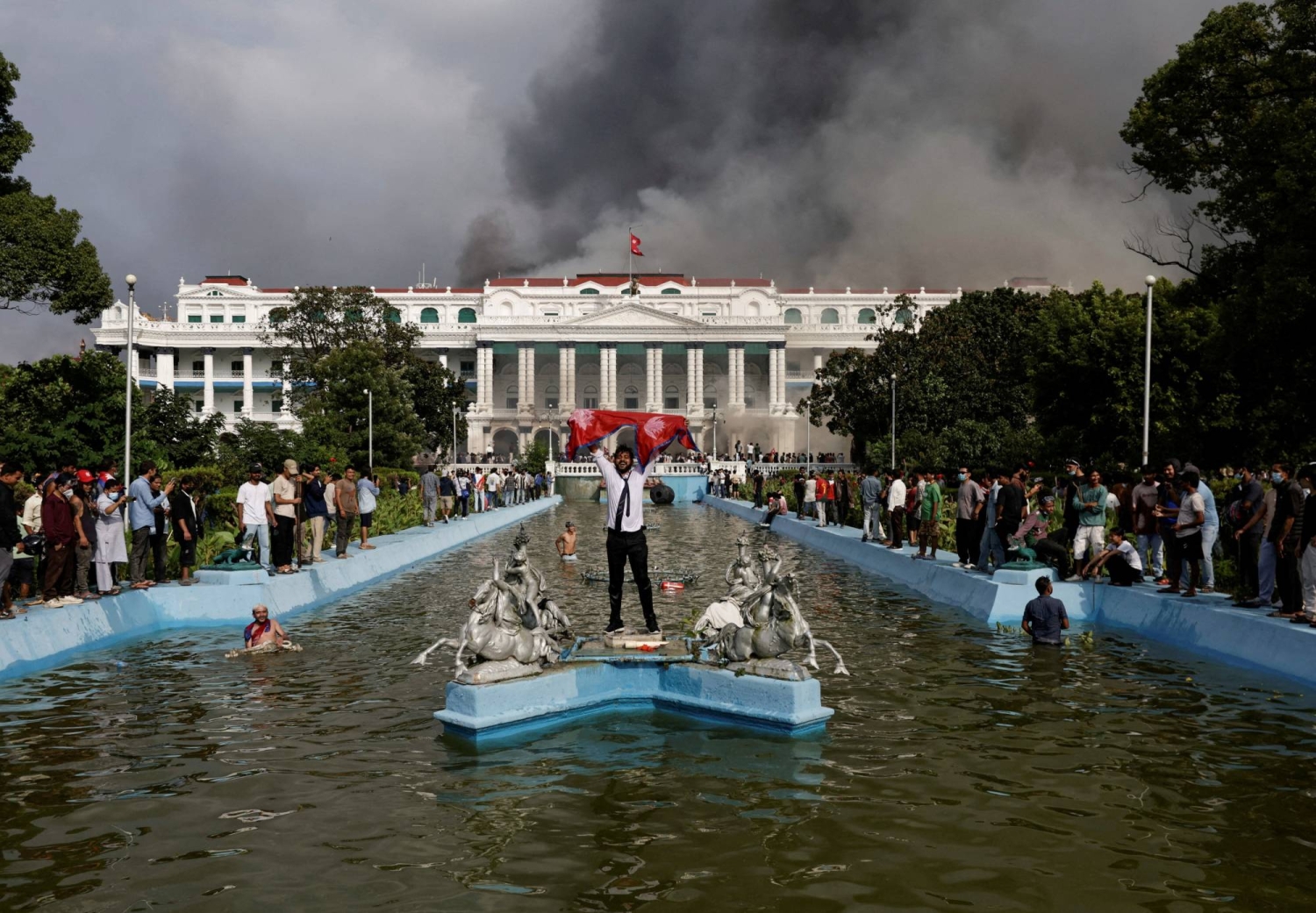
Last September’s mob rampages in Nepal did more than torch buildings; they incinerated public trust in the state itself. Parliament, the Supreme Court, ministries, police stations and thousands of government and privately owned buildings were reduced to charred shells. What followed was not merely a political crisis but a systemic shock that exposed the fragility of Nepal’s democratic experiment.
Yet this violence was curiously described in much of the Western media as a “Gen Z revolution.” That label was not just misleading; it was dangerous. It blurred the line between democratic dissent and nihilistic destruction, recasting the burning of institutions as a form of political awakening.
The recently held election has delivered a dramatic political response. In a stunning upset, a three-year-old party led by rapper-turned-politician Balendra Shah — or “Balen,” as he is popularly known — has swept to power, ending the dominance of Nepal’s established parties, especially the two main communist parties. At 35, Balen embodies a public demand for rupture with the past.
The scale of his party’s victory, however, raises a more fundamental question: Can an electoral earthquake translate into institutional stability?
For nearly two decades since abolishing its 239-year-old monarchy, Nepal has struggled to consolidate its republican order. It cycled through 15 governments in 17 years until last September’s violence forced the last communist-run government to resign, leading to the installation of an interim regime headed by a former chief justice.
Coalition fragility and institutional weakness have prevented durable governance in Nepal, widening the gap between democracy on paper and democracy in practice.
The September 2025 violence brought that gap into stark relief. The so-called “revolution” was, in practice, a collapse of order. The coordinated arson attacks suggested not just anger, but a deeper erosion of respect for state authority. Core administrative infrastructure was gutted, police personnel were lynched and prisons were overrun, allowing more than 13,500 inmates to escape, most of them still at large.
Democracy cannot survive without institutions. Courts, legislatures and bureaucracies are not symbols; they are the machinery through which democratic will is expressed and enforced. To destroy them in the name of political change is to hollow out democracy itself.
Yet the violence also revealed something else: a profound and widespread disillusionment, particularly among Nepal’s youth. With unemployment hovering above 20% and economic opportunity increasingly tied to migration abroad, many young Nepalis feel locked out of their country’s future. The unrest was as much about dignity as it was about governance.
Balen’s rise must be understood against this combustible backdrop. His party’s victory is less a conventional mandate than a rejection of the old order. Voters have placed a high-risk bet on a political outsider to break a cycle of economic stagnation and revolving-door politics.
That bet will be tested immediately, as the electoral mandate does not automatically translate into institutional renewal.
The new government will have to deal with three interlocking challenges.
The first challenge is restoring state authority without deepening mistrust. Nepal’s security apparatus emerged from the September violence both discredited and weakened. It was accused of excessive force, even as it became a target of mob fury.
Rebuilding credibility will require a delicate balance: Prosecuting those responsible for arson and looting while also holding security forces accountable for abuses. Failure on either front risks deepening the polarization, either by emboldening lawlessness or alienating the very institutions needed to enforce order.
Second is the economic crisis driving public anger. The country’s dependence on remittances from overseas Nepalis has created what some call a “dignity deficit,” where millions must leave home to earn a living. Reversing this will require credible domestic job creation.
The stakes are high. If economic frustration persists, today’s political reset could prove short-lived.
Reconstruction adds another layer of strain. Billions of dollars will be needed to rebuild infrastructure destroyed last September — funds that would otherwise support development. This creates an austerity dilemma: How to finance recovery without triggering fresh unrest. Transparency in reconstruction spending will be critical to maintaining public trust.
Third is the challenge of governance in the digital age. The violence was triggered by a Chinese-style social media ban, underscoring the centrality of digital platforms to both political mobilization and economic opportunity. The new government must regulate online spaces — where misinformation and even incitement can spread — while preserving digital freedoms that many young citizens see as non-negotiable. Resorting to heavy-handed controls could reignite tensions.
Beyond its borders, Nepal’s crisis has also reshaped its geopolitical environment. The electoral collapse of the country’s established communist parties complicates China’s longstanding strategy of cultivating a friendly government in Kathmandu. At the same time, it presents India with an opportunity to recalibrate its relationship with Nepal — if it avoids past missteps.
Ultimately, however, Nepal’s future will be determined less by geopolitics than by whether it can forge a new social contract.
The era of elite-driven governance appears to be over. What must replace it is a more participatory model that channels dissent into dialogue rather than destruction — through decentralization, credible accountability and sustained engagement with a disillusioned youth population.
But institutions cannot be rebuilt overnight, nor trust restored by electoral mandate alone.
Nepal’s election has delivered clarity. Whether it delivers stability will depend on what comes next.
Brahma Chellaney, a longtime contributor to The Japan Times, is the author of nine books, including “Water: Asia’s New Battleground.”
 Stagecraft and Statecraft

You must be logged in to post a comment.